
Animal field guide
European Rhinoceros Beetle
Oryctes nasicornis
Among the largest beetles in Europe, this scarab belongs to the rhinoceros beetle subfamily, which also holds the tropical Hercules and atlas beetles. Most of its life passes out of sight as a fat white grub inside decaying timber.
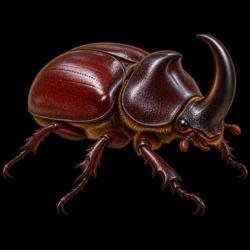
European Rhinoceros Beetle at a glance
Invertebrate · Europe · Lowland broadleaved woods · Relatively common
Known for: Glossy chestnut to dark brown, Stout, Dense reddish-brown hairs on the underside and legs, Broad front legs toothed for digging
Its Power
Resilient Strength
Grow strong for years in rotting wood before the horn appears.
Strength that shows in a moment is built over years of slow, unseen work.
“Strength in Resilience.”
Capture a European Rhinoceros Beetle, and it's yours when you finish one step it gives you.
Biological basis
European Rhinoceros Beetles spend three or four years as grubs digesting rotting wood with help from gut microbes; the short-lived adult males use their horn to lever rivals aside.
Put it into practice
The smallest kid on the team trains all winter and out-lifts players twice her size.
What does the European rhinoceros beetle symbolize?
The European rhinoceros beetle symbolizes resilient strength: grow strong for years in rotting wood before the horn appears. It represents strength, resilience and preparation. Its AnimalDex motto: "Strength in Resilience."
The European rhinoceros beetle as a spirit animal
If the European rhinoceros beetle is your spirit animal, the AnimalDex reading is Resilient Strength: strength that shows in a moment is built over years of slow, unseen work. It suggests a strength in strength and resilience, and a reminder to use it on purpose.
What can the European rhinoceros beetle help you with in life?
The European rhinoceros beetle is a guide for strength, resilience and preparation. Its lesson applies wherever strength matters: strength that shows in a moment is built over years of slow, unseen work.
- Strength
- Resilience
- Preparation
In practice: The smallest kid on the team trains all winter and out-lifts players twice her size.
What can we learn from the European Rhinoceros Beetle?What does it mean to dream about or encounter a wild European rhinoceros beetle?
Meeting a wild European rhinoceros beetle, asleep or awake, is often a nudge toward strength, the quality the European rhinoceros beetle is built around. In AnimalDex, the European rhinoceros beetle's principle is Resilient Strength: grow strong for years in rotting wood before the horn appears. Read the moment through its core lesson: Strength that shows in a moment is built over years of slow, unseen work.
It depends on how the European rhinoceros beetle behaved. Calm or close by, it reads as resilience within reach; aggressive or fleeing, it points to strength you are resisting.
Spotting an European rhinoceros beetle in the wild
Coming across an European rhinoceros beetle in person asks for attention more than interpretation. Watch it for a minute; the European rhinoceros beetle's way of working is Resilient Strength, and the lesson is: strength that shows in a moment is built over years of slow, unseen work.
An European rhinoceros beetle that keeps appearing
Repeated sightings of an European rhinoceros beetle usually mean the Resilient Strength lesson is still open: strength that shows in a moment is built over years of slow, unseen work.
Dreaming of being chased by an European rhinoceros beetle
If the European rhinoceros beetle pursues you, look at where resilience is being asked of you and you are stepping away instead of meeting it.
Dreaming that an European rhinoceros beetle attacks you
When the European rhinoceros beetle attacks, the dream may be about pressure: resilience or preparation applied too hard, by you or by someone close to you.
A calm or friendly European rhinoceros beetle
A relaxed European rhinoceros beetle near you, in a dream or in person, reads as readiness: Resilient Strength is available to you now, as its motto puts it, "Strength in Resilience.".
A dead or injured European rhinoceros beetle
An injured European rhinoceros beetle often reflects strength under strain; rest and repair come before pushing again.
These readings are reflective prompts drawn from how the European rhinoceros beetle really lives, not predictions. If you meet one in the wild, watch from a distance and leave it undisturbed.
Capture your own European Rhinoceros Beetle
Photograph or film one in the wild, at a zoo or at home with the app. It becomes yours: it remembers you, gives you steps, and can debate your problems with your other animals.
Animal field guide
European Rhinoceros Beetle
Sign in to hear this read by a natural AI voice instead of your browser's.
Among the largest beetles in Europe, this scarab belongs to the rhinoceros beetle subfamily, which also holds the tropical Hercules and atlas beetles. Most of its life passes out of sight as a fat white grub inside decaying timber.
Native range
Natural range, not this capture location
Lowland broadleaved woods, parkland, orchards and gardens, from the Mediterranean north to southern Scandinavia and east into Central Asia. Breeding sites are hollow trees, rotting stumps and heaps of decaying plant material.
Search near meAnimalDex stats
Size scale
Understand the animal
Understand the European Rhinoceros Beetle
Factual biology first: what this animal is like, where it lives, how it survives, and why those traits exist.
01
Introduction to European Rhinoceros Beetle
Among the largest beetles in Europe, this scarab belongs to the rhinoceros beetle subfamily, which also holds the tropical Hercules and atlas beetles. Most of its life passes out of sight as a fat white grub inside decaying timber.
How to identify a European Rhinoceros Beetle
- Glossy chestnut to dark brown, smooth wing cases
- Stout, cylindrical body roughly 2 to 4 centimetres long
- Dense reddish-brown hairs on the underside and legs
- Broad front legs toothed for digging
- Heavy, loudly humming flight at dusk
Why European Rhinoceros Beetle are interesting
- The name nasicornis means nose-horned, the same meaning as the Greek word rhinoceros.
- Grubs digest rotting wood with the help of microbes housed in an enlarged chamber of the hindgut.
- It does not occur in Britain or Ireland, although it lives just across the Channel and the North Sea.
- In Germany it is a specially protected species, and collecting the beetles or their grubs is against the law.
02
Adaptations and biological abilities
03
Why does European Rhinoceros Beetle behave this way?
- Glossy chestnut to dark brown, smooth wing cases
- Stout, cylindrical body roughly 2 to 4 centimetres long
- Dense reddish-brown hairs on the underside and legs
- Broad front legs toothed for digging
- Heavy, loudly humming flight at dusk
Adults fly from dusk into the night and often come to lights, then bury themselves again before morning. Grubs stay below the surface and are inactive in the cold of winter.
04
Why Lowland broadleaved woods?
Habitat: Lowland broadleaved woods, parkland, orchards and gardens, from the Mediterranean north to southern Scandinavia and east into Central Asia. Breeding sites are hollow trees, rotting stumps and heaps of decaying plant material.
Native range: Europe, North Africa & Middle East, Central Asia
Native range
Natural range, not this specific capture location.
Lowland broadleaved woods, parkland, orchards and gardens, from the Mediterranean north to southern Scandinavia and east into Central Asia. Breeding sites are hollow trees, rotting stumps and heaps of decaying plant material.
05
Why this diet?
Grubs eat decaying wood and other rotting plant matter, chewing through the material they live in. Adults are reported to feed little or not at all, living on reserves laid down as larvae.
06
Activity, rest, and lifespan
Adults fly from dusk into the night and often come to lights, then bury themselves again before morning. Grubs stay below the surface and are inactive in the cold of winter.
The larval stage lasts about 2 to 4 years, longer in cooler climates. Adults live only a few weeks to a few months in summer.
07
European Rhinoceros Beetle reproduction
Eggs are laid singly in the breeding material and given no further care. The grub grows to several centimetres long, then pupates in an egg-shaped cell built from soil and wood fragments.
Males carry a long, backward-curving horn on the head and a raised ridge with three bumps on the plate behind it. Females have only a small point in place of the horn and a smoother plate.
08
Predators, threats, and defense
The mammoth wasp, a large scoliid, stings the grubs and lays an egg on each, and its larva eats the grub alive. Grubs are also dug out by birds and mammals. Adults depend on thick armour and on staying hidden in daylight.
09
Conservation and rarity
Rarity: Relatively common · 40/100. AnimalDex canonical rarity score: 40/100, maintained by the live indexed species profile.
- Observe from a respectful distance and avoid changing the animal's behavior.
- Do not block feeding, shelter, nesting, or travel routes.
- Use a live camera capture without handling or staging wildlife.
Talk to it
Talk to the European Rhinoceros Beetle
It answers as itself: ask about how it lives, or bring it something of yours and hear what it would do, from its own Power.
Anonymous: 6/day. Signed-in: 10/day. Pro: 100/day.
Side by side
The European Rhinoceros Beetle, side by side
Nothing written side by side for the European Rhinoceros Beetle yet. Pick any animal to compare it with. Compare with any animal →
Where to find them
Where to find European Rhinoceros Beetle
To find European Rhinoceros Beetle in the wild, focus on the exact habitat patches that match its body design and daily behavior, not just the broad country where it exists. You usually do better by working one good piece of habitat inside europe, North Africa & Middle East, Central Asia than by covering too much ground.
- Lowland broadleaved woods, parkland, orchards
- Protected habitat blocks within europe, North Africa & Middle East, Central Asia
Where explorers saw it
- Saint-Montan, Auvergne-Rhône-Alpes, FranceAug · 2 sightings
In the Ark
8 European Rhinoceros Beetles are aboard right now.
Since November 17: 6 born.
The Ark is a live, shared animal world. Animals come aboard when people capture them, and live there by rules based on their field guides.
Scientific name
Oryctes nasicornis
Category
Invertebrate
Habitat
Lowland broadleaved woods, parkland, orchards and gardens, from the Mediterranean north to southern Scandinavia and east into Central Asia. Breeding sites are hollow trees, rotting stumps and heaps of decaying plant material.
Rarity
Relatively common · 40/100
Native range
Europe, North Africa & Middle East, Central Asia
Take the encyclopedia outside
AnimalDex helps you scan real animals, identify species, collect cards, and learn from nature wherever you are.