
Animal field guide
Firebug
Pyrrhocoris apterus
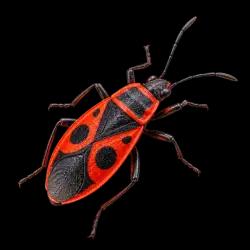
A red and black true bug that crowds together in dense clusters, sometimes hundreds strong, at the foot of lime trees and around mallows. Most individuals have short wings and cannot fly, so whole colonies live out their lives within walking distance of the same food plants.
Firebug at a glance
Animal · Europe · Parks · Relatively common
Known for: Bright red with a bold black pattern, Two black round spots on the red forewings, Black head and black central patch on the red thorax, Flat
Its Power
Social Bonding Pattern
Foster strong connections within your community.
Firebugs often gather in large groups, which helps them maintain warmth and protection, demonstrating the power of community bonds.
“Strength in numbers.”
Capture a Firebug, and it's yours when you finish one step it gives you.
Biological basis
Firebugs are known for their social behavior, frequently clustering together in large groups for warmth and protection.
Put it into practice
During a power cut, neighbours gather in the one house with a wood stove and share food and blankets.
What does the firebug symbolize?
The firebug symbolizes social bonding pattern: foster strong connections within your community. It represents community, safety in numbers and social bonds. Its AnimalDex motto: "Strength in numbers."
The firebug as a spirit animal
If the firebug is your spirit animal, the AnimalDex reading is Social Bonding Pattern: firebugs often gather in large groups, which helps them maintain warmth and protection, demonstrating the power of community bonds. It suggests a strength in community and safety in numbers, and a reminder to use it on purpose.
What can the firebug help you with in life?
The firebug is a guide for community, safety in numbers and social bonds. Its lesson applies wherever community matters: firebugs often gather in large groups, which helps them maintain warmth and protection, demonstrating the power of community bonds.
- Community
- Safety in Numbers
- Social Bonds
In practice: During a power cut, neighbours gather in the one house with a wood stove and share food and blankets.
What can we learn from the Firebug?What does it mean to dream about or encounter a wild firebug?
Meeting a wild firebug, asleep or awake, is often a nudge toward community, the quality the firebug is built around. In AnimalDex, the firebug's principle is Social Bonding Pattern: foster strong connections within your community. Read the moment through its core lesson: Firebugs often gather in large groups, which helps them maintain warmth and protection, demonstrating the power of community bonds.
Mostly a prompt rather than a warning. A calm firebug suggests community you already have; a threatening one suggests community is being tested or pushed too far.
Spotting a firebug in the wild
A real encounter is the plainest version of the sign: notice what the firebug was doing. Foster strong connections within your community. That is the community worth borrowing today.
A firebug that keeps appearing
Seeing the firebug again and again, in dreams or outside, suggests community is a theme you have not settled yet.
Dreaming of being chased by a firebug
Being chased suggests you are avoiding the Social Bonding Pattern the firebug stands for: firebugs often gather in large groups, which helps them maintain warmth and protection, demonstrating the power of community bonds. Ask what you keep postponing that needs community.
Dreaming that a firebug attacks you
When the firebug attacks, the dream may be about pressure: safety in numbers or social bonds applied too hard, by you or by someone close to you.
A calm or friendly firebug
Meeting a peaceful firebug is usually encouraging: safety in numbers and social bonds are within reach.
A dead or injured firebug
An injured firebug often reflects community under strain; rest and repair come before pushing again.
These readings are reflective prompts drawn from how the firebug really lives, not predictions. If you meet one in the wild, watch from a distance and leave it undisturbed.
Capture your own Firebug
Photograph or film one in the wild, at a zoo or at home with the app. It becomes yours: it remembers you, gives you steps, and can debate your problems with your other animals.
Animal field guide
Firebug
Sign in to hear this read by a natural AI voice instead of your browser's.
A red and black true bug that crowds together in dense clusters, sometimes hundreds strong, at the foot of lime trees and around mallows. Most individuals have short wings and cannot fly, so whole colonies live out their lives within walking distance of the same food plants.
Native range
Natural range, not this capture location
Parks, avenues, gardens, woodland edges and hedgerows across much of Europe, especially at sunny bases of lime trees and among mallows, hollyhocks and hibiscus on dry, warm ground.
Search near meAnimalDex stats
Size scale
Understand the animal
Understand the Firebug
Factual biology first: what this animal is like, where it lives, how it survives, and why those traits exist.
01
Introduction to Firebug
A red and black true bug that crowds together in dense clusters, sometimes hundreds strong, at the foot of lime trees and around mallows. Most individuals have short wings and cannot fly, so whole colonies live out their lives within walking distance of the same food plants.
How to identify a Firebug
- Bright red with a bold black pattern
- Two black round spots on the red forewings
- Black head and black central patch on the red thorax
- Flat, oval body about 1 centimetre long
Why Firebug are interesting
- A small fraction of adults develop full wings, but even these rarely fly.
- Firebugs are widely used in laboratories to study insect hormones and seasonal dormancy.
- Shortening days in late summer switch adults into a winter dormancy, during which they do not breed.
- Nymphs have no functional wings, only small wing pads in the later stages, and are more red than black.
02
Adaptations and biological abilities
03
Why does Firebug behave this way?
- Bright red with a bold black pattern
- Two black round spots on the red forewings
- Black head and black central patch on the red thorax
- Flat, oval body about 1 centimetre long
Active by day, especially in warm sunshine. It spends cold nights and the whole winter sheltered as an adult in crevices, leaf litter and bark near the base of its food trees.
04
Why Parks?
Habitat: Parks, avenues, gardens, woodland edges and hedgerows across much of Europe, especially at sunny bases of lime trees and among mallows, hollyhocks and hibiscus on dry, warm ground.
Native range: Europe
Native range
Natural range, not this specific capture location.
Parks, avenues, gardens, woodland edges and hedgerows across much of Europe, especially at sunny bases of lime trees and among mallows, hollyhocks and hibiscus on dry, warm ground.
05
Why this diet?
Pierces fallen seeds of lime trees and mallow-family plants with a needle-like beak and sucks out the contents. It also feeds on dead insects and insect eggs, and sometimes on other firebugs.
06
Activity, rest, and lifespan
Active by day, especially in warm sunshine. It spends cold nights and the whole winter sheltered as an adult in crevices, leaf litter and bark near the base of its food trees.
About one year: nymphs hatch in spring and summer, become adult by late summer, overwinter and breed the next spring, dying by early summer.
07
Firebug reproduction
Females lay batches of several dozen eggs in shallow holes in soil or leaf litter in spring. Nymphs pass through five moults over summer, bright red with black markings, and receive no parental care.
The sexes look alike in colour and pattern. Females are slightly larger and broader, and males can be told by the tip of the abdomen seen from below.
08
Predators, threats, and defense
Its bright colours warn that it tastes bad, and most birds avoid it. Scent glands release defensive chemicals when it is disturbed. Spiders and other invertebrate predators are thought to take some nymphs and adults.
09
Conservation and rarity
Rarity: Relatively common · 9/100. AnimalDex canonical rarity score: 9/100, maintained by the live indexed species profile.
- Observe from a respectful distance and avoid changing the animal's behavior.
- Do not block feeding, shelter, nesting, or travel routes.
- Use a live camera capture without handling or staging wildlife.
Talk to it
Talk to the Firebug
It answers as itself: ask about how it lives, or bring it something of yours and hear what it would do, from its own Power.
Anonymous: 6/day. Signed-in: 10/day. Pro: 100/day.
Side by side
The Firebug, side by side
Nothing written side by side for the Firebug yet. Pick any animal to compare it with. Compare with any animal →
Where to find them
Where to find Firebug
To find Firebug in the wild, focus on the exact habitat patches that match its body design and daily behavior, not just the broad country where it exists. You usually do better by working one good piece of habitat inside europe than by covering too much ground.
- Forest edge, canopy gaps, fruiting trees, or shaded trails where cover and food meet
- Burrow systems, sandy banks, fallen logs, or ground with clear den entrances
- Protected habitat blocks within europe
Where explorers saw it
- Croix, Hauts-de-France, FranceOct · 1 sighting
- Łąkie, Województwo lubuskie, PolskaOct · 1 sighting
- Niederneuching, Erding, DeutschlandAug · 1 sighting
Guides to seeing Firebug
In the Ark
6 Firebugs are aboard right now.
Since November 5: 6 came aboard.
The Ark is a live, shared animal world. Animals come aboard when people capture them, and live there by rules based on their field guides.
Scientific name
Pyrrhocoris apterus
Category
Animal
Habitat
Parks, avenues, gardens, woodland edges and hedgerows across much of Europe, especially at sunny bases of lime trees and among mallows, hollyhocks and hibiscus on dry, warm ground.
Rarity
Relatively common · 9/100
Native range
Europe
Take the encyclopedia outside
AnimalDex helps you scan real animals, identify species, collect cards, and learn from nature wherever you are.