
Animal field guide
Harris's Hawk
Parabuteo unicinctus
A dark brown, long-legged hawk of dry country from the south-western United States to Chile and Argentina, Harris's hawk is one of very few birds of prey that hunt in groups. Parties of two to six birds surround a rabbit or hare, flush it from cover and take turns leading the chase, then share the kill.
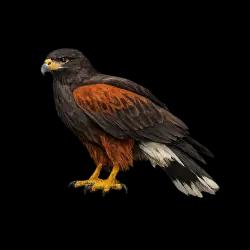
Harris's Hawk at a glance
Bird · North America · Semi-arid country with scattered · Often perched in groups of two or · Relatively common
Known for: Dark brown body with chestnut shoulders and thighs, White rump and white tip to a black tail, Long yellow legs and yellow skin at the bill base, Often perched in groups of two or more
Its Power
Collaborative Hunting
Leverage teamwork to achieve greater success.
Harris’s Hawks exemplify the power of collaboration by hunting in groups, allowing them to capture larger prey than they could alone.
“Team up for success.”
Capture a Harris's Hawk, and it's yours when you finish one step it gives you.
Biological basis
Harris’s Hawks are unique among raptors for their pack hunting strategy, which involves coordinated efforts and role-switching to capture prey.
Put it into practice
Four neighbours rotate who lifts and who guides, and carry a sofa none could move alone.
What does the Harris's hawk symbolize?
The Harris's hawk symbolizes collaborative hunting: leverage teamwork to achieve greater success. It represents teamwork, coordination and trust. Its AnimalDex motto: "Team up for success."
The Harris's hawk as a spirit animal
If the Harris's hawk is your spirit animal, the AnimalDex reading is Collaborative Hunting: harris’s Hawks exemplify the power of collaboration by hunting in groups, allowing them to capture larger prey than they could alone. It suggests a strength in teamwork and coordination, and a reminder to use it on purpose.
What can the Harris's hawk help you with in life?
The Harris's hawk is a guide for teamwork, coordination and trust. Its lesson applies wherever teamwork matters: harris’s Hawks exemplify the power of collaboration by hunting in groups, allowing them to capture larger prey than they could alone.
- Teamwork
- Coordination
- Trust
In practice: Four neighbours rotate who lifts and who guides, and carry a sofa none could move alone.
What can we learn from the Harris's Hawk?What does it mean to dream about or encounter a wild Harris's hawk?
A wild Harris's hawk, whether in a dream or in front of you, tends to show up when teamwork or coordination is on your mind. In AnimalDex, the Harris's hawk's principle is Collaborative Hunting: leverage teamwork to achieve greater success. Read the moment through its core lesson: Harris’s Hawks exemplify the power of collaboration by hunting in groups, allowing them to capture larger prey than they could alone.
Mostly a prompt rather than a warning. A calm Harris's hawk suggests teamwork you already have; a threatening one suggests teamwork is being tested or pushed too far.
Spotting a Harris's hawk in the wild
Coming across a Harris's hawk in person asks for attention more than interpretation. Watch it for a minute; the Harris's hawk's way of working is Collaborative Hunting, and the lesson is: harris’s Hawks exemplify the power of collaboration by hunting in groups, allowing them to capture larger prey than they could alone.
A Harris's hawk that keeps appearing
A Harris's hawk that keeps turning up points to coordination you keep circling back to. The repetition is the message.
Dreaming of being chased by a Harris's hawk
If the Harris's hawk pursues you, look at where coordination is being asked of you and you are stepping away instead of meeting it.
Dreaming that a Harris's hawk attacks you
When the Harris's hawk attacks, the dream may be about pressure: coordination or trust applied too hard, by you or by someone close to you.
A calm or friendly Harris's hawk
A relaxed Harris's hawk near you, in a dream or in person, reads as readiness: Collaborative Hunting is available to you now, as its motto puts it, "Team up for success.".
A dead or injured Harris's hawk
An injured Harris's hawk often reflects teamwork under strain; rest and repair come before pushing again.
These readings are reflective prompts drawn from how the Harris's hawk really lives, not predictions. If you meet one in the wild, watch from a distance and leave it undisturbed.
Capture your own Harris's Hawk
Photograph or film one in the wild, at a zoo or at home with the app. It becomes yours: it remembers you, gives you steps, and can debate your problems with your other animals.
Animal field guide
Harris's Hawk
Sign in to hear this read by a natural AI voice instead of your browser's.
A dark brown, long-legged hawk of dry country from the south-western United States to Chile and Argentina, Harris's hawk is one of very few birds of prey that hunt in groups. Parties of two to six birds surround a rabbit or hare, flush it from cover and take turns leading the chase, then share the kill.
Native range
Natural range, not this capture location
Semi-arid country with scattered tall perches: desert with saguaro cactus, mesquite and thorn scrub, dry savanna, and in South America open woodland, marsh edges and farmland. It lives mostly in the lowlands and increasingly in city suburbs with large trees.
Search near meAnimalDex stats
Size scale
Understand the animal
Understand the Harris's Hawk
Factual biology first: what this animal is like, where it lives, how it survives, and why those traits exist.
01
Introduction to Harris's Hawk
A dark brown, long-legged hawk of dry country from the south-western United States to Chile and Argentina, Harris's hawk is one of very few birds of prey that hunt in groups. Parties of two to six birds surround a rabbit or hare, flush it from cover and take turns leading the chase, then share the kill.
How to identify a Harris's Hawk
- Dark brown body with chestnut shoulders and thighs
- White rump and white tip to a black tail
- Long yellow legs and yellow skin at the bill base
- Often perched in groups of two or more
- Broad, rounded wings with chestnut linings
Why Harris's Hawk are interesting
- Birds sometimes stand on each other's backs on a perch, two or three high, a habit known as back-standing.
- Sociable and easy to train, it is widely used in falconry and is flown at airports and landfill sites to scare away gulls and pigeons.
- John James Audubon named the species after his friend and supporter Edward Harris.
- Nesting has been recorded in most months of the year, and a group may raise two or even three broods in twelve months.
- Studies of groups in Arizona and New Mexico found a rank order in which the breeding female was dominant over the males.
02
Adaptations and biological abilities
03
Why does Harris's Hawk behave this way?
- Dark brown body with chestnut shoulders and thighs
- White rump and white tip to a black tail
- Long yellow legs and yellow skin at the bill base
- Often perched in groups of two or more
- Broad, rounded wings with chestnut linings
Diurnal, hunting most actively in the cooler hours after dawn and before dusk and perching in shade through hot afternoons. Group members often roost together at night in tall trees, cacti or pylons. It is resident, with no seasonal dormancy.
04
Why Semi-arid country with scattered tall perches?
Habitat: Semi-arid country with scattered tall perches: desert with saguaro cactus, mesquite and thorn scrub, dry savanna, and in South America open woodland, marsh edges and farmland. It lives mostly in the lowlands and increasingly in city suburbs with large trees.
Native range: North America, South America
Native range
Natural range, not this specific capture location.
Semi-arid country with scattered tall perches: desert with saguaro cactus, mesquite and thorn scrub, dry savanna, and in South America open woodland, marsh edges and farmland. It lives mostly in the lowlands and increasingly in city suburbs with large trees.
05
Why this diet?
06
Activity, rest, and lifespan
Diurnal, hunting most actively in the cooler hours after dawn and before dusk and perching in shade through hot afternoons. Group members often roost together at night in tall trees, cacti or pylons. It is resident, with no seasonal dormancy.
Roughly 10 to 12 years in the wild for birds that reach adulthood, and often 20 to 25 years in captivity.
07
Harris's Hawk reproduction
Groups build a stick nest in a cactus, tree or pylon. The clutch of two to four eggs is incubated for about 35 days, and chicks fledge at around six weeks. Older offspring often stay on and help to feed later broods.
Plumage is alike in both sexes. Females are markedly larger, averaging about 1 kilogram against roughly 700 grams for males.
08
Predators, threats, and defense
Great horned owls, coyotes and ravens take eggs, nestlings and occasionally adults. Group members join forces to mob intruders near the nest. Electrocution on overhead electricity poles, collisions and shooting are the main losses caused by people.
09
Conservation and rarity
Rarity: Relatively common · 39/100. AnimalDex canonical rarity score: 39/100, maintained by the live indexed species profile.
- Observe from a respectful distance and avoid changing the animal's behavior.
- Do not block feeding, shelter, nesting, or travel routes.
- Use a live camera capture without handling or staging wildlife.
Talk to it
Talk to the Harris's Hawk
It answers as itself: ask about how it lives, or bring it something of yours and hear what it would do, from its own Power.
Anonymous: 6/day. Signed-in: 10/day. Pro: 100/day.
Side by side
The Harris's Hawk, side by side
Nothing written side by side for the Harris's Hawk yet. Pick any animal to compare it with. Compare with any animal →
Where to find them
Where to find Harris's Hawk
To find Harris's Hawk in the wild, focus on the exact habitat patches that match its body design and daily behavior, not just the broad country where it exists. You usually do better by working one good piece of habitat inside north America, South America than by covering too much ground.
- Quiet marsh edges, reedbeds, river bends, or shallow wetland margins
- Forest edge, canopy gaps, fruiting trees, or shaded trails where cover and food meet
- Water sources, dune bases, rocky wadis, or shaded scrub at first and last light
In the Ark
2 Harris's Hawks are aboard right now.
None have come aboard or left since November 17.
The Ark is a live, shared animal world. Animals come aboard when people capture them, and live there by rules based on their field guides.
Scientific name
Parabuteo unicinctus
Category
Bird
Habitat
Semi-arid country with scattered tall perches: desert with saguaro cactus, mesquite and thorn scrub, dry savanna, and in South America open woodland, marsh edges and farmland. It lives mostly in the lowlands and increasingly in city suburbs with large trees.
Rarity
Relatively common · 39/100
Native range
North America, South America
Take the encyclopedia outside
AnimalDex helps you scan real animals, identify species, collect cards, and learn from nature wherever you are.
Featured in tier lists
See where this species appears in AnimalDex tier-list pages built around structured comparison and methodology.
#3 · Character
Animals That Work Together
One of the few raptors that regularly hunts in groups, with birds flushing prey and taking turns in the chase.
Read tier list