
Animal field guide
Hermit Crab
Paguroidea
The Hermit Crab teaches Fit through a soft body protected by a borrowed shell that must change as growth continues. Its shell searching, shore movement, vulnerable abdomen, and housing swaps show that protection can become a prison when it stops fitting. Its lesson is to leave the shell that limits the life being built.
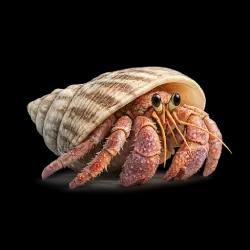
Hermit Crab at a glance
Marine invertebrate · North Atlantic · Most live in the sea · Relatively common
Known for: One claw often much larger than the other, Long eye stalks and antennae held forward, Soft, In shell dwellers
Its Power
Borrowed Shell
Know when what protected you no longer fits.
Survival depends on resourcefulness, timing, and knowing when a shell no longer fits.
“Outgrow it, then move.”
Capture a Hermit Crab, and it's yours when you finish one step it gives you.
Biological basis
Hermit crabs have a soft, asymmetrically coiled abdomen and no shell of their own, so they occupy empty gastropod shells and must swap as they grow — often in a vacancy chain, where crabs queue by size and each takes the shell the one ahead of it leaves.
Put it into practice
A graduate leaves the comfortable first job once it stops teaching her anything new.
What does the hermit crab symbolize?
The hermit crab symbolizes borrowed shell: know when what protected you no longer fits. It represents right timing, letting go and renewal. Its AnimalDex motto: "Outgrow it, then move."
The hermit crab as a spirit animal
If the hermit crab is your spirit animal, the AnimalDex reading is Borrowed Shell: survival depends on resourcefulness, timing, and knowing when a shell no longer fits. It suggests a strength in right timing and letting go, and a reminder to use it on purpose.
What can the hermit crab help you with in life?
The hermit crab is a guide for right timing, letting go and renewal. Its lesson applies wherever right timing matters: survival depends on resourcefulness, timing, and knowing when a shell no longer fits.
- Right Timing
- Letting Go
- Renewal
In practice: A graduate leaves the comfortable first job once it stops teaching her anything new.
What can we learn from the Hermit Crab?What does it mean to dream about or encounter a wild hermit crab?
Dreaming about a wild hermit crab, or coming across one, usually points to right timing and letting go: the qualities the hermit crab lives by. In AnimalDex, the hermit crab's principle is Borrowed Shell: know when what protected you no longer fits. Read the moment through its core lesson: Survival depends on resourcefulness, timing, and knowing when a shell no longer fits.
Mostly a prompt rather than a warning. A calm hermit crab suggests right timing you already have; a threatening one suggests right timing is being tested or pushed too far.
Spotting a hermit crab in the wild
A real encounter is the plainest version of the sign: notice what the hermit crab was doing. Know when what protected you no longer fits. That is the right timing worth borrowing today.
A hermit crab that keeps appearing
Seeing the hermit crab again and again, in dreams or outside, suggests right timing is a theme you have not settled yet.
Dreaming of being chased by a hermit crab
Being chased suggests you are avoiding the Borrowed Shell the hermit crab stands for: survival depends on resourcefulness, timing, and knowing when a shell no longer fits. Ask what you keep postponing that needs right timing.
Dreaming that a hermit crab attacks you
An attack points to right timing turned against you: someone using it on you, or your own right timing overused until it costs you.
A calm or friendly hermit crab
A relaxed hermit crab near you, in a dream or in person, reads as readiness: Borrowed Shell is available to you now, as its motto puts it, "Outgrow it, then move.".
A dead or injured hermit crab
A dead or injured hermit crab, dreamed or found, can mark right timing you have let lapse, or a phase built on Borrowed Shell coming to an end.
These readings are reflective prompts drawn from how the hermit crab really lives, not predictions. If you meet one in the wild, watch from a distance and leave it undisturbed.
Capture your own Hermit Crab
Photograph or film one in the wild, at a zoo or at home with the app. It becomes yours: it remembers you, gives you steps, and can debate your problems with your other animals.
Animal field guide
Hermit Crab
Sign in to hear this read by a natural AI voice instead of your browser's.
The Hermit Crab teaches Fit through a soft body protected by a borrowed shell that must change as growth continues. Its lesson is to leave the shell that limits the life being built.
Native range
Natural range, not this capture location
Most live in the sea, from rock pools, sandy shores and seagrass to coral rubble and the deep ocean floor. Land hermit crabs occupy tropical beaches and nearby coastal scrub and forest.
Search near meAnimalDex stats
Size scale
Understand the animal
Understand the Hermit Crab
Factual biology first: what this animal is like, where it lives, how it survives, and why those traits exist.
01
Introduction to Hermit Crab
The Hermit Crab teaches Fit through a soft body protected by a borrowed shell that must change as growth continues. Its shell searching, shore movement, vulnerable abdomen, and housing swaps show that protection can become a prison when it stops fitting. Its lesson is to leave the shell that limits the life being built.
How to identify a Hermit Crab
- One claw often much larger than the other
- Long eye stalks and antennae held forward
- Soft, curled abdomen, in most species tucked into a snail shell
- In shell dwellers, small rear legs used to grip the shell
- Legs brightly banded or spotted in many species
Why Hermit Crab are interesting
- Some species place sea anemones on their shell, and the anemones' stinging tentacles help to keep predators such as octopuses away.
- Land hermit crabs keep a little sea water in their shell to stop their gills drying out.
- The coconut crab belongs to this group; young ones use shells, but adults grow a hardened abdomen and give them up.
- A few species live in hollow sponges, pieces of wood or tube-worm tubes instead of snail shells.
- Studies have described crabs waiting beside an empty shell too large for any of them, then swapping shells in size order once a big enough crab arrives.
02
Adaptations and biological abilities
03
Why does Hermit Crab behave this way?
- One claw often much larger than the other
- Long eye stalks and antennae held forward
- Soft, curled abdomen, in most species tucked into a snail shell
- In shell dwellers, small rear legs used to grip the shell
- Legs brightly banded or spotted in many species
Activity varies with species and tide. Many shore species are thought to forage mostly at night or while the tide covers them, and land hermit crabs are largely nocturnal, sheltering by day under vegetation, in crevices or dug into damp sand.
04
Why Most live in the sea?
Habitat: Most live in the sea, from rock pools, sandy shores and seagrass to coral rubble and the deep ocean floor. Land hermit crabs occupy tropical beaches and nearby coastal scrub and forest.
Native range: North Atlantic, South Atlantic, North Pacific, South Pacific, Indian Ocean, Coral Triangle, Mediterranean, Red Sea
Native range
Natural range, not this specific capture location.
Some regional overlays are unavailable in this web build.
Most live in the sea, from rock pools, sandy shores and seagrass to coral rubble and the deep ocean floor. Land hermit crabs occupy tropical beaches and nearby coastal scrub and forest.
05
Why this diet?
06
Activity, rest, and lifespan
Activity varies with species and tide. Many shore species are thought to forage mostly at night or while the tide covers them, and land hermit crabs are largely nocturnal, sheltering by day under vegetation, in crevices or dug into damp sand.
Poorly known for most species. Small shore species are thought to live only a few years, while some land hermit crabs have been reported to live well over a decade in captivity.
07
Hermit Crab reproduction
In shell-dwelling species, females carry their eggs attached to swimmerets on the abdomen, inside the shell, until they hatch. The larvae drift in the plankton through several stages, then settle, and in most species the young crab must find a first shell of its own. Land species walk to the shore to release hatching larvae into the sea.
The sexes look alike in the field. Males often grow larger, and females can be recognised in the hand by the egg-bearing swimmerets under the curled abdomen.
08
Predators, threats, and defense
09
Conservation and rarity
Rarity: Relatively common · 14/100. AnimalDex canonical rarity score: 14/100, maintained by the live indexed species profile.
- Observe from a respectful distance and avoid changing the animal's behavior.
- Do not block feeding, shelter, nesting, or travel routes.
- Use a live camera capture without handling or staging wildlife.
Talk to it
Talk to the Hermit Crab
It answers as itself: ask about how it lives, or bring it something of yours and hear what it would do, from its own Power.
Anonymous: 6/day. Signed-in: 10/day. Pro: 100/day.
Side by side
The Hermit Crab, side by side
Nothing written side by side for the Hermit Crab yet. Pick any animal to compare it with. Compare with any animal →
Where to find them
Where to find Hermit Crab
To find Hermit Crab in the wild, focus on the exact habitat patches that match its body design and daily behavior, not just the broad country where it exists. You usually do better by working one good piece of habitat inside north Atlantic, South Atlantic, North Pacific, South Pacific, Indian Ocean, Coral Triangle, Mediterranean, Red Sea than by covering too much ground.
- Forest edge, canopy gaps, fruiting trees, or shaded trails where cover and food meet
- Headlands, reef edges, island colonies, tidal channels, or productive coastal water
- Protected habitat blocks within north Atlantic, South Atlantic, North Pacific, South Pacific, Indian Ocean, Coral Triangle, Mediterranean, Red Sea
In the Ark
No Hermit Crab is aboard yet.
None have come aboard or left since November 6.
The Ark is a live, shared animal world. Animals come aboard when people capture them, and live there by rules based on their field guides.
Scientific name
Paguroidea
Category
Marine invertebrate
Habitat
Most live in the sea, from rock pools, sandy shores and seagrass to coral rubble and the deep ocean floor. Land hermit crabs occupy tropical beaches and nearby coastal scrub and forest.
Rarity
Relatively common · 14/100
Native range
North Atlantic, South Atlantic, North Pacific, South Pacific, Indian Ocean, Coral Triangle, Mediterranean, Red Sea
Take the encyclopedia outside
AnimalDex helps you scan real animals, identify species, collect cards, and learn from nature wherever you are.
Related blog guides
Continue learning with practical articles connected to this species.
Best Types of Wildlife Activities for Animal Lovers
Birding, herping, night walks, macro, shore time, and photography outings compared: what each is like, when to go, what to bring, and which listings match.
Read blog article