
Animal field guide
Little Owl
Athene noctua
A stocky, short-tailed owl only about 22 centimetres long that does much of its hunting on the ground. It runs and hops across short turf after beetles and earthworms, often stopping to stand upright and look around.
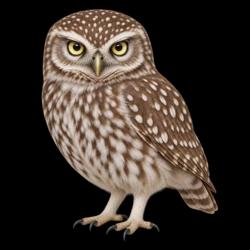
Little Owl at a glance
Bird · Europe · Open farmland with old trees · Relatively common
Known for: Round, Pale brows that give a stern, Brown upperparts spotted white, Bounding
Its Power
Night Focus Strategy
Embrace quiet moments to sharpen your focus.
The Little Owl hunts in the calm edges of the day; pick your quiet hour and give it your full focus.
“Focus in the quiet.”
Capture a Little Owl, and it's yours when you finish one step it gives you.
Biological basis
Little Owls are active by day as well as at dusk and night, watching from low open perches, then dropping down to run after beetles, earthworms and small mammals.
Put it into practice
A student does her hardest revision at dawn, before the house wakes and the phone starts buzzing.
What does the little owl symbolize?
The little owl symbolizes night focus strategy: embrace quiet moments to sharpen your focus. It represents focus, solitude and versatility. Its AnimalDex motto: "Focus in the quiet."
The little owl as a spirit animal
If the little owl is your spirit animal, the AnimalDex reading is Night Focus Strategy: the Little Owl hunts in the calm edges of the day; pick your quiet hour and give it your full focus. It suggests a strength in focus and solitude, and a reminder to use it on purpose.
What can the little owl help you with in life?
The little owl is a guide for focus, solitude and versatility. Its lesson applies wherever focus matters: the Little Owl hunts in the calm edges of the day; pick your quiet hour and give it your full focus.
- Focus
- Solitude
- Versatility
In practice: A student does her hardest revision at dawn, before the house wakes and the phone starts buzzing.
What can we learn from the Little Owl?What does it mean to dream about or encounter a wild little owl?
Dreaming about a wild little owl, or coming across one, usually points to focus and solitude: the qualities the little owl lives by. In AnimalDex, the little owl's principle is Night Focus Strategy: embrace quiet moments to sharpen your focus. Read the moment through its core lesson: The Little Owl hunts in the calm edges of the day; pick your quiet hour and give it your full focus.
Mostly a prompt rather than a warning. A calm little owl suggests focus you already have; a threatening one suggests focus is being tested or pushed too far.
Spotting a little owl in the wild
A real encounter is the plainest version of the sign: notice what the little owl was doing. Embrace quiet moments to sharpen your focus. That is the focus worth borrowing today.
A little owl that keeps appearing
Repeated sightings of a little owl usually mean the Night Focus Strategy lesson is still open: the Little Owl hunts in the calm edges of the day; pick your quiet hour and give it your full focus.
Dreaming of being chased by a little owl
If the little owl pursues you, look at where solitude is being asked of you and you are stepping away instead of meeting it.
Dreaming that a little owl attacks you
An aggressive little owl can mirror a conflict where focus has become a weapon rather than a strength.
A calm or friendly little owl
A calm little owl suggests you have made peace with focus and can use it without force.
A dead or injured little owl
A dead or injured little owl, dreamed or found, can mark focus you have let lapse, or a phase built on Night Focus Strategy coming to an end.
These readings are reflective prompts drawn from how the little owl really lives, not predictions. If you meet one in the wild, watch from a distance and leave it undisturbed.
Capture your own Little Owl
Photograph or film one in the wild, at a zoo or at home with the app. It becomes yours: it remembers you, gives you steps, and can debate your problems with your other animals.
Animal field guide
Little Owl
Sign in to hear this read by a natural AI voice instead of your browser's.
A stocky, short-tailed owl only about 22 centimetres long that does much of its hunting on the ground. It runs and hops across short turf after beetles and earthworms, often stopping to stand upright and look around.
Native range
Natural range, not this capture location
Open farmland with old trees, hedgerows, orchards, pollarded willows and stone barns, as well as steppe, semi-desert and rocky hillsides. It needs short, grazed grass for hunting and holes for nesting, and is mainly a lowland bird.
Search near meAnimalDex stats
Size scale
Understand the animal
Understand the Little Owl
Factual biology first: what this animal is like, where it lives, how it survives, and why those traits exist.
01
Introduction to Little Owl
A stocky, short-tailed owl only about 22 centimetres long that does much of its hunting on the ground. It runs and hops across short turf after beetles and earthworms, often stopping to stand upright and look around.
How to identify a Little Owl
- Round, flat-crowned head with no ear tufts
- Pale brows that give a stern, frowning look
- Brown upperparts spotted white, with streaked pale underparts
- Bounding, woodpecker-like undulating flight
- Long legs covered in pale feathering
Why Little Owl are interesting
- It was introduced to England in the late nineteenth century and now breeds widely across lowland England and Wales.
- The genus name Athene refers to the Greek goddess, and the owl appeared on the silver coins of ancient Athens.
- Pairs often stay on the same territory for years and may reuse the same nest hole.
- Nest boxes put up in orchards and farmland have helped declining populations in parts of western Europe.
- Pellets found beneath its roosts are often packed with shiny beetle wing-cases.
02
Adaptations and biological abilities
03
Why does Little Owl behave this way?
- Round, flat-crowned head with no ear tufts
- Pale brows that give a stern, frowning look
- Brown upperparts spotted white, with streaked pale underparts
- Bounding, woodpecker-like undulating flight
- Long legs covered in pale feathering
Rests by day in a tree hole, barn or rock cleft, often sitting at the entrance in the sun. Activity is mainly at dusk and at night, though it also hunts in daylight, especially when feeding young.
04
Why Open farmland with old trees?
Habitat: Open farmland with old trees, hedgerows, orchards, pollarded willows and stone barns, as well as steppe, semi-desert and rocky hillsides. It needs short, grazed grass for hunting and holes for nesting, and is mainly a lowland bird.
Native range: Europe, North Africa & Middle East, Central Asia
Native range
Natural range, not this specific capture location.
Open farmland with old trees, hedgerows, orchards, pollarded willows and stone barns, as well as steppe, semi-desert and rocky hillsides. It needs short, grazed grass for hunting and holes for nesting, and is mainly a lowland bird.
05
Why this diet?
06
Activity, rest, and lifespan
Rests by day in a tree hole, barn or rock cleft, often sitting at the entrance in the sun. Activity is mainly at dusk and at night, though it also hunts in daylight, especially when feeding young.
Usually around 3 to 5 years in the wild, with heavy losses in the first year; a few ringed wild birds have reached about 15 years.
07
Little Owl reproduction
Eggs are laid in a cavity in a tree, wall, bank or nest box with no added lining. The female usually lays 3 to 5 white eggs and incubates them for about four weeks while the male brings food; young leave the hole at around five weeks.
Plumage is identical, and females average only slightly larger. Voice helps more than looks: in spring the male gives a drawn-out, rising hoot, and the female answers with a higher, often hoarser version.
08
Predators, threats, and defense
Tawny Owls, Eagle Owls, Goshawks and Common Buzzards take adults, and martens and cats raid nests. When alarmed it bobs and sways its head, crouches flat, or slips back into its nest hole.
09
Conservation and rarity
Rarity: Relatively common · 19/100. AnimalDex canonical rarity score: 19/100, maintained by the live indexed species profile.
- Observe from a respectful distance and avoid changing the animal's behavior.
- Do not block feeding, shelter, nesting, or travel routes.
- Use a live camera capture without handling or staging wildlife.
Talk to it
Talk to the Little Owl
It answers as itself: ask about how it lives, or bring it something of yours and hear what it would do, from its own Power.
Anonymous: 6/day. Signed-in: 10/day. Pro: 100/day.
Side by side
The Little Owl, side by side
Nothing written side by side for the Little Owl yet. Pick any animal to compare it with. Compare with any animal →
Where to find them
Where to find Little Owl
To find Little Owl in the wild, focus on the exact habitat patches that match its body design and daily behavior, not just the broad country where it exists. You usually do better by working one good piece of habitat inside europe, North Africa & Middle East, Central Asia than by covering too much ground.
- Open grassland edges, lightly wooded plains, or raised ground where you can scan long distances
- Water sources, dune bases, rocky wadis, or shaded scrub at first and last light
- Protected habitat blocks within europe, North Africa & Middle East, Central Asia
In the Ark
2 Little Owls are aboard right now.
Since November 5: 2 came aboard.
The Ark is a live, shared animal world. Animals come aboard when people capture them, and live there by rules based on their field guides.
Scientific name
Athene noctua
Category
Bird
Habitat
Open farmland with old trees, hedgerows, orchards, pollarded willows and stone barns, as well as steppe, semi-desert and rocky hillsides. It needs short, grazed grass for hunting and holes for nesting, and is mainly a lowland bird.
Rarity
Relatively common · 19/100
Native range
Europe, North Africa & Middle East, Central Asia
Take the encyclopedia outside
AnimalDex helps you scan real animals, identify species, collect cards, and learn from nature wherever you are.