Animal field guide
Silver Pheasant
Lophura nycthemera
This large pheasant spends most of its life walking the floor of evergreen hill forest in southern China and mainland South-east Asia. More than a dozen subspecies have been named across that range, and males differ noticeably between them in the pattern of their plumage.
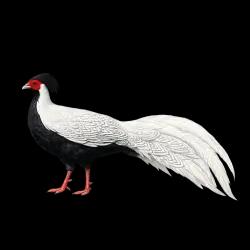
Silver Pheasant at a glance
Bird · Southeast Asia · Evergreen and mixed broadleaf · Relatively common
Known for: Bright red legs in both sexes, Pale horn-coloured bill, Bare red skin around the eye, Male's white upperparts crossed by black lines
Its Power
Confident Display
Embrace your unique qualities and let them shine.
The Silver Pheasant uses its striking plumage and bold displays to assert presence and attract mates, teaching us the power of self-assuredness and visibility.
“Shine Brightly.”
Capture a Silver Pheasant, and it's yours when you finish one step it gives you.
Biological basis
Male Silver Pheasants exhibit elaborate courtship displays, showcasing their vibrant plumage to attract females and establish dominance.
Put it into practice
A shy baker puts her boldest cake in the front window and new customers walk in all week.
What does the silver pheasant symbolize?
The silver pheasant symbolizes confident display: embrace your unique qualities and let them shine. It represents confidence, confident display and presence. Its AnimalDex motto: "Shine Brightly."
The silver pheasant as a spirit animal
If the silver pheasant is your spirit animal, the AnimalDex reading is Confident Display: the Silver Pheasant uses its striking plumage and bold displays to assert presence and attract mates, teaching us the power of self-assuredness and visibility. It suggests a strength in confidence and confident display, and a reminder to use it on purpose.
What can the silver pheasant help you with in life?
The silver pheasant is a guide for confidence, confident display and presence. Its lesson applies wherever confidence matters: the Silver Pheasant uses its striking plumage and bold displays to assert presence and attract mates, teaching us the power of self-assuredness and visibility.
- Confidence
- Confident Display
- Presence
In practice: A shy baker puts her boldest cake in the front window and new customers walk in all week.
What can we learn from the Silver Pheasant?What does it mean to dream about or encounter a wild silver pheasant?
Meeting a wild silver pheasant, asleep or awake, is often a nudge toward confidence, the quality the silver pheasant is built around. In AnimalDex, the silver pheasant's principle is Confident Display: embrace your unique qualities and let them shine. Read the moment through its core lesson: The Silver Pheasant uses its striking plumage and bold displays to assert presence and attract mates, teaching us the power of self-assuredness and visibility.
Neither good nor bad on its own. How the silver pheasant acts matters: at ease, it reflects confidence; hostile, it flags confidence out of balance.
Spotting a silver pheasant in the wild
A real encounter is the plainest version of the sign: notice what the silver pheasant was doing. Embrace your unique qualities and let them shine. That is the confidence worth borrowing today.
A silver pheasant that keeps appearing
Seeing the silver pheasant again and again, in dreams or outside, suggests confidence is a theme you have not settled yet.
Dreaming of being chased by a silver pheasant
If the silver pheasant pursues you, look at where confident display is being asked of you and you are stepping away instead of meeting it.
Dreaming that a silver pheasant attacks you
An attack points to confidence turned against you: someone using it on you, or your own confidence overused until it costs you.
A calm or friendly silver pheasant
A relaxed silver pheasant near you, in a dream or in person, reads as readiness: Confident Display is available to you now, as its motto puts it, "Shine Brightly.".
A dead or injured silver pheasant
A dead or injured silver pheasant, dreamed or found, can mark confidence you have let lapse, or a phase built on Confident Display coming to an end.
These readings are reflective prompts drawn from how the silver pheasant really lives, not predictions. If you meet one in the wild, watch from a distance and leave it undisturbed.
Capture your own Silver Pheasant
Photograph or film one in the wild, at a zoo or at home with the app. It becomes yours: it remembers you, gives you steps, and can debate your problems with your other animals.
Animal field guide
Silver Pheasant
Sign in to hear this read by a natural AI voice instead of your browser's.
This large pheasant spends most of its life walking the floor of evergreen hill forest in southern China and mainland South-east Asia. More than a dozen subspecies have been named across that range, and males differ noticeably between them in the pattern of their plumage.
Native range
Natural range, not this capture location
Evergreen and mixed broadleaf forest on hills and mountains, often with bamboo or dense undergrowth, from the lowlands up to about 2,000 metres, in southern China, Hainan and mainland South-east Asia.
Search near meAnimalDex stats
Dominance
34
Speed
53
Size
27
Intelligence
33
Rarity
49%
Total
196
Size scale
Understand the animal
Understand the Silver Pheasant
Factual biology first: what this animal is like, where it lives, how it survives, and why those traits exist.
01
Introduction to Silver Pheasant
This large pheasant spends most of its life walking the floor of evergreen hill forest in southern China and mainland South-east Asia. More than a dozen subspecies have been named across that range, and males differ noticeably between them in the pattern of their plumage.
How to identify a Silver Pheasant
- Bright red legs in both sexes
- Pale horn-coloured bill
- Bare red skin around the eye, largest in males
- Male's white upperparts crossed by black lines, heavier in some subspecies
Why Silver Pheasant are interesting
- Its image was embroidered on the rank badges worn by fifth-grade civil officials in Ming and Qing dynasty China.
- It has long been one of the pheasants most often kept in aviaries, and it breeds readily in captivity.
- Where its range meets that of the Kalij Pheasant in Myanmar, birds with intermediate plumage occur, and some ornithologists have treated the two as one species.
- Outside the breeding season it often moves in small parties, commonly a male with several females.
- It is classed as Least Concern, although it has declined locally where forest is cleared or hunting is heavy.
02
Adaptations and biological abilities
03
Why does Silver Pheasant behave this way?
- Bright red legs in both sexes
- Pale horn-coloured bill
- Bare red skin around the eye, largest in males
- Male's white upperparts crossed by black lines, heavier in some subspecies
Active by day, feeding mostly in the early morning and late afternoon on the forest floor. At night it flies up to roost on branches in trees. It does not migrate or enter any seasonal dormancy.
04
Why Evergreen and mixed broadleaf forest on hills and mountains?
Habitat: Evergreen and mixed broadleaf forest on hills and mountains, often with bamboo or dense undergrowth, from the lowlands up to about 2,000 metres, in southern China, Hainan and mainland South-east Asia.
Native range: Southeast Asia, East Asia
Native range
Natural range, not this specific capture location.
Evergreen and mixed broadleaf forest on hills and mountains, often with bamboo or dense undergrowth, from the lowlands up to about 2,000 metres, in southern China, Hainan and mainland South-east Asia.
05
Why this diet?
Seeds, fallen fruit and berries, shoots, leaves, insects and worms, found by scratching through leaf litter with the feet and picking from the forest floor.
06
Activity, rest, and lifespan
Active by day, feeding mostly in the early morning and late afternoon on the forest floor. At night it flies up to roost on branches in trees. It does not migrate or enter any seasonal dormancy.
Captive birds are commonly reported to live about 10 to 15 years; lifespan in the wild has not been documented.
07
Silver Pheasant reproduction
The hen makes a shallow scrape on the ground in dense cover and incubates alone. Captive hens typically lay about six to eight buff eggs, incubated for about 25 days; the downy chicks leave the nest soon after hatching and follow her.
Males are mainly white and black and considerably larger. Females are olive-brown with a much shorter tail and a brown crest.
08
Predators, threats, and defense
09
Conservation and rarity
Rarity: Relatively common · 49/100. AnimalDex canonical rarity score: 49/100, maintained by the live indexed species profile.
- Observe from a respectful distance and avoid changing the animal's behavior.
- Do not block feeding, shelter, nesting, or travel routes.
- Use a live camera capture without handling or staging wildlife.
Talk to it
Talk to the Silver Pheasant
It answers as itself: ask about how it lives, or bring it something of yours and hear what it would do, from its own Power.
Anonymous: 3/day. Signed-in: 10/day. Pro: 100/day.
Side by side
The Silver Pheasant, side by side
Nothing written side by side for the Silver Pheasant yet. Pick any animal to compare it with. Compare with any animal →
Where to find them
Where to find Silver Pheasant
To find Silver Pheasant in the wild, focus on the exact habitat patches that match its body design and daily behavior, not just the broad country where it exists. You usually do better by working one good piece of habitat inside southeast Asia, East Asia than by covering too much ground.
- Forest edge, canopy gaps, fruiting trees, or shaded trails where cover and food meet
- Rocky slopes, ridge lines, cliff ledges, or open mountain meadows with a wide view
- Protected habitat blocks within southeast Asia, East Asia
Scientific name
Lophura nycthemera
Category
Bird
Habitat
Evergreen and mixed broadleaf forest on hills and mountains, often with bamboo or dense undergrowth, from the lowlands up to about 2,000 metres, in southern China, Hainan and mainland South-east Asia.
Rarity
Relatively common · 49/100
Native range
Southeast Asia, East Asia
Take the encyclopedia outside
AnimalDex helps you scan real animals, identify species, collect cards, and learn from nature wherever you are.