Animal field guide
Tokay Gecko
Gekko gecko
Tokay Gecko teaches Grip Voice through a wall-clinging lizard announcing its place in the night. Adhesive toe pads, bold spots, powerful bite, and loud territorial calls make holding ground both physical and vocal.
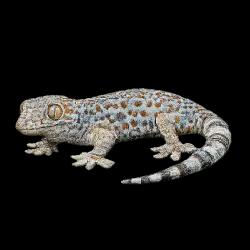
Tokay Gecko at a glance
Reptile · South and Southeast Asia · forest · Relatively common
Known for: Adhesive toe pads that grip walls, Loud tokay call used for territory and mating, Bold spotted body with strong night presence, Powerful bite for close-range defense
Its Power
Grip Voice
Wall-Clinging Night Call
Hold your place so clearly that the night hears you.
“Grip and call.”
Capture a Tokay Gecko, and it's yours when you finish one step it gives you.
Biological basis
bright spotted body, powerful climbing toe pads, and loud territorial call give the Tokay Gecko a body plan tuned for its niche. Tokay Geckos operate through forest, limestone outcrop, village edge, and tropical wall-like surfaces Their design links movement, shelter, and feeding into one workable survival system.
What does the tokay gecko symbolize?
The tokay gecko symbolizes grip voice: wall-Clinging Night Call. It represents energy management, prioritization and sustainable output. Its AnimalDex motto: "Grip and call."
The tokay gecko as a spirit animal
If the tokay gecko is your spirit animal, the AnimalDex reading is Grip Voice: hold your place so clearly that the night hears you. It suggests a strength in energy management and prioritization, and a reminder to use it on purpose.
What can the tokay gecko help you with in life?
The tokay gecko is a guide for energy management, prioritization and sustainable output. Its lesson applies wherever energy management matters: hold your place so clearly that the night hears you.
- Energy Management
- Prioritization
- Sustainable Output
What does it mean to dream about or encounter a wild tokay gecko?
Dreaming about a wild tokay gecko, or coming across one, usually points to energy management and prioritization: the qualities the tokay gecko lives by. In AnimalDex, the tokay gecko's principle is Grip Voice: wall-Clinging Night Call. Read the moment through its core lesson: Hold your place so clearly that the night hears you.
Mostly a prompt rather than a warning. A calm tokay gecko suggests energy management you already have; a threatening one suggests energy management is being tested or pushed too far.
Spotting a tokay gecko in the wild
A real encounter is the plainest version of the sign: notice what the tokay gecko was doing. Wall-Clinging Night Call. That is the energy management worth borrowing today.
A tokay gecko that keeps appearing
Seeing the tokay gecko again and again, in dreams or outside, suggests energy management is a theme you have not settled yet.
Dreaming of being chased by a tokay gecko
Being chased suggests you are avoiding the Grip Voice the tokay gecko stands for: hold your place so clearly that the night hears you. Ask what you keep postponing that needs energy management.
Dreaming that a tokay gecko attacks you
An attack points to energy management turned against you: someone using it on you, or your own energy management overused until it costs you.
A calm or friendly tokay gecko
A relaxed tokay gecko near you, in a dream or in person, reads as readiness: Grip Voice is available to you now, as its motto puts it, "Grip and call.".
A dead or injured tokay gecko
A dead or injured tokay gecko, dreamed or found, can mark energy management you have let lapse, or a phase built on Grip Voice coming to an end.
These readings are reflective prompts drawn from how the tokay gecko really lives, not predictions. If you meet one in the wild, watch from a distance and leave it undisturbed.
Capture your own Tokay Gecko
Photograph or film one in the wild, at a zoo or at home with the app. It becomes yours: it remembers you, gives you steps, and can debate your problems with your other animals.
Animal field guide
Tokay Gecko
Sign in to hear this read by a natural AI voice instead of your browser's.
The Tokay Gecko grips walls and tree trunks as if gravity were only a suggestion. In human life, that means paying close attention can reveal options other people miss.
Native range
Natural range, not this capture location
forest, limestone outcrop, village edge, and tropical wall-like surfaces
Search near meAnimalDex stats
Dominance
38
Speed
42
Size
17
Intelligence
32
Rarity
30%
Total
159
Size scale
Understand the animal
Understand the Tokay Gecko
Factual biology first: what this animal is like, where it lives, how it survives, and why those traits exist.
01
Introduction to Tokay Gecko
Tokay Gecko teaches Grip Voice through a wall-clinging lizard announcing its place in the night. Adhesive toe pads, bold spots, powerful bite, and loud territorial calls make holding ground both physical and vocal.
How to identify a Tokay Gecko
- Adhesive toe pads that grip walls, trunks, and ceilings
- Loud tokay call used for territory and mating
- Bold spotted body with strong night presence
- Powerful bite for close-range defense
02
Adaptations and biological abilities
03
Why does Tokay Gecko behave this way?
- Tokay Geckos are named after their loud call, often heard as “to-kay.”
- They can climb vertical walls using microscopic structures on their toe pads.
- They are known for being bold and defensive when handled or cornered.
- They often live near humans as well as in forests and rocky places.
Tokay Geckos are nocturnal. The call carries after dark, and the feet own the wall when most daytime competitors have gone quiet.
04
Why forest?
Habitat: forest, limestone outcrop, village edge, and tropical wall-like surfaces
Native range: South and Southeast Asia
Native range
Natural range, not this specific capture location.
forest, limestone outcrop, village edge, and tropical wall-like surfaces
05
Why this diet?
Moths, beetles, cockroaches, crickets, small lizards, frogs, and other small animals.
06
Activity, rest, and lifespan
Tokay Geckos are nocturnal. The call carries after dark, and the feet own the wall when most daytime competitors have gone quiet.
Captive tokays often live more than 10 years, with some reports of about 20; wild lifespan has not been well studied.
07
Tokay Gecko reproduction
Females lay eggs in sheltered places, often attached to surfaces, and may guard them in some situations.
Males are often larger and more vocal, especially around territory.
08
Predators, threats, and defense
09
Conservation and rarity
Rarity: Relatively common · 30/100. Tokay Gecko remains fairly widespread where forest, limestone outcrop, village edge, and tropical wall-like surfaces is still available.
- Keep distance and let the animal choose the space.
- Avoid blocking movement routes, nesting areas, or feeding behavior.
- Use optics, patience, and quiet observation instead of crowding for a closer view.
Talk to it
Talk to the Tokay Gecko
It answers as itself: ask about how it lives, or bring it something of yours and hear what it would do, from its own Power.
Anonymous: 6/day. Signed-in: 10/day. Pro: 100/day.
Side by side
The Tokay Gecko, side by side
Where to find them
Where to find Tokay Gecko
To find Tokay Gecko in the wild, focus on the exact habitat patches that match its body design and daily behavior, not just the broad country where it exists. You usually do better by working one good piece of habitat inside south and Southeast Asia than by covering too much ground.
- Forest edge, canopy gaps, fruiting trees, or shaded trails where cover and food meet
- Protected habitat blocks within south and Southeast Asia
Where explorers saw it
- Batu, East Java, IndonesiaApr · 1 sighting
Scientific name
Gekko gecko
Category
Reptile
Habitat
forest, limestone outcrop, village edge, and tropical wall-like surfaces
Rarity
Relatively common · 30/100
Native range
South and Southeast Asia
Related animals
Burmese Python
Burmese Python is a reptile known for massive muscular coils, blotched camouflage…
Read species guideKing Cobra
The king cobra is the world’s longest venomous snake, known for its height when…
Read species guideMonocled Cobra
Monocled Cobra is a reptile known for single round hood mark, broad threat display, and…
Read species guideMore animals with Energy Management
Addax
Addax is a mammal known for pale desert coat, wide spreading hooves, and slow-energy…
Read species guideAfrican Bullfrog
African Bullfrog is a amphibian known for huge frog body, powerful bite, and burrowing…
Read species guideAfrican Forest Elephant
African Forest Elephant is a mammal known for rounded ears for tight forest travel,…
Read species guideTake the encyclopedia outside
AnimalDex helps you scan real animals, identify species, collect cards, and learn from nature wherever you are.