Animal field guide
Two-tailed Pasha
Charaxes jasius
One of Europe's largest butterflies, with a wingspan of roughly 7 to 9 centimetres and two slender tails on each hindwing. Its rapid, gliding flight around Mediterranean treetops makes it easy to notice but hard to follow.
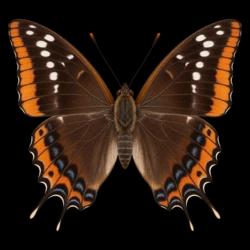
Two-tailed Pasha at a glance
Animal · Europe · Warm Mediterranean maquis · Relatively common
Known for: Dark brown upperside with a broad orange border, Underside marbled brown with white and orange bands, Small blue-grey spots near the hindwing tails above, Four-horned head on the green caterpillar
Its Power
Territorial Perch
Establish a vantage point to monitor your domain.
By choosing a high perch, the Two-tailed Pasha can effectively oversee its territory and respond to intruders swiftly.
“Claim your view.”
Capture a Two-tailed Pasha, and it's yours when you finish one step it gives you.
Biological basis
The Two-tailed Pasha often selects elevated positions to keep watch over its territory, ensuring it can defend its space from rivals.
Put it into practice
Emma chooses a corner desk at work, giving her a clear view of the office and allowing her to anticipate tasks and interactions.
What does the two-tailed pasha symbolize?
The two-tailed pasha symbolizes territorial perch: establish a vantage point to monitor your domain. It represents perspective, healthy territory and alertness. Its AnimalDex motto: "Claim your view."
The two-tailed pasha as a spirit animal
If the two-tailed pasha is your spirit animal, the AnimalDex reading is Territorial Perch: by choosing a high perch, the Two-tailed Pasha can effectively oversee its territory and respond to intruders swiftly. It suggests a strength in perspective and healthy territory, and a reminder to use it on purpose.
What can the two-tailed pasha help you with in life?
The two-tailed pasha is a guide for perspective, healthy territory and alertness. Its lesson applies wherever perspective matters: by choosing a high perch, the Two-tailed Pasha can effectively oversee its territory and respond to intruders swiftly.
- Perspective
- Healthy Territory
- Alertness
In practice: Emma chooses a corner desk at work, giving her a clear view of the office and allowing her to anticipate tasks and interactions.
What can we learn from the Two-tailed Pasha?What does it mean to dream about or encounter a wild two-tailed pasha?
Dreaming about a wild two-tailed pasha, or coming across one, usually points to perspective and healthy territory: the qualities the two-tailed pasha lives by. In AnimalDex, the two-tailed pasha's principle is Territorial Perch: establish a vantage point to monitor your domain. Read the moment through its core lesson: By choosing a high perch, the Two-tailed Pasha can effectively oversee its territory and respond to intruders swiftly.
Mostly a prompt rather than a warning. A calm two-tailed pasha suggests perspective you already have; a threatening one suggests perspective is being tested or pushed too far.
Spotting a two-tailed pasha in the wild
Coming across a two-tailed pasha in person asks for attention more than interpretation. Watch it for a minute; the two-tailed pasha's way of working is Territorial Perch, and the lesson is: by choosing a high perch, the Two-tailed Pasha can effectively oversee its territory and respond to intruders swiftly.
A two-tailed pasha that keeps appearing
Repeated sightings of a two-tailed pasha usually mean the Territorial Perch lesson is still open: by choosing a high perch, the Two-tailed Pasha can effectively oversee its territory and respond to intruders swiftly.
Dreaming of being chased by a two-tailed pasha
A chase often means a demand for perspective is catching up with you. The two-tailed pasha's lesson, "By choosing a high perch, the Two-tailed Pasha can effectively oversee its territory and respond to intruders swiftly", is the part you may be running from.
Dreaming that a two-tailed pasha attacks you
An aggressive two-tailed pasha can mirror a conflict where perspective has become a weapon rather than a strength.
A calm or friendly two-tailed pasha
Meeting a peaceful two-tailed pasha is usually encouraging: healthy territory and alertness are within reach.
A dead or injured two-tailed pasha
A dead or injured two-tailed pasha, dreamed or found, can mark perspective you have let lapse, or a phase built on Territorial Perch coming to an end.
These readings are reflective prompts drawn from how the two-tailed pasha really lives, not predictions. If you meet one in the wild, watch from a distance and leave it undisturbed.
Capture your own Two-tailed Pasha
Photograph or film one in the wild, at a zoo or at home with the app. It becomes yours: it remembers you, gives you steps, and can debate your problems with your other animals.
Animal field guide
Two-tailed Pasha
Sign in to hear this read by a natural AI voice instead of your browser's.
One of Europe's largest butterflies, with a wingspan of roughly 7 to 9 centimetres and two slender tails on each hindwing. Its rapid, gliding flight around Mediterranean treetops makes it easy to notice but hard to follow.
Native range
Natural range, not this capture location
Warm Mediterranean maquis, coastal scrub and open woodland where strawberry trees grow, from sea level into low hills, including sunny rocky slopes and hilltops.
Search near meAnimalDex stats
Size scale
Understand the animal
Understand the Two-tailed Pasha
Factual biology first: what this animal is like, where it lives, how it survives, and why those traits exist.
01
Introduction to Two-tailed Pasha
One of Europe's largest butterflies, with a wingspan of roughly 7 to 9 centimetres and two slender tails on each hindwing. Its rapid, gliding flight around Mediterranean treetops makes it easy to notice but hard to follow.
How to identify a Two-tailed Pasha
- Dark brown upperside with a broad orange border
- Underside marbled brown with white and orange bands
- Small blue-grey spots near the hindwing tails above
- Four-horned head on the green caterpillar
Why Two-tailed Pasha are interesting
- It is the only European member of Charaxes, a genus with well over a hundred species, most of them African.
- Adults are drawn to spilled wine and beer, which collectors have long used as bait.
- Caterpillars rest on a pad of silk spun on a leaf, returning to it between meals.
- Because its caterpillars feed almost entirely on strawberry tree, its distribution largely follows that shrub around Mediterranean coasts.
02
Adaptations and biological abilities
03
Why does Two-tailed Pasha behave this way?
- Dark brown upperside with a broad orange border
- Underside marbled brown with white and orange bands
- Small blue-grey spots near the hindwing tails above
- Four-horned head on the green caterpillar
Active in sunshine through the middle of the day. At night and in dull weather adults rest in tree canopies with wings closed, the patterned underside blending with bark and leaves.
04
Why Warm Mediterranean maquis?
Habitat: Warm Mediterranean maquis, coastal scrub and open woodland where strawberry trees grow, from sea level into low hills, including sunny rocky slopes and hilltops.
Native range: Europe, North Africa & Middle East
Native range
Natural range, not this specific capture location.
Warm Mediterranean maquis, coastal scrub and open woodland where strawberry trees grow, from sea level into low hills, including sunny rocky slopes and hilltops.
05
Why this diet?
Adults rarely visit flowers; they suck juices from rotting fruit such as figs, from tree sap and from dung. Caterpillars feed on the leaves of the strawberry tree.
06
Activity, rest, and lifespan
Active in sunshine through the middle of the day. At night and in dull weather adults rest in tree canopies with wings closed, the patterned underside blending with bark and leaves.
Adults usually live a few weeks. The autumn brood overwinters as a caterpillar, spending roughly six months in the larval stage.
07
Two-tailed Pasha reproduction
Females lay single pale, rounded eggs on the upper side of strawberry-tree leaves. There are usually two broods a year; caterpillars from the second brood grow slowly through winter and pupate in spring as green hanging chrysalises.
The sexes are similarly patterned, but females are larger, with broader wings.
08
Predators, threats, and defense
09
Conservation and rarity
Rarity: Relatively common · 35/100. AnimalDex canonical rarity score: 35/100, maintained by the live indexed species profile.
- Observe from a respectful distance and avoid changing the animal's behavior.
- Do not block feeding, shelter, nesting, or travel routes.
- Use a live camera capture without handling or staging wildlife.
Talk to it
Talk to the Two-tailed Pasha
It answers as itself: ask about how it lives, or bring it something of yours and hear what it would do, from its own Power.
Anonymous: 6/day. Signed-in: 10/day. Pro: 100/day.
Side by side
The Two-tailed Pasha, side by side
Nothing written side by side for the Two-tailed Pasha yet. Pick any animal to compare it with. Compare with any animal →
Where to find them
Where to find Two-tailed Pasha
To find Two-tailed Pasha in the wild, focus on the exact habitat patches that match its body design and daily behavior, not just the broad country where it exists. You usually do better by working one good piece of habitat inside europe, North Africa & Middle East than by covering too much ground.
- Forest edge, canopy gaps, fruiting trees, or shaded trails where cover and food meet
- Rocky slopes, ridge lines, cliff ledges, or open mountain meadows with a wide view
- Headlands, reef edges, island colonies, tidal channels, or productive coastal water
Scientific name
Charaxes jasius
Category
Animal
Habitat
Warm Mediterranean maquis, coastal scrub and open woodland where strawberry trees grow, from sea level into low hills, including sunny rocky slopes and hilltops.
Rarity
Relatively common · 35/100
Native range
Europe, North Africa & Middle East
Take the encyclopedia outside
AnimalDex helps you scan real animals, identify species, collect cards, and learn from nature wherever you are.