

Chameleon behaviorAnimal visionReptile survival
How Chameleons See and Strike: Vision and Tongue Mechanics
How chameleon vision and tongue strikes work: independent eyes, tongues that reach two body lengths in hundredths of a second, and why colour changes.
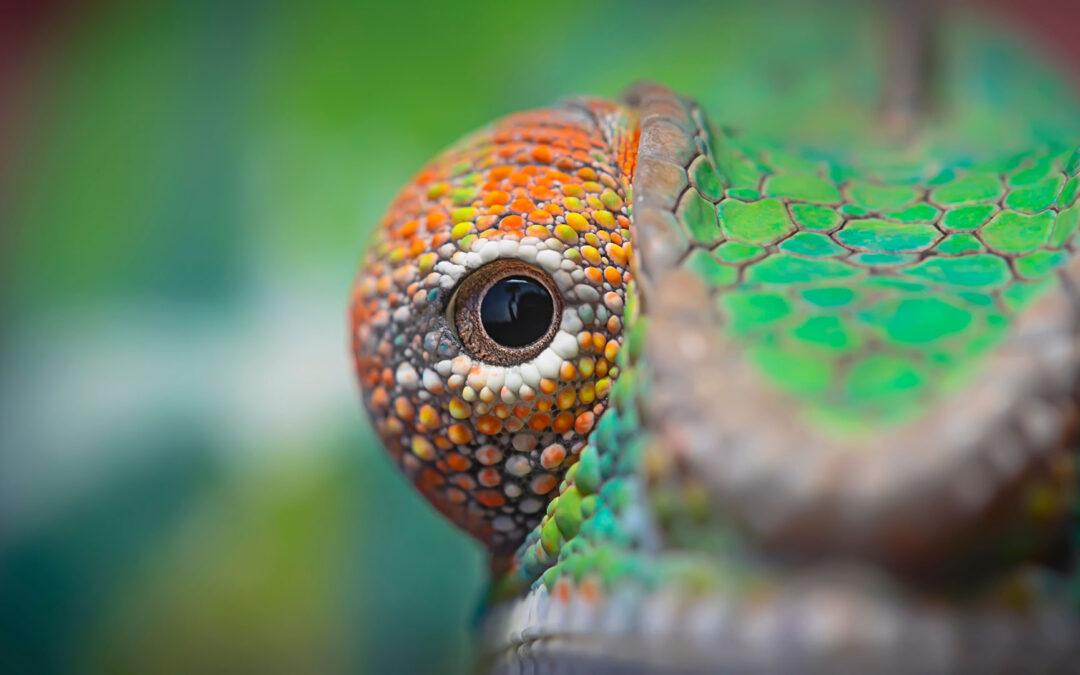
Why chameleons are more than just color-change curiosities
There are more than 200 chameleon species, and roughly half live only on Madagascar. They range from Brookesia nana, a leaf chameleon whose males measure about 22 millimetres, to Parson's and Oustalet's chameleons at nearly 70 centimetres. All of them share the same hunting platform: turret eyes that scan independently, feet and tail that lock onto a twig, and a tongue that is launched rather than flicked.
Colour change is the famous trait, but it is mostly a signalling and temperature tool. The real design story is how a slow, cold-blooded lizard that cannot chase anything still catches fast insects at a distance, branch by branch.
What makes a chameleon unique?
Each chameleon eye sits in a cone of fused eyelid with only a pinhole for the pupil, and each turret swings on its own through about 180 degrees horizontally and 90 degrees vertically. One eye can watch a fly behind while the other checks the branch ahead, giving nearly full coverage around the body. The moment a target is chosen, both eyes swing forward and lock on, and the lizard switches from monocular scanning to binocular aim. Chameleons can also judge distance with one eye by reading how far the lens must focus, which is unusual among vertebrates.
The tongue is a stored-energy weapon. A ring of accelerator muscle squeezes the tongue skeleton, stretching coiled collagen sheaths like a compressed spring. When they release, the tongue shoots out faster than muscle alone could drive it. Small species are the extreme case: in Rhampholeon spinosus the tongue tip accelerates at about 2,590 metres per second squared, 264 times gravity, and reaches the prey in a few hundredths of a second. Most species project the tongue one and a half to two body lengths; some small ones exceed two and a half. The club-shaped tip hits with suction and mucus roughly 400 times more viscous than human saliva, then the hyoglossus muscle reels the prey back in.
Everything else is grip. The toes are fused into two opposing bundles, two on one side and three on the other, and the prehensile tail acts as a fifth limb, so the body stays rigid while the tongue does the moving.
| Trait | How it works | Numbers |
|---|---|---|
| Independent eyes | Each turret scans alone, then both converge on a target | ~180° horizontal and 90° vertical per eye |
| Tongue projection | Elastic collagen recoil, not muscle, launches the tongue | 1.5–2 body lengths; up to 264 g acceleration in small species |
| Tongue tip | Suction cup plus thick mucus holds the prey | Mucus about 400× more viscous than human saliva |
| Feet and tail | Opposed toe bundles and a prehensile tail lock the body in place | Toes fused 2 + 3; tail acts as a fifth limb |
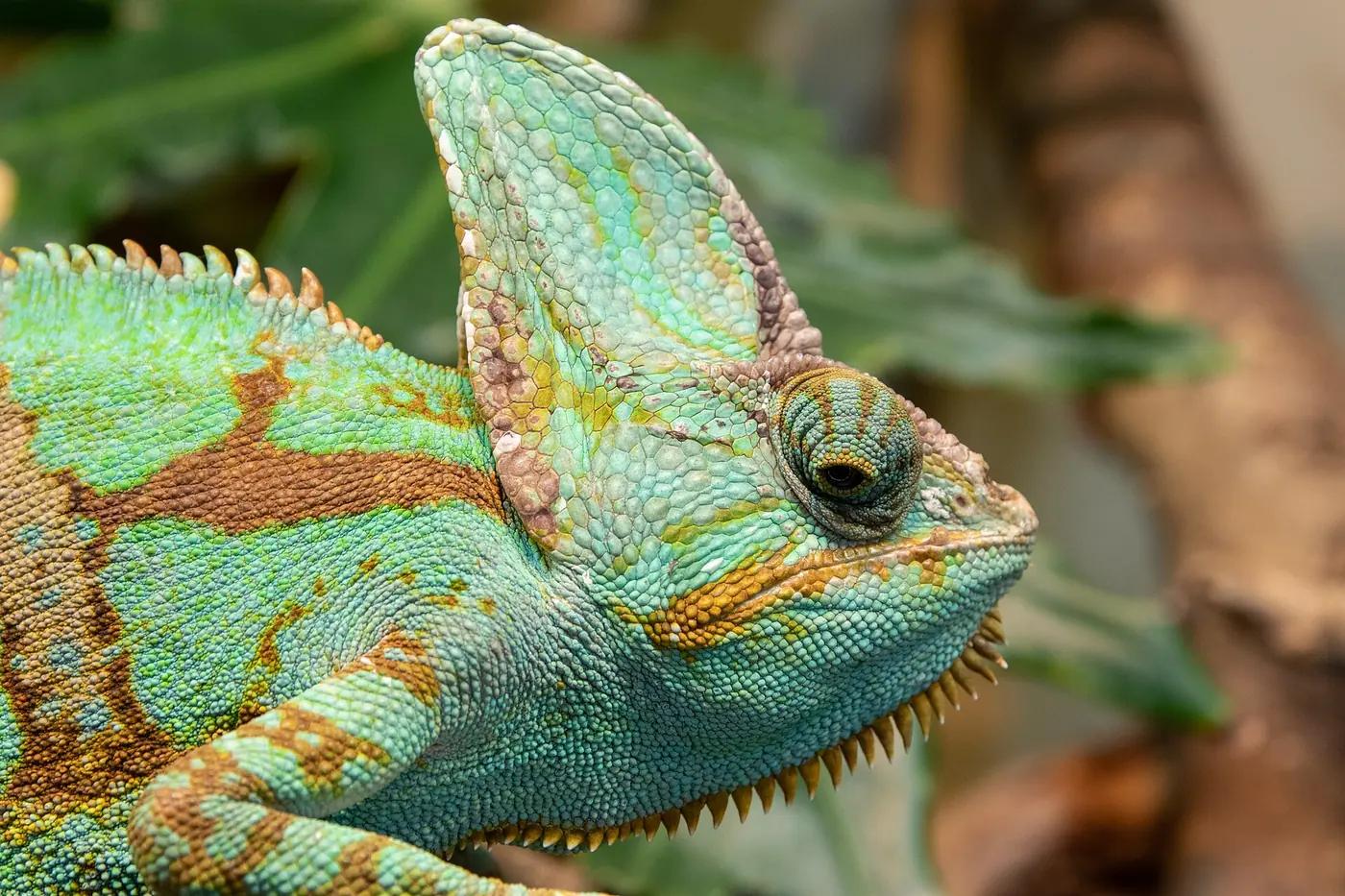
How chameleons survive
Chameleons are ambush hunters that barely move. A panther chameleon spends the day creeping along branches with a rocking, leaf-in-the-wind gait, pausing for long stretches while its eyes do the searching. When an insect lands within range it turns its head, converges both eyes and fires. Movement is rationed because it costs energy for an ectotherm and because stillness is the best defence against the birds and snakes that eat them.
Diet is mostly insects: crickets, grasshoppers, flies, mantises and caterpillars. The largest species also take small lizards, nestlings and even small birds. Water comes from licking dew and rain off leaves rather than drinking from pools.
Life is short. Panther chameleons live two to five years in the wild. Labord's chameleon (Furcifer labordi) of south-west Madagascar hatches, grows, mates and dies in four to five months, spending more of its life inside the egg than out, which is the shortest adult lifespan known for any four-legged vertebrate.
Better surveillance creates more value than busier execution. The chameleon holds still and lets its eyes do the work.
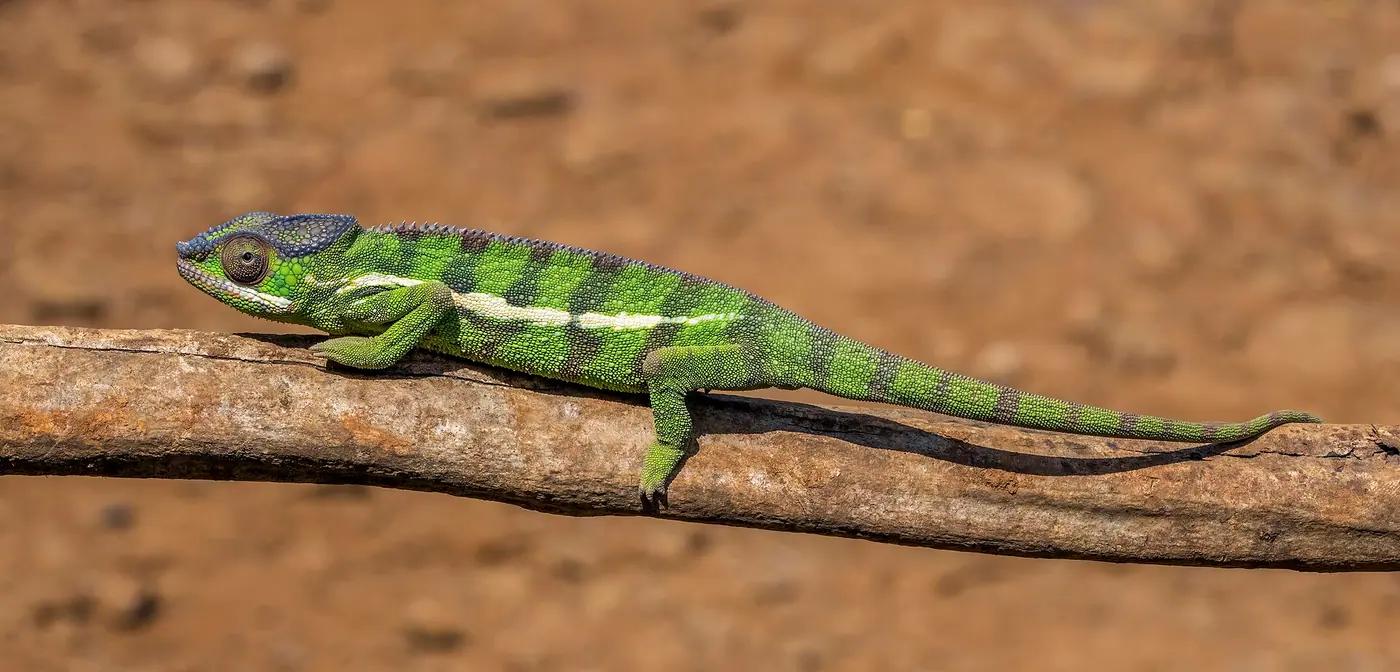
What colour change is really for
Chameleons do not change colour mainly to match backgrounds. Their resting greens and browns already blend with foliage. Rapid change is used to signal: a male panther chameleon brightens to reds and yellows to challenge a rival or court a female, a losing male turns dull and dark, and a gravid female shows a specific rejection pattern. Darkening also lets a cold lizard absorb more morning sun, and paling reflects heat at midday.
The mechanism was worked out in panther chameleons in 2015. Beneath the pigment cells lies a layer of iridophores containing a lattice of guanine nanocrystals. Relaxed, the crystals sit close together and reflect blue and green; excited, the lizard stretches the lattice so it reflects yellow, orange and red. A deeper layer of larger crystals reflects near-infrared and helps with heat. Pigment-bearing melanophores and xanthophores then tune the final colour.
The ecosystem role of chameleons
Chameleons regulate insect numbers in shrubs, trees and forest edges, taking large numbers of grasshoppers and other herbivorous insects. They are in turn prey for snakes such as the boomslang, for shrikes, hornbills and other birds, and for small mammals. Their eggs, buried in soil, feed many more.
Because most species are tied to particular forest types on Madagascar and in East Africa, chameleons are sensitive indicators of habitat loss, and a large share of Madagascan species are assessed as threatened by the IUCN. Finding one on a night walk says something about the state of the surrounding forest.
How to spot and photograph chameleons
Chameleons are hard to see by day and easy at night. The cues below are what guides in Madagascar and Kenya use.
Walk at night with a torch
Sleeping chameleons pale to a whitish green and glow in a headlamp beam against dark leaves, usually at the tips of thin branches 1 to 3 metres up.
Check the outermost twigs
They sleep on branches too thin for predators to climb. Scan the edges of bushes beside paths and streams rather than the centre.
Look for the silhouette
By day, look for a leaf that rocks against the breeze. The casque, curled tail and separate eye turrets break the leaf outline.
Keep your distance
A chameleon that turns its body away and flattens is stressed. Shoot from the side so both the eye and the curled tail are in frame, then move on; a live in-app capture needs only a few seconds.
What humans can learn from chameleons
Chameleons are the case for patient sensing. Constant activity is unnecessary if observation quality is high enough to make the one important move count, and a stored spring beats a fast muscle when timing matters more than endurance.
Mantis shrimp and jumping spiders solve the same see-then-strike problem with very different hardware, and the comparison shows how many routes lead to the same outcome.
mantis shrimp vision and strikewhy jumping spiders are so precise
Systems Intelligence & Hidden Purpose
See these animals as engineered biological systems: what they are built to do, how they fit the wider environment, and what their design can teach us.
Specialized Hardware
Independently mobile eyes, a ballistic tongue, and branch-gripping feet let a chameleon scan multiple angles before converting visual lock into a precise strike.
Systems Script
Chameleons operate as small-scale insect regulators in arboreal environments. They show how patient sensory coverage can stabilize a niche without high-speed roaming or constant conflict.
Strategic Insight
Do not confuse stillness with inactivity. Good surveillance buys better timing than constant motion.
Quick questions
Short answers to common questions readers ask on this topic.
- How do chameleon eyes work?
- Each chameleon eye moves independently in a turret of fused eyelid, covering about 180 degrees horizontally and 90 degrees vertically, so the lizard can watch two directions at once. When it picks a target, both eyes swing forward for binocular aim. Chameleons can also judge distance with a single eye by reading how far the lens has to focus.
- How fast is a chameleon's tongue?
- A chameleon's tongue reaches its prey in a few hundredths of a second. The tongue is launched by elastic recoil of collagen sheaths loaded by a ring of accelerator muscle, so it goes faster than muscle alone could manage. In small species such as Rhampholeon spinosus the tip accelerates at 264 times gravity. Most species reach 1.5 to 2 body lengths.
- Why do chameleons change colour?
- Chameleons change colour mainly to communicate and to control body temperature, not to match their background. Males brighten to challenge rivals or court females and darken when they lose; darker skin also absorbs more sun on cool mornings. The change comes from a lattice of guanine nanocrystals in skin cells called iridophores that the lizard stretches or relaxes to shift the reflected colour.
- What do chameleons eat?
- Chameleons eat mostly insects, including crickets, grasshoppers, flies, mantises and caterpillars, caught with their projectile tongue. Large species such as Parson's and Oustalet's chameleons also take small lizards, nestlings and occasionally small birds. They drink by licking dew and rain from leaves rather than from standing water.
- Where do chameleons live in the wild?
- About half of all chameleon species live only on Madagascar, and most of the rest are in mainland Africa, with a few species in the Middle East, southern Europe, India and Sri Lanka. They live in forests, scrub and gardens from sea level to mountain slopes. Veiled chameleons come from Yemen and Saudi Arabia, panther chameleons from northern Madagascar.
Animals mentioned
Jump from this article into the species pages behind the examples, systems notes, and field-guide references.
Answer guides related to this topic
If you want direct comparisons and clear recommendations, continue with these answer-focused pages.
Best Animal Identification Apps
Compare the best animal identification apps by features like photo/video identification, species coverage, collection capabilities, offline use, and more.
What Is Animal Collecting
Learn what animal collecting means in modern apps and how AnimalDex turns real-world sightings into cards, sets, rarity, and species learning.
Pokemon-Like Animal App
Looking for a Pokemon-like animal app with real species? AnimalDex combines creature-collection energy with AI scanning and wildlife learning.
Related guides
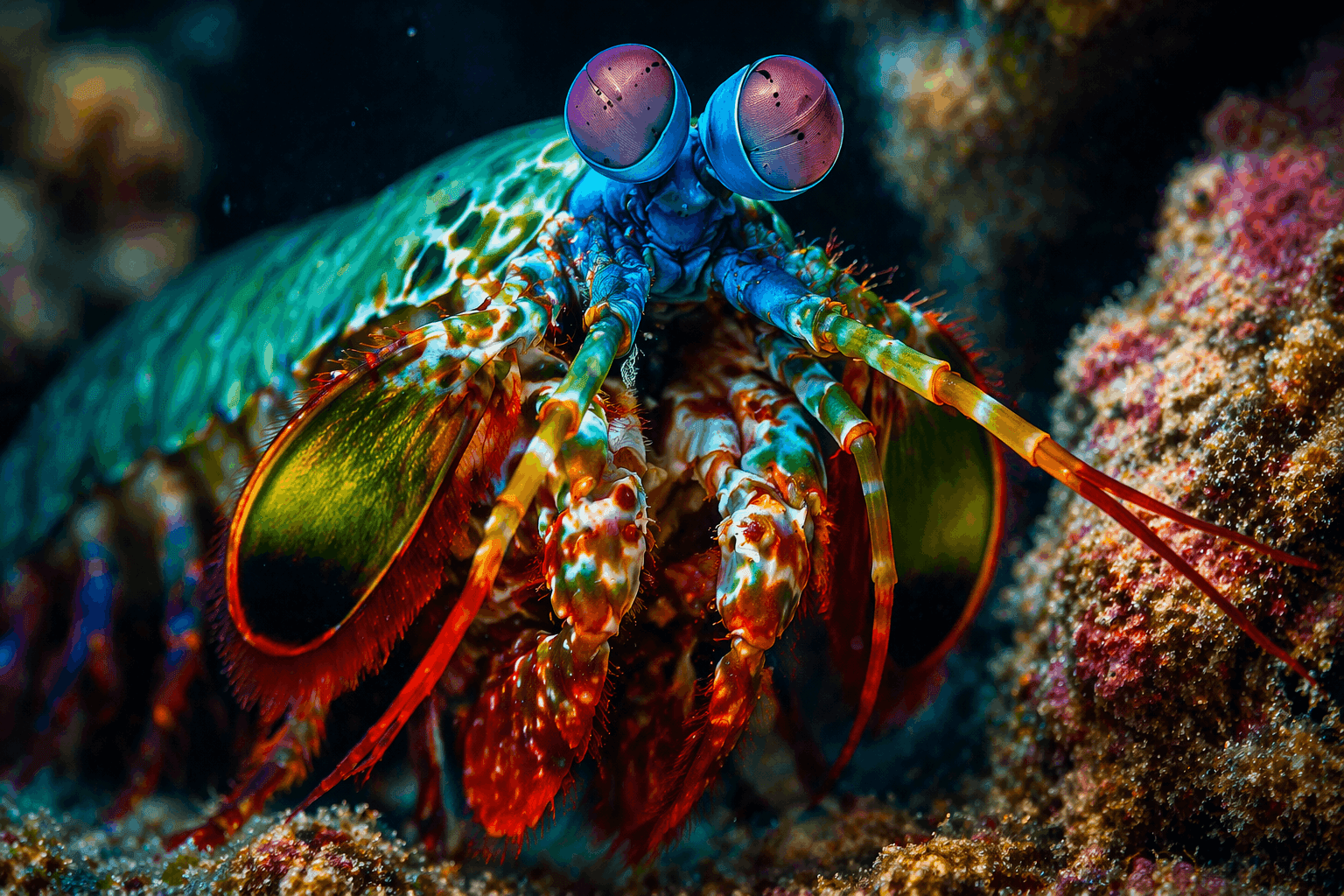
Mantis shrimp
Mantis Shrimp Vision and Strike Power Explained
Mantis shrimp vision and strike explained: 12 to 16 photoreceptor types, polarised light, and a club that hits at 23 m/s and 10,000 g, then hits again.
8 min read
Why Jumping Spiders Are So Precise: Vision and Jump Planning
Why jumping spiders are so precise: four pairs of eyes with set roles, principal eyes near a pigeon in acuity, depth from defocus, and hydraulic legs.
9 min read
How Barn Owls Hunt in the Dark: Hearing and Silent Flight
How barn owls hunt in the dark: asymmetric ears that place a mouse within two degrees, a facial disc that works as a dish, and wings that make no sound.
9 min read