

Barn owlAnimal behaviorNocturnal predators
How Barn Owls Hunt in the Dark: Hearing and Silent Flight
How barn owls hunt in the dark: asymmetric ears that place a mouse within two degrees, a facial disc that works as a dish, and wings that make no sound.
Why the barn owl feels almost engineered for night work
The barn owl (Tyto alba) is the most widespread land bird on Earth, found on every continent except Antarctica, from English farmland to Australian wheat belts. It is 32 to 40 centimetres long, spans a metre or more across the wings, and weighs only 400 to 700 grams, which is less than a pigeon-sized body with a much larger wing would suggest.
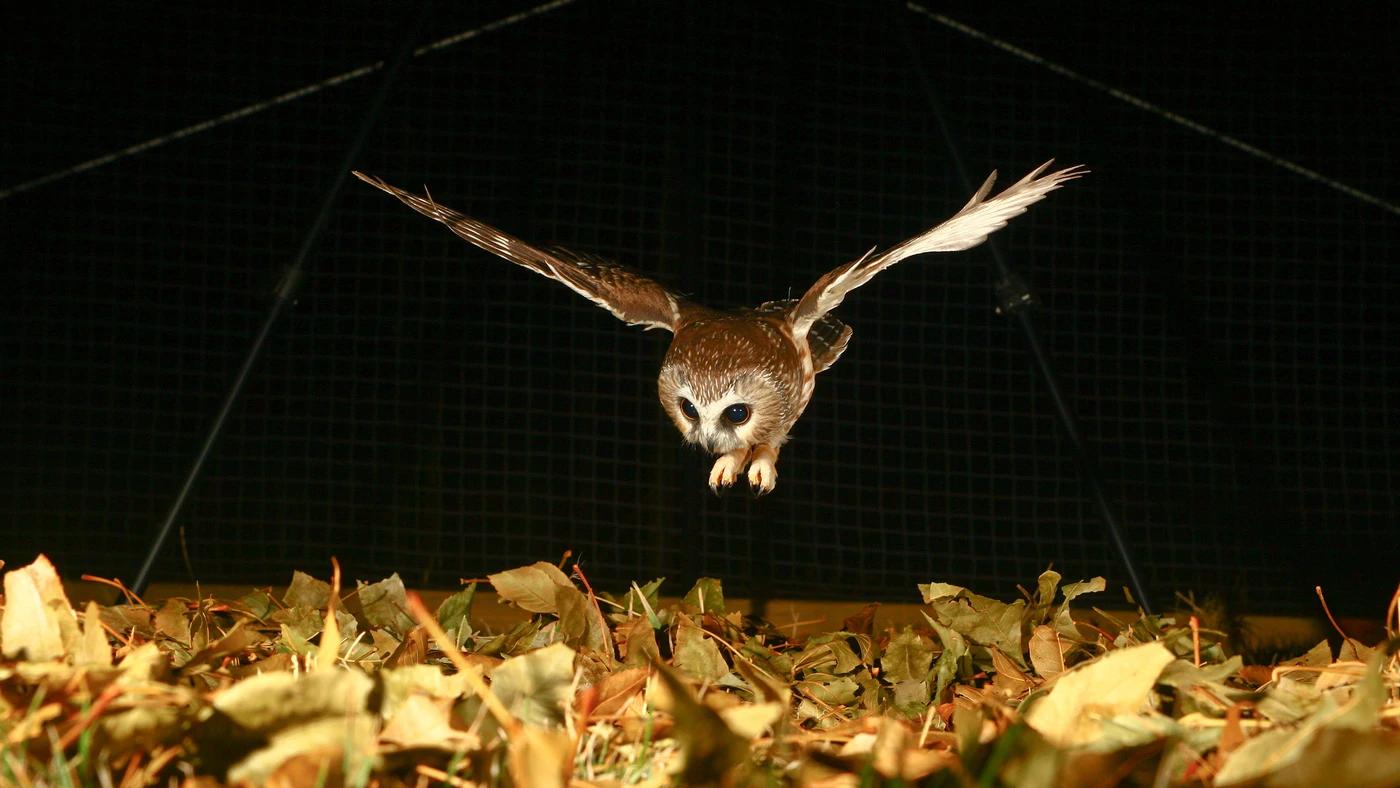
In 1971 Roger Payne published the experiment that defines the species. He released barn owls in a completely dark room with a mouse on a floor of dry leaves, and the owls struck the mouse accurately by sound alone. When he dragged a wad of paper on a string instead, the owl hit the paper. The bird was not seeing; it was triangulating.
That ability, combined with flight that produces almost no sound above the frequencies rodents hear, is why the barn owl is the standard animal for research on sound localisation and the standard answer to how an animal can hunt on a moonless night.
How eagles use height, vision, and timingGreat horned owl species page
What makes a barn owl unique?
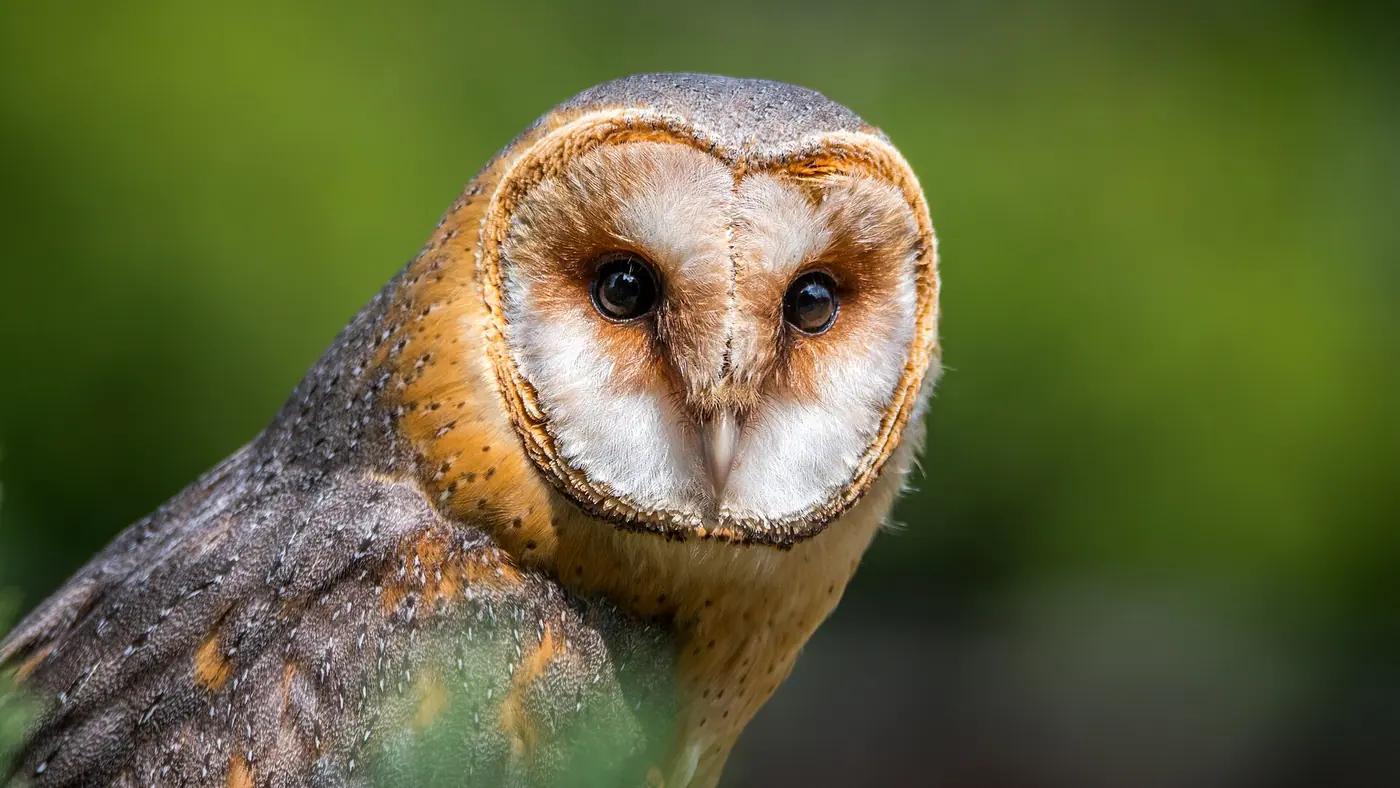
The face is a sound dish. The heart-shaped facial disc is a ruff of dense, stiff feathers that the owl can adjust with muscles, and it funnels sound toward two ear openings hidden under the feathers at the disc's edges. For the frequencies a vole makes moving through grass, roughly 3 to 9 kilohertz, the disc adds in the order of 10 to 20 decibels of gain and sharpens direction.
The ears are not level. The left opening sits higher on the skull and points slightly down; the right sits lower and points up. A sound from above reaches the right ear a fraction louder, a sound from below the left, so the loudness difference between ears gives elevation. A sound from the side reaches the nearer ear a few microseconds earlier, and that time difference gives horizontal bearing. Eric Knudsen and Masakazu Konishi showed in 1979 that barn owls combine the two to locate a sound source to within about one to two degrees in both axes, the most precise passive hearing measured in any animal.
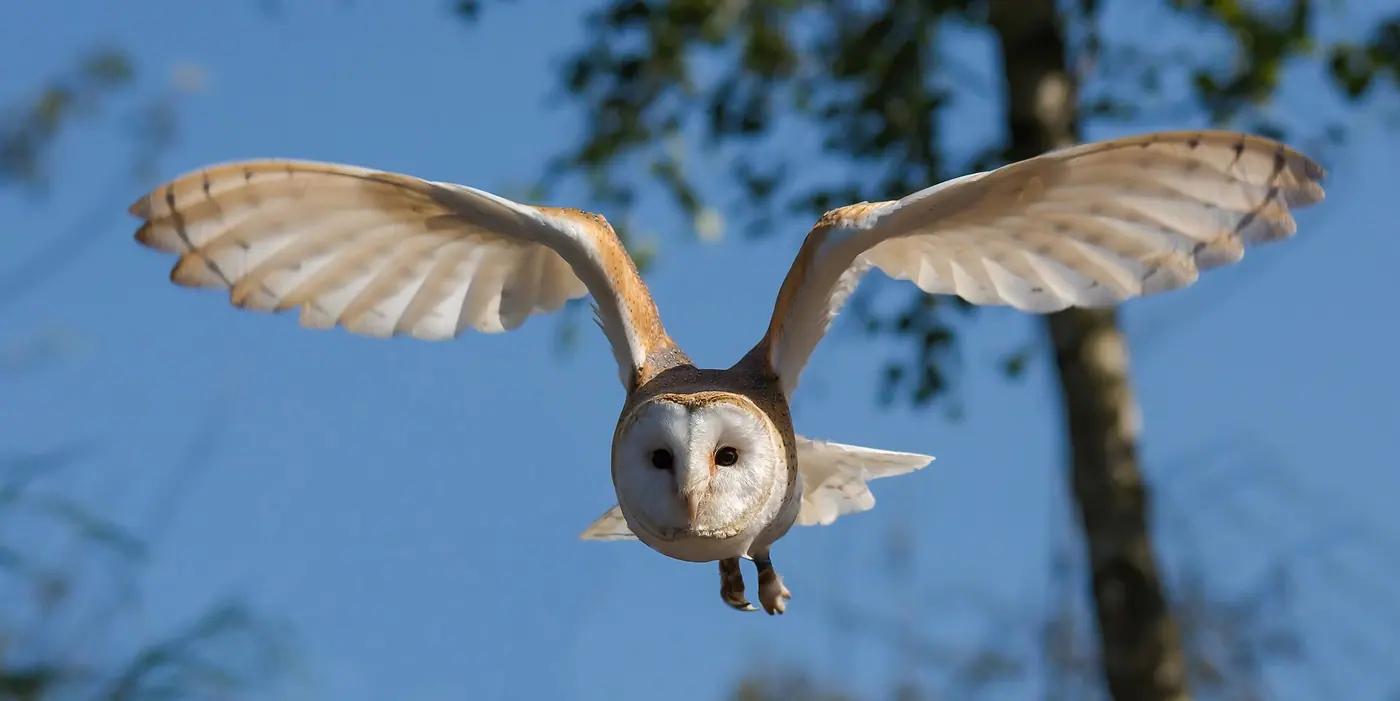
The wings are the other half. A comb of stiff serrations on the leading edge of the outer primaries breaks up the airflow, a velvety pile on the upper surface damps vibration, and a soft fringe on the trailing edge smooths the wake. Together they push most of the flight noise below 2 kilohertz, under what a mouse hears well, and under what would mask the owl's own hearing. Low wing loading, a big wing on a light body, means the owl can quarter a field at walking pace without stalling.
| Feature | Barn owl (Tyto alba) | Great horned owl (Bubo virginianus) |
|---|---|---|
| Size | 32 to 40 cm, 400 to 700 g | 46 to 63 cm, 900 to 2,500 g |
| Ear openings | Asymmetric in height and angle | Symmetric; the tufts are feathers, not ears |
| Facial disc | Large, heart-shaped, adjustable | Present but smaller and rounder |
| Hunting style | Low quartering flight over open grass, strike from the air | Perch and pounce from a tree or post |
| Main prey | Voles, mice, shrews, rats | Rabbits, hares, skunks, birds, including barn owls |
| Voice | Drawn-out screech and hiss; never hoots | Deep hoo-hoo-hoo hoot |
| Habitat | Open farmland, grassland, marsh edge | Woodland, suburbs, almost anywhere with trees |
How barn owls survive
A barn owl hunts by quartering: a slow, buoyant flight two to three metres above rough grassland, field margins, and ditches, with sudden hovers when it hears something. It may also still-hunt from a fence post. When it commits, it swings its feet forward, spreads the talons, and drops onto the sound with its head drawn back and the facial disc still tracking the prey until the last moment. Small mammals are swallowed whole; an adult needs three or four a night.
The indigestible remains come back up as a pellet, usually one or two a day, a compact grey wad of fur and clean bones. Because the bones are intact, pellets collected from a roost are used by ecologists and school classes to census the small mammals of a whole farm without a trap.
Breeding tracks vole numbers. A pair nests in a hollow tree, a barn, a cliff cavity, or a nest box, laying four to seven eggs at two-to-three-day intervals from March onwards. Incubation takes about 30 days and the chicks hatch in sequence, so a brood contains owlets of visibly different ages and the youngest starve first if food runs short. In a strong vole year a pair may raise two broods. The cost of this fast strategy is a short life: most barn owls die in their first year, many on roads, and the average adult lives only a few years, though wild birds have reached 15.
The ecosystem role of a barn owl
Barn owls are rodent control that runs on grass. A pair with a brood removes well over a thousand voles, mice, and rats in a season from the few square kilometres around the nest, taking them from exactly the habitat where crops and stored grain are at risk. Growers have noticed: vineyards in California and oil palm plantations in Malaysia install nest boxes by the hundred, and studies in both have measured lower rodent damage around occupied boxes.
The same diet makes barn owls a sensitive indicator. Second-generation anticoagulant rodenticides accumulate in the rodents the owls eat, and surveys in Britain and North America have found residues in most barn owl carcasses tested. Loss of rough grassland to intensive farming and the conversion of old barns into housing have removed both hunting habitat and nest sites across much of Europe. Where nest boxes and grass margins have been put back, populations have recovered quickly, which is the clearest evidence that habitat, not the owl, was the limit.
Barn owls are also prey. Great horned owls in North America and eagle owls in Europe take them regularly, and nests in open barns are raided by raccoons, martens, and crows. The barn owl's night shift is partly a way of staying out of the day's traffic.
A barn owl does not see the mouse. It hears where the mouse will be and arrives there without a sound.
What humans can learn from barn owls
Engineers have been copying the wing for a decade. Serrated leading edges and fringed trailing edges modelled on owl feathers are in trials on wind turbine blades, drone rotors, and aircraft landing gear to cut noise, and the barn owl's auditory map in the midbrain was the model for early neural circuits that localise sound in hearing aids and robots.
The behavioural lesson is simpler. The owl's advantage is not a better signal from the mouse; it is less noise from itself. By removing its own sound, it both avoids alerting the prey and keeps its own sensors clean. Reducing the noise you generate is often cheaper than amplifying the signal you want.
And it is one of the most rewarding nocturnal animals to find, because a barn owl is white, slow, and hunts open ground where you can see it. The notes below are the field version.
Where and when
Rough grassland, field margins, river meadows, and marsh edges at dusk and the hour after, and again before dawn. In winter and when feeding chicks they hunt in daylight too, especially late afternoon after rain.
What you will see
A pale, almost white bird with a big head and no visible neck, flying low and buoyantly like an enormous moth, turning back on itself and hovering briefly. No other owl in open country looks that pale from below.
What you will hear
Not a hoot. A barn owl gives a long, harsh screech in flight and a snake-like hiss at the nest. Chicks begging from a barn in June sound like a kettle through a wall.
Sign and etiquette
Pellets under a roof beam or on a ledge mean a roost; white splash on a wall below a hole means a nest. In the UK barn owls are Schedule 1 protected: do not approach an active nest, use lights on a roost, or play calls.
How wolves hunt, survive, and shape ecosystemsWildlife spotting app
Systems Intelligence & Hidden Purpose
See these animals as engineered biological systems: what they are built to do, how they fit the wider environment, and what their design can teach us.
Specialized Hardware
A facial disc that funnels sound, asymmetrical ears that triangulate prey in three dimensions, and feather geometry built for near-silent flight make the barn owl elite nocturnal capture hardware.
Systems Script
Barn owls convert darkness into rodent control. They reduce small-mammal pressure in grassland, farmland, and edge habitats while proving that low-noise predators can reshape a system without announcing themselves.
Strategic Insight
If you want cleaner decisions, lower your own signal first. Quiet systems detect more than loud ones.
Quick questions
Short answers to common questions readers ask on this topic.
- How do barn owls hunt in total darkness?
- By hearing alone. The left and right ear openings sit at different heights and angles, so a sound reaches one ear slightly earlier and slightly louder than the other; the owl reads the time difference for horizontal bearing and the loudness difference for elevation. Experiments in a completely dark room showed barn owls striking mice to within one or two degrees using only the rustle.
- Why is barn owl flight silent?
- Three feather adaptations. A comb of serrations on the leading edge of the outer wing feathers breaks the airflow into small, quiet vortices; a velvety surface on the feathers damps the rubbing noise; and a soft fringe on the trailing edge smooths the wake. Large wings on a 500 gram body also let the owl fly slowly, which itself cuts noise. Most of what is left is below what a mouse hears well.
- What do barn owls eat?
- Mainly small mammals: voles, mice, shrews, and young rats, with the exact mix depending on the local habitat. An adult eats three or four a night and swallows them whole, and a pair raising a brood accounts for well over a thousand rodents in a season. Small birds, frogs, and large insects are taken occasionally. The fur and bones come back up as a pellet.
- Do barn owls hoot?
- No. The hooting owl of films is usually a tawny owl in Europe or a great horned owl in North America. Barn owls give a drawn-out, rasping screech, often in flight, and hiss at the nest; chicks make a wheezing, snoring beg. If you hear a hoot in the dark, it is a different species.
- Where can I see a barn owl?
- Over rough grassland, field margins, and marsh edges at dusk, in most temperate and tropical regions of the world. Look for a pale, big-headed bird flying low and slowly, hovering and doubling back. Winter afternoons and the weeks when adults are feeding chicks in early summer are the best times, because the birds hunt in daylight when they need more food.
Animals mentioned
Jump from this article into the species pages behind the examples, systems notes, and field-guide references.
Answer guides related to this topic
If you want direct comparisons and clear recommendations, continue with these answer-focused pages.
Best Animal Identification Apps
Compare the best animal identification apps by features like photo/video identification, species coverage, collection capabilities, offline use, and more.
What Is Animal Collecting
Learn what animal collecting means in modern apps and how AnimalDex turns real-world sightings into cards, sets, rarity, and species learning.
Pokemon-Like Animal App
Looking for a Pokemon-like animal app with real species? AnimalDex combines creature-collection energy with AI scanning and wildlife learning.
Related guides
Eagle behavior
How Eagles Use Height, Vision, and Timing to Survive
How eagles hunt: visual acuity 4–8 times ours, two foveae per eye, 2-metre wingspans, thermal soaring and stoops over 240 km/h, with a species comparison.
7 min read
How Wolves Hunt, Survive, and Shape Ecosystems
How wolves hunt and shape ecosystems: pack size, prey selection, hunt success rates, the Yellowstone reintroduction, and what the cascade evidence shows.
9 min read
What Makes Crows So Intelligent? Tool Use, Memory, Society
What makes crows so intelligent: hooked tools, faces remembered for years, primate-level neuron density, and a society that spreads what one bird learns.
8 min read