

King cobraReptile behaviorPredator ecology
How King Cobras Survive and Hunt Other Snakes
How the king cobra hunts other snakes: up to 5.5 m long, venom by the millilitre, the only snake that builds a nest, and how it differs from true cobras.
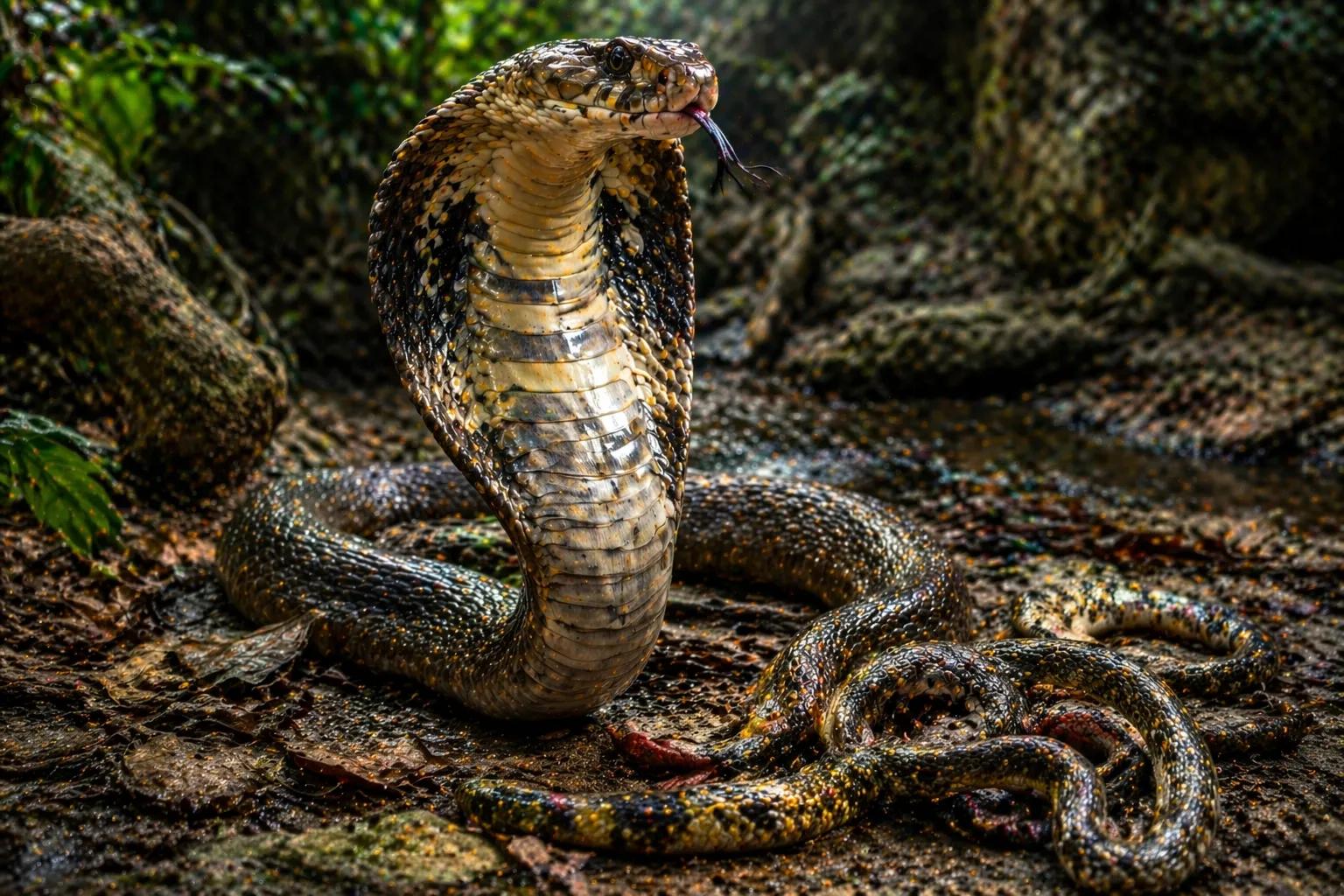
Why the king cobra stands apart
The king cobra is the longest venomous snake in the world. Adults commonly reach 3 to 4 metres, and the largest reliably measured, a captive animal from Malaysia, was about 5.7 metres; most references give a maximum of around 5.5 metres. Despite the name, it is not a true cobra. It sits in its own genus, Ophiophagus, which means snake-eater, and that is the whole story of the animal.
It matters because it is a specialist with scale. Most snakes are generalists that eat rodents, frogs, or birds. The king cobra is tuned to track, confront, and swallow other reptiles, including rat snakes, pythons, and venomous species such as kraits and true cobras. That narrow focus gives it a distinct place in discussions about predator behaviour and evolutionary strategy, and it makes the species a good indicator of healthy forest: where there are enough snakes to feed a king cobra, the rest of the food web is usually intact.
What makes a king cobra unique?
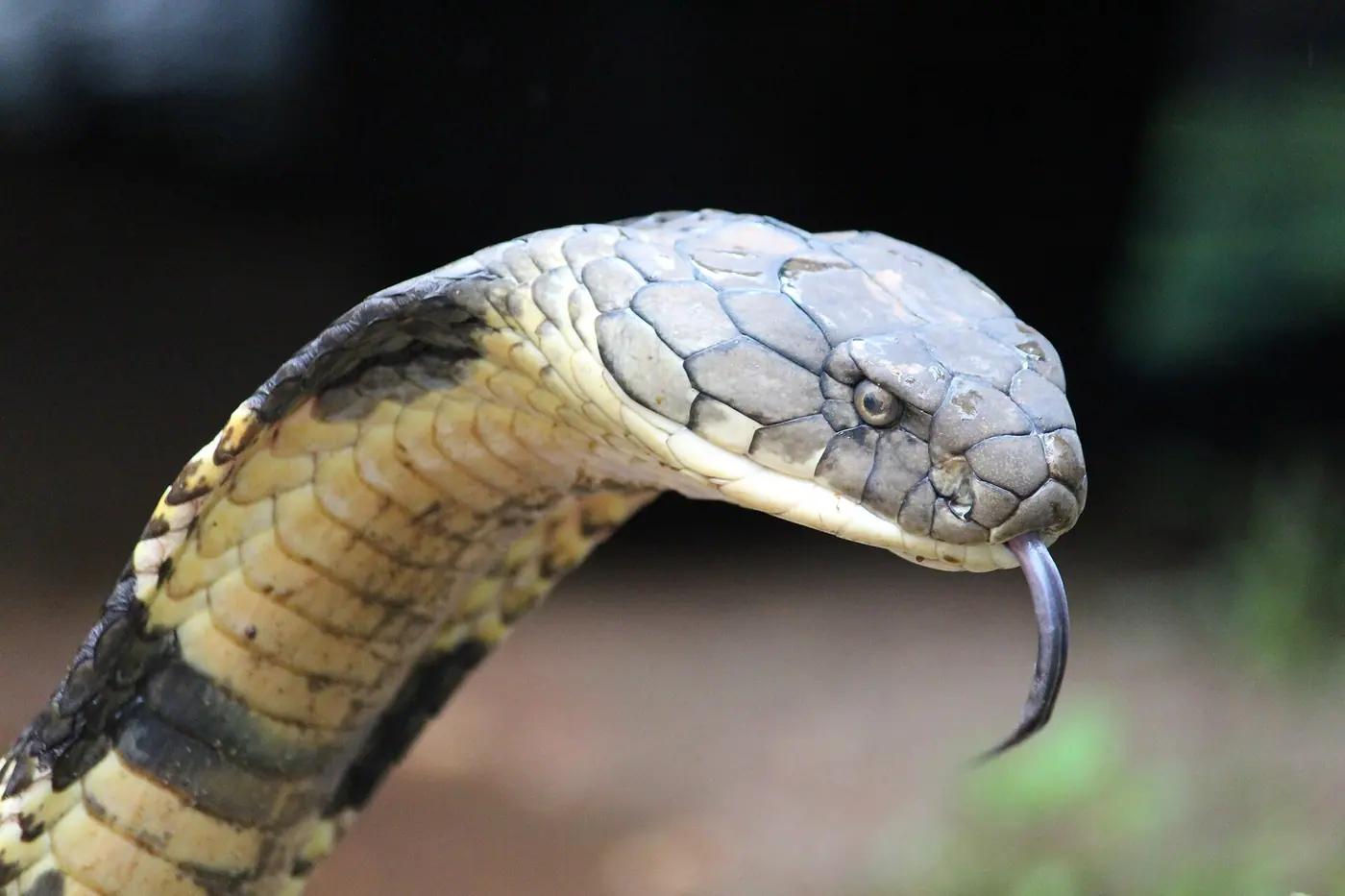
The king cobra hunts by scent and sight. A flickering forked tongue carries chemical traces to the Jacobson's organ in the roof of the mouth, letting it follow a snake's trail across the forest floor, and its eyesight is good enough to track a moving animal from around 100 metres. Once it finds prey, it seizes the head or neck, holds on, and chews to work venom into the wound.
The venom is mostly neurotoxins that shut down the nerves controlling breathing, with tissue-damaging components as well. Drop for drop it is less potent than many other elapids, but the king cobra compensates with volume: a single bite can deliver up to 7 millilitres of venom, several hundred milligrams by dry weight, enough to kill an adult elephant or around 20 people. Untreated bites can be fatal within 30 minutes.
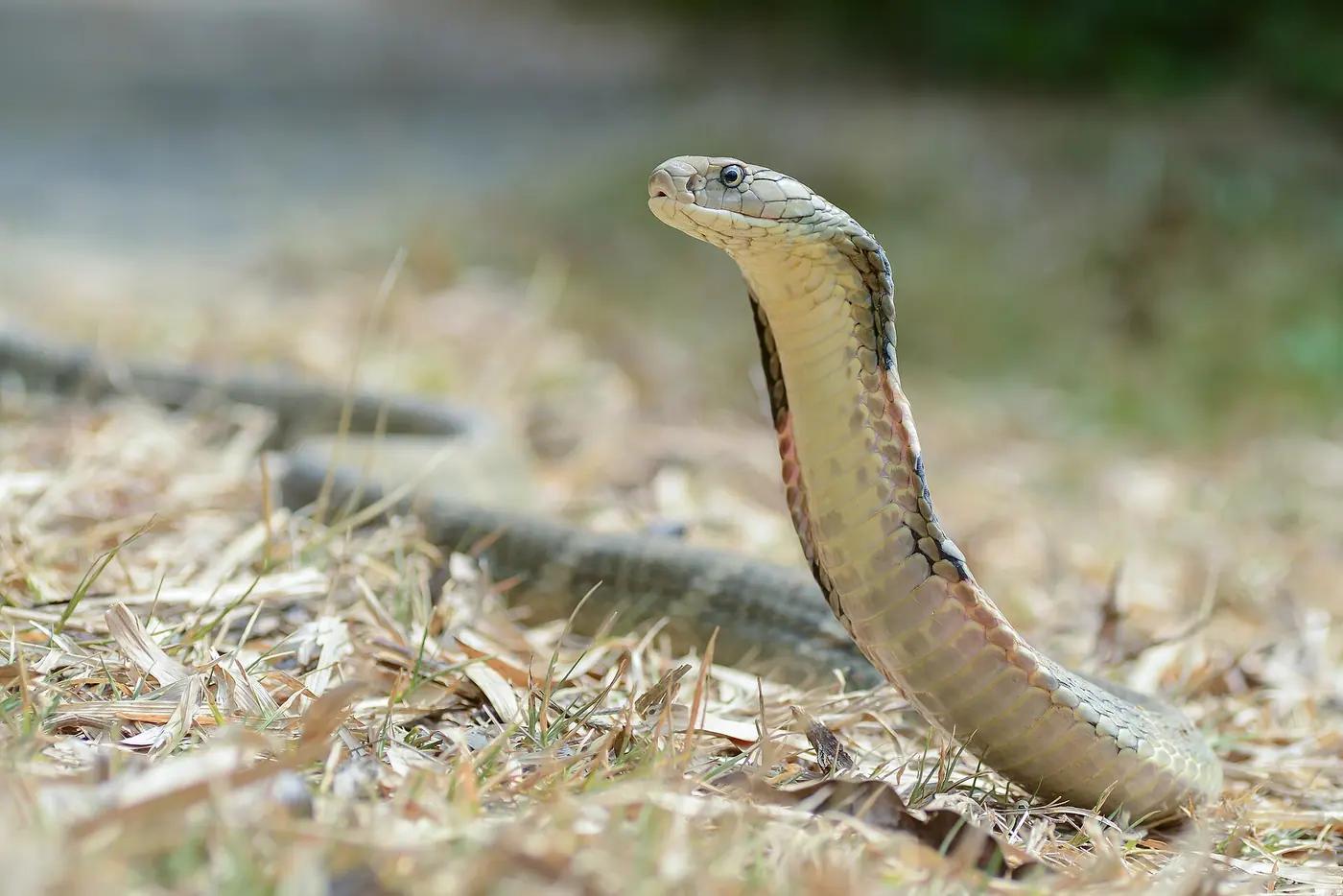
The defensive display is the part everyone knows. The snake lifts up to a third of its body off the ground, which puts the head of a big animal at eye level with a person, spreads a narrow hood, and produces a low growl around 600 hertz rather than a hiss, using air chambers along the trachea. Unlike a true cobra, it can advance while raised and strike downward from height.
How king cobras survive
King cobra survival is built on specialization. By focusing on reptiles that most other predators avoid or cannot handle cleanly, it reduces direct competition for its main food channel, and it appears to tolerate the venom of the cobras and kraits it eats. A large meal, such as a 3-metre rat snake, can keep an adult going for weeks, and king cobras can fast for months when prey is scarce.
They live in dense, wet forest from the Western Ghats and northeast India through southern China and Southeast Asia to Indonesia and the Philippines, usually near streams and up to about 2,000 metres. Radio-tracking in Agumbe, in India's Western Ghats, has shown adults using home ranges of several square kilometres, moving through bamboo, mangrove, and plantation edges and often sheltering in termite mounds and tree hollows. They climb well and swim readily.
A 2024 taxonomic revision proposed splitting the king cobra into four species across its range, which fits the differences in banding and size that field herpetologists had long noticed between, for example, Western Ghats and Southeast Asian animals. Whatever the final count, the system is the same: this is not a generalist gambler. It is a predator tuned for a narrow, high-skill niche.
The only snake that builds a nest
The king cobra is the only snake known to build a nest. In the months before the monsoon, the female uses the coils of her body to rake dead leaves and bamboo litter into a mound up to a metre across, lays 20 to 40 eggs in a chamber inside it, and then coils on top. The rotting leaves generate heat and keep the eggs at a steady temperature and humidity through incubation of roughly 60 to 90 days.
She guards the mound the entire time without feeding and is at her most dangerous then; many bites in rural India and Southeast Asia happen when someone disturbs a nesting female. Shortly before the eggs hatch she leaves, which likely protects the hatchlings from being eaten. The 45 to 55 centimetre young emerge boldly banded in black and yellow, with fully functional venom, and are on their own from the first day.
Males compete for females in a wrestling match, each trying to push the other's head to the ground; they do not bite. Growth is fast for a snake, and individuals have lived more than 20 years in captivity.
King cobra vs other large Asian snakes
The king cobra shares its forests with true cobras, kraits, and pythons, and people confuse them regularly. The table lists the field marks that separate them.
| Snake | Length | Hood and markings | Venom and diet | How to tell it apart |
|---|---|---|---|---|
| King cobra (Ophiophagus hannah) | 3–4 m, up to about 5.5 m | Narrow hood; olive to black body with pale chevrons; juveniles banded black and yellow | Neurotoxic, large volume; eats snakes and some monitor lizards | Two large occipital scales behind the head; growls; raises a third of its body |
| Indian cobra (Naja naja) | 1–1.5 m, rarely 2 m | Wide hood, usually with a spectacle mark on the back | Neurotoxic; eats rodents, frogs, birds | Much smaller and shorter; broad rounded hood; hisses |
| Banded krait (Bungarus fasciatus) | 1.5–2 m | No hood; bold alternating black and yellow bands; triangular body | Highly neurotoxic; eats snakes and lizards, mostly at night | Bands run the full body at all ages; raised vertebral ridge; blunt tail |
| Reticulated python (Malayopython reticulatus) | 4–6 m, the longest snake | No hood; net-like pattern of diamonds | Non-venomous constrictor; eats mammals and birds | Thick body, heat-sensing pits along the lips, slow on land |
The ecosystem role of a king cobra
King cobras regulate other snake populations and occupy a high position in reptile food chains. By eating rat snakes, which are themselves abundant rodent predators, and venomous cobras and kraits, they keep one difficult predator layer from going unchecked, and the effect runs through the system in ways that are easy to miss until the king cobra is gone.
They are prey themselves only when small. Hatchlings are taken by birds of prey, civets, and other snakes, and mongooses will kill juveniles. An adult king cobra has few natural enemies, so its population is limited mainly by prey and by people: habitat loss to plantations, roadkill, and killing out of fear are the reasons the IUCN lists the species as Vulnerable.
That matters because controlling predator density inside predator-rich systems can stabilise the broader structure. A forest with king cobras is a forest with enough rat snakes, pythons, frogs, and rodents to support them, which is why Agumbe and other Western Ghats sites treat the species as a flagship for the whole rainforest.
How to find king cobras in the field
King cobras are shy, rare, and dangerous, so sightings are a matter of being in the right forest at the right season and never approaching. These are the cues herpetologists use.
Where to go
Agumbe in Karnataka and the surrounding Western Ghats rainforest, where the Agumbe Rainforest Research Station runs long-term studies; Kaeng Krachan and Khao Sok in Thailand; Danum Valley and Kinabatangan in Sabah; and the forests of Mizoram and Arunachal Pradesh in northeast India. Sightings peak in the pre-monsoon breeding season from March to May.
Look near water and cover
Streams, bamboo thickets, and the edges of plantations where rat snakes are common. King cobras shelter in termite mounds, under fallen trunks, and in tree hollows, and they bask on forest tracks in the early morning after cool nights.
Read the sign
A shed skin more than 3 m long with large head scales is a strong clue. A raked mound of leaf litter up to a metre across in April or May is likely a nest, and the female will be nearby: do not go closer.
If you meet one
Stop, stay still, then back away slowly. A raised, growling king cobra is warning you, and it can advance; keep at least 5 m away and never corner it. Most bites happen to people who try to catch or kill the snake.
Photograph for an ID
A side-on shot of the head showing the large scales behind the eye and the two big occipital scales, plus the pale chevrons on the neck, confirms the species. Note the location and the time; records from outside the known range are valuable to researchers.
wildlife photography companion
What humans can learn from king cobras
The king cobra demonstrates the value of hard specialization. General competence has value, but some systems create their edge by getting extremely good at one difficult job that others cannot do at all, and the edge compounds because the competition stays small.
The lesson is not to narrow blindly. It is to choose the niche where precision has the highest payoff, and then to build everything else, from the sensory system to the nest, around that choice. A wildlife photography companion built around one honest record of what you saw and where follows the same logic.
The king cobra eats the animals everything else is afraid of, and that is the entire strategy.
Systems Intelligence & Hidden Purpose
See these animals as engineered biological systems: what they are built to do, how they fit the wider environment, and what their design can teach us.
Specialized Hardware
Long-range chemosensory tracking, elevated striking posture, large venom yield, and a body built to move efficiently through forest structure make the king cobra specialized anti-snake hardware.
Systems Script
King cobras sit high in reptile food chains and apply pressure to other snake populations. They occupy a narrow but strategic niche, proving that specialization can stabilize a system by targeting one hard problem well.
Strategic Insight
Broad competence is useful, but deep specialization can create uncontested territory. Pick the problem where precision matters more than popularity.
Quick questions
Short answers to common questions readers ask on this topic.
- How long is a king cobra?
- Adults are usually 3 to 4 metres long, and the species can reach about 5.5 metres, which makes it the longest venomous snake in the world. The largest reliably measured individual, a captive animal from Malaysia in the 1930s, was around 5.7 metres. Hatchlings are 45 to 55 centimetres. Only the reticulated python and the green anaconda are consistently longer among all snakes.
- What do king cobras eat?
- Mostly other snakes: rat snakes are the staple, along with pythons, kraits, true cobras, and other king cobras. The genus name Ophiophagus means snake-eater. They will also take monitor lizards and occasionally other vertebrates when snakes are scarce. A single large meal can sustain an adult for weeks, and king cobras can go months without feeding.
- Is a king cobra a true cobra?
- No. True cobras belong to the genus Naja, while the king cobra is the only member of the genus Ophiophagus. It is much longer, has a narrower hood without a spectacle mark, carries two large occipital scales behind its head, growls instead of hissing, and eats snakes rather than rodents. A 2024 study proposed that the king cobra is actually four separate species across its range.
- How much venom does a king cobra deliver in one bite?
- Up to about 7 millilitres, which is several hundred milligrams of venom by dry weight, among the largest volumes of any snake. The venom is mainly neurotoxic and stops the muscles that control breathing; drop for drop it is less potent than a krait's, but the volume makes a full bite capable of killing an elephant or around 20 people. Antivenom exists and bites are survivable with fast hospital treatment.
- Do king cobras really build nests?
- Yes, and they are the only snake known to do it. Before the monsoon, the female rakes dead leaves into a mound up to a metre wide using her coils, lays 20 to 40 eggs inside, and guards it for roughly two to three months as the rotting leaves keep the eggs warm. She leaves just before the eggs hatch, so the black-and-yellow banded hatchlings fend for themselves from the start.
Animals mentioned
Jump from this article into the species pages behind the examples, systems notes, and field-guide references.
Sources and further reading
Answer guides related to this topic
If you want direct comparisons and clear recommendations, continue with these answer-focused pages.
Best Animal Identification Apps
Compare the best animal identification apps by features like photo/video identification, species coverage, collection capabilities, offline use, and more.
What Is Animal Collecting
Learn what animal collecting means in modern apps and how AnimalDex turns real-world sightings into cards, sets, rarity, and species learning.
Pokemon-Like Animal App
Looking for a Pokemon-like animal app with real species? AnimalDex combines creature-collection energy with AI scanning and wildlife learning.
Related comparisons
Continue with structured animal-vs-animal comparison pages connected to the species in this guide.
Python vs Cobra: Who Would Win in a Fight?
King cobra has the edge if it lands the first clean venom strike at range. Python has the edge once it turns the fight into body contact and constriction.
King Cobra vs Black Mamba: Who Would Win in a Fight?
King cobra gets the slight overall edge because it is built to handle other snakes and can fight from a high controlled posture. Black mamba remains terrifying through speed, strike delivery, and lethal venom.
King Cobra vs Black Vulture: Who Would Win in a Fight?
King cobra gets the overall edge because the black vulture lacks the dedicated leg reach, speed pattern, and strike-management hardware of true snake specialists. The vulture can still harass from above, but the closer the contact gets, the more dangerous the cobra answer becomes.
King Cobra vs Wolverine: Who Would Win in a Fight?
King cobra gets the slight overall edge because one clean venom strike can decide the encounter quickly. Wolverine remains dangerous because it is relentless, fast to close, and built to turn the fight ugly if it survives the first danger window.
Related guides
Crocodile behavior
How Crocodiles Dominate the Water Edge
How crocodiles control the water edge: a 3,700 psi bite, ambush energetics, basking and gaping, nest guarding, and how to spot crocodiles safely.
10 min read
How Tigers Survive as Solo Apex Hunters
How tigers hunt alone: home-range sizes, a 5–10 percent hunting success rate, prey and kill rate, subspecies compared, and how to read tiger sign.
9 min read
How Chameleons See and Strike: Vision and Tongue Mechanics
How chameleon vision and tongue strikes work: independent eyes, tongues that reach two body lengths in hundredths of a second, and why colour changes.
7 min read