

Crocodile behaviorAmbush predatorsEcosystem role
How Crocodiles Dominate the Water Edge
How crocodiles control the water edge: a 3,700 psi bite, ambush energetics, basking and gaping, nest guarding, and how to spot crocodiles safely.
Why crocodiles remain such effective predators
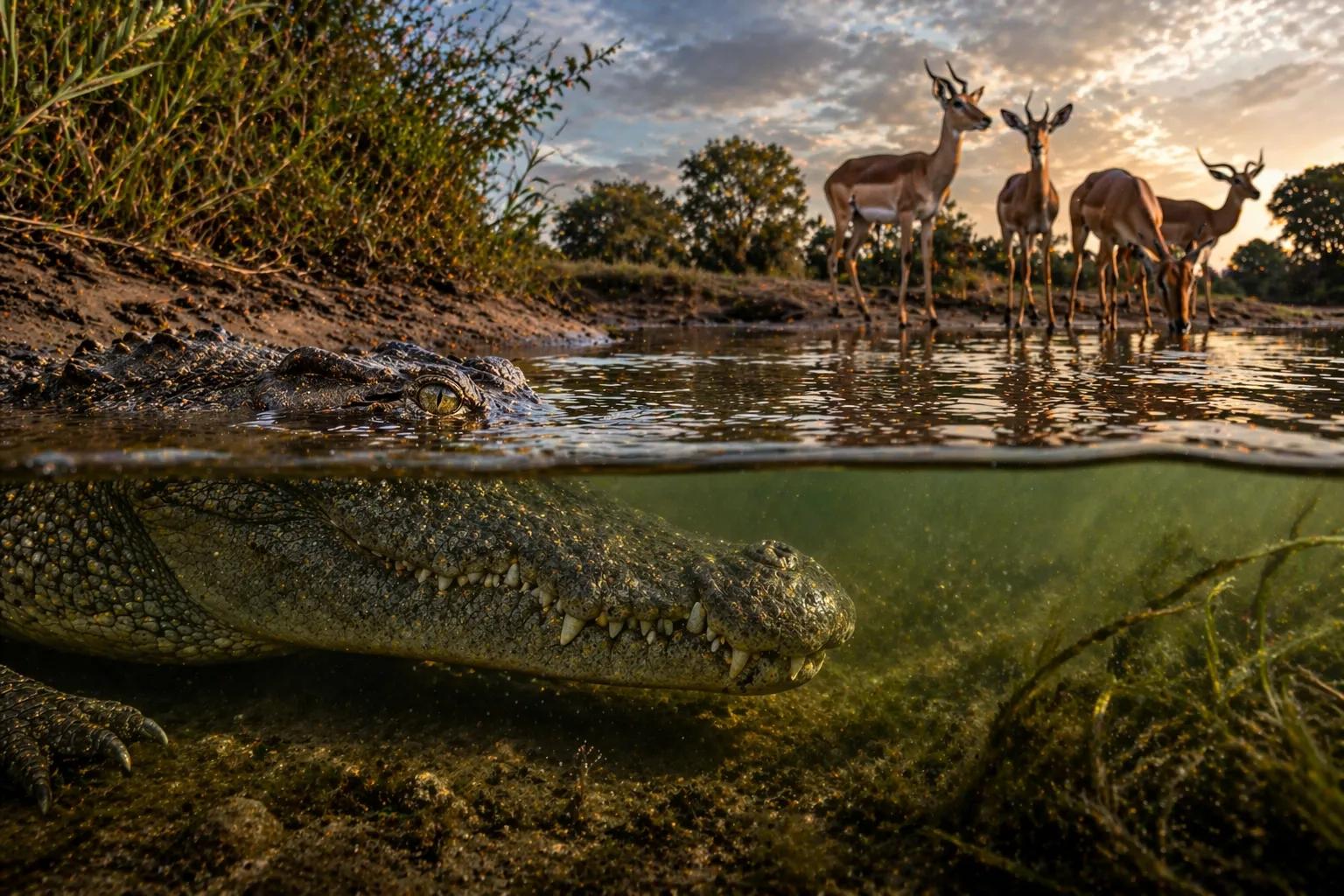
Crocodiles solve one problem extremely well: control the edge between land and water, where every animal has to come to drink and where attention gets split between the bank and the surface. The body plan that does it has barely changed in 80 million years because it has never needed to.
The saltwater crocodile is the largest living reptile. Big males reach 5 to 6 metres and more than 1,000 kilograms; the largest reliably measured, a Philippine animal called Lolong, was 6.17 metres. The Nile crocodile runs to 5 metres and 500 kilograms and takes wildebeest and zebra at the Mara River crossings. A crocodile is dangerous because the terrain is helping, and it has spent its whole life learning exactly where the terrain helps most.
What makes a crocodile unique?
The saltwater crocodile has the strongest bite ever measured in a living animal: about 3,700 pounds per square inch, or 16,000 newtons, recorded by Florida State University researchers in 2012. The muscles that close the jaw are enormous; the muscles that open it are so weak that a few turns of tape hold the mouth shut. Teeth are replaced continuously, so a crocodile may go through 3,000 in a lifetime.
Eyes, ears, and nostrils sit on top of the skull, so the animal can float with less than a tenth of its body showing. The jaws are studded with tiny dome pressure receptors that detect ripples from a drinking animal in complete darkness, a flap at the back of the throat seals the airway so it can grab prey underwater, and a transparent third eyelid protects the eye below the surface.
Below the waterline, the tail does the work. A single sweep launches a 4-metre crocodile up a bank in a fraction of a second, and the death roll, a full-body spin, twists limbs off prey too large to swallow. None of this is built for open pursuit; it is built to hold still until the environment has done most of the setup.
How crocodiles survive
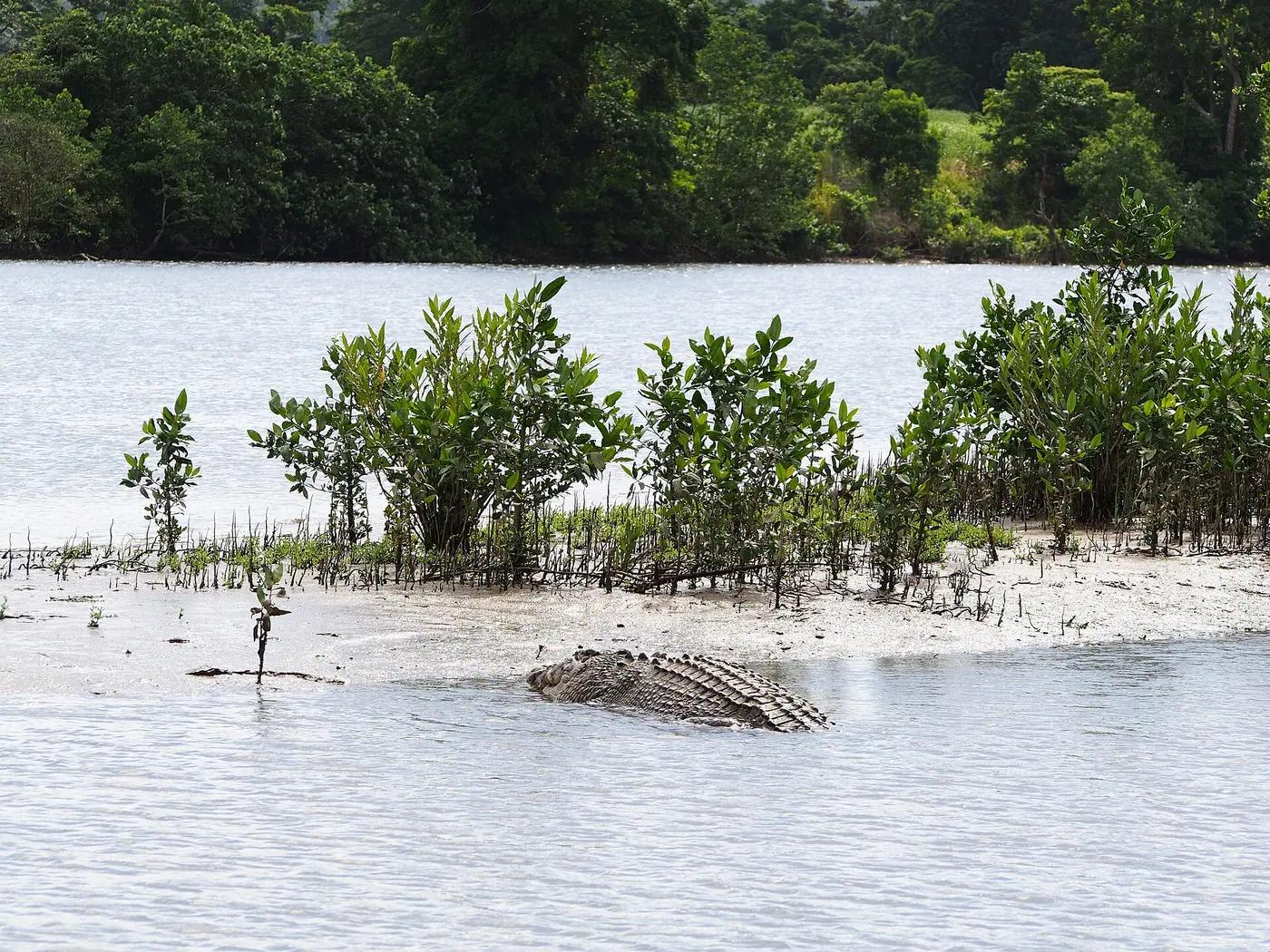
Crocodile survival strategy depends on patience, a low profile, and decisive short-range force. The success window is narrow, so timing matters more than continuous action. A crocodile may wait at a crossing point for days, and in that time it burns almost nothing. As an ectotherm with a slow metabolism, a large adult can go months between meals and, in extreme cases, close to a year.
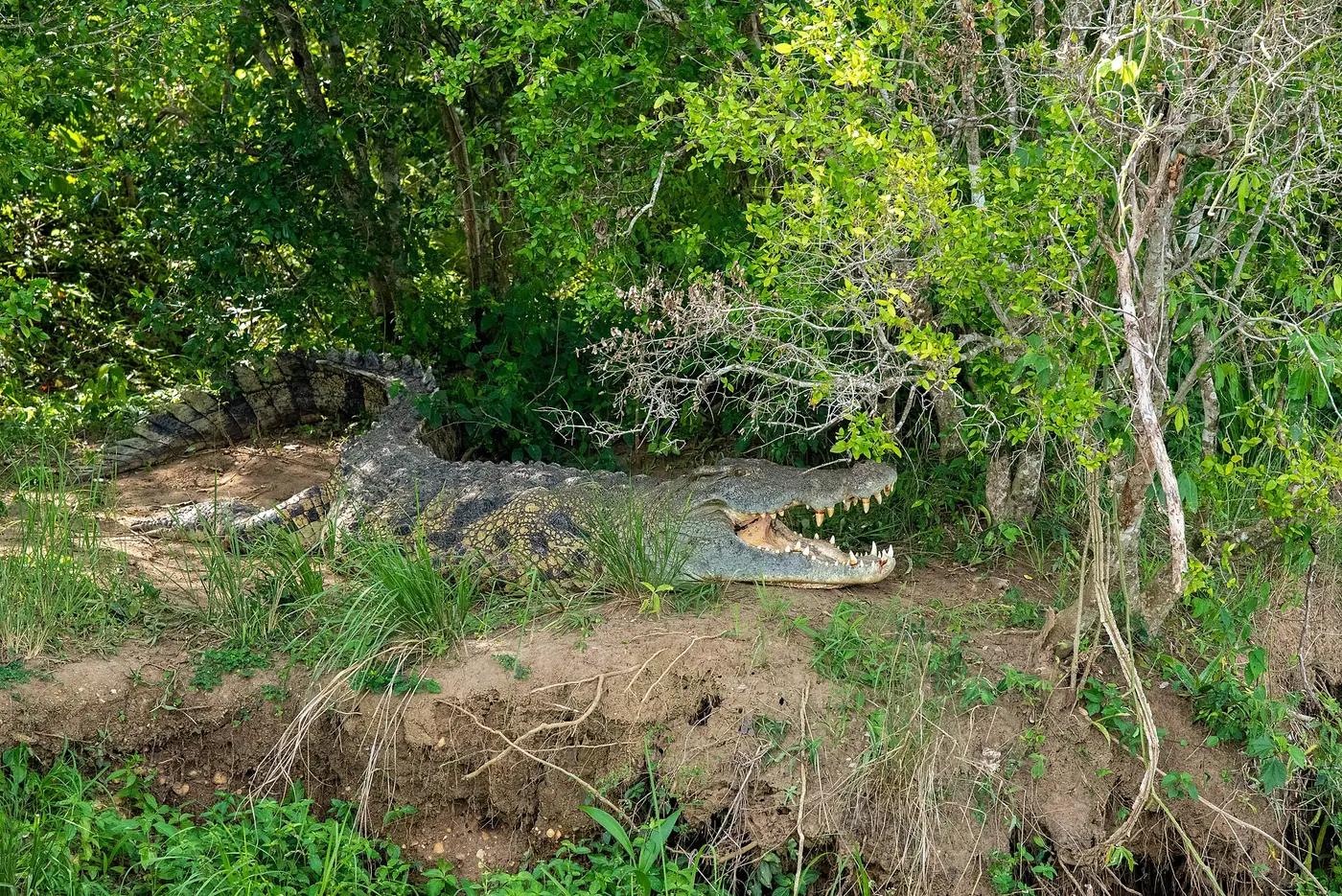
Body temperature is managed by moving between sun, shade, and water rather than by burning food. Crocodiles bask on banks in the morning to reach a working temperature of around 30 to 33 degrees Celsius, open their mouths to shed heat through the lining of the jaws, and slip into the water when the afternoon gets too hot. That is why crocodile behaviour looks lazy to casual observers: it is an energy-saving system waiting for a chokepoint to become a trap.
A resting crocodile can stay submerged for an hour or more by slowing its heart to a few beats a minute. Saltwater crocodiles also ride tidal currents, resting on the bottom when the tide turns against them; tagged animals have travelled more than 500 kilometres along the Australian coast in a few weeks, which is how the species spread from eastern India to the Solomon Islands.
Crocodilians compared
There are 26 or so living crocodilian species in three families: true crocodiles, alligators and caimans, and the gharial. Snout shape is the quickest clue: broad and rounded in alligators, V-shaped in most crocodiles with the fourth lower tooth visible when the mouth is closed, and pencil-thin in the fish-eating gharial.
| Species | Maximum length | Where | Notes | IUCN status |
|---|---|---|---|---|
| Saltwater crocodile (Crocodylus porosus) | 6 m+, over 1,000 kg | Eastern India to northern Australia and the western Pacific | Strongest measured bite, 3,700 psi; crosses open sea | Least Concern |
| Nile crocodile (Crocodylus niloticus) | 5 m, around 500 kg | Sub-Saharan Africa, the Nile, Madagascar | Takes wildebeest and zebra at river crossings; most attacks on people in Africa | Least Concern |
| American crocodile (Crocodylus acutus) | 4–5 m | Florida, Caribbean, Central and northern South America | Shy, tolerates salt water, lives alongside alligators in south Florida | Vulnerable |
| Mugger crocodile (Crocodylus palustris) | 4–5 m | Indian subcontinent, Sri Lanka, Iran | Broad snout; digs burrows to survive dry seasons | Vulnerable |
| American alligator (Alligator mississippiensis) | 4 m+ | Southeastern United States | Rounded snout; teeth hidden when the mouth is closed; digs gator holes | Least Concern |
| Gharial (Gavialis gangeticus) | 6 m | Rivers of northern India and Nepal | Needle-thin snout for fish; males carry a bulbous pot on the nose | Critically Endangered |
Saltwater crocodileAmerican crocodileMugger crocodileAmerican alligatorGharial
CrocodileGharialAmerican Alligator
Crocodile parents and the first year of life
For an animal with that reputation, crocodiles are attentive parents. A female Nile crocodile digs a nest hole in a sunny bank and lays 25 to 80 eggs; a saltwater crocodile builds a mound of rotting vegetation and lays 40 to 60. Incubation takes around 80 to 90 days, and the nest temperature decides the sex of the clutch: roughly 31 to 33 degrees produces mostly males, cooler or hotter nests produce females.
The mother stays by the nest for the whole period, barely feeding, and chases off monitor lizards, baboons, and mongooses. When the hatchlings chirp from inside the eggs, she digs them out, carries them to the water in her mouth, and guards the creche of 30-centimetre young for weeks to months.
Even so, fewer than one in a hundred hatchlings reaches adulthood. Herons, fish, turtles, and larger crocodiles eat most of them in the first year, which is why a clutch is so large and why adults, once they reach 3 metres, have almost no enemies apart from people.
The ecosystem role of crocodiles
Crocodiles regulate prey access around rivers, wetlands, estuaries, and shorelines. Their presence shifts drinking behaviour and movement timing for every animal that uses the bank; antelope drink fast and in groups, and wildebeest herds stack up at crossings for hours before the first animal commits. They turn exposed edges into risk zones, and that alone changes how the rest of the system allocates space.
They also move nutrients. Carcasses pulled under and cached feed fish, turtles, and catfish, and the remains of large kills fertilise the riverbed. By eating the sick, the weak, and the drowned, crocodiles help keep carcasses from fouling the water, and by eating large numbers of catfish and other predatory fish, they can indirectly support the smaller fish those predators eat.
In the dry season, the wallows and burrows that crocodiles and alligators dig hold the last water on a floodplain, which keeps fish, frogs, and turtles alive until the rains. Because they are long-lived, slow-growing, and sit at the top of the food web, crocodiles are also useful indicators: where their populations recover, as saltwater crocodiles have in northern Australia since protection in 1971, the wetland usually recovers with them.
How to spot crocodiles safely
Crocodiles are among the easiest big predators to watch, as long as the watching is done from a boat, a vehicle, or a bank well back from the water. These cues work anywhere in crocodile country.
Where to go
Saltwater crocodiles: Kakadu and the Adelaide and Daintree rivers in Australia, the Sundarbans, and Bhitarkanika in India. Nile crocodiles: the Mara River in Kenya and Tanzania, the Chobe and Zambezi, and Murchison Falls in Uganda. American crocodiles: Everglades National Park and Costa Rica's Tárcoles River. Gharials: the Chambal River in India.
Scan the waterline
Look for a pair of eye bumps and the ridge of a snout just above a calm surface, or a long floating log that is drifting against the wind. A mid-river sandbar or a sunny bank below a thicket in the mid-morning is the best place to look for a basking animal.
Read the bank
A crocodile slide is a smooth, flattened groove down a muddy bank with claw marks either side and a drag mark from the tail. Fresh slides, especially several at one spot, mark a regular haul-out.
Spotlight at night
Shine a torch across the water at head height: crocodile eyes reflect bright orange-red. This is the surest way to count animals in a stretch of river and the standard survey method.
Stay 5 metres from the edge
In saltwater and Nile crocodile country, never swim, wade, or stand at the water's edge, and do not clean fish or fill containers from the same spot each day. Most attacks happen within a few metres of the bank, and crocodiles learn routines.
wildlife photography companion
What humans can learn from crocodiles
Crocodiles are a sharp lesson in bottleneck control. You do not need to own the entire map if you understand where the map collapses into a few forced pathways, and you do not need to be fast if you are already there when the other animal arrives.
In strategic terms, chokepoints matter more than surface area, and patience is cheap when your operating costs are low. A wildlife photography companion that logs when and where you saw a crocodile builds the same kind of knowledge: the crossing points and basking banks that pay off every season.
A crocodile does not chase the river. It waits where the river forces everything else to come to it.
Systems Intelligence & Hidden Purpose
See these animals as engineered biological systems: what they are built to do, how they fit the wider environment, and what their design can teach us.
Specialized Hardware
Pressure-sensitive receptors around the jaws, eyes and nostrils mounted high on the skull, and a tail built for explosive propulsion make crocodiles effective ambush hardware at the land-water edge.
Systems Script
Crocodiles control chokepoints where rivers, wetlands, and shorelines concentrate traffic. They regulate prey behavior, move nutrients through kills and carcasses, and add caution to landscapes that would otherwise become too predictable.
Strategic Insight
You do not need to dominate every square meter. Control the bottlenecks and the rest of the map starts behaving differently.
Quick questions
Short answers to common questions readers ask on this topic.
- What is the bite force of a crocodile?
- The saltwater crocodile has the strongest bite ever measured in a living animal, about 3,700 pounds per square inch (16,000 newtons), recorded by Florida State University researchers in 2012. Nile crocodiles and American alligators bite in the 2,500 to 3,000 psi range. By comparison, a lion bites at roughly 1,000 psi. The jaw-opening muscles, however, are weak enough that tape can hold a crocodile's mouth shut.
- How long can a crocodile stay underwater?
- A resting crocodile can stay submerged for about an hour, and large adults have been recorded holding their breath for close to two hours in cool water by slowing their heart to a few beats a minute. During active hunting or a struggle, dives are much shorter, usually a few minutes. A throat flap seals the airway so the mouth can open underwater without the animal drowning.
- How long can a crocodile go without eating?
- Months. A large adult has a slow reptile metabolism and stores fat in its tail, so it can survive six months to a year without a meal, and most adults eat far less often than people assume, perhaps 50 meals a year. Juveniles need to eat more frequently because they are growing. This low running cost is what lets a crocodile wait at a crossing point for days.
- Do crocodiles look after their young?
- Yes. The female guards the nest for the whole 80 to 90 day incubation, digs the hatchlings out when they call from inside the eggs, carries them to the water in her mouth, and protects the creche for weeks to months. In some species the male helps guard. Despite that care, fewer than one in a hundred hatchlings survives to adulthood, because birds, fish, and bigger crocodiles eat most of them in the first year.
- How do you tell a crocodile from an alligator?
- Look at the snout and teeth. Crocodiles have a narrower V-shaped snout, and the large fourth tooth of the lower jaw sits outside the upper lip when the mouth is closed. Alligators have a broad, rounded U-shaped snout that hides the lower teeth. Crocodiles are usually olive or tan and tolerate salt water; alligators are darker and stay in fresh water. South Florida is the only place both live side by side.
Animals mentioned
Jump from this article into the species pages behind the examples, systems notes, and field-guide references.
Answer guides related to this topic
If you want direct comparisons and clear recommendations, continue with these answer-focused pages.
Best Animal Identification Apps
Compare the best animal identification apps by features like photo/video identification, species coverage, collection capabilities, offline use, and more.
What Is Animal Collecting
Learn what animal collecting means in modern apps and how AnimalDex turns real-world sightings into cards, sets, rarity, and species learning.
Pokemon-Like Animal App
Looking for a Pokemon-like animal app with real species? AnimalDex combines creature-collection energy with AI scanning and wildlife learning.
Related comparisons
Continue with structured animal-vs-animal comparison pages connected to the species in this guide.
Crocodile vs Alligator: Differences and Who Would Win
Crocodile usually gets the slight overall edge because it is often more aggressive and more built for a wider range of salty and open-water environments. Alligator remains massively dangerous and can look better in some freshwater ambush contexts.
Crocodile vs Black Caiman: Who Would Win in a Fight?
Crocodile gets the slight broader edge through more generalized dominance and a stronger all-round reputation. Black caiman remains extremely dangerous and fully credible in quiet river-ambush contexts.
Crocodile vs Polar Bear: Who Would Win in a Fight?
Polar bear gets the overall edge on land or partial land because it is larger, more mobile out of water, and better at sustained violent contact once the crocodile loses ambush shape. Crocodile becomes far more dangerous in water-linked ambush where the bite starts first and the bear does not control footing.
Crocodile vs Shark: Who Would Win in a Fight?
Great white shark has the edge in open ocean. Crocodile becomes more dangerous the closer the matchup gets to shallow water, shoreline bottlenecks, and ambush-heavy edge habitat.
Related guides
King cobra
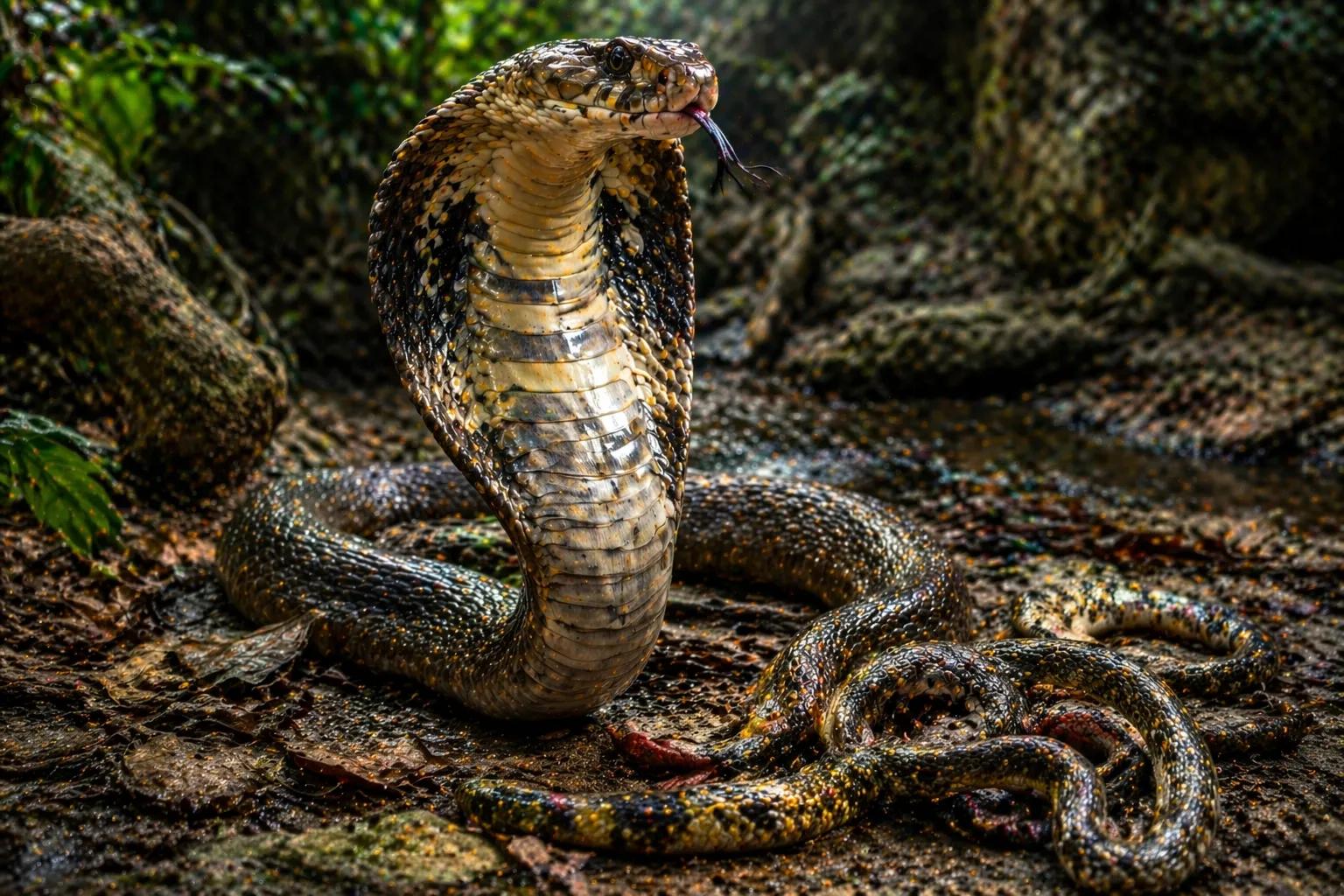
How King Cobras Survive and Hunt Other Snakes
How the king cobra hunts other snakes: up to 5.5 m long, venom by the millilitre, the only snake that builds a nest, and how it differs from true cobras.
10 min read
How Tigers Survive as Solo Apex Hunters
How tigers hunt alone: home-range sizes, a 5–10 percent hunting success rate, prey and kill rate, subspecies compared, and how to read tiger sign.
9 min read
Why Jellyfish Thrive in Changing Oceans
Why jellyfish bloom as oceans warm and lose oxygen: the polyp life cycle, nematocysts, a body with no brain, Turritopsis, and how to spot jellies safely.
10 min read