

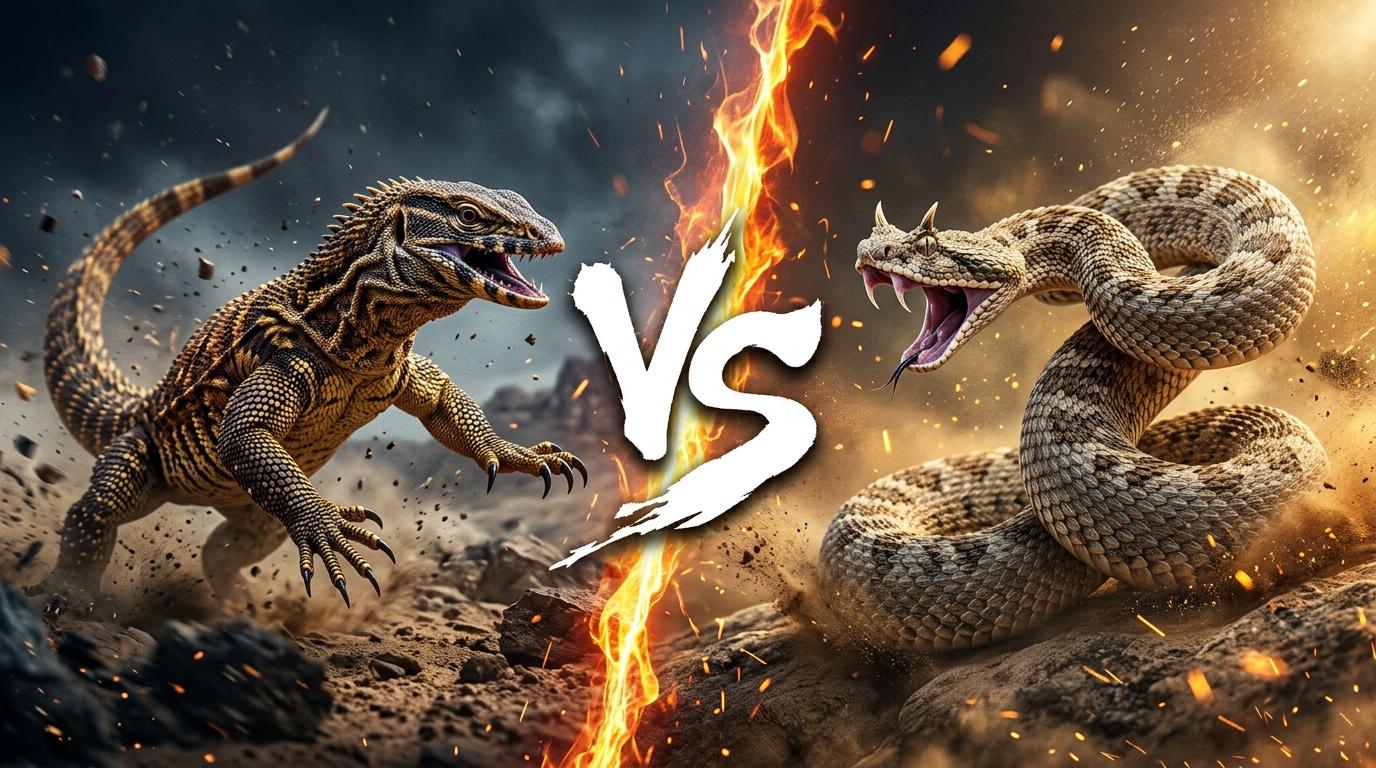
Ackie Monitor vs Desert Horned Viper: Who Actually Wins?
Ackie monitor vs desert horned viper: who would win? A biology-first breakdown of venom, bite force, ambush tactics, armor, and speed, with a clear verdict.
Ackie Monitor vs Desert Horned Viper
Matchup winner
Desert Horned Viper
Quick verdict
Start with the direct answer, then use the structured comparison below to see what changes the outcome.
The Desert Horned Viper wins this one. The Ackie Monitor is the smarter, more mobile, and more active animal, and at roughly 60–70 cm including its spiny tail it often outlengthens the viper. But most of that length is tail, and the fight comes down to one strike. Cerastes cerastes is a buried, motionless ambush specialist whose hemotoxic, tissue-destroying venom is built to stop lizard- and rodent-sized prey. A single well-placed bite can cripple a small monitor within minutes. The ackie's best tools are curiosity, a grabbing bite, and headshaking, and those force it into exactly the close range where the viper is most dangerous. The ackie can win if it gets the first clean grab behind the head, but the viper's venom gives it more ways to end the fight and fewer ways to lose it.
Read the full explanation
Desert Horned Viper wins most encounters thanks to fast-acting hemotoxic venom.
The Ackie Monitor is longer, smarter, and more active, but it is lightly built and must close to bite range.
The viper's sand-buried ambush means the ackie often doesn't see the threat until the strike lands.
An ackie that seizes the viper behind the head first can win, but that window is narrow.
Reader vote
Who do you think wins?
Pick a side — no account needed. Results update live.
No votes yet — be the first to call it.
Editorial note
Why people disagree
Monitor lizards are famous snake-eaters, but that reputation belongs to big species like lace monitors and Nile monitors, not a palm-sized dwarf monitor like the ackie.
Lethal payload
Venom lets the viper win with one contact. The ackie needs sustained grappling to do real damage.
Ambush control
The animal that picks the moment of contact usually wins small-reptile fights.
Mobility and pursuit
The ackie controls whether a fight starts at all and can disengage if it spots the snake early.
Read the full explanation +
Horned viper venom is rarely lethal to humans, so people underestimate it. Scaled to a lizard weighing a few dozen grams, it's a different story.
Ackies are clever, bold foragers, and people assume intelligence beats instinct. In a one-strike contest, reaction speed and venom outrank problem-solving.
Comparison FAQ
Short, direct answers to the next questions readers usually ask after the headline verdict.
Would an Ackie Monitor beat a Desert Horned Viper?+
Usually not. The viper's venom and ambush strike give it the edge in most realistic setups. The ackie can win in open daylight if it grabs the viper behind the head before being bitten.
Which is stronger, the Ackie Monitor or the Desert Horned Viper?+
In raw muscle and grappling, the ackie is stronger and more active. In fight-ending power, the viper is far stronger because its venom does the work that muscle can't.
Don't monitor lizards eat snakes?+
Larger monitor species do. The ackie is a dwarf monitor that mainly eats insects and small lizards, so a venomous viper of similar mass is a dangerous target rather than a routine meal.
Is the Desert Horned Viper dangerous to humans?+
Its bite is painful and causes swelling and tissue damage, but deaths are rare. Against an animal the size of an ackie, the same venom is far more serious.
Why is the Ackie Monitor still dangerous even if it loses?+
Its bite is strong and tearing, it is quick and persistent, and it shakes its head hard on a grab. If it seizes a viper near the head first, it can injure or kill the snake before a strike lands.
Do Ackie Monitors and Desert Horned Vipers live in the same place?+
No. Ackies are native to arid Australia, while horned vipers range across North Africa and the Middle East. They never meet in the wild.
Head-to-head species stats
These are the same core AnimalDex stat dimensions used on the dedicated animal pages, pulled side by side so the matchup is faster to scan.
Ackie Monitor
Tier DDesert Horned Viper
Tier BTrait-by-trait comparison
Only the categories that matter to this matchup are included. The goal is not filler stats, but the real design differences that change the result.
No venom; crushing, tearing bite
Lethal payload
Desert Horned Viper
Hemotoxic, cytotoxic venom via hinged fangs
Lethal payload
Desert Horned Viper
Active forager, rarely hides to strike
Ambush control
Desert Horned Viper
Buries in sand with only eyes and horns showing
Ambush control
Desert Horned Viper
Quick bursts, agile climber on rocks
Mobility and pursuit
Ackie Monitor
Sidewinding cruiser, slow over distance
Mobility and pursuit
Ackie Monitor
Curious, exploratory, learns quickly
Problem-solving
Ackie Monitor
Hard-wired strike-and-wait routine
Problem-solving
Ackie Monitor
Spiny tail armor, light body
Close-range durability
Desert Horned Viper
Keeled scales, compact coils
Close-range durability
Desert Horned Viper
Up to ~70 cm, mostly tail
Reach and length
Desert Horned Viper
Typically 30–60 cm, all strike body
Reach and length
Desert Horned Viper
How the verdict forms
Verdict timeline
01 · Lethal payload
Desert Horned Viper
02 · Ambush control
Desert Horned Viper
03 · Mobility and pursuit
Ackie Monitor
04 · Problem-solving
Ackie Monitor
05 · Close-range durability
Desert Horned Viper
06 · Reach and length
Desert Horned Viper
Change the conditions
Scenario breakdown
This is where shallow battle content usually fails. Terrain, spacing, timing, and engagement style can change the answer.
Scenario lean
Desert Horned Viper
Verdict confidence
82%
Buried viper strikes first.
In loose sand or leaf cover, the horned viper's ambush posture is at full strength. An investigating ackie nosing toward movement steps into a pre-loaded strike zone. Once the venom is in, it starts breaking down tissue and blood clotting. The viper releases and waits, a low-risk sequence the ackie can't easily counter.
AnimalDex field profiles
Explore these animals
Ackie Monitor
Varanus acanthurus
rocky desert, spinifex plain, and arid scrub
Desert Horned Viper
Cerastes cerastes
sand desert, dune slope, and arid plain
Systems Intelligence & Hidden Purpose
See the animals behind this comparison as engineered biological systems: what each one is built to do, where it gains leverage, and why the matchup changes by scenario.
Specialized Hardware
spiny defensive tail, compact muscular monitor body, and rock-crevice basking life give the Ackie Monitor a body plan tuned for its niche.
Systems Script
Ackie Monitors operate through rocky desert, spinifex plain, and arid scrub. Their design links movement, feeding, shelter, and timing into one workable survival system.
Strategic Insight
Harsh places reward efficiency, timing, and bodies that waste very little.
Specialized Hardware
horns above the eyes, sidewinding sand travel, and buried ambush posture give the Desert Horned Viper a body plan tuned for its niche.
Systems Script
Desert Horned Vipers operate through sand desert, dune slope, and arid plain. Their design links movement, feeding, shelter, and timing into one workable survival system.
Strategic Insight
Harsh places reward efficiency, timing, and bodies that waste very little.
Final take
This is a meeting that couldn't happen in nature. Ackies live in the rocky arid outback of Australia, and horned vipers sidewind across the Sahara and Arabian sands. As a thought experiment, though, it shows a clear rule of small-reptile combat: a guaranteed knockout tool usually beats general athleticism.
Read the full explanation
The Ackie Monitor is the more impressive animal in many ways. It is inquisitive, energetic, and capable of reading its surroundings. But winning would require grappling a venomous snake at close range without being bitten once. The Desert Horned Viper needs only that one bite, delivered from concealment at a moment of its choosing.
Verdict: Desert Horned Viper, with the ackie's best chance coming in open daylight where it can see the snake first.
Collect both animals in AnimalDex
Track the species behind this matchup, compare their real traits, and build the rivalry into your AnimalDex collection.
Related comparisons
Continue with nearby matchups to compare more real-world animal traits without dropping into junky who-wins filler.
Desert Horned Viper vs Spiny-tailed Lizard: Who Actually Wins?
The Desert Horned Viper wins a direct fight, though not by much. The Egyptian Spiny-tailed Lizard is far heavier and longer, and it is armored with a club-like tail ringed in spines. But it is a plant-eater built to defend a burrow, not to kill. The viper is a sit-and-wait predator that spends its life concealed under sand. It delivers a fast hemotoxic bite that damages tissue and blood, and that venom keeps working after the strike. If the viper lands a clean bite on an exposed limb or flank, the lizard's size slows the damage but may not stop it. The lizard's best result is not a win in combat. It is denying the viper any target by wedging into its burrow behind that spiked tail. Because 'who wins' means who comes out on top when contact happens, the edge goes to the snake. Venom outweighs mass when the attacker sets the timing.
Read comparison
Camel Spider vs Desert Horned Viper: Who Actually Wins?
The Desert Horned Viper wins this one, and it isn't especially close. A camel spider (Galeodes arabs) is a fast, ferocious solifuge with huge crushing chelicerae, but it has no venom and averages around 10–15 cm across its legs. Cerastes cerastes is a 30–60 cm sand-buried ambush predator with a strike measured in milliseconds and a hemotoxic venom built to subdue prey many times heavier than any solifuge. The camel spider's whole strategy is to sprint in and seize. That puts it right into the strike envelope of a snake whose entire design is to wait for something warm and moving to come close. One envenomating bite ends the contest, while the spider has to land repeated, well-placed chelicerae bites through scales to do serious damage. The viper also has a big mass advantage and the patience edge, so it takes most realistic encounters.
Read comparison
Ackie Monitor vs Sidewinder: Who Actually Wins?
The sidewinder wins most realistic encounters. The ackie monitor is the heavier, smarter, more mobile reptile, with gripping jaws, hooked claws and a spiny defensive tail. The sidewinder, though, carries hemotoxic venom delivered by a strike faster than a small lizard can reliably react to. It also has heat-sensing pits that let it target warm prey in low light. An ackie is roughly lizard-prey size for a rattlesnake, and one well-placed bite can cause swelling, tissue damage and collapse long before the monitor's mechanical bites become fatal. The ackie's best outcomes come from refusing the fight: wedging into a rock crack behind its spiked tail, or spotting the snake first and leaving. In a forced, committed exchange, venom outweighs claws.
Read comparison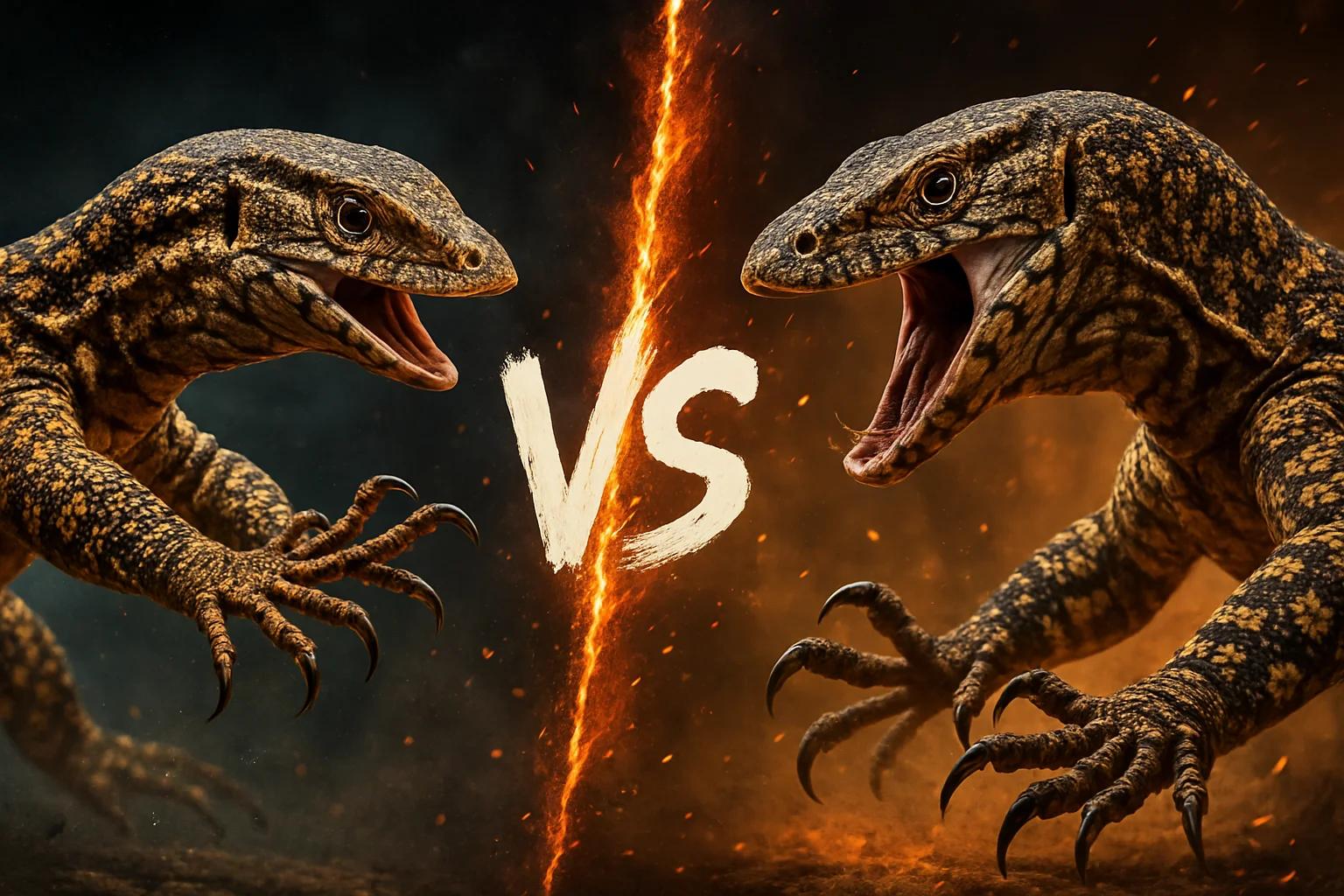
Ackie Monitor vs Perentie: Who Actually Wins?
The perentie wins, and it is not close. Varanus giganteus is Australia's largest lizard. Adults commonly reach about 1.7–2 m and can weigh 15 kg or more. The ackie monitor (Varanus acanthurus) tops out around 60–70 cm and a few hundred grams. That is a mass gap of well over tenfold. Perentie diets include other lizards, and smaller monitors are realistic prey. Its serrated teeth, venom-associated oral glands, powerful neck and long whipping tail are built to subdue animals the ackie's size. The ackie's real edge is defensive. It wedges into rock crevices and inflates its body against the walls. Its spiny, armored tail blocks the entrance. In open contact, though, the perentie's reach, weight and bite end the encounter quickly. The ackie wins only by never being caught.
Read comparison
Discussion
What do you think?
Share your reasoning with other readers. Be civil and stick to the animals.
Sign in to join the discussion.
Sign inNo comments yet. Start the conversation.