

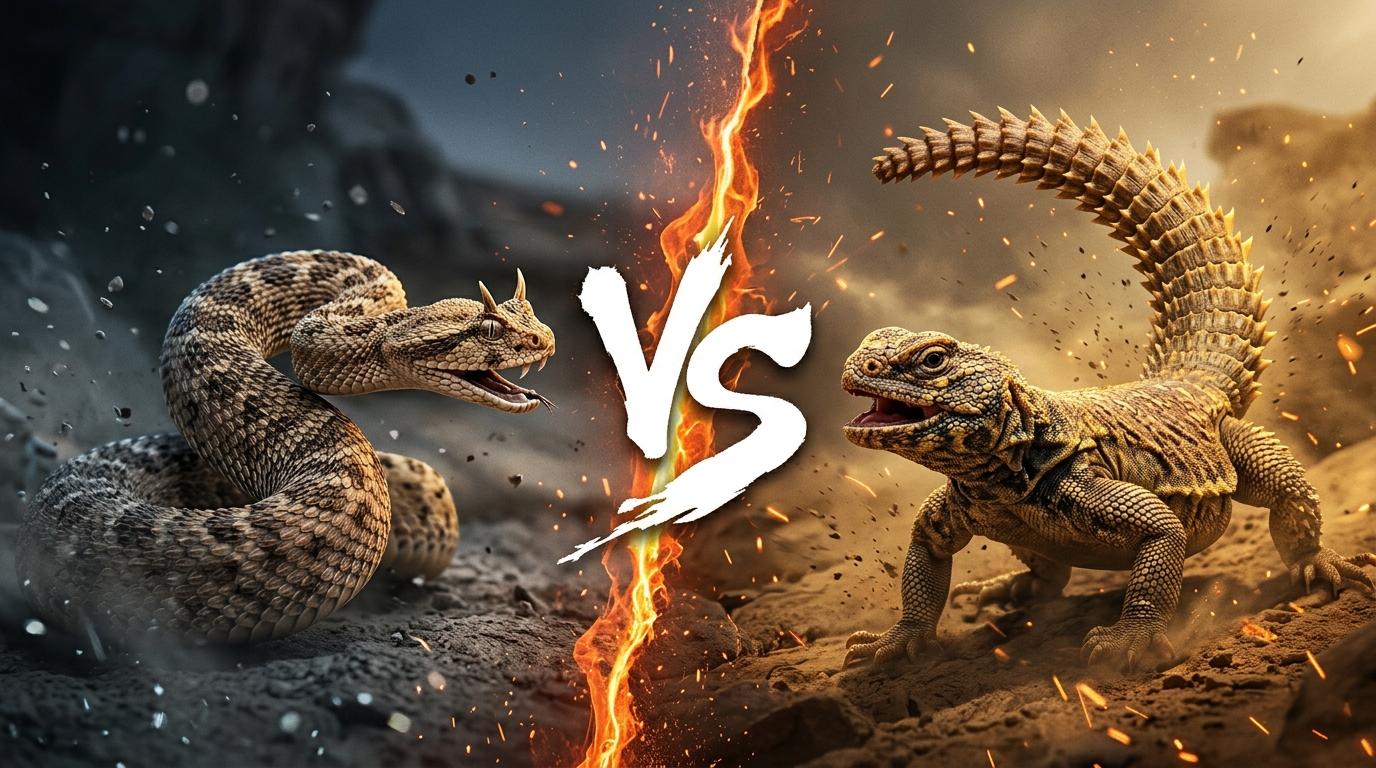
Desert Horned Viper vs Spiny-tailed Lizard: Who Actually Wins?
Desert horned viper vs Egyptian spiny-tailed lizard: venom, armor, size and burrow tactics compared to see which Saharan survivor wins a real confrontation.
Desert Horned Viper vs Spiny-tailed Lizard
Matchup winner
Desert Horned Viper
Quick verdict
Start with the direct answer, then use the structured comparison below to see what changes the outcome.
The Desert Horned Viper wins a direct fight, though not by much. The Egyptian Spiny-tailed Lizard is far heavier and longer, and it is armored with a club-like tail ringed in spines. But it is a plant-eater built to defend a burrow, not to kill. The viper is a sit-and-wait predator that spends its life concealed under sand. It delivers a fast hemotoxic bite that damages tissue and blood, and that venom keeps working after the strike. If the viper lands a clean bite on an exposed limb or flank, the lizard's size slows the damage but may not stop it. The lizard's best result is not a win in combat. It is denying the viper any target by wedging into its burrow behind that spiked tail. Because 'who wins' means who comes out on top when contact happens, the edge goes to the snake. Venom outweighs mass when the attacker sets the timing.
Read the full explanation
Overall winner: Desert Horned Viper, mainly because of venom and ambush timing.
The Spiny-tailed Lizard is heavier, longer and armored, with a spiked tail that can lash attackers.
The lizard wins any fight at its burrow entrance by plugging the hole with its tail.
One well-placed bite can turn the fight. The lizard has no venom-neutralizing trick.
Reader vote
Who do you think wins?
Pick a side — no account needed. Results update live.
No votes yet — be the first to call it.
Editorial note
Why people disagree
Size bias: the lizard can outweigh the viper several times over, so many readers assume bulk beats a small snake.
Lethal payload
Venom lets a small animal deal damage far beyond its size. The lizard's strikes bruise but rarely finish anything.
Ambush control
The animal that chooses when contact happens usually decides how it ends.
Close-range durability
The lizard can absorb hits and survive minor bites far better than a snake can survive a hard tail strike.
Read the full explanation +
Armor confusion: the lizard's spiny tail and tough scales look like full protection, but its limbs, head and flanks are still exposed.
Context matters: the two species are rarely active at the same time. The lizard is a daytime heat-seeker and the viper does most of its hunting from dusk through the night.
Comparison FAQ
Short, direct answers to the next questions readers usually ask after the headline verdict.
Would a Desert Horned Viper beat a Spiny-tailed Lizard?+
Usually, yes, in a direct fight. A clean venomous bite can disable or kill even a large lizard. The lizard wins if it reaches its burrow or meets the viper in full heat.
Which animal is stronger?+
The Spiny-tailed Lizard is physically stronger. It is heavier, thicker-bodied, and its spiked tail can deliver real blows. The viper makes up for it with venom.
Is the Spiny-tailed Lizard immune to viper venom?+
There is no evidence it is immune. Its size may slow the effects, but hemotoxic venom still damages its tissue and blood.
Why is the Spiny-tailed Lizard still dangerous to the viper?+
Its spiny tail can injure a snake's slender body, and its burrow defense leaves no target. A viper striking into that tail risks harm with nothing to gain.
Do these two animals actually meet in the wild?+
Their ranges overlap across North African and Middle Eastern deserts, but they are active at different times. Encounters are mostly brief and happen around dawn or dusk.
Head-to-head species stats
These are the same core AnimalDex stat dimensions used on the dedicated animal pages, pulled side by side so the matchup is faster to scan.
Desert Horned Viper
Tier BSpiny-tailed Lizard
Tier DTrait-by-trait comparison
Only the categories that matter to this matchup are included. The goal is not filler stats, but the real design differences that change the result.
Hemotoxic venom through folding fangs
Lethal payload
Desert Horned Viper
No venom; blunt and spiny tail blows
Lethal payload
Desert Horned Viper
Buries in sand with only eyes and horns exposed
Ambush control
Desert Horned Viper
Basks openly and relies on watching for threats
Ambush control
Desert Horned Viper
Slender body, vulnerable to crushing
Close-range durability
Spiny-tailed Lizard
Thick-bodied, heavy, tough-scaled
Close-range durability
Spiny-tailed Lizard
Loose sand cover, no fixed refuge
Fortress defense
Spiny-tailed Lizard
Deep burrow sealed with a spiked tail
Fortress defense
Spiny-tailed Lizard
Fast strike from a coiled position
Strike speed
Desert Horned Viper
Slower tail swipes after spotting the threat
Strike speed
Desert Horned Viper
Active in cooler hours; buries to escape heat
Thermal readiness
Spiny-tailed Lizard
Darkens to warm up, then is fully alert in daylight
Thermal readiness
Spiny-tailed Lizard
How the verdict forms
Verdict timeline
01 · Lethal payload
Desert Horned Viper
02 · Ambush control
Desert Horned Viper
03 · Close-range durability
Spiny-tailed Lizard
04 · Fortress defense
Spiny-tailed Lizard
05 · Strike speed
Desert Horned Viper
06 · Thermal readiness
Spiny-tailed Lizard
Change the conditions
Scenario breakdown
This is where shallow battle content usually fails. Terrain, spacing, timing, and engagement style can change the answer.
Scenario lean
Desert Horned Viper
Verdict confidence
82%
The viper strikes before the lizard can react.
Buried in sand, the viper is effectively invisible. A lizard passing within range takes a bite to a limb or flank before it can swing its tail. Hemotoxic venom then works on tissue and circulation, and the lizard's size only slows the outcome.
AnimalDex field profiles
Explore these animals
Desert Horned Viper
Cerastes cerastes
sand desert, dune slope, and arid plain
Spiny-tailed Lizard
Uromastyx aegyptia
rocky desert, arid plain, and semi-desert scrub
Systems Intelligence & Hidden Purpose
See the animals behind this comparison as engineered biological systems: what each one is built to do, where it gains leverage, and why the matchup changes by scenario.
Specialized Hardware
horns above the eyes, sidewinding sand travel, and buried ambush posture give the Desert Horned Viper a body plan tuned for its niche.
Systems Script
Desert Horned Vipers operate through sand desert, dune slope, and arid plain. Their design links movement, feeding, shelter, and timing into one workable survival system.
Strategic Insight
Harsh places reward efficiency, timing, and bodies that waste very little.
Specialized Hardware
clubby spined tail, stocky desert body, and burrow-based basking life give the Spiny-tailed Lizard a body plan tuned for its niche.
Systems Script
Spiny-tailed Lizards operate through rocky desert, arid plain, and semi-desert scrub. Their design links movement, feeding, shelter, and timing into one workable survival system.
Strategic Insight
Harsh places reward efficiency, timing, and bodies that waste very little.
Final take
The Desert Horned Viper wins because the deciding factor in this pairing is venom, not size. The Spiny-tailed Lizard is the heavier and more durable animal, but its defenses are built for escaping and holding out, not for finishing an attacker.
Read the full explanation
The lizard is still a serious opponent. In midday heat or at its burrow it reverses the outcome. Its survival strategy is to never give the snake a clean shot, and on its own terms it rarely does. In a forced confrontation, though, the viper's ambush and bite give it the overall win.
Collect both animals in AnimalDex
Track the species behind this matchup, compare their real traits, and build the rivalry into your AnimalDex collection.
Related comparisons
Continue with nearby matchups to compare more real-world animal traits without dropping into junky who-wins filler.
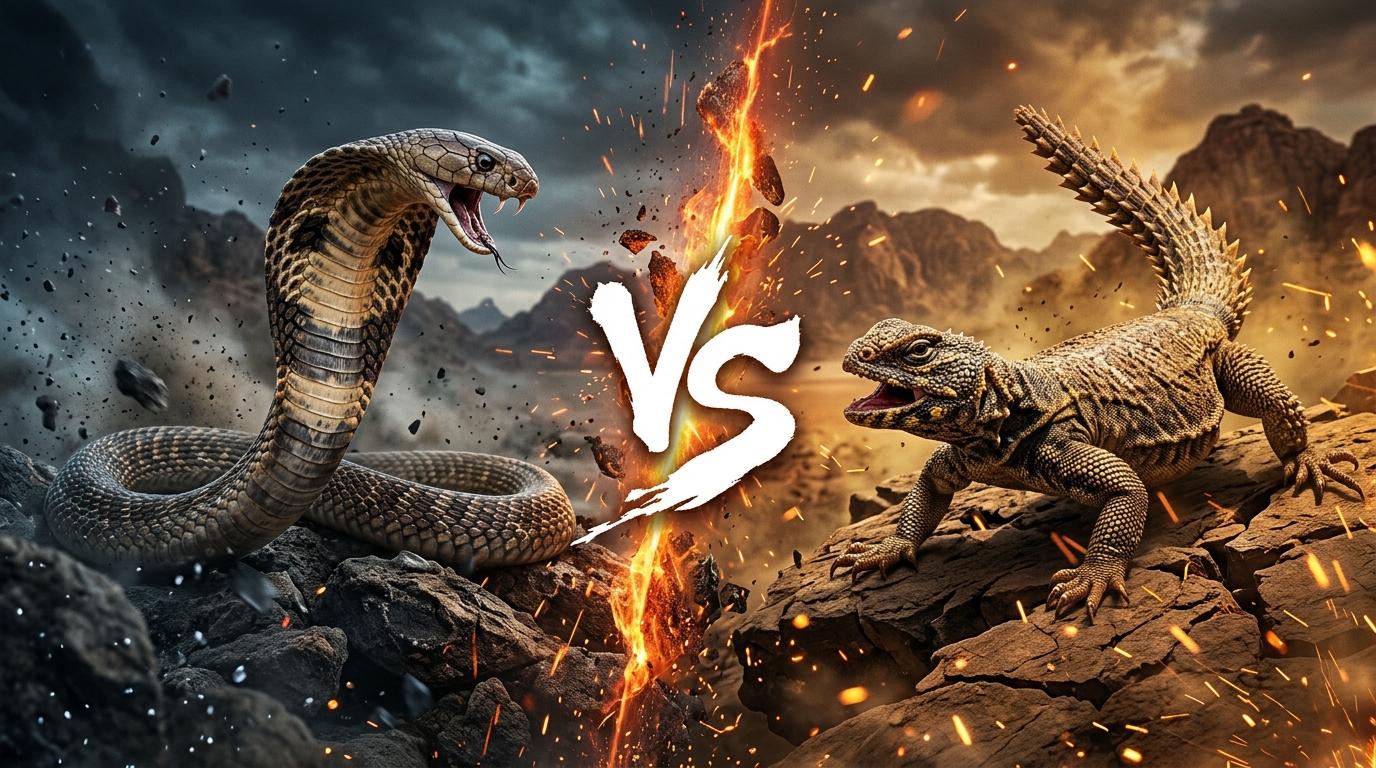
Egyptian Cobra vs Spiny-tailed Lizard: Who Actually Wins?
The Egyptian Cobra wins. Naja haje is a venomous predator built to deliver potent neurotoxic venom through fixed front fangs. It is also a reach-and-retreat striker that can stay back from a lizard's jaws and tail. The Egyptian Spiny-tailed Lizard (Uromastyx aegyptia) is one of the largest uromastyx species. It is heavier per body length and protected by a club-like tail ringed with spiky scales, and its strong herbivore jaws can bite hard. But it has no venom, no reliable way to land a decisive blow, and its main defense is to shut itself inside a burrow and block the entrance with its tail. In the open, one effective bite from the cobra starts a clock the lizard cannot stop. Cobras in North Africa do take lizards and rodents. The uromastyx is a herbivore that fights to deter attackers, not to kill them. The lizard's best result is a stalemate at its burrow mouth. That is a reason it survives, not a way to win.
Read comparison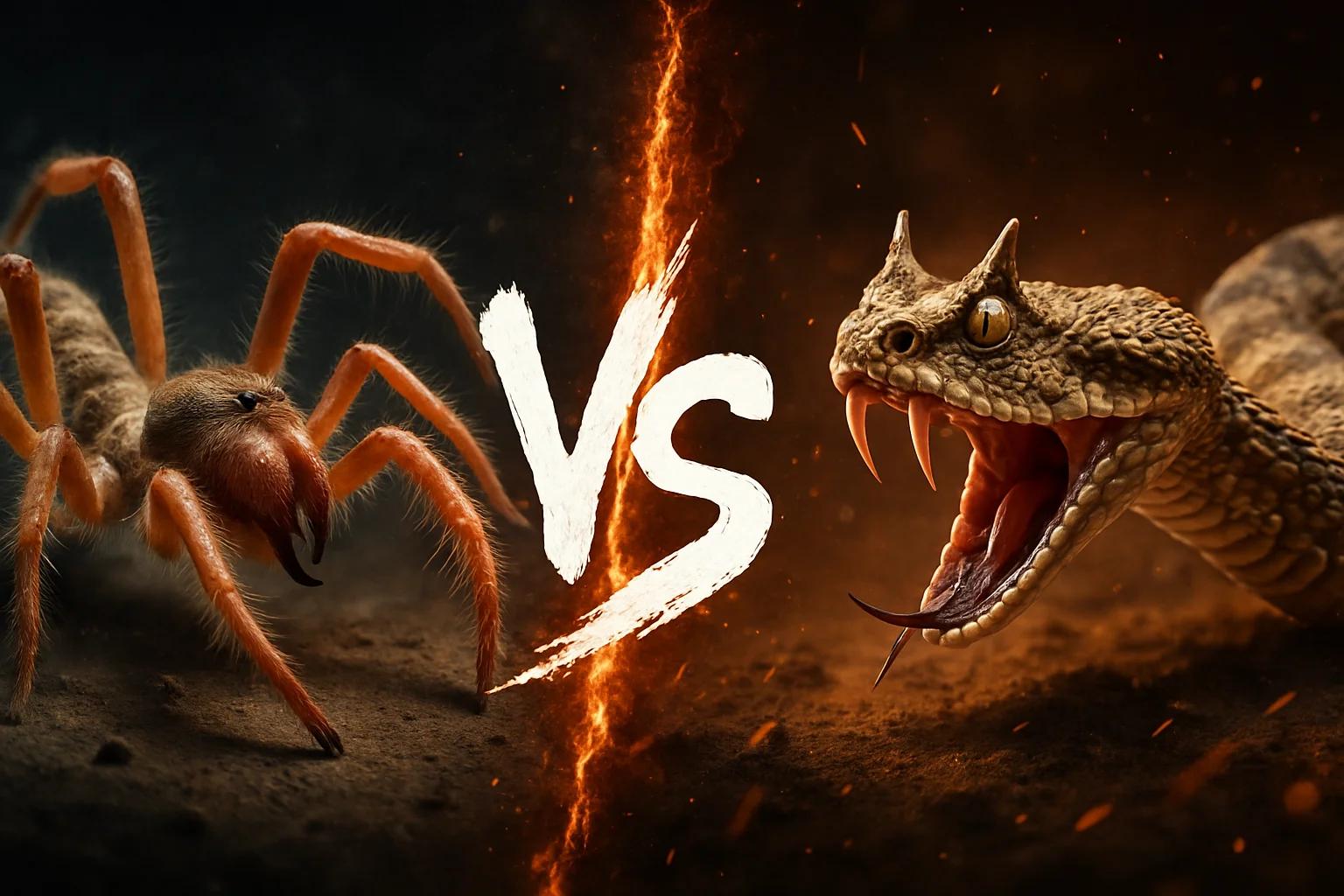
Camel Spider vs Desert Horned Viper: Who Actually Wins?
The Desert Horned Viper wins this one, and it isn't especially close. A camel spider (Galeodes arabs) is a fast, ferocious solifuge with huge crushing chelicerae, but it has no venom and averages around 10–15 cm across its legs. Cerastes cerastes is a 30–60 cm sand-buried ambush predator with a strike measured in milliseconds and a hemotoxic venom built to subdue prey many times heavier than any solifuge. The camel spider's whole strategy is to sprint in and seize. That puts it right into the strike envelope of a snake whose entire design is to wait for something warm and moving to come close. One envenomating bite ends the contest, while the spider has to land repeated, well-placed chelicerae bites through scales to do serious damage. The viper also has a big mass advantage and the patience edge, so it takes most realistic encounters.
Read comparison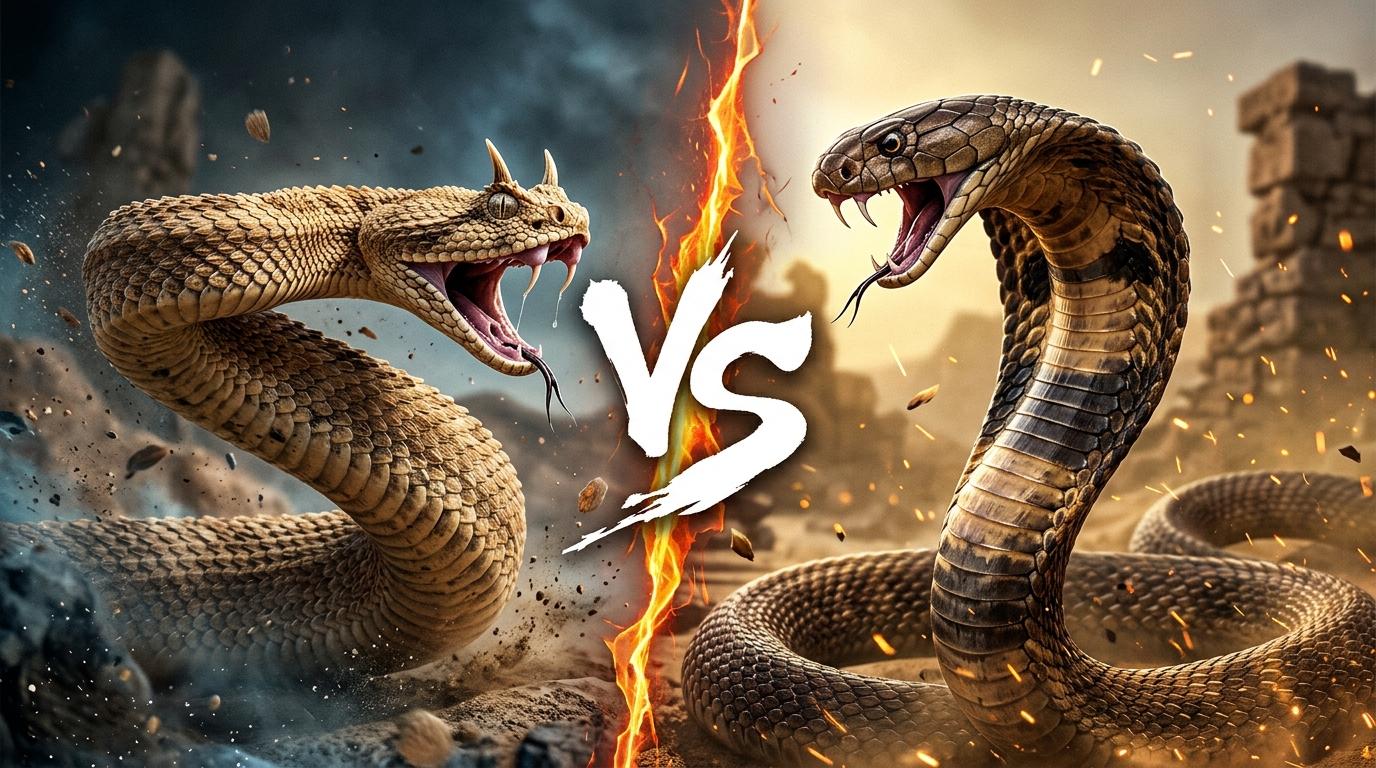
Desert Horned Viper vs Egyptian Cobra: Who Actually Wins?
The Egyptian Cobra wins this matchup clearly. A typical adult Naja haje is roughly 1.5–2 m long, about three times the length of a desert horned viper (usually 50–70 cm). It is also far heavier and carries a potent neurotoxic venom. Cobras in the genus Naja sometimes eat other snakes, so a small viper sits inside the cobra's prey range. The reverse is not true. The horned viper is a superb sand-burying ambusher with a fast strike and tissue-damaging venom. Its toolkit is built for lizards, rodents and birds, not for subduing a long, muscular elapid that can rear, track and pin. The viper's real chance is a lucky early bite from cover. Even then, its smaller venom dose acts more slowly than the cobra's ability to grab and envenomate.
Read comparison
Discussion
What do you think?
Share your reasoning with other readers. Be civil and stick to the animals.
Sign in to join the discussion.
Sign inNo comments yet. Start the conversation.