

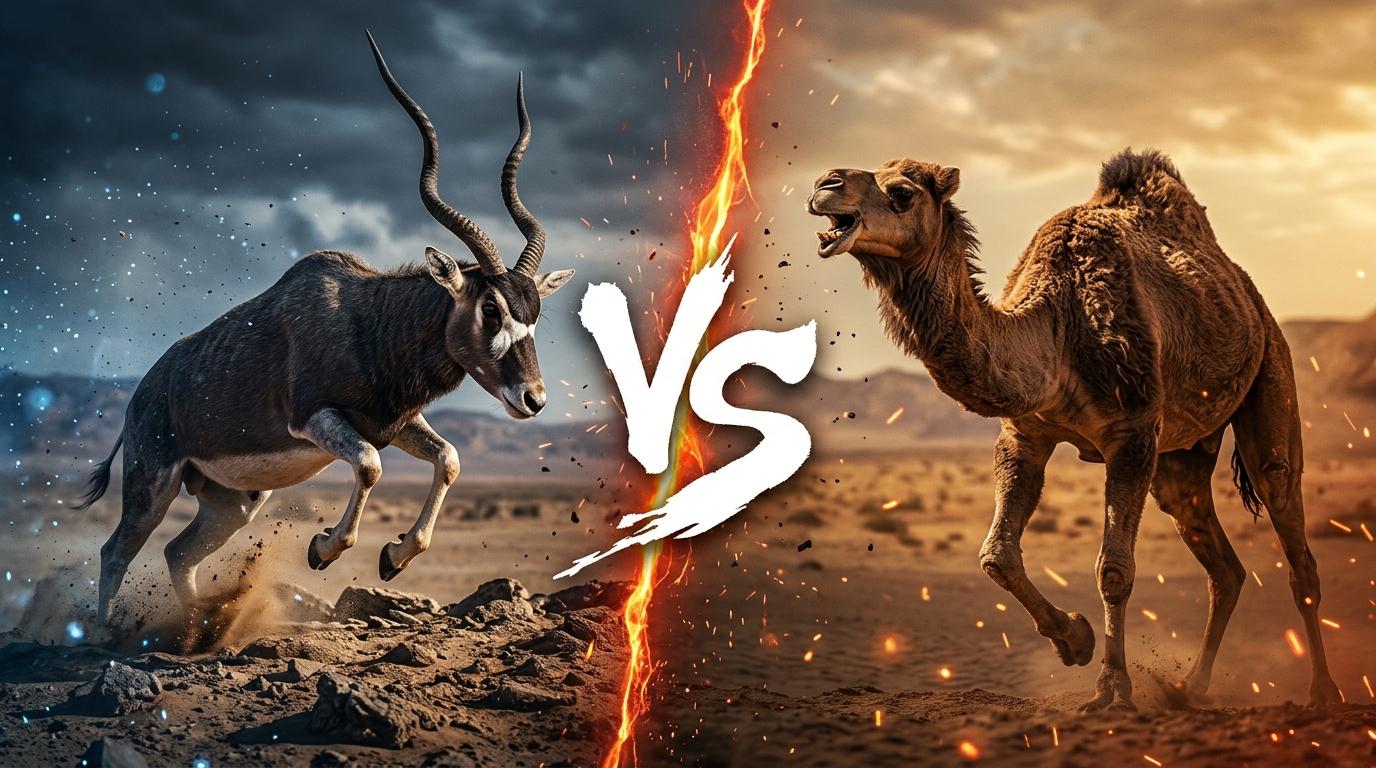
Addax vs Dromedary Camel: Who Actually Wins?
Addax vs dromedary camel: a biology-first look at size, horns, bites, and desert toughness to decide who would win and why the addax is still no pushover.
Addax vs Dromedary Camel
Matchup winner
Dromedary Camel
Quick verdict
Start with the direct answer, then use the structured comparison below to see what changes the outcome.
The dromedary camel wins this matchup clearly. An adult dromedary typically weighs 400–600 kg and stands around 1.8–2 m at the shoulder. A large addax rarely tops 125 kg and stands about 1 m tall. That size gap means the camel holds the decisive advantages in mass, reach, and staying power. Bull camels in rut fight with crushing neck wrestling, heavy body checks, and powerful bites, and those tools work against any animal the size of an antelope. The addax brings long, spiraled horns that can wound, but it is a slow, energy-saving antelope built to survive the deep Sahara, not to fight prolonged battles against an animal four or five times its weight. If a real confrontation happened, the camel's bulk and aggression would end it fast. The addax's best outcome is landing a horn strike and getting away.
Read the full explanation
Dromedary camel wins: it is roughly 4–5x heavier and much taller.
Rutting bull camels are genuinely aggressive, biting and neck-wrestling hard.
The addax's spiral horns are its only real weapon, and its body can't back them up.
Both are elite desert survivors, but only the camel is built to win a shoving match.
Reader vote
Who do you think wins?
Pick a side — no account needed. Results update live.
No votes yet — be the first to call it.
Editorial note
Why people disagree
Horns look decisive, but camels rely on bites, leverage, and weight, which matter more at this size gap.
Raw mass
In hoofed-animal clashes, mass decides who controls the shove. The camel's weight overwhelms the addax.
Weaponry
The addax carries the more specialized weapon. It is the antelope's one real equalizer.
Explosive power
The camel can move its entire bulk into a hit, while the addax lacks the burst to dodge and counter.
Read the full explanation +
Camels seem docile because most people meet domestic ones. A bull in rut is a very different animal.
The addax's legendary desert endurance gets mistaken for combat stamina. It saves energy rather than spending it.
Comparison FAQ
Short, direct answers to the next questions readers usually ask after the headline verdict.
Would an addax beat a dromedary camel?+
No. The camel's roughly fivefold weight advantage, bite, and neck-wrestling power would overwhelm the addax in almost any realistic confrontation.
Which is stronger, the addax or the camel?+
The dromedary camel, by a wide margin. It carries heavy loads and outweighs the addax several times over.
Why is the addax still dangerous?+
Its long spiral horns can inflict deep puncture wounds, especially if an attacker charges carelessly. A cornered addax can injure a much larger animal before escaping.
Are camels actually aggressive?+
Usually not, but bull camels in rut can become very aggressive. They bite hard and try to pin rivals with their necks.
Which survives the desert better?+
The addax is arguably the more extreme specialist. It can go almost indefinitely without drinking, getting moisture from plants.
Head-to-head species stats
These are the same core AnimalDex stat dimensions used on the dedicated animal pages, pulled side by side so the matchup is faster to scan.
Addax
Tier BDromedary Camel
Tier CTrait-by-trait comparison
Only the categories that matter to this matchup are included. The goal is not filler stats, but the real design differences that change the result.
~60–125 kg, compact frame
Raw mass
Dromedary Camel
~400–600 kg, towering frame
Raw mass
Dromedary Camel
Long twisted horns, up to ~80 cm
Weaponry
Addax
Strong bite with sharp canines, kicks, neck pinning
Weaponry
Addax
Modest bursts, notoriously slow runner
Explosive power
Dromedary Camel
Powerful lunges and body checks
Explosive power
Dromedary Camel
Light build, limited padding
Close-range durability
Dromedary Camel
Thick hide, callused pads, dense neck
Close-range durability
Dromedary Camel
Can go nearly without drinking, extreme heat tolerance
Desert economy
Addax
Can go long periods without water, efficient cooling
Desert economy
Addax
Cautious, avoids conflict
Combat temperament
Dromedary Camel
Bulls turn aggressive in rut
Combat temperament
Dromedary Camel
How the verdict forms
Verdict timeline
01 · Raw mass
Dromedary Camel
02 · Weaponry
Addax
03 · Explosive power
Dromedary Camel
04 · Close-range durability
Dromedary Camel
05 · Desert economy
Addax
06 · Combat temperament
Dromedary Camel
Change the conditions
Scenario breakdown
This is where shallow battle content usually fails. Terrain, spacing, timing, and engagement style can change the answer.
Scenario lean
Dromedary Camel
Verdict confidence
82%
Camel dominates.
Open sand lets the camel use its full height and stride to close distance and bring its weight to bear. The addax's broad hooves handle sand well, but it is a slow runner and cannot outpace an aggressive camel for long. Once contact happens, neck pressure and bites decide it.
AnimalDex field profiles
Explore these animals
Addax
Addax nasomaculatus
deep desert, arid dune system, and sparse Sahel fringe
Dromedary Camel
Camelus dromedarius
Desert, semi-desert, dry scrubland, and human-managed arid travel routes.
Systems Intelligence & Hidden Purpose
See the animals behind this comparison as engineered biological systems: what each one is built to do, where it gains leverage, and why the matchup changes by scenario.
Specialized Hardware
pale desert coat, wide spreading hooves, and slow-energy dryland survival give the Addax a body plan tuned for its niche.
Systems Script
Addaxs operate through deep desert, arid dune system, and sparse Sahel fringe Their design links movement, shelter, and feeding into one workable survival system.
Strategic Insight
The harsher the environment, the more valuable efficiency becomes.
Specialized Hardware
Single large hump on the back, long legs and broad padded feet, and long neck and narrow head give the Dromedary Camel a body plan tuned for its niche.
Systems Script
Dromedary Camels operate in desert, semi-desert, dry scrubland, and human-managed arid travel routes. Their design helps them match food access, shelter, and timing inside that environment.
Strategic Insight
Good design makes harsh places feel less impossible.
Final take
The dromedary camel is the clear winner. This is a matchup of a 500 kg wrestler against a 100 kg antelope, and in hoofed-animal combat, size, leverage, and willingness to escalate decide nearly everything.
Read the full explanation
The addax deserves respect anyway. Its horns can puncture, and it is one of the most remarkable desert specialists on Earth. It is also critically endangered, which makes its survival strategy of avoidance, not confrontation, the smarter play.
Collect both animals in AnimalDex
Track the species behind this matchup, compare their real traits, and build the rivalry into your AnimalDex collection.
Related comparisons
Continue with nearby matchups to compare more real-world animal traits without dropping into junky who-wins filler.

Dromedary Camel vs Siberian Cat: Who Actually Wins?
The Dromedary Camel wins, and it is one of the most lopsided matchups in the AnimalDex. An adult dromedary weighs roughly 400–600 kg against a Siberian cat's 4.5–9 kg, a mass gap of around 60 to 100 times. The camel brings a crushing bite, a lot of kicking reach, thick hide, and the habit of pressing its weight onto a threat. The cat brings real skill: fast reflexes, sharp claws, and a dense triple coat that protects it from scratches and cold. None of that can harm an animal the size of a small car in any meaningful way. The Siberian cat's realistic best outcome is to avoid a fight altogether, and the camel's huge size and reach decide nearly every frame that matters.
Read comparison
Addax vs Lesser Egyptian Jerboa: Who Actually Wins?
The addax wins clearly. This is one of the most lopsided size matchups in the Sahara. An adult addax weighs roughly 60–125 kg and carries long spiraling horns. The lesser Egyptian jerboa weighs about 40–75 grams, which makes the antelope well over a thousand times heavier. Neither animal is a predator, and neither has any reason to fight the other. In any forced confrontation, though, the addax's mass, horns, and hooves decide it instantly. The jerboa's real strengths are its zigzag ricochet jumps, its burrow escapes, and its nighttime habits. Those skills keep it alive, but they cannot win a contest of force. The jerboa doesn't lose the desert. It loses the duel.
Read comparison
Addax vs Fennec Fox: Who Actually Wins?
The addax wins, and it is not close in a physical confrontation. This critically endangered Saharan antelope stands around a meter at the shoulder, typically weighs 60–125 kg, and carries long spiraled horns. The fennec fox weighs roughly 1–1.5 kg, about one-hundredth of the addax's mass. The fennec's real weapons are its 15 cm ears, its fast reflexes, and its ability to dig a burrow in minutes. Those tools are built for catching insects and rodents and for escaping predators, not for overpowering a large herbivore. An addax only needs to lower its horns, stamp, or simply walk forward, and the fox's best move is to leave. The fennec is quicker and harder to pin down. If it chooses not to engage, it 'survives' the encounter, but it never has a route to winning one.
Read comparison
Dromedary Camel vs Meerkat: Who Actually Wins?
The dromedary camel wins, and it isn't close in a direct confrontation. An adult dromedary weighs roughly 400–600 kg against a meerkat's 0.6–1 kg, a mass gap of several hundred to one. Camels defend themselves with heavy kicks that can reach in any direction, crushing body weight, and a bite strong enough to injure large mammals, especially rutting bulls. A meerkat's sharp teeth and claws are built for scorpions, beetles and burrow digging, not for harming an animal whose legs alone outweigh an entire mob. The meerkat's real strength is avoidance. Sentinel calls, burrow networks and group mobbing mean a camel would almost never catch one. But 'who would win' means who prevails if they clash, and on that question the camel's size and durability settle it.
Read comparison
Discussion
What do you think?
Share your reasoning with other readers. Be civil and stick to the animals.
Sign in to join the discussion.
Sign inNo comments yet. Start the conversation.