

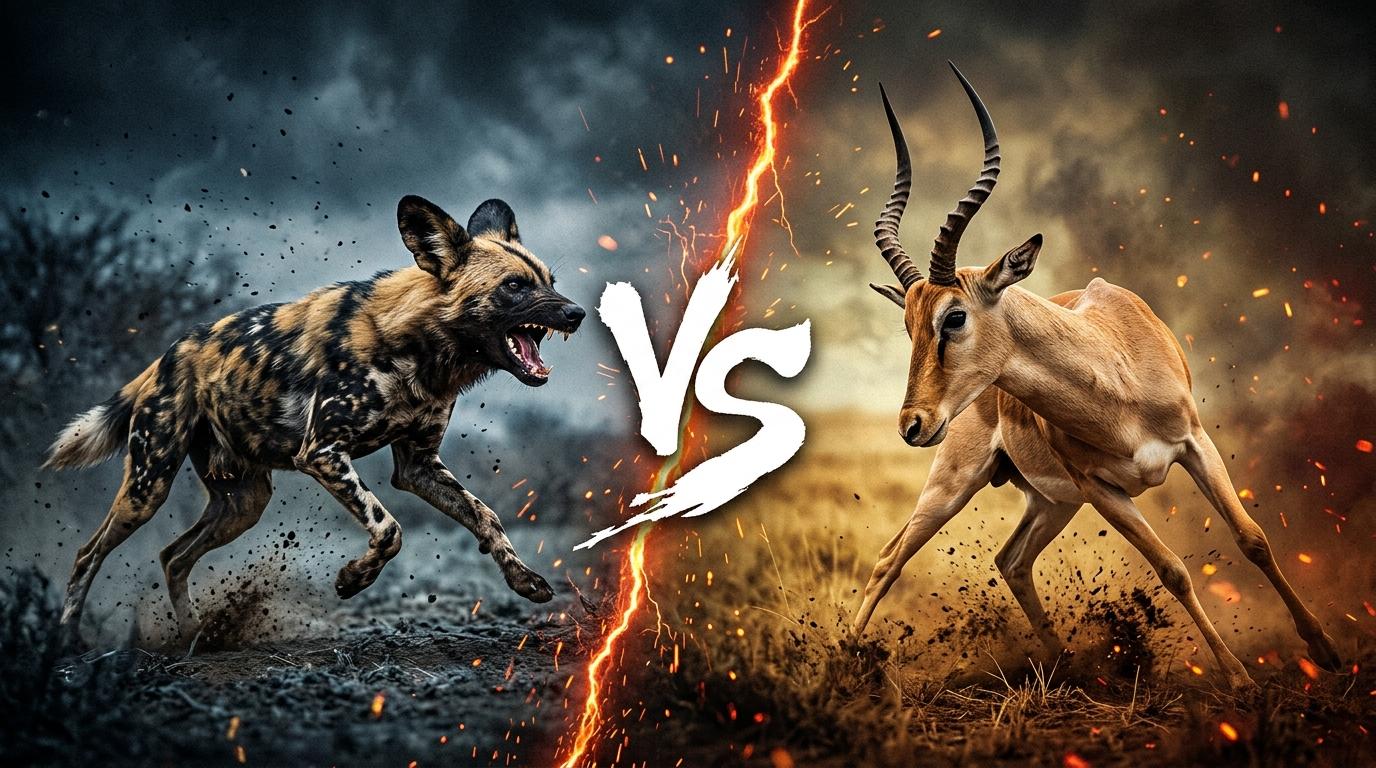
African Wild Dog vs Hirola: Who Actually Wins?
African wild dog vs hirola: a pack-hunting endurance predator meets one of the world's rarest antelopes. Here is who wins, why, and when the hirola holds its ground.
African Wild Dog vs Hirola
Matchup winner
African Wild Dog
Quick verdict
Start with the direct answer, then use the structured comparison below to see what changes the outcome.
The African wild dog wins this matchup clearly. It is a predator built around coordinated pursuit, sustained running and fast, repeated bites, and the hirola is the kind of medium-sized grassland antelope its system is designed to wear down. The hirola is heavier, roughly 70–120 kg against the dog's 18–36 kg, and both sexes carry sharp, ringed, lyre-shaped horns that can puncture a careless attacker. In a strict one-dog, one-antelope standoff, the hirola has a real chance to bluff, jab and escape. But wild dogs are defined by the pack, not the individual. Once several dogs rotate through a chase on open grassland, the hirola's sprint-and-stand defense runs out of options well before the dogs run out of stamina.
Read the full explanation
Overall winner: African wild dog, mainly because of its pack coordination and endurance chase.
The hirola is heavier and armed with sharp horns, so a single dog cannot take it carelessly.
Open-ground chases strongly favor the dogs, and few prey animals outlast a committed pack.
The hirola's best result is an escape or a successful standoff, not an outright victory over a pack.
Reader vote
Who do you think wins?
Pick a side — no account needed. Results update live.
No votes yet — be the first to call it.
Editorial note
Why people disagree
Size versus system: the hirola outweighs a wild dog by roughly three to one, so some readers expect the bigger animal to win, while others point out that the pack is the real competitor.
Explosive power
In the first seconds of a chase, the hirola's burst and mass can open a gap or knock a lone dog aside.
Pursuit endurance
Wild dogs win by stretching a chase out until the prey slows, and the hirola is not built for marathon escapes.
Coordinated attack
Pack rotation lets dogs keep the pressure on without any single dog absorbing the full risk.
Read the full explanation +
Solo versus pack framing: a lone wild dog against a healthy adult hirola is a genuinely uncertain fight, and arguments often come down to which version of the matchup someone has in mind.
Horns versus bites: hirola horns can do real damage to a dog, but wild dog tactics target the flanks and hindquarters, away from the horns, which makes horn threat less decisive than it looks.
Comparison FAQ
Short, direct answers to the next questions readers usually ask after the headline verdict.
Would an African wild dog beat a hirola?+
A pack of African wild dogs would win in most realistic encounters. A single wild dog against a healthy adult hirola is much closer, and the hirola may come out ahead.
Which is stronger, the African wild dog or the hirola?+
Pound for pound, the hirola is the stronger animal because it is heavier and armed with sharp horns. The wild dog is the more effective hunter because of its endurance, bite efficiency and pack coordination.
Why is the hirola still dangerous to wild dogs?+
Both male and female hirola have sharp, ringed horns and weigh roughly three times as much as a wild dog. A well-aimed thrust can seriously injure or kill a dog, which is why packs attack from the sides and rear.
Do African wild dogs actually hunt hirola?+
Yes. Wild dogs are among the recorded natural predators of the hirola, along with lions, leopards, cheetahs and hyenas, in the parts of eastern Kenya where their ranges overlap.
How fast is a hirola compared to a wild dog?+
Both are fast sprinters, but the wild dog's advantage is stamina. Packs can keep up a chase over several kilometres, while the hirola relies on a shorter escape burst.
Why is the hirola so rare?+
Hirola are critically endangered, with only a few hundred left. Their decline is linked to habitat degradation, competition with livestock, drought, past disease outbreaks and predation on a population that is already small.
Head-to-head species stats
These are the same core AnimalDex stat dimensions used on the dedicated animal pages, pulled side by side so the matchup is faster to scan.
African Wild Dog
Tier AHirola
Tier BTrait-by-trait comparison
Only the categories that matter to this matchup are included. The goal is not filler stats, but the real design differences that change the result.
Fast acceleration, light frame
Explosive power
Hirola
Strong flight burst, heavier body
Explosive power
Hirola
Elite long-distance chaser
Pursuit endurance
African Wild Dog
Sprinter that tires in long chases
Pursuit endurance
African Wild Dog
Rotating pack pressure
Coordinated attack
African Wild Dog
Small herd, individual defense
Coordinated attack
African Wild Dog
Shearing teeth, rapid bites
Close-range weaponry
Hirola
Sharp ringed horns on both sexes
Close-range weaponry
Hirola
Lean, injury-sensitive
Close-range durability
Hirola
Larger frame absorbs more
Close-range durability
Hirola
Vocal coordination, adaptive chases
Tactical awareness
African Wild Dog
Vigilant, alarm-driven flight
Tactical awareness
African Wild Dog
How the verdict forms
Verdict timeline
01 · Explosive power
Hirola
02 · Pursuit endurance
African Wild Dog
03 · Coordinated attack
African Wild Dog
04 · Close-range weaponry
Hirola
05 · Close-range durability
Hirola
06 · Tactical awareness
African Wild Dog
Change the conditions
Scenario breakdown
This is where shallow battle content usually fails. Terrain, spacing, timing, and engagement style can change the answer.
Scenario lean
Hirola
Verdict confidence
82%
A lone hirola can hold off a lone dog.
With no packmates to flank or relieve it, a single wild dog faces an animal about three times its weight with sharp horns pointed at it. The dog's usual strategy depends on distraction and rotation, so on its own it has to commit close to the horns. A healthy adult hirola that stands its ground, or breaks away at the right moment, is likely to come out of this version unharmed.
AnimalDex field profiles
Explore these animals
African Wild Dog
Lycaon pictus
Open woodland, savannah, and lightly wooded grassland with space for wide-range pack movement.
Hirola
Beatragus hunteri
dry grassland, open bushland, and lightly wooded savannah
Systems Intelligence & Hidden Purpose
See the animals behind this comparison as engineered biological systems: what each one is built to do, where it gains leverage, and why the matchup changes by scenario.
Specialized Hardware
Oversized ears, endurance-focused limbs, and a social communication stack built on posture, vocal cues, and pack coordination turn the African wild dog into elite pursuit hardware.
Systems Script
African wild dogs pressure prey populations through coordinated movement rather than isolated brute force. They help shape herbivore behavior, redistribute risk across landscapes, and reward connected ecosystems over fragmented ones.
Strategic Insight
High-performance teams do not need constant hierarchy chatter. Shared rules, clean signals, and role clarity create speed that solo talent cannot match.
Specialized Hardware
long alert face, lyre-shaped horns, and dry grassland herd vigilance give the Hirola a body plan tuned for its niche.
Systems Script
Hirolas operate through dry grassland, open bushland, and lightly wooded savannah. Their design links movement, feeding, shelter, and timing into one workable survival system.
Strategic Insight
Harsh places reward efficiency, timing, and bodies that waste very little.
Final take
The African wild dog wins because the matchup is really pack against individual. The hirola has the bigger body, the sharper close-range weapons and the better odds in a one-on-one standoff, and those strengths are real. But wild dogs do not hunt as individuals, and their whole biology, from long-distance stamina to rotating attackers and constant vocal coordination, is built to beat exactly the defense the hirola relies on.
Read the full explanation
The hirola is still a formidable animal. Its horns can seriously injure a dog, and any pack that rushes the front end pays for it. Its rarity matters too. With only a few hundred left, mostly along the Kenya–Somalia border, every encounter with a predator carries consequences for the species, which is why conservation efforts focus on predator-proof sanctuaries and habitat recovery.
Final verdict: African wild dog wins overall, about 85 percent confident. The hirola wins solo standoffs, while the pack wins nearly everything else.
Collect both animals in AnimalDex
Track the species behind this matchup, compare their real traits, and build the rivalry into your AnimalDex collection.
Related comparisons
Continue with nearby matchups to compare more real-world animal traits without dropping into junky who-wins filler.

Blackbuck vs Hirola: Who Actually Wins?
The hirola wins. This is a clash between two horned antelopes from different continents. The blackbuck is faster and more agile. The hirola brings what a horn-to-horn contest rewards: more mass, a taller and heavier frame, and thick, ringed lyre-shaped horns built for shoving duels. Adult hirola commonly weigh around 80–118 kg against a blackbuck's roughly 25–45 kg, so in a committed head-on clash the hirola can drive the blackbuck backward and off balance. The blackbuck's long corkscrew horns are dangerous at the tips and its acceleration is elite, but its whole design favors escape over grinding contact. If the blackbuck can run, it survives. If it has to stand and push, the hirola's weight decides it.
Read comparison
African Wild Dog vs Hartebeest: Who Actually Wins?
The African wild dog wins this matchup overall, but the reason matters: it wins as a pack, not as a lone animal. A single wild dog weighs about 20–30 kg. An adult hartebeest weighs roughly 120–200 kg and carries sharp, sharply bent horns. One-on-one, a healthy adult hartebeest can hold off or injure a lone dog. Real encounters are rarely one-on-one, though. Wild dogs hunt in coordinated packs and run their prey down over distance. They are among the most successful large predators in Africa by kill rate, and hartebeest are documented prey in their range. The hartebeest is extremely fast in a short burst. Its long, high-shouldered build is made for efficient galloping, and it can stand and fight with its horns. But it is built to outlast a single chaser, not a relay of dogs that never lets the pressure drop. In the ecologically realistic frame, the dogs win the long chase and the takedown.
Read comparison
African Wild Dog vs White-headed Vulture: Who Actually Wins?
The African wild dog wins clearly. At roughly 20–30 kg of sinew, stamina and shearing carnassial teeth, a wild dog outweighs a white-headed vulture (about 3.5–5.5 kg) several times over and is built to grab, hold and subdue live animals. The white-headed vulture is a scavenger with a strong hooked bill and weak, unspecialized feet. It cannot pin or kill a fit mammal of that size, and once grounded it is slow to take off. The vulture's real advantage is flight. It does not win fights. It simply leaves them. In any encounter where the bird must stand its ground, the dog's bite, agility and grip decide it in seconds.
Read comparison
Discussion
What do you think?
Share your reasoning with other readers. Be civil and stick to the animals.
Sign in to join the discussion.
Sign inNo comments yet. Start the conversation.