


American Bison vs Llama: Who Actually Wins?
American bison vs llama: a biology-first breakdown of size, power, horns, and temperament, and why the bison wins nearly every realistic clash.
American Bison vs Llama
Matchup winner
American Bison
Quick verdict
Start with the direct answer, then use the structured comparison below to see what changes the outcome.
The American bison wins, and it isn't close. An adult bull bison can weigh 900–1,000 kg (about 2,000 lb), carries curved horns, a massive shoulder hump of muscle anchored to tall spinal processes, and a skull built for head-on ramming. It can sprint around 55 km/h and pivot hard for its size. A llama typically weighs 130–200 kg, has no horns, and fights mostly by spitting, chest-butting, neck-wrestling, and kicking. Those tools are effective against coyotes and other llamas but carry no real threat to a bison's armored front end. The llama's alertness and herd-guarding courage are genuine strengths, but they are tuned to deter small predators, not to stop an animal five times its mass.
Read the full explanation
Bison win: roughly 5x the body mass, plus horns and a ramming skull.
Llamas fight with spit, kicks, and neck-wrestling. Those tools work on canids, not on bovine giants.
The llama's best move is vigilance and retreat, not confrontation.
A llama's kick can still injure, so even a winning bison takes on some risk.
Reader vote
Who do you think wins?
Pick a side — no account needed. Results update live.
No votes yet — be the first to call it.
Editorial note
Why people disagree
Llamas are famous livestock guardians, so people overestimate how that bravery scales against large herbivores.
Explosive power
Momentum decides herbivore clashes, and the bison brings several times more of it.
Built-in weaponry
Horns convert mass into puncture and leverage. The llama has no equivalent tool.
Close-range durability
A bison's front end is built to absorb head-on blows. A llama's frame is built for efficient travel.
Read the full explanation +
Bison look slow and placid while grazing, which hides their explosive acceleration and short temper.
Viral videos of llamas chasing off dogs blur the difference between deterring a predator and winning a fight.
Comparison FAQ
Short, direct answers to the next questions readers usually ask after the headline verdict.
Would an American bison beat a llama in a fight?+
Yes. A bison's roughly 5x weight advantage, horns, and ramming skull give it a decisive win in almost any direct fight.
Which is stronger, a bison or a llama?+
The bison, by a wide margin. Its shoulder and neck musculature can toss animals and shove through obstacles. Llamas are strong for pack carrying but can't approach that output.
Why is a llama still dangerous even though it loses?+
Llamas kick hard and fast, and males have sharp fighting teeth. A well-placed kick can injure a leg or eye, so even a dominant bison risks being hurt.
Can a llama outrun a bison?+
On flat ground, generally no, since bison sprint very fast. On steep or rocky terrain, the llama's agility gives it the better escape.
Do llamas guard against large animals?+
Llamas guard mainly against coyotes, foxes, and dogs. They are not effective deterrents against large ungulates like bison.
Head-to-head species stats
These are the same core AnimalDex stat dimensions used on the dedicated animal pages, pulled side by side so the matchup is faster to scan.
American Bison
Tier BLlama
Tier BTrait-by-trait comparison
Only the categories that matter to this matchup are included. The goal is not filler stats, but the real design differences that change the result.
Ton-class charge, hump-driven shove
Explosive power
American Bison
Light chest-butts and kicks
Explosive power
American Bison
Curved horns, thick ramming skull
Built-in weaponry
American Bison
No horns, spit, fighting teeth in males
Built-in weaponry
American Bison
Dense woolly forehead mat, heavy forequarters
Close-range durability
American Bison
Long, exposed neck and slim legs
Close-range durability
American Bison
Herd-reliant, moderate alertness
Threat awareness
Llama
Highly alert alarm-caller
Threat awareness
Llama
Fast sprinter, heavy turner
Agility and terrain handling
Llama
Sure-footed on rocky, steep ground
Agility and terrain handling
Llama
Short-fused, rut-hardened bulls
Combat temperament
American Bison
Defensive bluffing, posturing
Combat temperament
American Bison
How the verdict forms
Verdict timeline
01 · Explosive power
American Bison
02 · Built-in weaponry
American Bison
03 · Close-range durability
American Bison
04 · Threat awareness
Llama
05 · Agility and terrain handling
Llama
06 · Combat temperament
American Bison
Change the conditions
Scenario breakdown
This is where shallow battle content usually fails. Terrain, spacing, timing, and engagement style can change the answer.
Scenario lean
American Bison
Verdict confidence
82%
Bison overwhelms in seconds.
Flat ground lets the bison build its full charge. With no obstacles to break momentum, horns and mass decide the outcome almost immediately. Spitting and kicking can't stop a ton of forward motion.
AnimalDex field profiles
Explore these animals
American Bison
Bison bison
Prairie, grassland, open woodland, and managed conservation ranges.
Llama
Lama glama
High grassland, mountain pasture, dry valleys, and domestic grazing systems.
Systems Intelligence & Hidden Purpose
See the animals behind this comparison as engineered biological systems: what each one is built to do, where it gains leverage, and why the matchup changes by scenario.
Specialized Hardware
Large shoulder hump and heavy forequarters, shaggy head and neck fur, and short curved horns give the American Bison a body plan tuned for its niche.
Systems Script
American Bisons operate in prairie, grassland, open woodland, and managed conservation ranges. Their design helps them match food access, shelter, and timing inside that environment.
Strategic Insight
Slow heavy force can reshape a landscape without needing speed or noise.
Specialized Hardware
Long neck with upright ears, woolly body with narrow face, and light-footed walking on rocky ground give the Llama a body plan tuned for its niche.
Systems Script
Llamas operate in high grassland, mountain pasture, dry valleys, and domestic grazing systems. Their design helps them match food access, shelter, and timing inside that environment.
Strategic Insight
Reliable balance matters more than speed when the road is narrow and steep.
Final take
The American bison is the clear winner. Evolution shaped it for bison-on-bison combat: thick skull, horns, a muscular hump, and the fury of the rut. The llama's defensive kit evolved to manage canids and herd politics.
Read the full explanation
Respect the llama for what it does best. It sees trouble early, raises the alarm, and uses rough ground to stay out of reach. In any fair, contact-based fight, though, the bison's mass and armament settle the question almost instantly.
Collect both animals in AnimalDex
Track the species behind this matchup, compare their real traits, and build the rivalry into your AnimalDex collection.
Related comparisons
Continue with nearby matchups to compare more real-world animal traits without dropping into junky who-wins filler.

American Bison vs Pronghorn: Who Actually Wins?
The American bison wins clearly. A bull bison weighs up to around 900 kg (2,000 lb), roughly fifteen to twenty times a pronghorn's 40–65 kg. It carries curved horns on a skull and neck built for head-on ramming, and a massive shoulder hump anchors the neck muscles that drive those charges. The pronghorn is a marvel of endurance speed. It can sprint near 88 km/h (55 mph) and cruise at highway pace for miles, but its anatomy is tuned for escape, not combat. Its forked horns are light display and sparring tools, and its slim legs cannot absorb a collision with a ton of momentum. In any setting where the two actually make contact, the bison's mass, durability, and close-range power decide it almost immediately. The pronghorn's only 'win' is to leave, which it does better than almost anything alive.
Read comparison
American Bison vs Black-footed Ferret: Who Actually Wins?
The American bison wins, and it isn't close in a direct confrontation. A bull bison can weigh around 900 kg, while a black-footed ferret weighs about 1 kg, a mass gap of nearly a thousand to one. The bison's charge, horns, hooves and thick hide mean the ferret has no meaningful way to injure it. The ferret's real strengths are elsewhere: it is a specialist predator built to slip into prairie dog burrows and kill prey its own size in total darkness. That makes it nearly impossible for the bison to catch underground, but avoiding a fight is not the same as winning one. On open prairie, where both species actually live, the bison controls the space and the ferret's only sensible move is to disappear.
Read comparison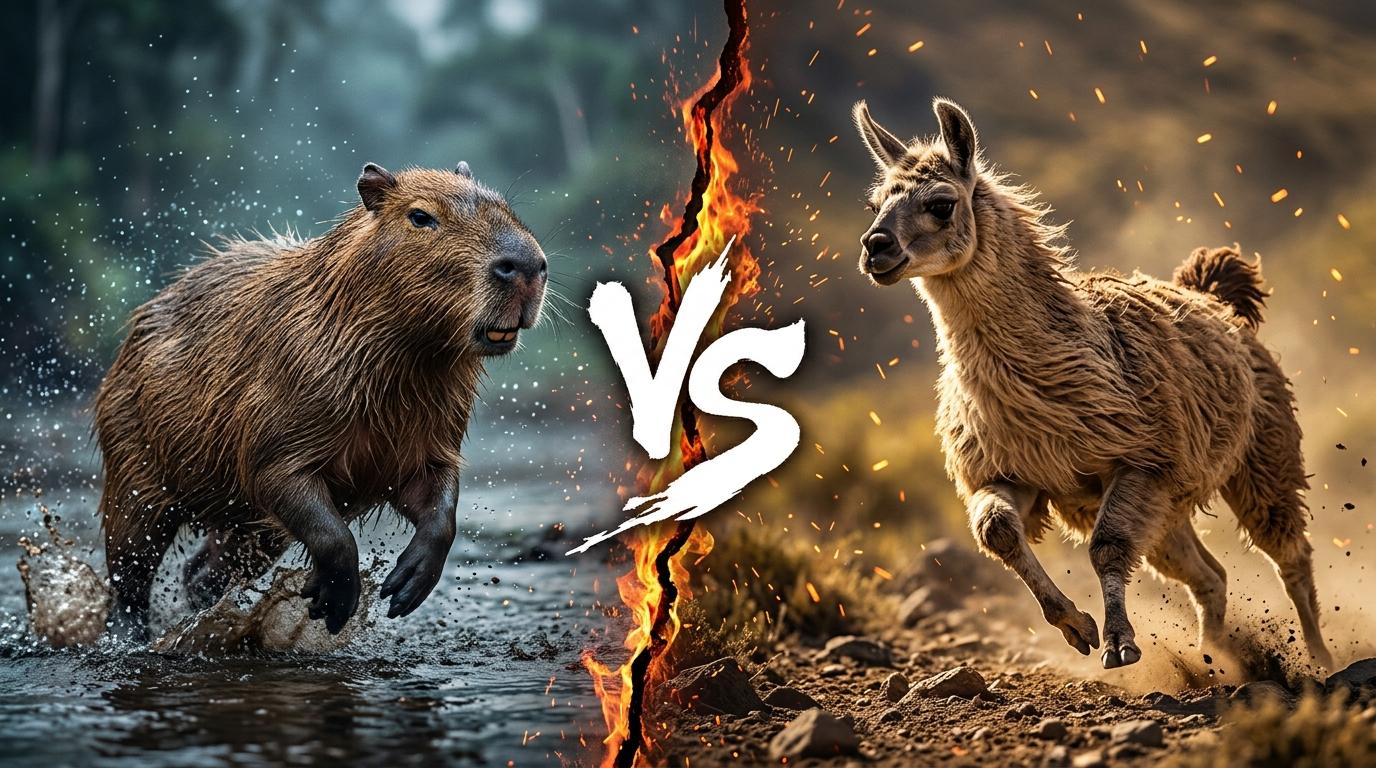
Capybara vs Llama: Who Actually Wins?
The llama wins this matchup clearly. An adult llama stands about 1.7–1.8 m at the head and weighs roughly 130–200 kg. A large capybara is about 35–65 kg and sits low to the ground. That gives the llama a 3–4x mass advantage and a huge reach and height edge. Llamas are also used as livestock guardians because they will confront and chase off canids. They use chest-butts, neck-wrestling, stomping forefeet and, in males, sharp 'fighting teeth' meant for rival combat. The capybara has formidable chisel incisors and a thick hide, but it is built as a grazer that escapes into water, not one that wins confrontations. On land, the llama controls the encounter. The capybara's real winning move is to leave. If water is nearby, it simply dives and the 'fight' never happens.
Read comparison
Llama vs Pacarana: Who Actually Wins?
The llama wins, and it is not close on paper. An adult llama weighs roughly 130–200 kg and stands about 1.7–1.8 m at the head. A pacarana, the slow, heavy-bodied rodent of Andean cloud forests, tops out around 10–15 kg. That mass gap of more than ten to one decides almost everything. Llamas are herd guardians: farmers use them to drive off coyotes and dogs with chest-butts, front-leg stomps, kicks and spitting. The pacarana's best weapons are long, ever-growing incisors and a stubborn, defensive temperament. Its bite can open a painful wound, but it cannot stop a large ungulate that can simply trample, shove or walk away. The pacarana's real edge is cover and patience, not combat. In any confrontation it is far more likely to retreat to a burrow or rock crevice than to win.
Read comparison
Discussion
What do you think?
Share your reasoning with other readers. Be civil and stick to the animals.
Sign in to join the discussion.
Sign inNo comments yet. Start the conversation.