


American Bison vs Pronghorn: Who Actually Wins?
American bison vs pronghorn: who would win a fight? A biology-first breakdown of mass, horns, speed, and why the fastest land animal in the Americas still loses a showdown.
American Bison vs Pronghorn
Matchup winner
American Bison
Quick verdict
Start with the direct answer, then use the structured comparison below to see what changes the outcome.
The American bison wins clearly. A bull bison weighs up to around 900 kg (2,000 lb), roughly fifteen to twenty times a pronghorn's 40–65 kg. It carries curved horns on a skull and neck built for head-on ramming, and a massive shoulder hump anchors the neck muscles that drive those charges. The pronghorn is a marvel of endurance speed. It can sprint near 88 km/h (55 mph) and cruise at highway pace for miles, but its anatomy is tuned for escape, not combat. Its forked horns are light display and sparring tools, and its slim legs cannot absorb a collision with a ton of momentum. In any setting where the two actually make contact, the bison's mass, durability, and close-range power decide it almost immediately. The pronghorn's only 'win' is to leave, which it does better than almost anything alive.
Read the full explanation
Bison wins any real physical confrontation thanks to a roughly 15–20x weight advantage and a ramming-built skull.
Pronghorn is far faster and can outlast nearly any predator, but speed avoids fights rather than winning them.
Pronghorn horns are light display and sparring weapons that cannot meaningfully injure a bison.
In open country the pronghorn simply escapes, and survival is not the same as victory.
Reader vote
Who do you think wins?
Pick a side — no account needed. Results update live.
No votes yet — be the first to call it.
Editorial note
Why people disagree
Speed fans point to the pronghorn's elite running and argue that a bison can't catch it. That's true, but a successful escape is not a fight won.
Raw mass
Mass dominates collisions. A bison's momentum alone could knock a pronghorn down and break bones.
Explosive power
The bison's neck and shoulder musculature turn its head into a battering ram.
Top speed & endurance
Unmatched in the Americas, this speed controls whether a fight happens at all, not who wins it.
Read the full explanation +
Some people overrate the pronghorn's horns because they look sharp. In reality they are built for display and rival sparring, not for piercing a hide covered in thick wool and shaggy hair.
Bison look slow and docile in parks, but they can hit about 55 km/h (35 mph) and pivot surprisingly fast. That leads people to underestimate how quickly a short-range clash would end.
Comparison FAQ
Short, direct answers to the next questions readers usually ask after the headline verdict.
Would an American bison beat a pronghorn in a fight?+
Yes. The bison's huge weight advantage, ramming horns, and durable build make it the overwhelming favorite in any physical confrontation.
Which is stronger, a bison or a pronghorn?+
The bison, by a wide margin. Bulls can weigh up to around 900 kg, with massive neck and shoulder muscles. Pronghorn weigh roughly 40–65 kg.
Can a bison catch a pronghorn?+
Almost never in open country. Pronghorn can reach about 88 km/h and sustain high speeds over long distances, far beyond a bison's capability.
Why is the pronghorn still dangerous if it loses?+
Its sharp hooves and horns can injure animals or people at close range, especially a buck during the rut. Its main danger to rivals, though, is in sparring with other pronghorn, not in overpowering large animals.
Do bison and pronghorn interact in the wild?+
Yes. They share prairies in places like Yellowstone and the Great Plains, and they mostly coexist peacefully, with pronghorn giving bison space.
Head-to-head species stats
These are the same core AnimalDex stat dimensions used on the dedicated animal pages, pulled side by side so the matchup is faster to scan.
American Bison
Tier BPronghorn
Tier BTrait-by-trait comparison
Only the categories that matter to this matchup are included. The goal is not filler stats, but the real design differences that change the result.
Up to ~900 kg bull
Raw mass
American Bison
~40–65 kg
Raw mass
American Bison
Hump-anchored head charge
Explosive power
American Bison
Light, springy frame
Explosive power
American Bison
~55 km/h bursts
Top speed & endurance
Pronghorn
~88 km/h, sustained cruising
Top speed & endurance
Pronghorn
Thick curved horns, heavy skull
Weaponry
American Bison
Forked keratin-sheathed display horns
Weaponry
American Bison
Dense wool, thick hide, heavy bone
Close-range durability
American Bison
Light build, thin legs
Close-range durability
American Bison
Herd vigilance, decent senses
Threat detection
Pronghorn
Huge wide-set eyes, early warning
Threat detection
Pronghorn
How the verdict forms
Verdict timeline
01 · Raw mass
American Bison
02 · Explosive power
American Bison
03 · Top speed & endurance
Pronghorn
04 · Weaponry
American Bison
05 · Close-range durability
American Bison
06 · Threat detection
Pronghorn
Change the conditions
Scenario breakdown
This is where shallow battle content usually fails. Terrain, spacing, timing, and engagement style can change the answer.
Scenario lean
American Bison
Verdict confidence
82%
Bison wins decisively at close range.
In broken terrain or brush, the pronghorn loses its long sight lines and running room. Once the gap closes, the fight comes down to collision physics. The bison's mass and ramming skull overwhelm a light, thin-legged animal that has no meaningful defensive weapon.
AnimalDex field profiles
Explore these animals
American Bison
Bison bison
Prairie, grassland, open woodland, and managed conservation ranges.
Pronghorn
Antilocapra americana
prairie, desert grassland, sagebrush plain, and open steppe
Systems Intelligence & Hidden Purpose
See the animals behind this comparison as engineered biological systems: what each one is built to do, where it gains leverage, and why the matchup changes by scenario.
Specialized Hardware
Large shoulder hump and heavy forequarters, shaggy head and neck fur, and short curved horns give the American Bison a body plan tuned for its niche.
Systems Script
American Bisons operate in prairie, grassland, open woodland, and managed conservation ranges. Their design helps them match food access, shelter, and timing inside that environment.
Strategic Insight
Slow heavy force can reshape a landscape without needing speed or noise.
Specialized Hardware
extreme long-distance speed, huge side-set eyes, and light open-country frame give the Pronghorn a body plan tuned for its niche.
Systems Script
Pronghorns operate through prairie, desert grassland, sagebrush plain, and open steppe Their design links movement, shelter, and feeding into one workable survival system.
Strategic Insight
When the landscape offers nowhere to hide, seeing early and moving fast become everything.
Final take
The American bison is the clear winner. This matchup pits a heavyweight collision specialist against an elite escape artist, and when the question is who wins a fight, the specialist built for contact takes it.
Read the full explanation
The pronghorn deserves real respect. Its speed and vision evolved during an era of now-extinct fast predators such as the American cheetah-like Miracinonyx. That heritage is why the pronghorn rarely loses its life, even though it would lose almost any physical clash with a bison.
Collect both animals in AnimalDex
Track the species behind this matchup, compare their real traits, and build the rivalry into your AnimalDex collection.
Related comparisons
Continue with nearby matchups to compare more real-world animal traits without dropping into junky who-wins filler.
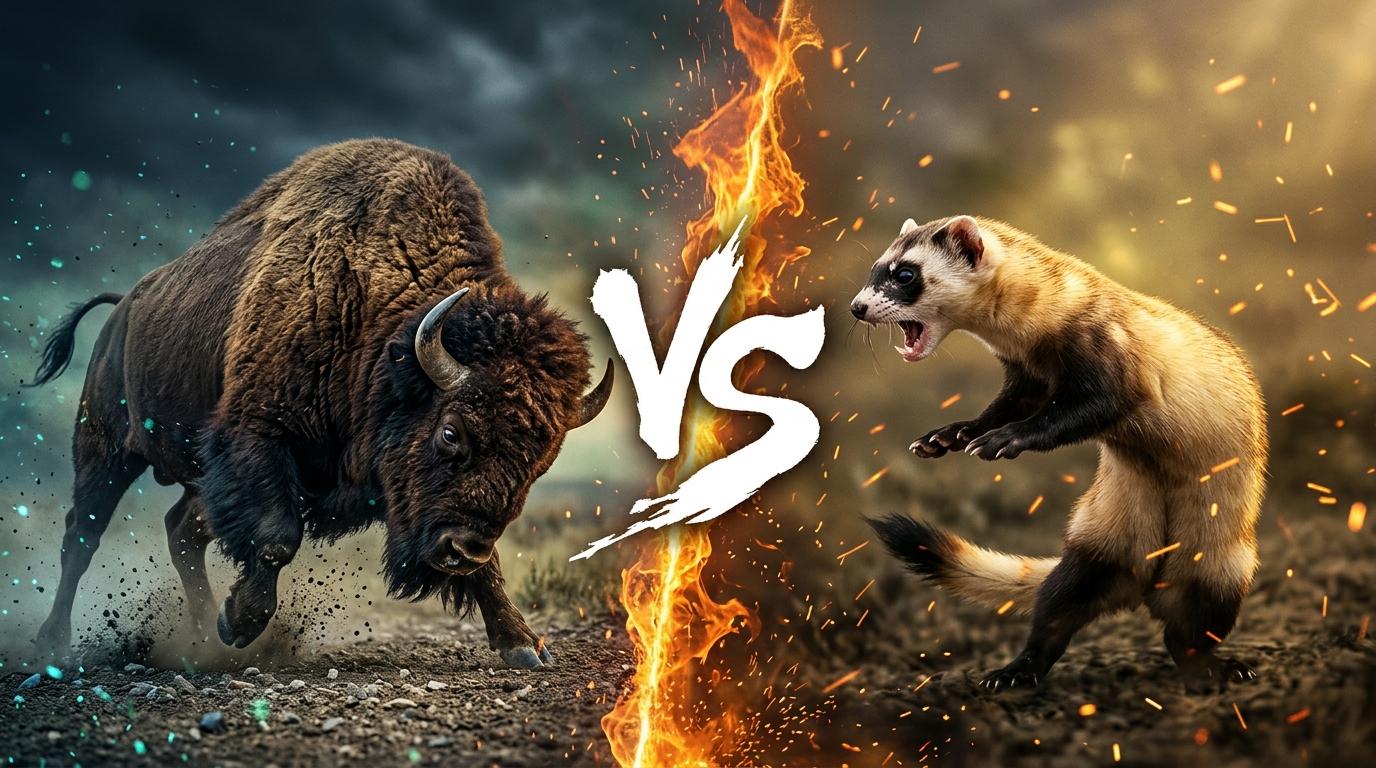
American Bison vs Black-footed Ferret: Who Actually Wins?
The American bison wins, and it isn't close in a direct confrontation. A bull bison can weigh around 900 kg, while a black-footed ferret weighs about 1 kg, a mass gap of nearly a thousand to one. The bison's charge, horns, hooves and thick hide mean the ferret has no meaningful way to injure it. The ferret's real strengths are elsewhere: it is a specialist predator built to slip into prairie dog burrows and kill prey its own size in total darkness. That makes it nearly impossible for the bison to catch underground, but avoiding a fight is not the same as winning one. On open prairie, where both species actually live, the bison controls the space and the ferret's only sensible move is to disappear.
Read comparison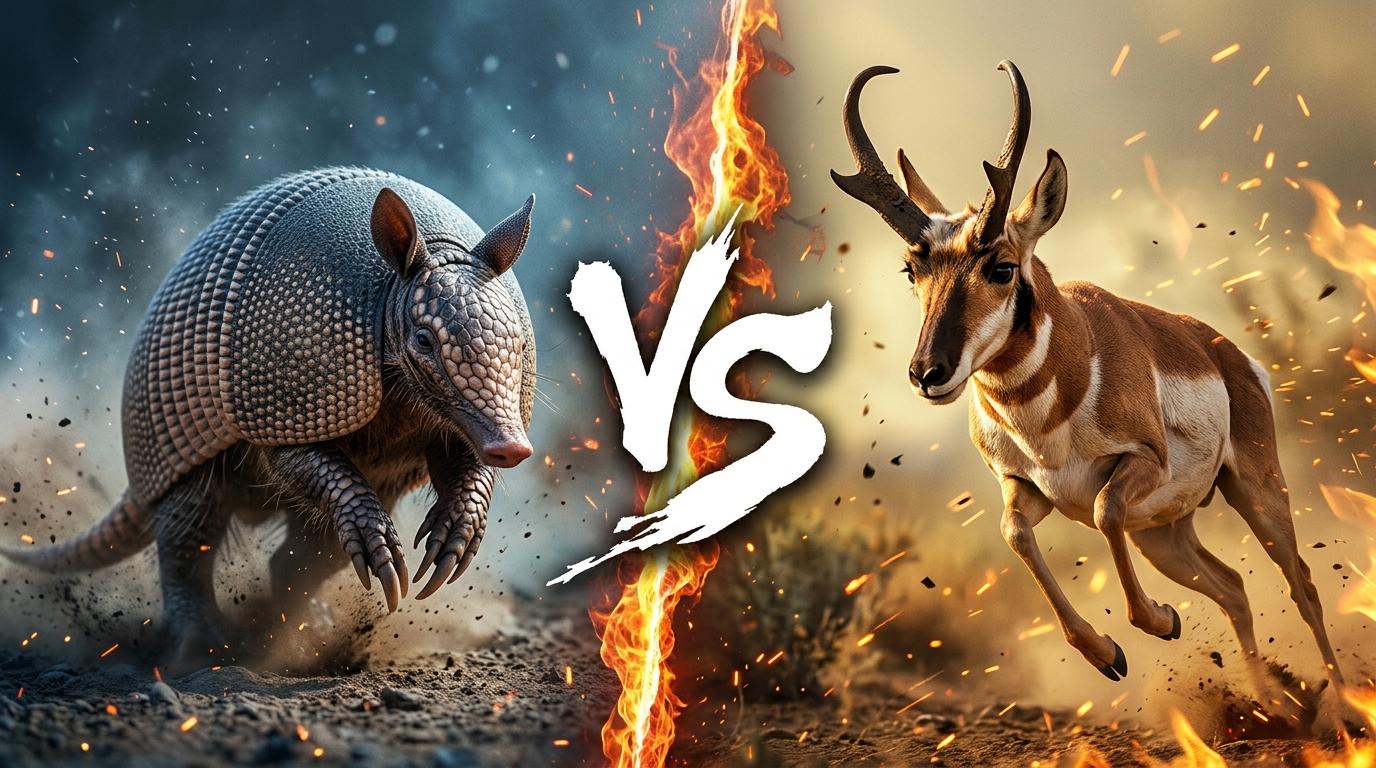
Nine-banded Armadillo vs Pronghorn: Who Actually Wins?
The pronghorn wins, and it is not especially close. A healthy adult pronghorn weighs roughly 40–65 kg, about ten times the mass of a 3–7 kg nine-banded armadillo. It carries sharp, pointed hooves, and bucks carry forked horns used in real shoving duels. The armadillo's armor is genuine bony protection, but this species cannot roll into a sealed ball; only the three-banded armadillos can do that. Its soft belly stays exposed, and its main weapons are digging claws built for soil and insect nests, not for fighting a large ungulate. The pronghorn's catch is motivation, not ability. It is a grazer and browser with no reason to start this fight, and most real encounters would end with one animal ignoring the other. If the two are forced into a confrontation, though, size, reach, and hoof strikes decide it for the pronghorn.
Read comparison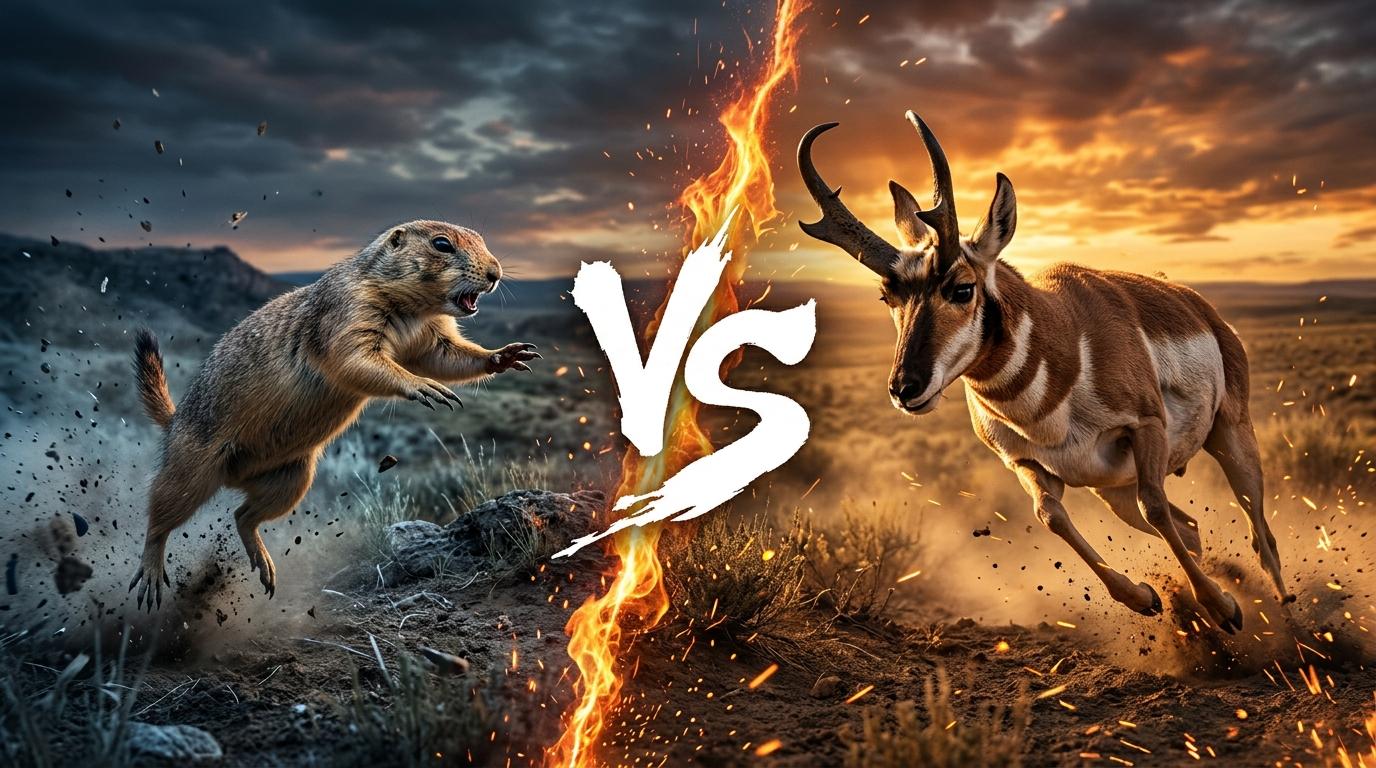
Prairie Dog vs Pronghorn: Who Actually Wins?
The pronghorn wins, and it isn't close. An adult pronghorn weighs roughly 40–65 kg against a prairie dog's 0.7–1.4 kg, about 40 to 60 times heavier. It carries sharp, forward-hooking horn sheaths, hard cloven hooves, and a frame built for violent rutting clashes with other bucks. The black-tailed prairie dog is a sharp, socially sophisticated rodent with chisel incisors and one of the most information-rich alarm-call systems known in mammals. Every one of those tools is built to avoid a fight, not win one. In any frame where the two actually make contact, mass, reach, and hooves decide it in the pronghorn's favor. The prairie dog's only true victory condition is the burrow, which ends the encounter rather than winning it.
Read comparison
Discussion
What do you think?
Share your reasoning with other readers. Be civil and stick to the animals.
Sign in to join the discussion.
Sign inNo comments yet. Start the conversation.