

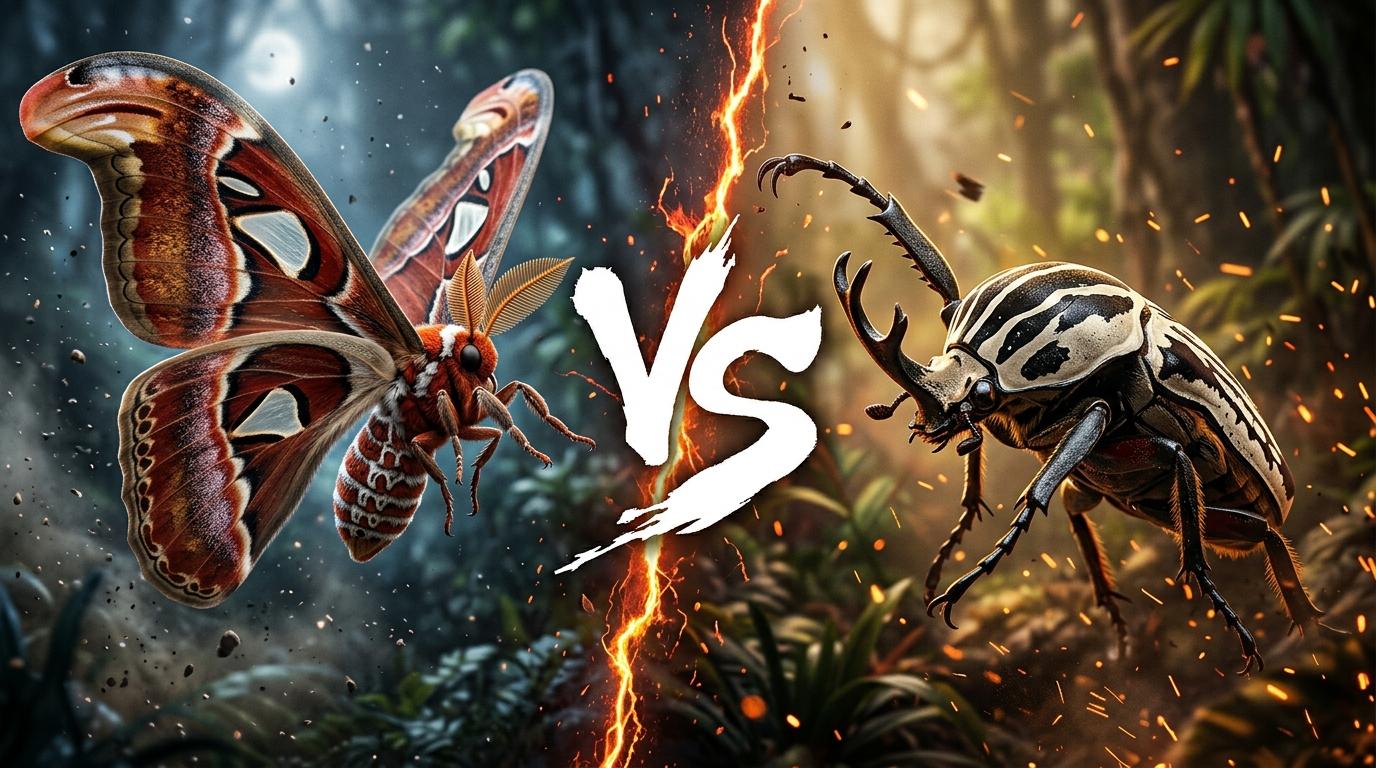
Atlas Moth vs Goliath Beetle: Who Actually Wins?
Atlas moth vs Goliath beetle: the giant-winged bluffer meets one of the heaviest insects alive. See who wins, why, and where the moth still has an edge.
Atlas Moth vs Goliath Beetle
Matchup winner
Goliath Beetle
Quick verdict
Start with the direct answer, then use the structured comparison below to see what changes the outcome.
The Goliath beetle wins, and it is not especially close. The Atlas moth is spectacular, with one of the largest wing areas of any insect, but almost all of that size is thin, scaled membrane on a light body. The adult moth also cannot feed: it has no functional mouthparts, lives only about one to two weeks on fat stored as a caterpillar, and never evolved to grapple, bite, or absorb force. The Goliath beetle is the opposite build. It is a dense, armored scarab weighing several times more than the moth, with hardened elytra, powerful legs, and hooked tarsal claws. Males carry a Y-shaped head horn used in shoving contests with rival males. In any forced contact, the beetle's mass, grip, and armor overwhelm a fragile flier whose only real tools are mimicry and escape. The moth's best outcome is to leave before contact happens, not to win once it does.
Read the full explanation
Winner: Goliath beetle. It brings armor, mass, grip, and a combat horn against an animal built for display and breeding.
The Atlas moth's huge wings look intimidating, but they are a liability in close contact.
The adult Atlas moth cannot eat and lives only about 1–2 weeks, so it has no stamina to spare.
The moth's only realistic win condition is flying away before the beetle can grab it.
Reader vote
Who do you think wins?
Pick a side — no account needed. Results update live.
No votes yet — be the first to call it.
Editorial note
Why people disagree
Wingspan fools people: the Atlas moth looks like the 'bigger' insect, but the Goliath beetle is far heavier and far denser.
Close-range durability
Contact damage decides insect clashes. The moth's wings tear and lose scales at a touch, while the beetle's armor shrugs off pressure.
Mass and leverage
Mass converts directly into shoving and pinning power. The beetle out-weighs the moth several times over.
Grip and weaponry
The beetle evolved for wrestling rivals on branches. The moth has nothing to grab, cut, or pry with.
Read the full explanation +
The moth's wingtips resemble cobra heads, which reads as menacing, but it is a bluff aimed at vertebrate predators, not a weapon.
Some readers count 'escape' as winning. In an open-air encounter the moth can simply leave, which feels like a moral victory even though it never beats the beetle.
Comparison FAQ
Short, direct answers to the next questions readers usually ask after the headline verdict.
Would an Atlas moth beat a Goliath beetle?+
No. The Goliath beetle wins any physical clash thanks to its armor, mass, claws, and horn. The moth's only success is escaping by air before contact.
Which is stronger, the Atlas moth or the Goliath beetle?+
The Goliath beetle by a wide margin. It is among the heaviest insects on Earth and is built for pushing and gripping. The Atlas moth is large in wingspan but light and fragile.
Is the Atlas moth bigger than the Goliath beetle?+
In wingspan and wing area, yes. In weight and body density, no. The Goliath beetle is far heavier, and weight is what matters in a fight.
Why is the Atlas moth still a tough opponent if it loses?+
Its wingtip patterns mimic snake heads, and a sudden wing flash can startle visual predators. Its broad wings also let it glide away fast in open space. It does not need to win fights, because it is designed to avoid them.
Can a Goliath beetle hurt people?+
Not meaningfully. Its claws can grip skin firmly, but it is harmless to humans.
Do Atlas moths eat?+
Adults do not. They have no functional mouthparts and live off reserves stored as caterpillars, surviving roughly one to two weeks.
Head-to-head species stats
These are the same core AnimalDex stat dimensions used on the dedicated animal pages, pulled side by side so the matchup is faster to scan.
Atlas Moth
Tier CGoliath Beetle
Tier CTrait-by-trait comparison
Only the categories that matter to this matchup are included. The goal is not filler stats, but the real design differences that change the result.
Soft body, scale-covered membrane wings
Close-range durability
Goliath Beetle
Hardened elytra and thick exoskeleton
Close-range durability
Goliath Beetle
Huge surface area, low body mass
Mass and leverage
Goliath Beetle
One of the heaviest insects; dense, compact frame
Mass and leverage
Goliath Beetle
No functional mouthparts, no weapons
Grip and weaponry
Goliath Beetle
Hooked tarsal claws; males carry a Y-shaped horn
Grip and weaponry
Goliath Beetle
Broad, gliding wings; can drift away from threats
Escape flight
Atlas Moth
Capable but loud, heavy flier
Escape flight
Atlas Moth
Snake-head wingtip mimicry, sudden wing flash
Bluff and deterrence
Atlas Moth
Bold patterning, armored bulk
Bluff and deterrence
Atlas Moth
Adults cannot feed; run on larval fat reserves
Endurance budget
Goliath Beetle
Adults feed on sap and fruit
Endurance budget
Goliath Beetle
How the verdict forms
Verdict timeline
01 · Close-range durability
Goliath Beetle
02 · Mass and leverage
Goliath Beetle
03 · Grip and weaponry
Goliath Beetle
04 · Escape flight
Atlas Moth
05 · Bluff and deterrence
Atlas Moth
06 · Endurance budget
Goliath Beetle
Change the conditions
Scenario breakdown
This is where shallow battle content usually fails. Terrain, spacing, timing, and engagement style can change the answer.
Scenario lean
Goliath Beetle
Verdict confidence
82%
The beetle wins decisively.
On a cluttered branch the moth's wings snag and it cannot take off cleanly. The Goliath beetle is built for exactly this terrain. Its claws hold bark, and its body is shaped for shoving rivals off perches. Contact quickly damages the moth's wings and ends any hope of escape.
AnimalDex field profiles
Explore these animals
Atlas Moth
Attacus atlas
Tropical forest, plantation edge, and wooded gardens with suitable host plants.
Goliath Beetle
Goliathus goliatus
tropical forest canopy and woodland edge
Systems Intelligence & Hidden Purpose
See the animals behind this comparison as engineered biological systems: what each one is built to do, where it gains leverage, and why the matchup changes by scenario.
Specialized Hardware
Massive wing display, stored larval energy, and adult life focused almost entirely on reproduction make atlas moths short-window signaling hardware.
Systems Script
Atlas moths compress their adult mission into mating, while caterpillars do the real accumulation phase earlier. The design is blunt but effective: build first, signal later.
Strategic Insight
Not every phase should multitask. Some windows are for building, others are for deploying.
Specialized Hardware
massive armored body, bold black-and-white pattern, and flower and sap feeding give the Goliath Beetle a body plan tuned for its niche.
Systems Script
Goliath Beetles operate through tropical forest canopy and woodland edge. Their design links movement, feeding, shelter, and timing into one workable survival system.
Strategic Insight
Dense environments reward precision, patience, and the ability to read layered cover.
Final take
The Goliath beetle is the clear winner. It is a compact armored wrestler that evolved to grip branches and fight rivals with a horn. The Atlas moth is a short-lived breeding flier built for display and dispersal. When contact happens, density beats surface area every time.
Read the full explanation
The Atlas moth's real genius is avoiding fights. Its wingtip snake mimicry and its brief, fasting adult life are strategies for breeding before anything catches it. That works well against hungry birds, but it offers nothing against an armored insect at close range.
In the wild these two would never meet: Atlas moths live in South and Southeast Asian forests, and Goliath beetles in equatorial Africa. In a hypothetical clash, though, the beetle owns the decisive frame.
Collect both animals in AnimalDex
Track the species behind this matchup, compare their real traits, and build the rivalry into your AnimalDex collection.
Related comparisons
Continue with nearby matchups to compare more real-world animal traits without dropping into junky who-wins filler.
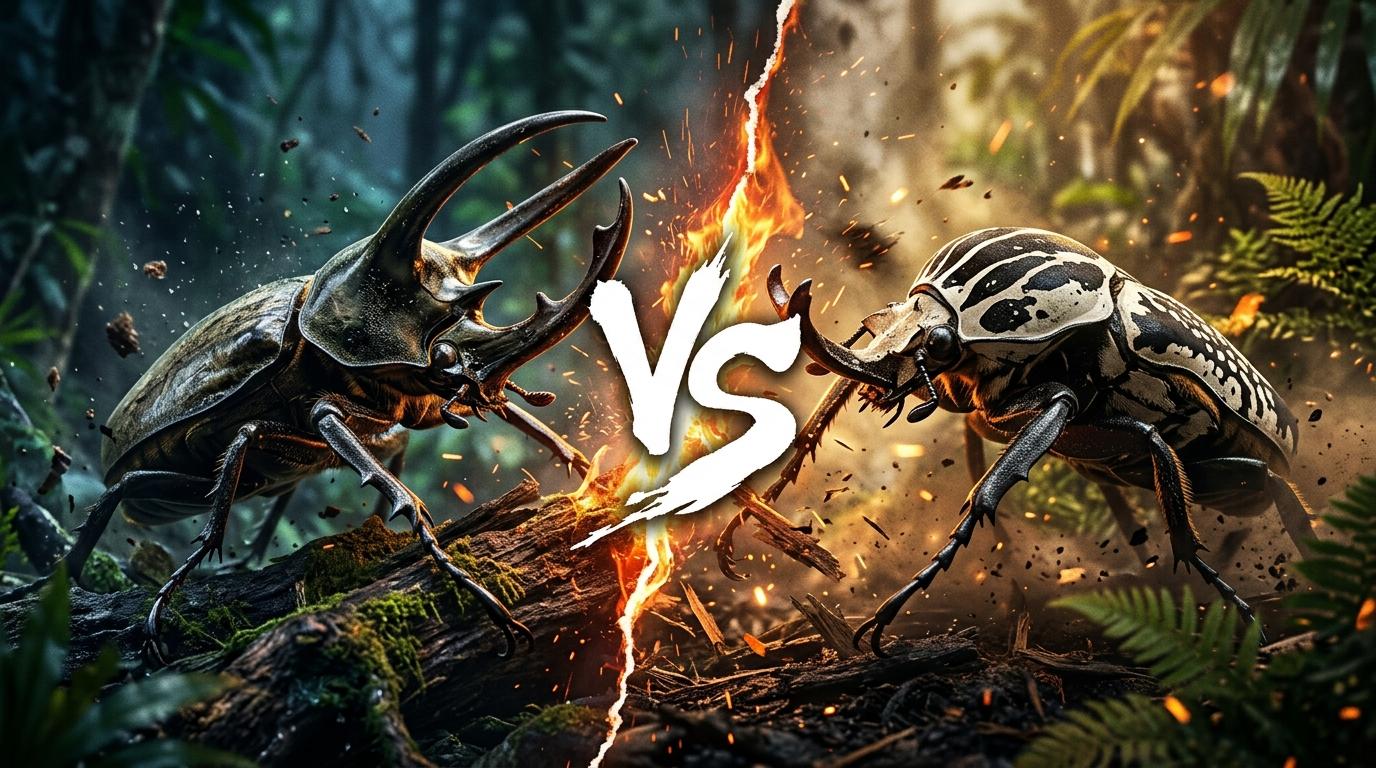
Atlas Beetle vs Goliath Beetle: Who Actually Wins?
The Atlas beetle wins this matchup more often than not, at about 62% confidence. The Goliath beetle is the heavier, bulkier insect and one of the heaviest adult beetles on Earth, so it has the advantage in raw mass and grip. But a male Atlas beetle carries dedicated combat hardware: long curved horns on its thorax that work against its head horn like a clamp. Its whole fighting style is built around one goal, which is getting under a rival, pinching it, and levering it off a branch. A male Goliath has a Y-shaped head horn and real shoving power, but its body plan leans more toward feeding, flying and carrying weight than toward specialized wrestling. In a contest decided by flipping or dislodging the opponent, which is how beetle fights actually end, the specialist's leverage beats the generalist's heft in most settings.
Read comparison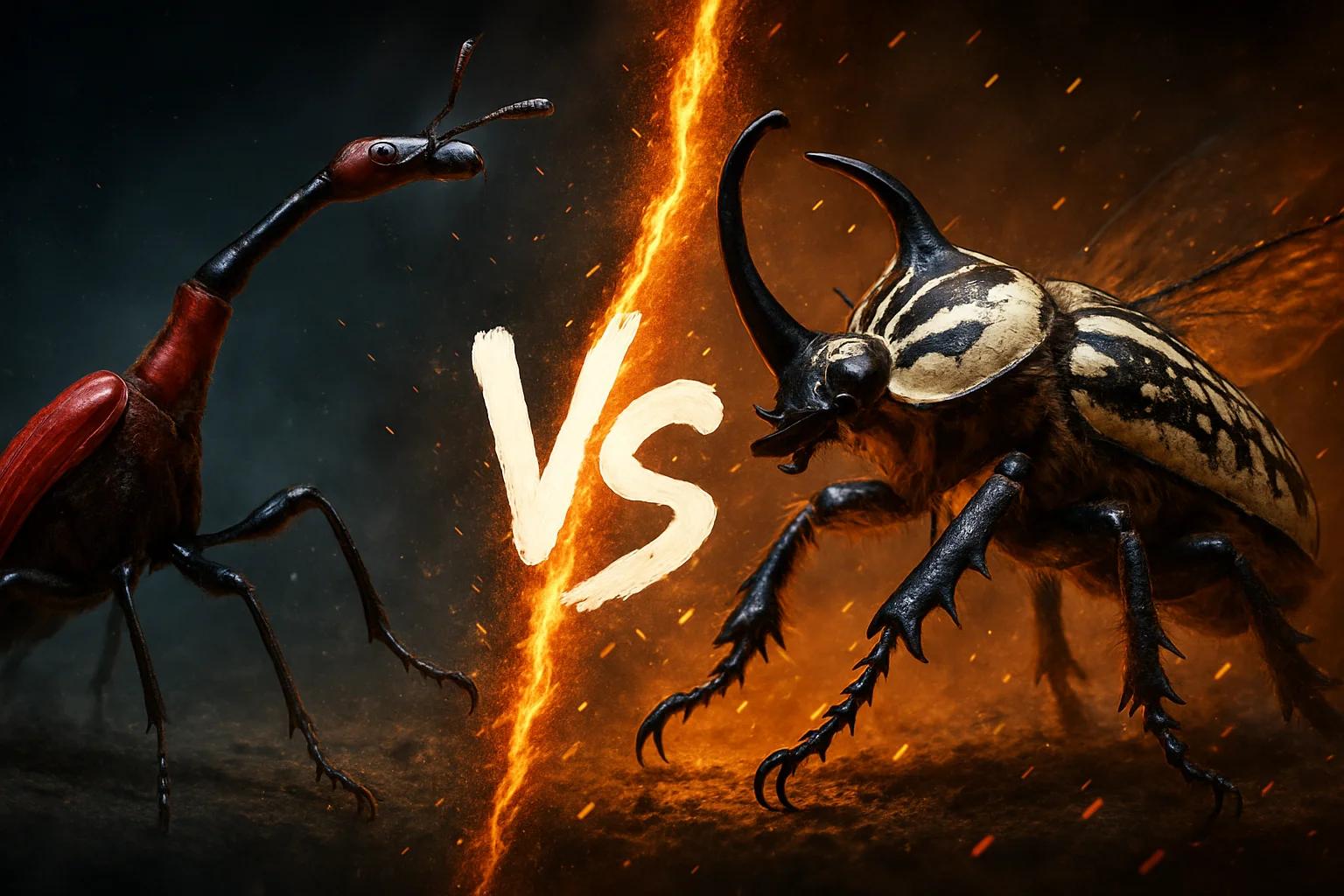
Giraffe Weevil vs Goliath Beetle: Who Actually Wins?
The Goliath beetle wins, and it is not close. Goliathus goliatus is one of the heaviest insects on Earth. Adults reach roughly 6–11 cm and can weigh tens of grams in the larval stage. Madagascar's giraffe weevil is a slender 2–2.5 cm specialist built around an elongated neck for leaf-rolling and male sparring. The Goliath's thick, domed elytra and powerful tarsal claws give it a massive mass and armor edge. Males also carry a Y-shaped head horn used to shove rivals off feeding sites. The weevil's neck is a display-and-leverage tool, not a weapon that can pry open beetle armor. In any contact scenario the Goliath simply outweighs, out-grips and out-shoves it. The weevil's real 'wins' come from not being there: it can fly off, drop from the plant, or avoid the confrontation entirely.
Read comparison
Atlas Moth vs Orchid Mantis: Who Actually Wins?
The Orchid Mantis wins this matchup, and the reason is simple biology: it is a predator built to seize flying insects, while the Atlas Moth is a short-lived adult built only to mate and lay eggs. Its wingspan can approach 25 cm and dwarfs a female orchid mantis, which is roughly 6–7 cm long, but the moth's adult stage has no functional mouthparts, no weapon, and no reason to fight. A female orchid mantis that locks its spined raptorial forelegs around the moth's soft thorax holds the only offensive tool in the matchup. The moth's real defenses are size, snake-head wingtip bluffing, and slippery scales that can tear away from a predator's grip. Those defenses make it a dangerous mark to hold, not a winner. If the mantis lands a clean grab, the contest is effectively over. The moth wins only by never being grabbed.
Read comparison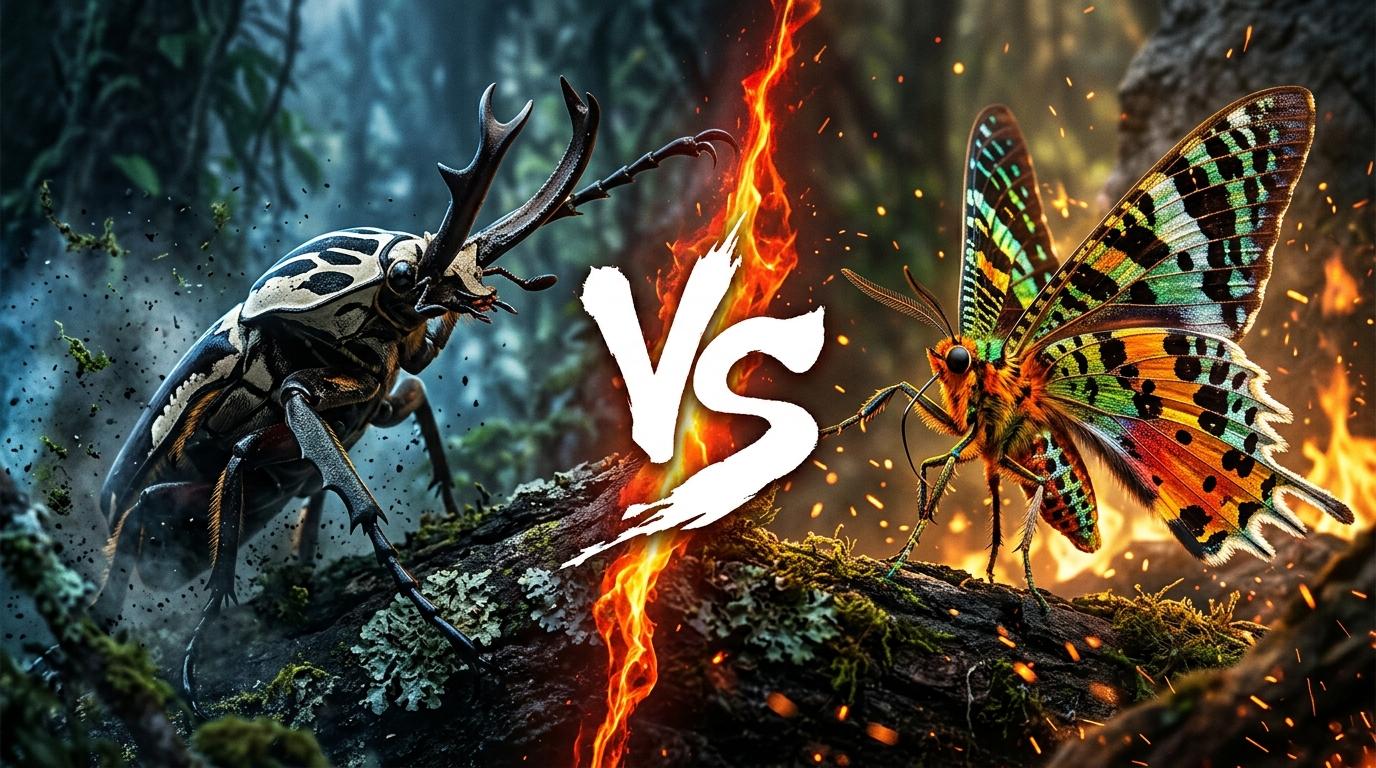
Goliath Beetle vs Sunset Moth: Who Actually Wins?
The Goliath beetle wins clearly. It is one of the heaviest insects on Earth, with adult males reaching about 11 cm and up to roughly 50 g as larvae. It carries a hardened exoskeleton, gripping tarsal claws, and males have a forked head horn built for shoving rivals off sap flows and branches. The sunset moth (Chrysiridia rhipheus) is a spectacular day-flier with iridescent wings and toxins sequestered from its Omphalea host plants as a caterpillar. Its body is light, soft, and built for flight, not contact. It has no weapon that can hurt an armored beetle, and its chemical defense deters vertebrate predators, not a beetle that only feeds on sap and fruit. In any forced physical contest, the beetle's mass and armor decide it. The moth's real win condition is leaving, and leaving is not winning.
Read comparison
Discussion
What do you think?
Share your reasoning with other readers. Be civil and stick to the animals.
Sign in to join the discussion.
Sign inNo comments yet. Start the conversation.