

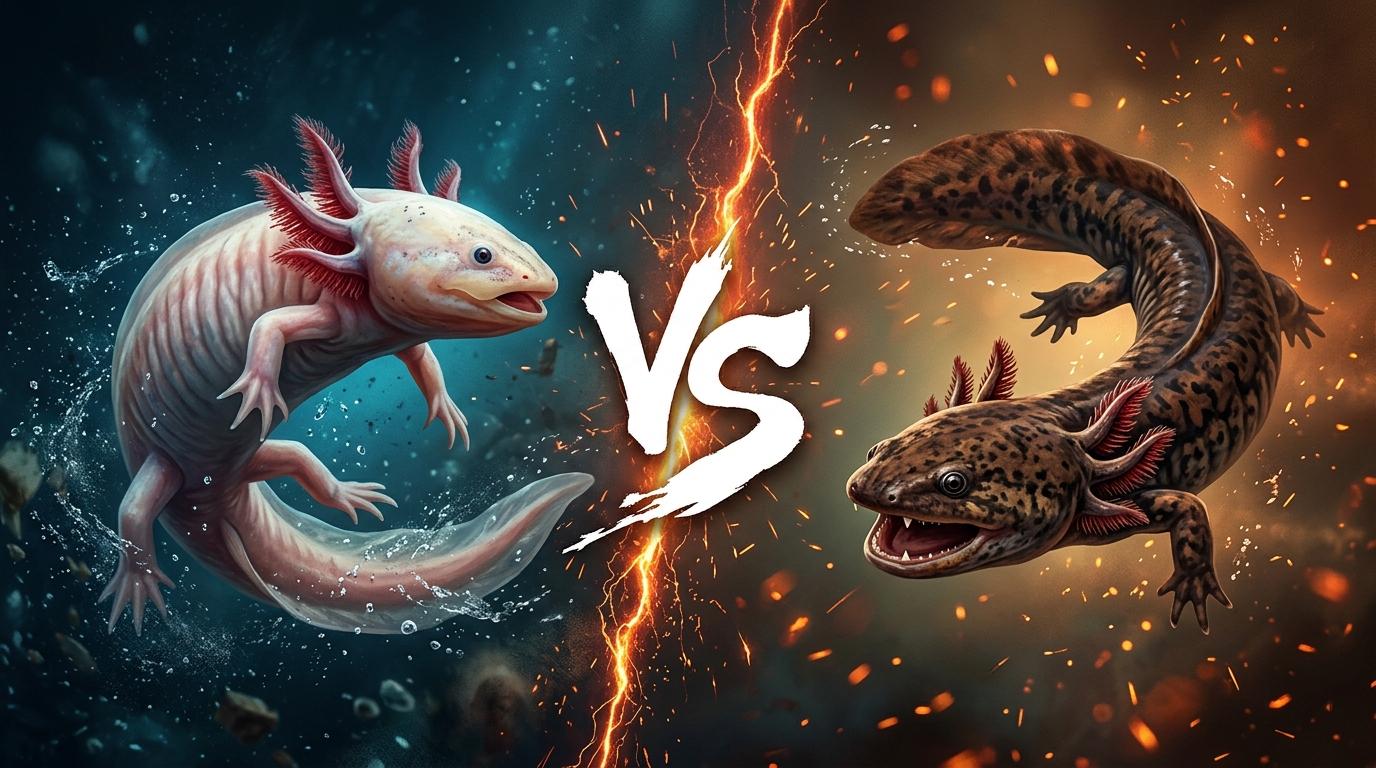
Axolotl vs Mudpuppy: Who Actually Wins?
Axolotl vs mudpuppy, the battle of the gilled salamanders. We compare size, bite, toughness, and regeneration to explain why the mudpuppy usually comes out ahead.
Axolotl vs Mudpuppy
Matchup winner
Mudpuppy
Quick verdict
Start with the direct answer, then use the structured comparison below to see what changes the outcome.
The mudpuppy wins this matchup most of the time. Both are permanently gilled, aquatic salamanders, but the mudpuppy is the bigger, bulkier, more committed predator. Adults commonly reach about 30 cm and sometimes exceed 40 cm, while wild axolotls typically measure around 15–25 cm. The mudpuppy's jaws carry rows of small teeth built for gripping crayfish, fish, and other armored or slippery prey, and it stays active in cold water when many amphibians shut down. The axolotl is quicker off the mark and has the most famous regenerative ability among vertebrates. It does not have the frame or grip to control a larger opponent, though. Its suction-feeding style is tuned for worms, insect larvae, and small fish, not for dominating another salamander its own size or larger. In a realistic encounter, the mudpuppy's size and gripping bite decide the outcome. The axolotl's regeneration makes it a resilient survivor, not a winner.
Read the full explanation
The mudpuppy wins thanks to greater length, body mass, and a gripping jaw made for crayfish.
The axolotl is slightly faster and more reactive, but it lacks the size to control the encounter.
Axolotl regeneration helps it recover from damage. It does not help it win the exchange.
Both species have exposed external gills, so neither is armored. Size becomes the tiebreaker.
Reader vote
Who do you think wins?
Pick a side — no account needed. Results update live.
No votes yet — be the first to call it.
Editorial note
Why people disagree
Many people know axolotls only as pets and underestimate how much larger and more predatory a wild adult mudpuppy is.
Body mass and reach
Among small aquatic predators, length and head width determine who can grip whom. The mudpuppy simply out-sizes the axolotl.
Grip bite
A jaw built to hold struggling, hard-shelled prey translates directly into control in a close-quarters scuffle.
Burst reaction
The axolotl can strike first or slip away, which matters most in open water.
Read the full explanation +
Regeneration sounds like a superpower in a fight, but regrowing tissue takes weeks. It matters for survival, not for the encounter itself.
The two species never meet in the wild. Axolotls live in the Xochimilco canals of Mexico, and mudpuppies live in North American lakes and rivers. Every verdict is a biology-based hypothetical.
Comparison FAQ
Short, direct answers to the next questions readers usually ask after the headline verdict.
Would an axolotl beat a mudpuppy?+
Usually not. The mudpuppy is larger and has a stronger gripping bite, so it wins most realistic encounters. The axolotl's best outcome is a quick escape.
Which is stronger, an axolotl or a mudpuppy?+
The mudpuppy. It grows longer and heavier, and its jaws are built to hold crayfish and fish.
Is the axolotl still dangerous to a mudpuppy?+
In a limited way. It can make fast suction strikes and nip, and its regeneration lets it recover from injuries that would set back other amphibians.
Do axolotls and mudpuppies live together?+
No. Axolotls are native only to the Mexico City area, and mudpuppies live in eastern North America. Keeping them together in captivity is not recommended.
Are mudpuppies and axolotls related?+
Both are salamanders that keep external gills as adults, but they belong to different families, Ambystomatidae and Proteidae.
Head-to-head species stats
These are the same core AnimalDex stat dimensions used on the dedicated animal pages, pulled side by side so the matchup is faster to scan.
Axolotl
Tier CMudpuppy
Tier DTrait-by-trait comparison
Only the categories that matter to this matchup are included. The goal is not filler stats, but the real design differences that change the result.
Typically 15–25 cm in the wild, slender build
Body mass and reach
Mudpuppy
Commonly about 30 cm, up to 40+ cm, broad flat head
Body mass and reach
Mudpuppy
Small teeth, suction-gulp feeding
Grip bite
Mudpuppy
Rows of small teeth for holding crayfish and fish
Grip bite
Mudpuppy
Quick tail-driven lunges
Burst reaction
Axolotl
Deliberate, slower bottom-cruiser
Burst reaction
Axolotl
Regrows limbs, gills, even parts of organs
Damage recovery
Axolotl
Normal amphibian healing
Damage recovery
Axolotl
Needs cool, still, clean water
Environmental toughness
Mudpuppy
Tolerates icy, flowing, variable water and is active in winter
Environmental toughness
Mudpuppy
Sit-and-wait suction strikes
Ambush control
Mudpuppy
Rock-and-debris lurker that pins prey
Ambush control
Mudpuppy
How the verdict forms
Verdict timeline
01 · Body mass and reach
Mudpuppy
02 · Grip bite
Mudpuppy
03 · Burst reaction
Axolotl
04 · Damage recovery
Axolotl
05 · Environmental toughness
Mudpuppy
06 · Ambush control
Mudpuppy
Change the conditions
Scenario breakdown
This is where shallow battle content usually fails. Terrain, spacing, timing, and engagement style can change the answer.
Scenario lean
Mudpuppy
Verdict confidence
82%
The mudpuppy's home turf.
Mudpuppies spend their days wedged under rocks and logs, waiting to grab passing prey. In tight cover, the axolotl's speed advantage disappears and the fight becomes a contest of grip and mass. The mudpuppy wins that contest.
AnimalDex field profiles
Explore these animals
Axolotl
Ambystoma mexicanum
Cool freshwater canals, remnant lakes, and slow wetland channels with cover.
Mudpuppy
Necturus maculosus
Cool rivers, lakes, reservoirs, and rocky freshwater bottoms.
Systems Intelligence & Hidden Purpose
See the animals behind this comparison as engineered biological systems: what each one is built to do, where it gains leverage, and why the matchup changes by scenario.
Specialized Hardware
External gills, aquatic neoteny, and unusual regenerative capacity make axolotls living hardware for low-motion survival and tissue rebuilding.
Systems Script
Axolotls occupy cool freshwater systems where regeneration, camouflage, and patience outperform speed. They are less about domination and more about biological repair efficiency under pressure.
Strategic Insight
Some systems win not by avoiding damage entirely, but by rebuilding faster than disruption compounds.
Specialized Hardware
Feathery red external gills, flattened body and tail, and spotted brown coloration give the Mudpuppy a body plan tuned for its niche.
Systems Script
Mudpuppys operate in cool rivers, lakes, reservoirs, and rocky freshwater bottoms. Their design helps them match food access, shelter, and timing inside that environment.
Strategic Insight
Some systems work by never leaving the environment they were built for.
Final take
This is a gentle heavyweight-versus-lightweight matchup between two gilled salamanders that never grew up in the usual sense. Both kept their larval gills for life, but they used that body plan differently. The mudpuppy became a robust, cold-tolerant predator of crayfish and fish. The axolotl became a small, fast suction feeder with extraordinary repair abilities.
Read the full explanation
When the two meet head-on, size and grip carry the day, and the mudpuppy has both. The axolotl's best results come from speed and escape, and its regeneration means it rarely stays defeated for long. Overall, the mudpuppy is the winner.
Collect both animals in AnimalDex
Track the species behind this matchup, compare their real traits, and build the rivalry into your AnimalDex collection.
Related comparisons
Continue with nearby matchups to compare more real-world animal traits without dropping into junky who-wins filler.

Axolotl vs Hamilton's Frog: Who Actually Wins?
The axolotl wins. This is a matchup between two amphibians that would never meet in nature. The axolotl is a fully aquatic salamander from the canals of Xochimilco, Mexico. Hamilton's frog is a tiny terrestrial frog from New Zealand's offshore rock piles. Once you force a meeting, size and feeding mechanics decide almost everything. An adult axolotl is often 20–25 cm long. Hamilton's frog is usually under 5 cm. The axolotl feeds by suction: it opens its wide mouth suddenly and pulls small animals in whole. A frog that size falls within the range of prey an axolotl can swallow. Hamilton's frog is built for damp rock crevices, not open water, so any meeting that touches water favors the salamander heavily. The frog's real advantages are on dry, broken ground, where the axolotl cannot function at all, and in skin secretions that may make it unpleasant to eat. Those keep this from being a total shutout, but they don't overturn the core verdict.
Read comparison
Axolotl vs Cayenne Caecilian: Who Actually Wins?
The Cayenne caecilian (Typhlonectes compressicauda) wins this matchup. It is the longer, more muscular animal, often reaching 50–60 cm against the axolotl's typical 20–30 cm, and its whole body is built for close contact. It has a reinforced, bullet-shaped skull and needle-like recurved teeth. It can also spin its entire body to wrench grip-held food apart, and its skin produces noxious secretions that discourage biting back. The axolotl is a suction feeder with a weak bite. Its feathery external gills are delicate, exposed, and sit right where an opponent would strike. The axolotl's famous ability to regrow limbs helps it survive damage, but it does not help it win an encounter. In almost every realistic contact scenario, the caecilian controls the engagement and the axolotl's best move is to leave.
Read comparison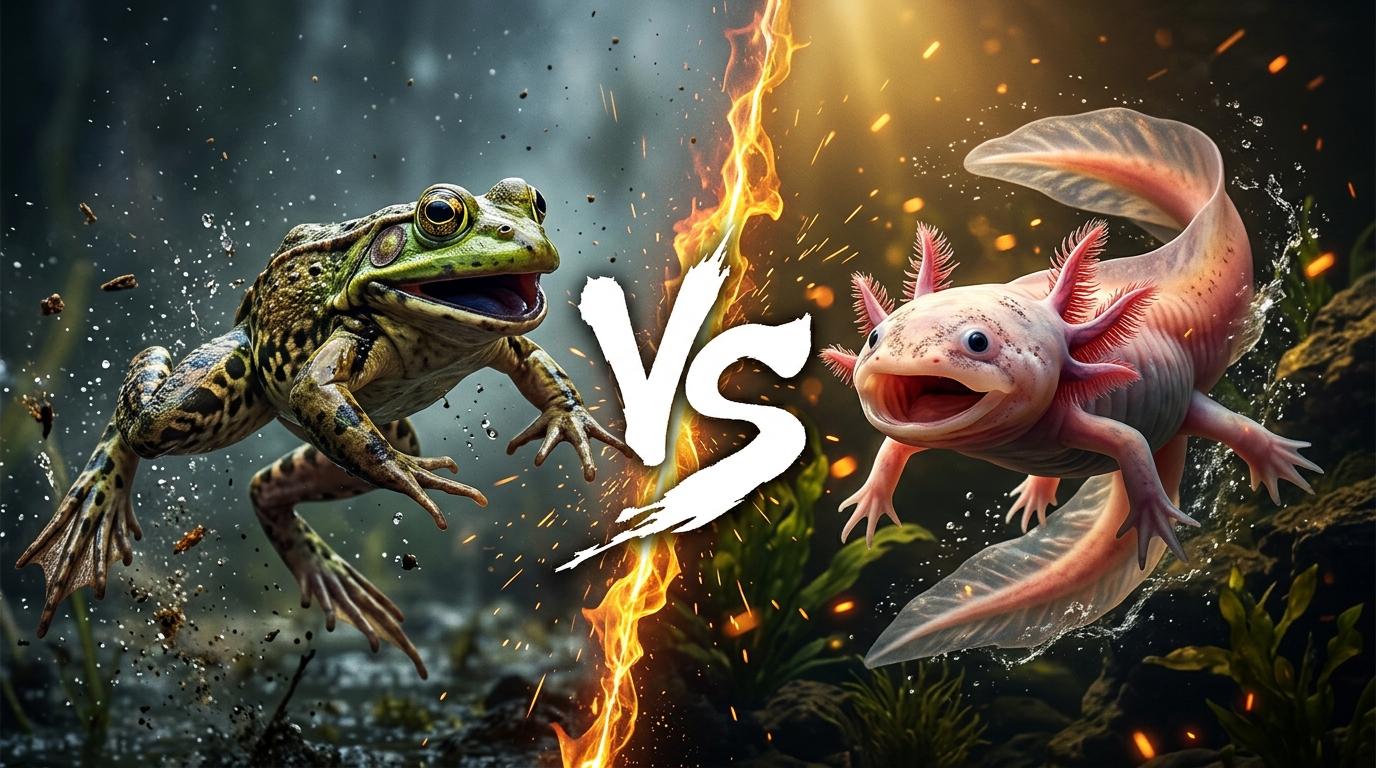
American Bullfrog vs Axolotl: Who Actually Wins?
The American Bullfrog wins, and it isn't especially close. An adult bullfrog can reach about 15–20 cm in body length and often weighs 300–500 g. It is a gape-limited swallowing predator: it lunges, pins prey with its forelimbs, and gulps down anything that fits in its mouth, including other amphibians. An adult axolotl is often 20–25 cm long, but much of that is tail, and it usually weighs only 60–110 g. It feeds by suction on small, soft prey. It has no fangs, no armored skin, and no strong burst escape on land. In shared water, the bullfrog's explosive leg drive and huge mouth beat the axolotl's slower, buoyancy-based movement. The axolotl's real superpower is regeneration, and that is a recovery trait, not a combat trait.
Read comparison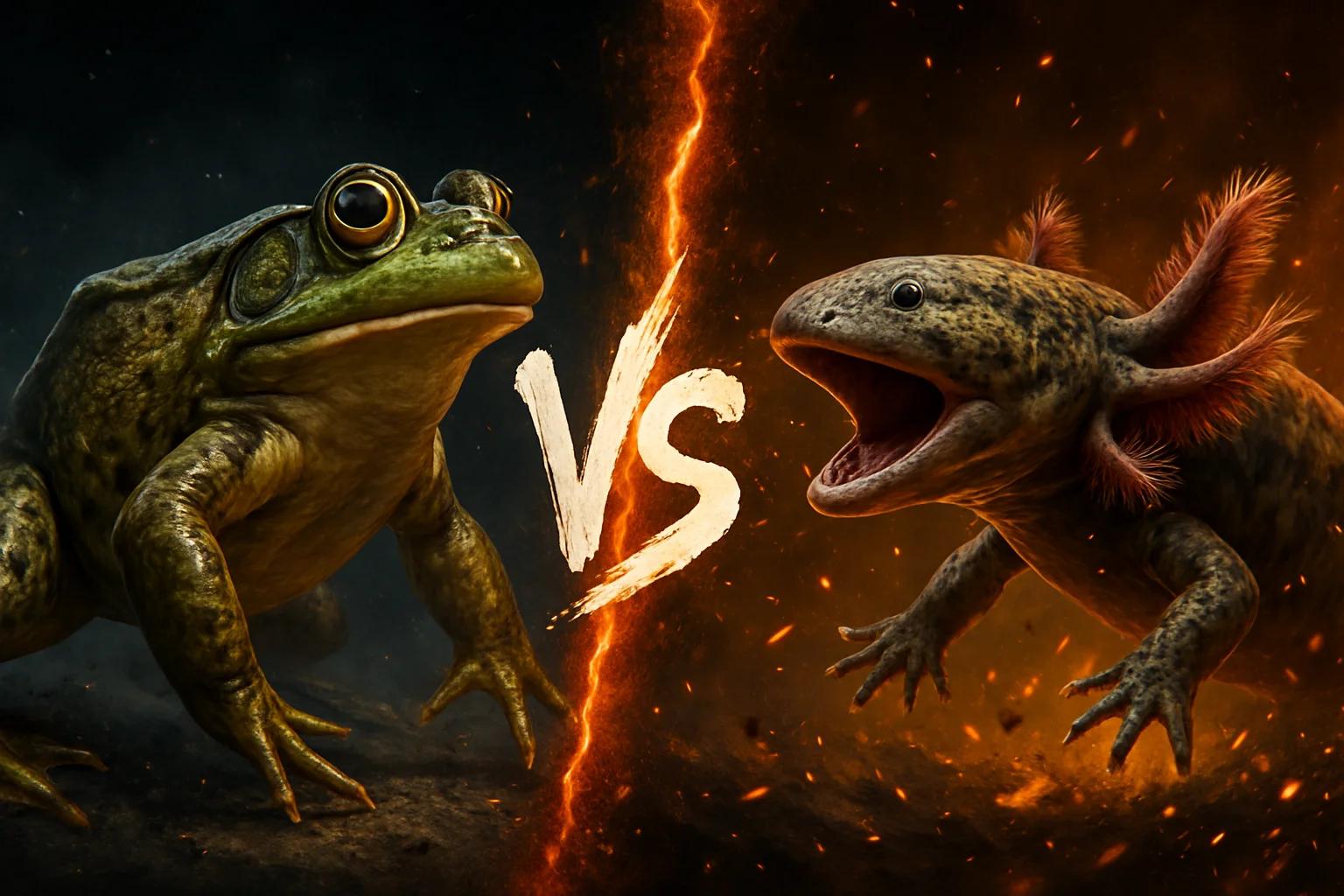
American Bullfrog vs Mudpuppy: Who Actually Wins?
The American Bullfrog wins this matchup. Both are aquatic ambush feeders that swallow prey whole, but the bullfrog brings advantages the mudpuppy cannot match: a far heavier, more muscular body (adults often reach 400–500 g, against a mudpuppy's typical 100–200 g), an enormous gape that can engulf animals nearly its own length, explosive leg-driven strikes, and a well-documented habit of eating other amphibians, including salamanders. The mudpuppy is a capable bottom predator with good chemical senses and a slippery, elongated body, but it is built for slow foraging under rocks rather than for confrontation. When the two meet, it is far more likely to be prey than predator. The mudpuppy's real edge is cold, deep, flowing water where bullfrogs are sluggish or absent. In a direct encounter in shared shallows, the frog's mass and mouth decide the outcome.
Read comparison
Discussion
What do you think?
Share your reasoning with other readers. Be civil and stick to the animals.
Sign in to join the discussion.
Sign inNo comments yet. Start the conversation.