

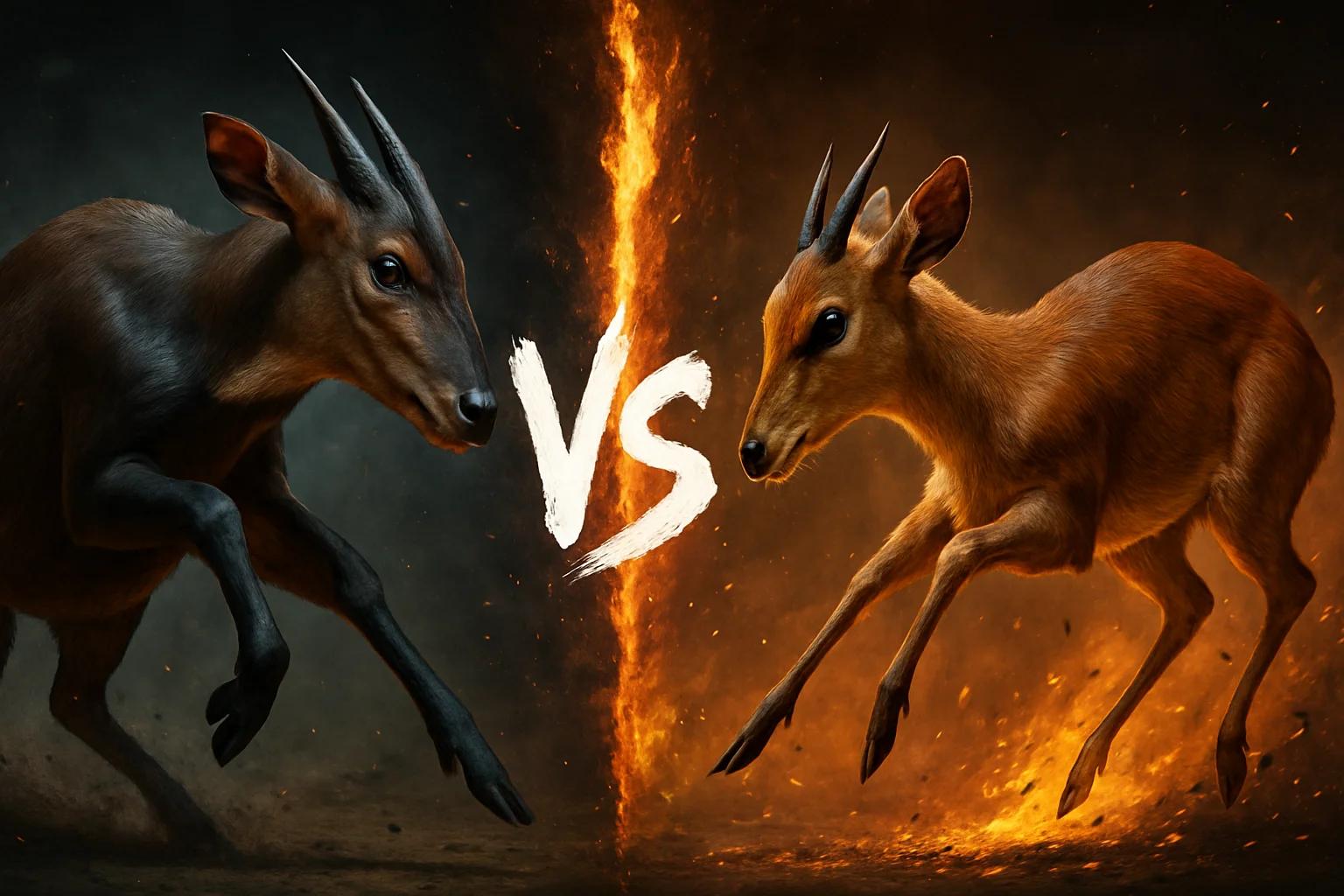
Bay Duiker vs Royal Antelope: Who Actually Wins?
Bay duiker vs royal antelope, two West African forest antelopes compared. We look at size, horns, speed, escape tactics, and who wins a forest standoff.
Bay Duiker vs Royal Antelope
Matchup winner
Bay Duiker
Quick verdict
Start with the direct answer, then use the structured comparison below to see what changes the outcome.
The bay duiker wins, and it isn't close. An adult bay duiker typically weighs about 15–24 kg, roughly six to eight times the 2–3 kg royal antelope, the smallest antelope on Earth. The duiker carries sturdy spike horns on a thick-necked, wedge-shaped body built for driving through dense undergrowth, and it has the bulk to shove a rival off a fruit patch. The royal antelope's best weapon is leaving: explosive standing leaps of over 2.5 m and a hare-like dash into tangles where a larger animal can't follow. In any contest about holding ground or forcing contact, the duiker controls the outcome. The royal antelope wins only the contests that are really about vanishing.
Read the full explanation
Bay Duiker wins overall. It has a massive weight advantage and real head-on horn power.
Royal Antelope is the smallest antelope in the world, at about hare size.
The royal antelope's edge is escape: leaps and dives into micro-cover.
In a contested food patch, the duiker simply displaces it.
Reader vote
Who do you think wins?
Pick a side — no account needed. Results update live.
No votes yet — be the first to call it.
Editorial note
Why people disagree
The royal antelope's spectacular jumping makes some readers think it can't be caught. Escaping is not the same as winning, though.
Body mass & frame
At this scale, a sixfold weight gap decides almost every shove, charge, or standoff.
Head-on weaponry
Duiker horns, backed by a muscular neck, can actually deter. Royal antelope horns are mostly symbolic.
Explosive escape
The royal antelope's spring-loaded hindquarters let it break contact before a fight can start.
Read the full explanation +
Both are shy, nocturnal-to-crepuscular forest dwellers that avoid conflict, so real confrontations are rare and poorly documented.
Rarity and charm inflate the royal antelope's image, but biology is ruled by mass, and here the mass gap is enormous.
Comparison FAQ
Short, direct answers to the next questions readers usually ask after the headline verdict.
Would a bay duiker beat a royal antelope?+
Yes. The bay duiker is several times heavier and has stronger horns, so it would dominate any direct confrontation.
Which is stronger, the bay duiker or the royal antelope?+
The bay duiker, by a wide margin. It weighs roughly 15–24 kg, while the royal antelope weighs about 2–3 kg.
Why is the royal antelope still hard to beat?+
Its explosive leaping and tiny size let it vanish into dense undergrowth almost instantly, so a larger animal rarely gets to make contact.
Do bay duikers and royal antelopes live in the same places?+
Their ranges overlap in parts of West Africa's lowland forests, where both feed on fallen fruit and leaves.
Is the royal antelope the smallest antelope?+
Yes. It is widely considered the world's smallest antelope, standing about 25 cm at the shoulder.
Head-to-head species stats
These are the same core AnimalDex stat dimensions used on the dedicated animal pages, pulled side by side so the matchup is faster to scan.
Bay Duiker
Tier BRoyal Antelope
Tier BTrait-by-trait comparison
Only the categories that matter to this matchup are included. The goal is not filler stats, but the real design differences that change the result.
~15–24 kg, compact wedge
Body mass & frame
Bay Duiker
~2–3 kg, hare-sized
Body mass & frame
Bay Duiker
Sturdy spike horns, both sexes
Head-on weaponry
Bay Duiker
Tiny ~2–3 cm spikes, males only
Head-on weaponry
Bay Duiker
Fast zigzag dive into brush
Explosive escape
Royal Antelope
Standing leaps over 2.5 m, instant bolt
Explosive escape
Royal Antelope
Pushes through dense thicket
Micro-cover mastery
Royal Antelope
Slips into gaps a duiker can't enter
Micro-cover mastery
Royal Antelope
Thick hide, low heavy build
Close-range durability
Bay Duiker
Fragile, ultralight frame
Close-range durability
Bay Duiker
Holds fruit falls, ranges widely
Resource control
Bay Duiker
Yields and browses elsewhere
Resource control
Bay Duiker
How the verdict forms
Verdict timeline
01 · Body mass & frame
Bay Duiker
02 · Head-on weaponry
Bay Duiker
03 · Explosive escape
Royal Antelope
04 · Micro-cover mastery
Royal Antelope
05 · Close-range durability
Bay Duiker
06 · Resource control
Bay Duiker
Change the conditions
Scenario breakdown
This is where shallow battle content usually fails. Terrain, spacing, timing, and engagement style can change the answer.
Scenario lean
Bay Duiker
Verdict confidence
82%
The duiker owns the patch.
Fallen figs and other forest fruit are prime food for both species. The duiker's bulk and a single head-lowered approach are enough to make the royal antelope retreat. No real fight is needed when the size gap signals the outcome.
AnimalDex field profiles
Explore these animals
Bay Duiker
Cephalophus dorsalis
lowland rainforest, dense thicket, and swamp forest edge
Royal Antelope
Neotragus pygmaeus
rainforest edge, dense thicket, and low woodland
Systems Intelligence & Hidden Purpose
See the animals behind this comparison as engineered biological systems: what each one is built to do, where it gains leverage, and why the matchup changes by scenario.
Specialized Hardware
chestnut forest-floor coat, arched back posture, and secretive understory browsing give the Bay Duiker a body plan tuned for its niche.
Systems Script
Bay Duikers operate through lowland rainforest, dense thicket, and swamp forest edge. Their design links movement, feeding, shelter, and timing into one workable survival system.
Strategic Insight
Dense environments reward precision, patience, and the ability to read layered cover.
Specialized Hardware
pinhead-sized antelope frame, delicate spindle legs, and leaf-litter hiding give the Royal Antelope a body plan tuned for its niche.
Systems Script
Royal Antelopes operate through rainforest edge, dense thicket, and low woodland. Their design links movement, feeding, shelter, and timing into one workable survival system.
Strategic Insight
Dense environments reward precision, patience, and the ability to read layered cover.
Final take
The bay duiker is the clear winner. Everything that decides a physical contest favors it: mass, horns, durability, and the ability to hold a resource. It is a compact forest bulldozer by small-antelope standards.
Read the full explanation
The royal antelope wins a different game. Its whole design is about never being caught in a contest at all, through tiny size, explosive leaps, and instant disappearance into cover. In a straight confrontation, it loses.
Collect both animals in AnimalDex
Track the species behind this matchup, compare their real traits, and build the rivalry into your AnimalDex collection.
Related comparisons
Continue with nearby matchups to compare more real-world animal traits without dropping into junky who-wins filler.
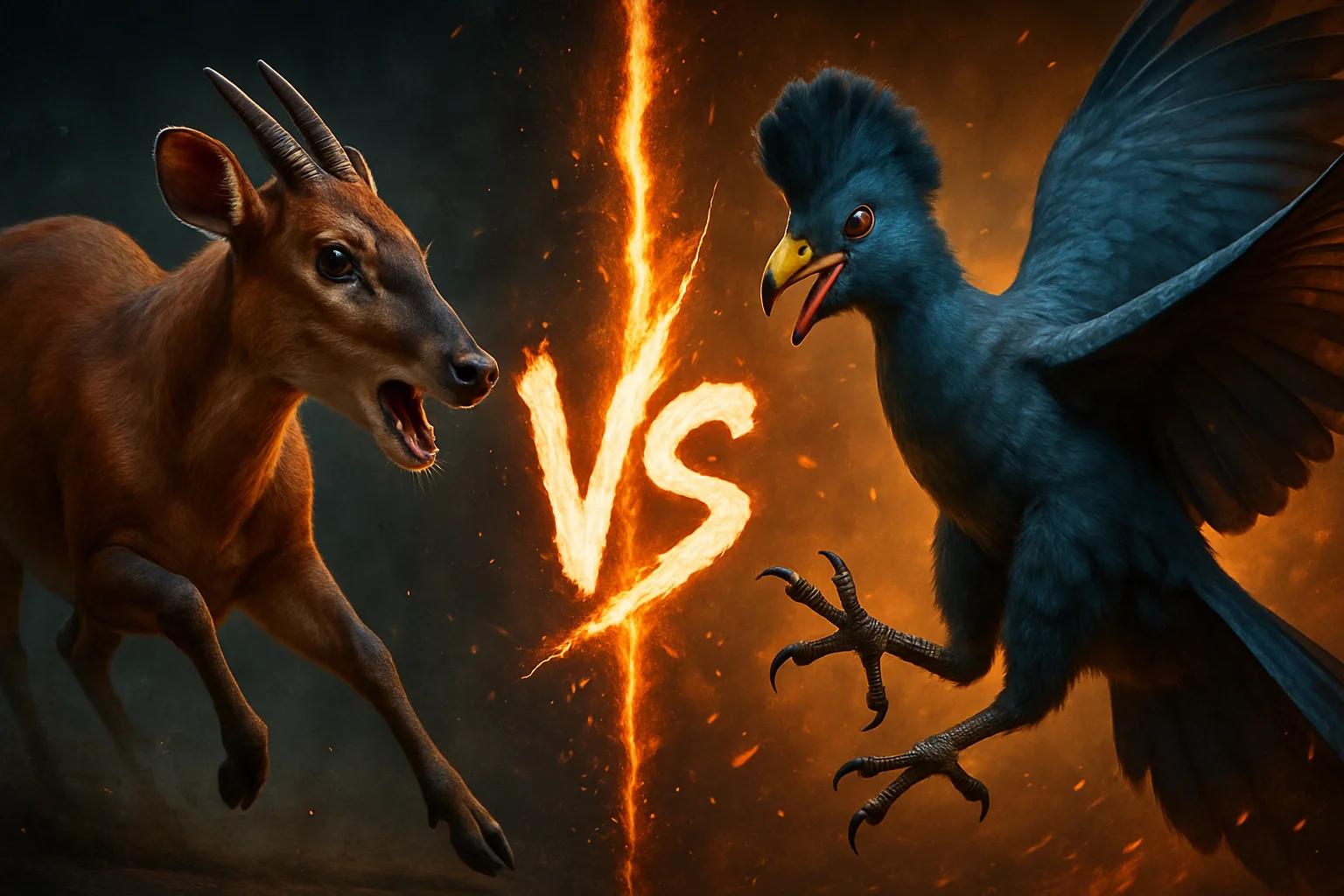
Bay Duiker vs Great Blue Turaco: Who Actually Wins?
The bay duiker wins. A bay duiker weighs roughly 15–25 kg, against about 1 kg for a great blue turaco, so it brings around twenty times the mass. It also has short, spike-like horns, a dense forehead built for butting, and hard hooves on a compact sprinter's frame. The turaco is a striking canopy specialist: about 70–75 cm long, with a heavy bill, strong feet, and a habit of bounding along branches. But it has no weapon that can seriously threaten a mammal of that size. Its real advantage is altitude, not force. If the meeting happens where the duiker can reach it, on the ground or at a fallen-fruit patch, the antelope's mass and horns settle things fast. The turaco's only reliable 'win' is to leave, usually by hopping upward and gliding away in its famously clumsy style. That counts as survival, not victory.
Read comparison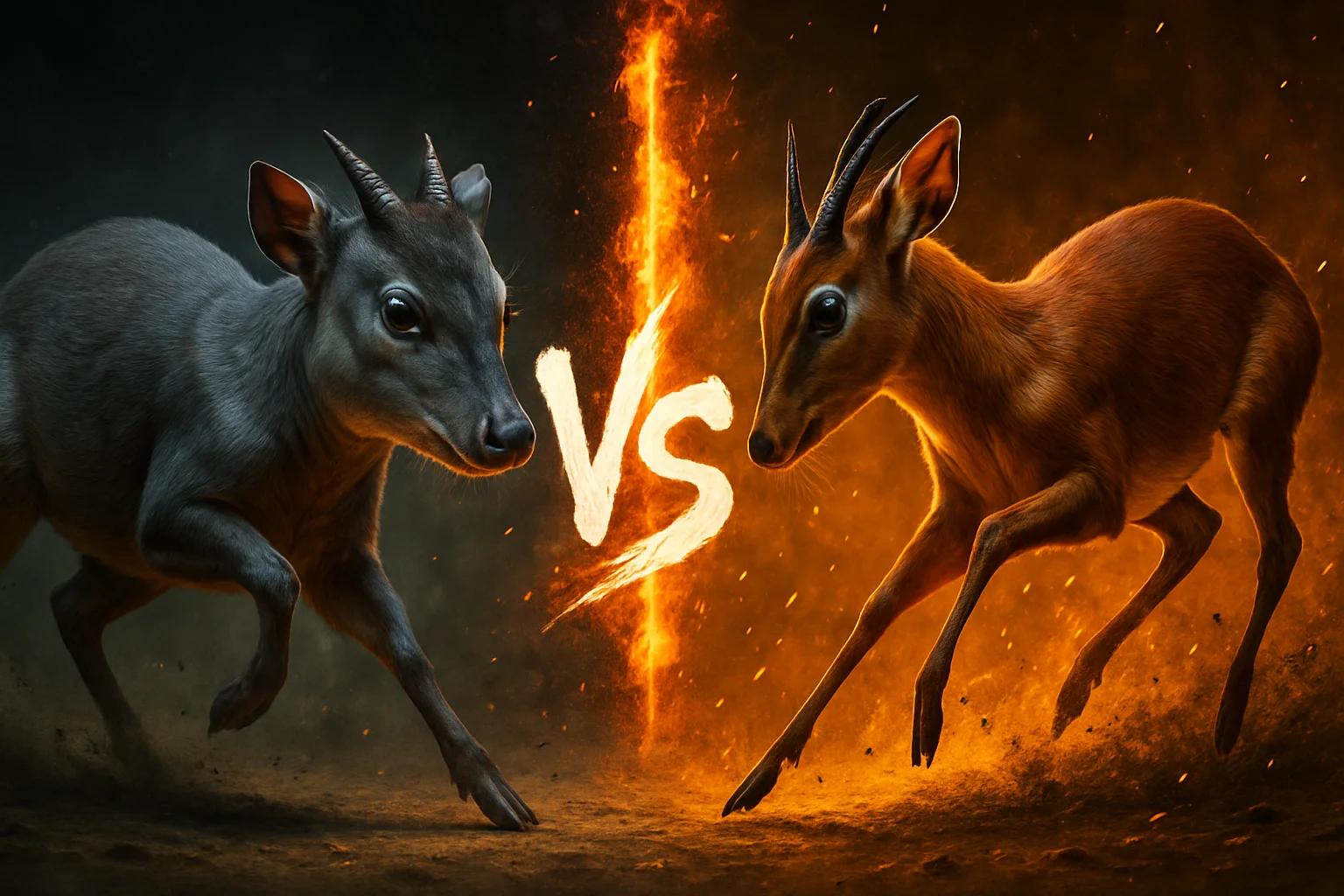
Blue Duiker vs Royal Antelope: Who Actually Wins?
The blue duiker wins. At roughly 4–9 kg against the royal antelope's 1.5–3 kg, the blue duiker carries two to four times the mass. Both sexes usually have short, sharp spike horns, and the species defends small territories in pairs, driving off rivals with butts and horn jabs. The royal antelope is the world's smallest antelope. It is built for one job: vanishing. It freezes in leaf litter and then explodes away in bounds that can reportedly cover around 2.5 m. Only males have horns, and they are tiny. In any forced confrontation, such as a shared trail or a contested fruit fall, the duiker's weight, armed females and habit of defending ground decide it. The royal antelope's real victory condition is never being there when the duiker arrives.
Read comparison
Discussion
What do you think?
Share your reasoning with other readers. Be civil and stick to the animals.
Sign in to join the discussion.
Sign inNo comments yet. Start the conversation.