


Beira vs Dibatag: Who Actually Wins?
Beira vs dibatag: who would win? A biology-first comparison of two rare Horn of Africa antelopes. We look at size, horns, speed, terrain and behavior to name a clear winner.
Beira vs Dibatag
Matchup winner
Dibatag
Quick verdict
Start with the direct answer, then use the structured comparison below to see what changes the outcome.
The dibatag wins this matchup. Clarke's gazelle carries roughly two to three times the body mass of the beira, roughly 20–35 kg against about 9–11 kg. It stands noticeably taller, and males bear longer, forward-curving horns that are better suited to shoving and hooking than the beira's short spikes. Those three advantages compound in any sustained contact. The beira is no pushover, though. It is a compact, sure-footed rock specialist with huge ears and padded hooves, and on broken boulder slopes it can out-maneuver almost anything its size. But neither species is built to seek out fights. Once the encounter becomes a real shoving contest rather than a scramble, the dibatag's leverage, reach and weight decide it.
Read the full explanation
Dibatag wins overall: it is heavier, taller and longer-horned.
Male dibatag horns curve forward, which helps in head-to-head pushing contests.
Beira is the better rock climber and can win by refusing to fight on open ground.
Neither species is aggressive by nature, so most real encounters would end in avoidance.
Reader vote
Who do you think wins?
Pick a side — no account needed. Results update live.
No votes yet — be the first to call it.
Editorial note
Why people disagree
Both animals are obscure, so people often guess from photos. The beira's oversized ears make it look bigger than its roughly 10 kg frame.
Body mass and frame
In antelope contests, mass drives pushing power. The dibatag's weight edge is the single biggest factor here.
Horn weaponry
Forward-curving horns let the animal catch and push an opponent. Short spikes give a sharp jab but little leverage.
Explosive speed
The dibatag edges the speed rating and can close or open distance faster on open terrain.
Read the full explanation +
Terrain changes everything. On steep rock the beira's footing is elite, while on flat scrub the dibatag's size takes over.
Some readers count escape as a win. The beira is excellent at disengaging, but avoiding a fight does not mean winning one.
Comparison FAQ
Short, direct answers to the next questions readers usually ask after the headline verdict.
Would a dibatag beat a beira in a fight?+
Yes, in most situations. The dibatag is significantly heavier and taller, with longer forward-curving horns, which gives it the edge in any pushing or horn-contact contest.
Which is stronger, the beira or the dibatag?+
The dibatag. Its larger frame of roughly 20–35 kg gives it far more pushing power than the beira at roughly 9–11 kg.
Why is the beira still dangerous to a dibatag?+
Its short, sharp horns can deliver quick jabs. On rocky terrain its agility means a dibatag could struggle to land contact or follow it at all. The beira's main threat is that it controls where the encounter happens.
Is the dibatag faster than the beira?+
Slightly faster on open ground, thanks to its longer legs. On steep rock, however, the beira is far nimbler.
Do beiras and dibatags live in the same area?+
Their ranges overlap broadly in the Horn of Africa, mainly Somalia and Ethiopia. However, the beira prefers rocky hills and the dibatag prefers bushland plains, so the two would rarely meet directly.
Head-to-head species stats
These are the same core AnimalDex stat dimensions used on the dedicated animal pages, pulled side by side so the matchup is faster to scan.
Beira
Tier BDibatag
Tier BTrait-by-trait comparison
Only the categories that matter to this matchup are included. The goal is not filler stats, but the real design differences that change the result.
About 9–11 kg; compact, low-slung
Body mass and frame
Dibatag
About 20–35 kg; tall, long-necked
Body mass and frame
Dibatag
Short, straight spikes, males only
Horn weaponry
Dibatag
Longer horns that curve forward at the tips, males only
Horn weaponry
Dibatag
Quick bursts over broken ground
Explosive speed
Dibatag
Fast, tail-up bounding run across open scrub
Explosive speed
Dibatag
Padded hooves built for boulder slopes
Rock and terrain mastery
Beira
Flat to rolling bushland specialist
Rock and terrain mastery
Beira
Enormous ears for detecting threats early
Early-warning senses
Beira
Upright, long-necked posture for scanning
Early-warning senses
Beira
Light frame, little to absorb impact
Close-range durability
Dibatag
Larger body tolerates shoving contests
Close-range durability
Dibatag
How the verdict forms
Verdict timeline
01 · Body mass and frame
Dibatag
02 · Horn weaponry
Dibatag
03 · Explosive speed
Dibatag
04 · Rock and terrain mastery
Beira
05 · Early-warning senses
Beira
06 · Close-range durability
Dibatag
Change the conditions
Scenario breakdown
This is where shallow battle content usually fails. Terrain, spacing, timing, and engagement style can change the answer.
Scenario lean
Dibatag
Verdict confidence
82%
The dibatag controls a close encounter in thorny scrub.
In dense acacia and Commiphora bush, the dibatag is on home ground. Its height lets it see over cover, and its weight advantage holds at close quarters. The beira has little room to use its agility, so a head-on push favors the bigger animal.
AnimalDex field profiles
Explore these animals
Beira
Dorcatragus megalotis
stony hillside, arid scrub, and thorny slope
Dibatag
Ammodorcas clarkei
arid bushland, open scrub, and sandy plain
Systems Intelligence & Hidden Purpose
See the animals behind this comparison as engineered biological systems: what each one is built to do, where it gains leverage, and why the matchup changes by scenario.
Specialized Hardware
oversized alert ears, tiny gray-tan body, and rocky scrub sure-footing give the Beira a body plan tuned for its niche.
Systems Script
Beiras operate through stony hillside, arid scrub, and thorny slope. Their design links movement, feeding, shelter, and timing into one workable survival system.
Strategic Insight
Harsh places reward efficiency, timing, and bodies that waste very little.
Specialized Hardware
very long thin neck, slender pointed face, and light desert step running give the Dibatag a body plan tuned for its niche.
Systems Script
Dibatags operate through arid bushland, open scrub, and sandy plain. Their design links movement, feeding, shelter, and timing into one workable survival system.
Strategic Insight
Harsh places reward efficiency, timing, and bodies that waste very little.
Final take
The dibatag is the clear overall winner. It has roughly double the beira's body mass, more reach, and horns better suited to grappling, and those advantages decide every scenario except steep rock.
Read the full explanation
The beira earns respect anyway. Its huge ears and rock-adapted hooves make it a master of detecting trouble early and getting out of it. In its preferred terrain, it simply never has to lose.
Both species are rare and listed as threatened in the Horn of Africa. Neither would ever be pitted against the other for real, which makes understanding their different survival strategies even more valuable.
Collect both animals in AnimalDex
Track the species behind this matchup, compare their real traits, and build the rivalry into your AnimalDex collection.
Related comparisons
Continue with nearby matchups to compare more real-world animal traits without dropping into junky who-wins filler.

Beira vs Kowari: Who Actually Wins?
The beira wins clearly. This small Horn of Africa antelope weighs roughly 9–11 kg, while the kowari, a crest-tailed carnivorous marsupial from Australia's gibber deserts, usually weighs about 70–140 g. That is a mass gap of nearly a hundredfold. The beira also brings hard hooves, a sure-footed rock-hopping frame, and, in males, short spike horns. The kowari is a genuine predator, fast-biting, aggressive for its size, and skilled at killing insects, lizards, and small rodents. But its toolkit is built for prey a fraction of its own weight, not a hoofed animal sixty centimeters at the shoulder. In almost any realistic encounter the beira either bolts out of range or delivers a kick or horn jab the kowari cannot absorb. The kowari's only real 'win' is refusing to be caught by retreating into a burrow.
Read comparison
Dibatag vs Southern Hairy-nosed Wombat: Who Actually Wins?
The Southern Hairy-nosed Wombat wins a committed confrontation. The Dibatag, a slender, long-necked antelope from the Ogaden scrub of Ethiopia and Somalia, is built to read danger early and leave. Its best weapon is distance, and only males carry short horns. The wombat is about the same weight, often 19–32 kg, but that mass sits low in a barrel-shaped body with powerful digging forelimbs, ever-growing incisors, and a tough, cartilage-backed rump designed to plug a burrow and take punishment. If the antelope chooses to run, nothing happens. That is not a loss for it, but it is not a win either. In any frame where the two actually have to settle something, the wombat's density, low center of gravity, and stubborn close-range durability outclass a browser whose anatomy is optimized for vigilance and flight.
Read comparison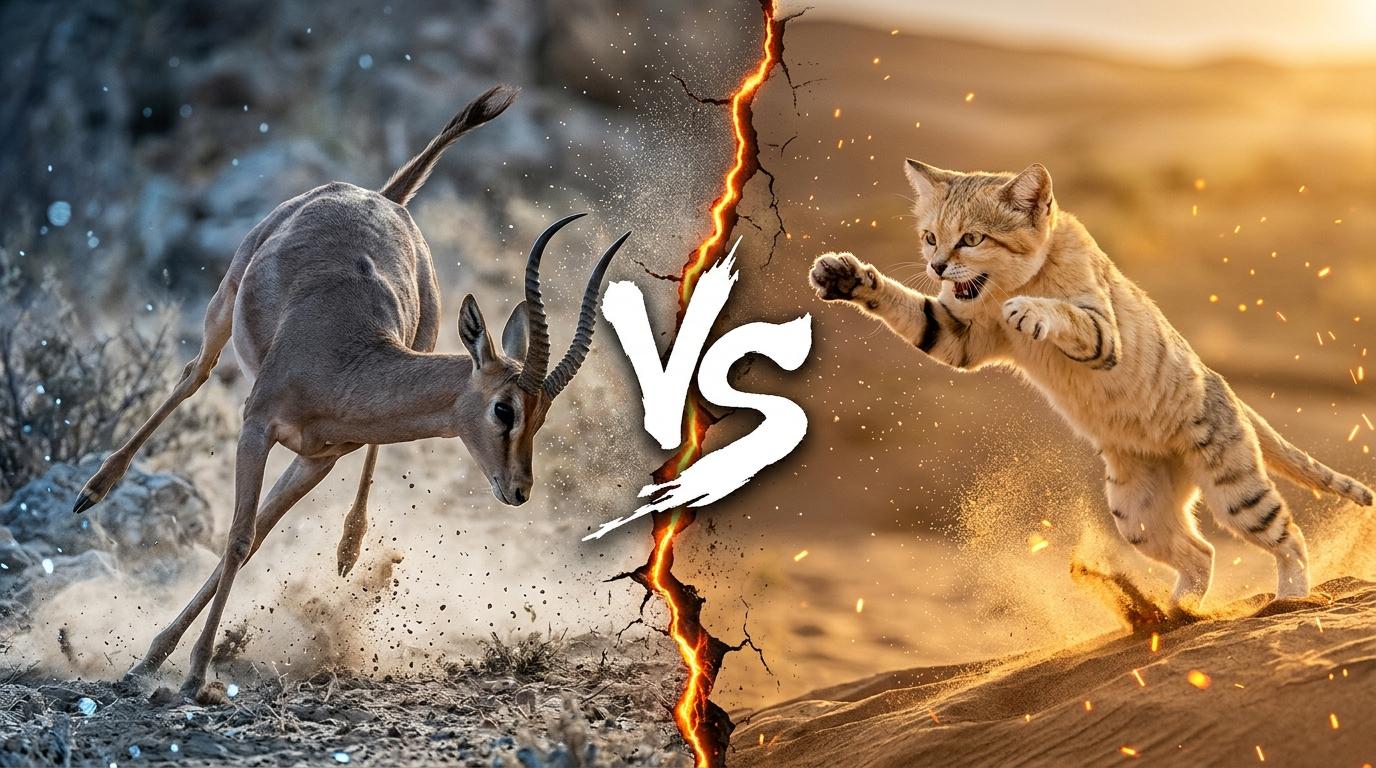
Dibatag vs Sand Cat: Who Actually Wins?
The dibatag wins, and it is not especially close. An adult dibatag (Ammodorcas clarkei) weighs roughly 20–35 kg, about ten times the mass of a sand cat (Felis margarita) at around 1.5–3.4 kg. Males carry short, forward-curving horns, and every dibatag can deliver sharp hoof strikes from long, slender legs. The sand cat is a superb predator of gerbils, jerboas, birds, and venomous snakes, with fast reflexes, real claws, and remarkable desert endurance. But its whole hunting toolkit is scaled for prey that weighs grams, not tens of kilograms. In a forced confrontation, the antelope's mass, reach, and kicking power outclass anything the cat can deliver. The realistic outcome is that the cat disengages and the dibatag walks away. The cat's best result is escape, not victory.
Read comparison
Dibatag vs Gemsbok: Who Actually Wins?
The gemsbok wins, and it isn't close in a straight confrontation. An adult gemsbok stands about 1.2 m at the shoulder and weighs roughly 180–240 kg. The dibatag is a slender, gerenuk-like gazelle of about 20–35 kg. Gemsbok of both sexes carry rapier-straight horns up to about 85–120 cm long, and they are famous for using them to hold off big predators. Only male dibatag have horns, and those are short, forward-curving hooks of around 15–25 cm. The dibatag's real strengths are concealment, browsing in dense Ogaden thornbush, and a fast, tail-up escape run. Those skills help it avoid fights, not win them. Once contact happens, mass, reach and a combative temperament decide the outcome, and all three belong to the gemsbok.
Read comparison
Discussion
What do you think?
Share your reasoning with other readers. Be civil and stick to the animals.
Sign in to join the discussion.
Sign inNo comments yet. Start the conversation.