

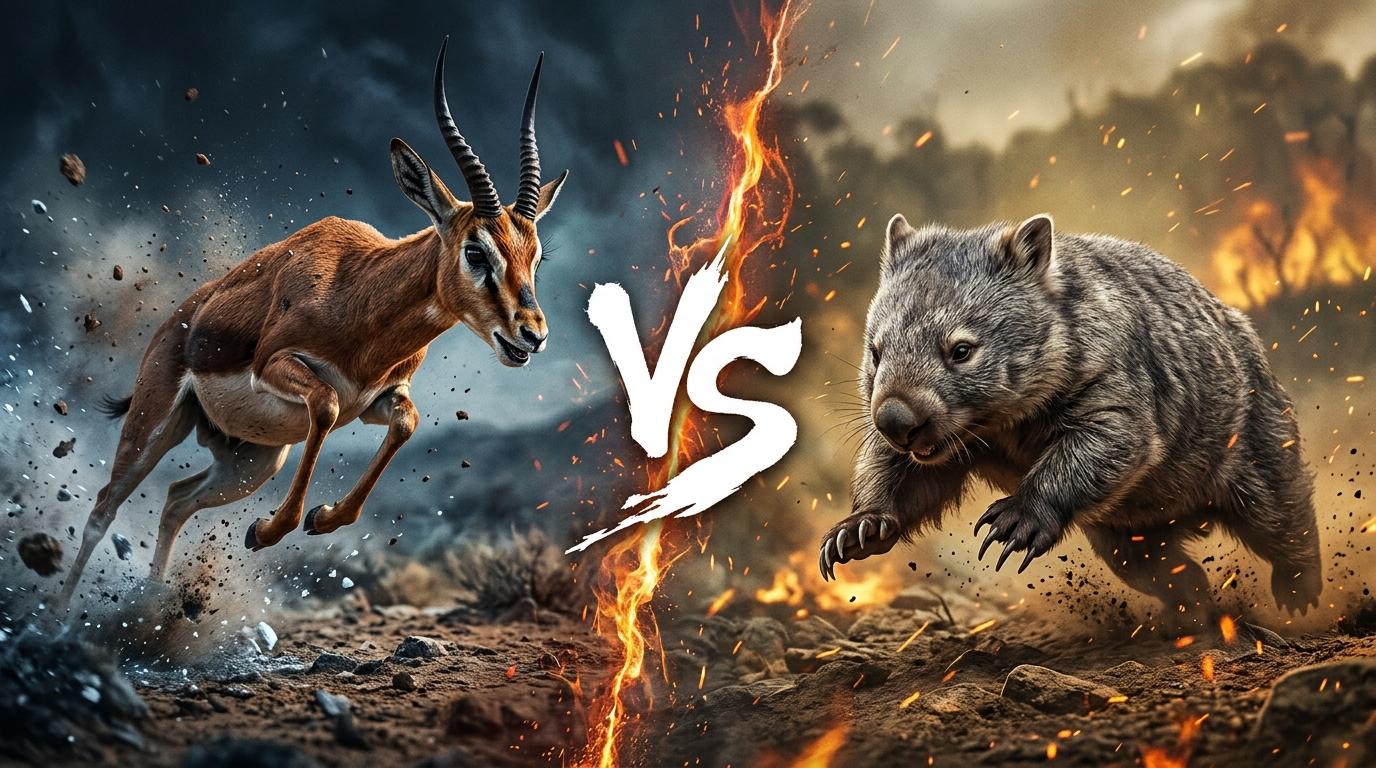
Dibatag vs Southern Hairy-nosed Wombat: Who Actually Wins?
Dibatag vs Southern Hairy-nosed Wombat: a biology-first breakdown of speed, armor, horns, and burrow tactics, and why the wombat wins a real confrontation.
Dibatag vs Southern Hairy-nosed Wombat
Matchup winner
Southern Hairy-nosed Wombat
Quick verdict
Start with the direct answer, then use the structured comparison below to see what changes the outcome.
The Southern Hairy-nosed Wombat wins a committed confrontation. The Dibatag, a slender, long-necked antelope from the Ogaden scrub of Ethiopia and Somalia, is built to read danger early and leave. Its best weapon is distance, and only males carry short horns. The wombat is about the same weight, often 19–32 kg, but that mass sits low in a barrel-shaped body with powerful digging forelimbs, ever-growing incisors, and a tough, cartilage-backed rump designed to plug a burrow and take punishment. If the antelope chooses to run, nothing happens. That is not a loss for it, but it is not a win either. In any frame where the two actually have to settle something, the wombat's density, low center of gravity, and stubborn close-range durability outclass a browser whose anatomy is optimized for vigilance and flight.
Read the full explanation
Southern Hairy-nosed Wombat wins: it is lower, denser, and far more durable up close.
The Dibatag is much faster and can simply disengage on open ground.
Only male dibatags have horns, and they are short and built for rival sparring, not breaking armor.
Near a burrow, the wombat's armored rump makes it almost impossible to dislodge.
Reader vote
Who do you think wins?
Pick a side — no account needed. Results update live.
No votes yet — be the first to call it.
Editorial note
Why people disagree
Stats favor the Dibatag on paper (speed, slightly higher dominance), but paper stats undervalue how much a low, armored body matters at contact range.
Explosive power
The Dibatag can open distance almost instantly, which lets it decide whether a fight happens at all.
Close-range durability
Once contact happens, the wombat can absorb pressure that would injure a gracile antelope.
Weaponry
The wombat's tools work from any angle at ground level. The Dibatag's horns are short and suited to sparring with rivals.
Read the full explanation +
Some readers count 'escaped successfully' as a win. Under that rule, the Dibatag takes open-ground scenarios easily.
Wombats look cuddly, and people underestimate how aggressive and physically forceful they can be in territorial encounters.
Comparison FAQ
Short, direct answers to the next questions readers usually ask after the headline verdict.
Would a Dibatag beat a Southern Hairy-nosed Wombat?+
Usually not in a real fight. The Dibatag's best move is to run, which it does very well. In a committed confrontation, the wombat's durability and low, forceful build win out.
Which is stronger, a Dibatag or a wombat?+
The wombat is stronger at close range. Its muscular forelimbs, digging claws, and dense body generate far more pushing force than the slender, browsing Dibatag.
Who wins a fight between a Dibatag and a wombat?+
The Southern Hairy-nosed Wombat wins most fight scenarios, especially in cover, near burrows, or when cornered.
Why is the Dibatag still dangerous?+
Male Dibatags carry sharp, forward-curving horns, and any antelope can kick hard. Its speed also means it chooses when and whether to engage, which makes it frustrating to pin down.
Are wombats really armored?+
Effectively, yes. Their rump is backed by tough cartilage and thick skin, which lets them block a burrow entrance and withstand attacks from behind.
Head-to-head species stats
These are the same core AnimalDex stat dimensions used on the dedicated animal pages, pulled side by side so the matchup is faster to scan.
Dibatag
Tier BSouthern Hairy-nosed Wombat
Tier CTrait-by-trait comparison
Only the categories that matter to this matchup are included. The goal is not filler stats, but the real design differences that change the result.
Springy sprinting legs, rapid acceleration
Explosive power
Dibatag
Short, forceful bursts from a compact frame
Explosive power
Dibatag
Light, slender build with thin limbs
Close-range durability
Southern Hairy-nosed Wombat
Dense barrel body with a cartilage-backed rump shield
Close-range durability
Southern Hairy-nosed Wombat
Short forward-curving horns (males only), hooves
Weaponry
Southern Hairy-nosed Wombat
Strong incisors, powerful digging claws, body-shove
Weaponry
Southern Hairy-nosed Wombat
High center of gravity on long legs
Ground-level stability
Southern Hairy-nosed Wombat
Low-slung and hard to tip or push
Ground-level stability
Southern Hairy-nosed Wombat
Tall stance, long neck, upright-tail flight signal
Threat detection & disengagement
Dibatag
Relies on burrow proximity rather than early escape
Threat detection & disengagement
Dibatag
Open bushland with no fixed refuge
Home-field fortress
Southern Hairy-nosed Wombat
Extensive warren systems used as defensive strongholds
Home-field fortress
Southern Hairy-nosed Wombat
How the verdict forms
Verdict timeline
01 · Explosive power
Dibatag
02 · Close-range durability
Southern Hairy-nosed Wombat
03 · Weaponry
Southern Hairy-nosed Wombat
04 · Ground-level stability
Southern Hairy-nosed Wombat
05 · Threat detection & disengagement
Dibatag
06 · Home-field fortress
Southern Hairy-nosed Wombat
Change the conditions
Scenario breakdown
This is where shallow battle content usually fails. Terrain, spacing, timing, and engagement style can change the answer.
Scenario lean
Southern Hairy-nosed Wombat
Verdict confidence
82%
Wombat dominates in close, cluttered terrain.
In dense scrub or near a warren, the Dibatag loses the space it needs to accelerate and maneuver. The wombat fights best at exactly this low, short range. It can shove, bite, and present its armored rump, while the antelope's long legs become a liability.
AnimalDex field profiles
Explore these animals
Dibatag
Ammodorcas clarkei
arid bushland, open scrub, and sandy plain
Southern Hairy-nosed Wombat
Lasiorhinus latifrons
semi-arid scrub, grassland, and sandy plain
Systems Intelligence & Hidden Purpose
See the animals behind this comparison as engineered biological systems: what each one is built to do, where it gains leverage, and why the matchup changes by scenario.
Specialized Hardware
very long thin neck, slender pointed face, and light desert step running give the Dibatag a body plan tuned for its niche.
Systems Script
Dibatags operate through arid bushland, open scrub, and sandy plain. Their design links movement, feeding, shelter, and timing into one workable survival system.
Strategic Insight
Harsh places reward efficiency, timing, and bodies that waste very little.
Specialized Hardware
powerful burrowing limbs, broad blunt muzzle, and cool-day underground sheltering give the Southern Hairy-nosed Wombat a body plan tuned for its niche.
Systems Script
Southern Hairy-nosed Wombats operate through semi-arid scrub, grassland, and sandy plain. Their design links movement, feeding, shelter, and timing into one workable survival system.
Strategic Insight
Harsh places reward efficiency, timing, and bodies that waste very little.
Final take
This matchup pits two survival philosophies against each other: the Dibatag survives by leaving early, and the wombat survives by being impossible to move. Both work well in their own deserts and scrublands. Only one of them is built to win a physical contest.
Read the full explanation
Give the Dibatag open space and it will not lose, because it will not be there. Force a real encounter, though, and the Southern Hairy-nosed Wombat's density, low stance, bite, and armored rump decide it. Overall winner: Southern Hairy-nosed Wombat.
Collect both animals in AnimalDex
Track the species behind this matchup, compare their real traits, and build the rivalry into your AnimalDex collection.
Related comparisons
Continue with nearby matchups to compare more real-world animal traits without dropping into junky who-wins filler.
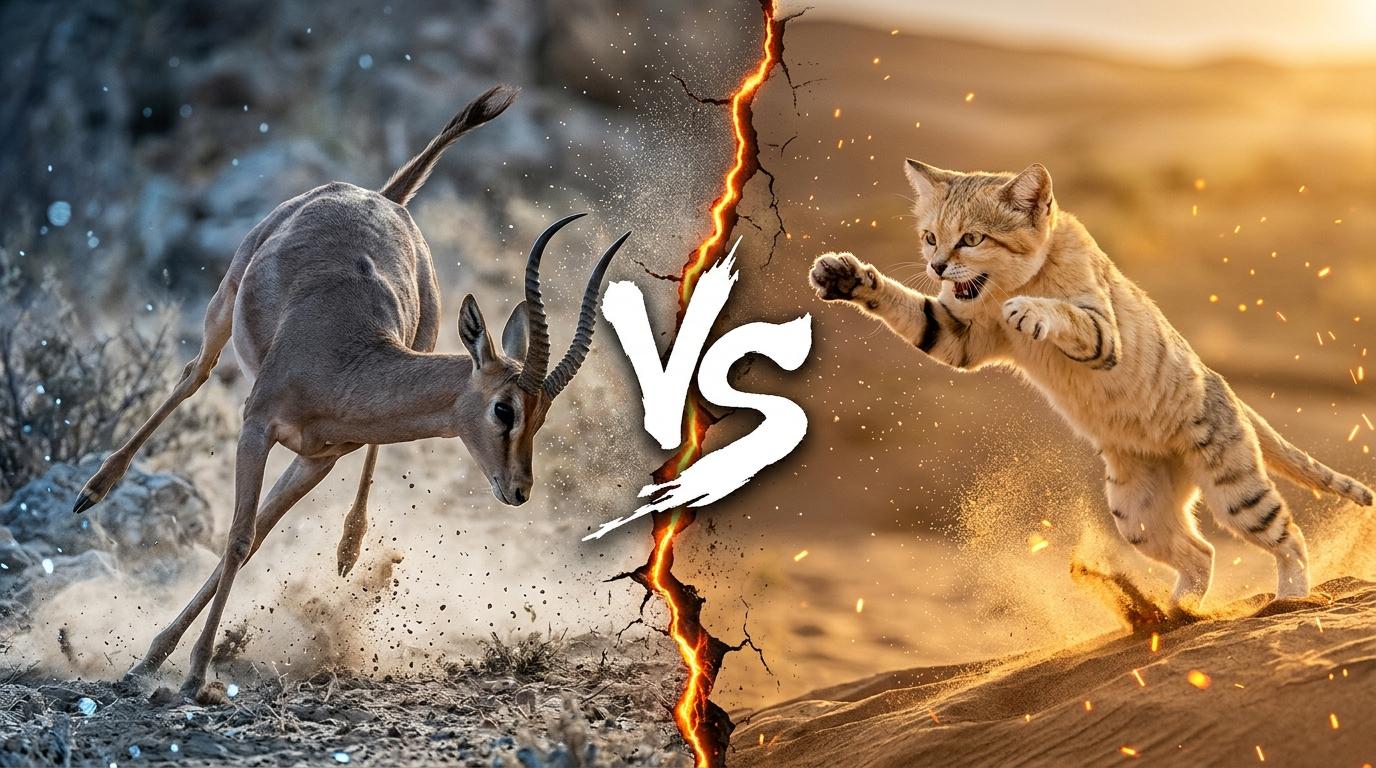
Dibatag vs Sand Cat: Who Actually Wins?
The dibatag wins, and it is not especially close. An adult dibatag (Ammodorcas clarkei) weighs roughly 20–35 kg, about ten times the mass of a sand cat (Felis margarita) at around 1.5–3.4 kg. Males carry short, forward-curving horns, and every dibatag can deliver sharp hoof strikes from long, slender legs. The sand cat is a superb predator of gerbils, jerboas, birds, and venomous snakes, with fast reflexes, real claws, and remarkable desert endurance. But its whole hunting toolkit is scaled for prey that weighs grams, not tens of kilograms. In a forced confrontation, the antelope's mass, reach, and kicking power outclass anything the cat can deliver. The realistic outcome is that the cat disengages and the dibatag walks away. The cat's best result is escape, not victory.
Read comparison
Dibatag vs Gemsbok: Who Actually Wins?
The gemsbok wins, and it isn't close in a straight confrontation. An adult gemsbok stands about 1.2 m at the shoulder and weighs roughly 180–240 kg. The dibatag is a slender, gerenuk-like gazelle of about 20–35 kg. Gemsbok of both sexes carry rapier-straight horns up to about 85–120 cm long, and they are famous for using them to hold off big predators. Only male dibatag have horns, and those are short, forward-curving hooks of around 15–25 cm. The dibatag's real strengths are concealment, browsing in dense Ogaden thornbush, and a fast, tail-up escape run. Those skills help it avoid fights, not win them. Once contact happens, mass, reach and a combative temperament decide the outcome, and all three belong to the gemsbok.
Read comparison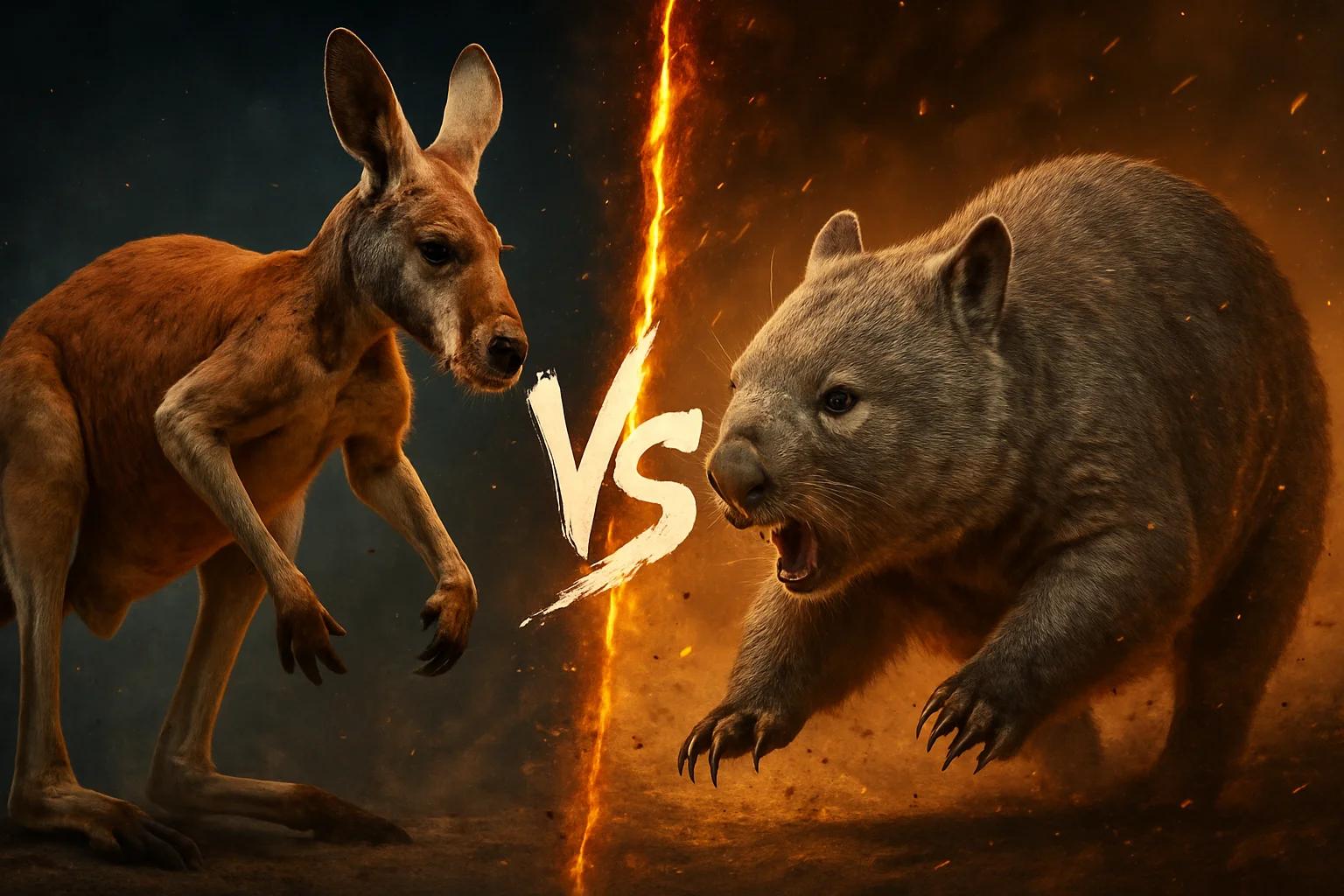
Red Kangaroo vs Southern Hairy-nosed Wombat: Who Actually Wins?
The red kangaroo wins this matchup overall. A large male red kangaroo can weigh around 85 kg and stand taller than most people, against a southern hairy-nosed wombat of roughly 19–32 kg. That size gap is decisive. The kangaroo also brings tail-braced double kicks with clawed hind feet, gripping forearms and serious speed. The wombat is no pushover. It is a dense, low-slung digging machine with a tough rump and powerful forelimbs. Next to its burrow it can make any intruder pay. But in open terrain it has no real way to stop a bigger, faster animal that can strike from range and leave whenever it wants. The kangaroo controls distance and timing. The wombat can only control its doorway.
Read comparison
Discussion
What do you think?
Share your reasoning with other readers. Be civil and stick to the animals.
Sign in to join the discussion.
Sign inNo comments yet. Start the conversation.