

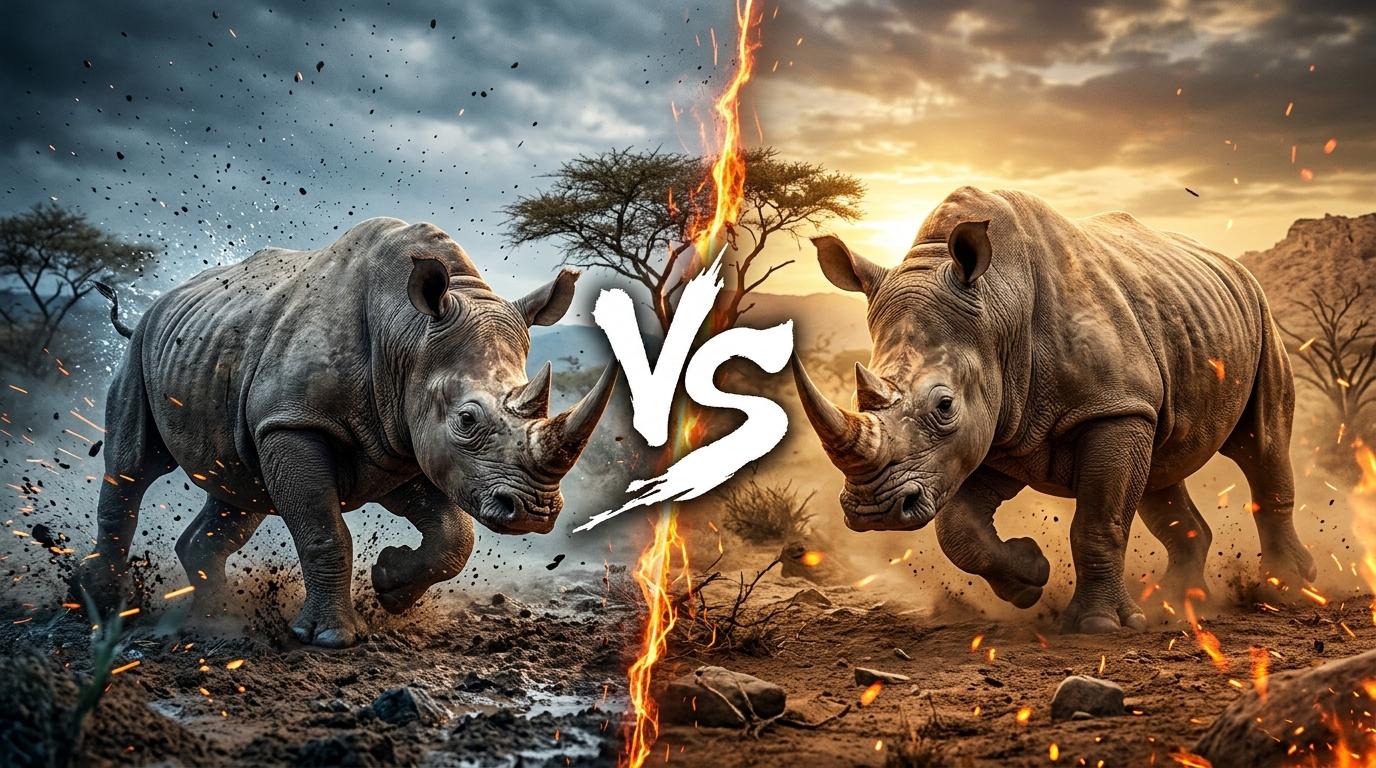
Black Rhinoceros vs White Rhinoceros: Who Actually Wins?
Black rhino vs white rhino: who would win a fight? We compare size, aggression, horns, agility and fighting style to explain why mass usually beats temper.
Black Rhinoceros vs White Rhinoceros
Matchup winner
White Rhinoceros
Quick verdict
Start with the direct answer, then use the structured comparison below to see what changes the outcome.
The White Rhinoceros wins most serious fights, though not by a landslide. A mature white rhino bull typically weighs about 1,800 to 2,300 kg, roughly 1.5 to 2 times the mass of a black rhino bull at about 800 to 1,400 kg. It also tends to carry a longer front horn and a broad, low-slung frame built for shoving. The Black Rhinoceros is the more volatile, quicker-turning and more fight-practiced species. Black rhinos have one of the highest rates of fatal combat injury of any large mammal, and they can open with a ferocious first charge. But in a sustained horn-to-horn contest, momentum and sheer weight decide who gets pushed off balance and who gets gored in the flank. Expect the black rhino to win the opening seconds and the white rhino to win the fight.
Read the full explanation
White Rhinoceros wins most full-contact fights, mainly because it is much heavier and has a longer front horn.
Black Rhinoceros is more aggressive, quicker to charge and more agile in tight brush.
The black rhino's best chance is an explosive ambush charge in dense cover before the white rhino can set its weight.
In open ground or a drawn-out shoving match, mass strongly favors the white rhino.
Reader vote
Who do you think wins?
Pick a side — no account needed. Results update live.
No votes yet — be the first to call it.
Editorial note
Why people disagree
Reputation vs physics: the black rhino's notorious temper makes it sound like the tougher fighter, but the white rhino's extra tonnage is the harder fact.
Raw mass
In a horn-shoving contest, the heavier animal controls the push, the angle and the outcome.
Explosive aggression
A black rhino commits early and hard, which can land damaging blows before a bigger rival braces.
Horn reach
Longer reach lets the white rhino strike or fend off a charge first in a head-on meeting.
Read the full explanation +
The names mislead: neither species is truly black or white, so many readers assume they are near-identical in size when the gap is large.
Encounter vs fight: black rhinos may initiate more often, and field anecdotes of them bullying white rhinos get mixed up with who wins a committed, sustained clash.
Comparison FAQ
Short, direct answers to the next questions readers usually ask after the headline verdict.
Would a black rhino beat a white rhino?+
Usually not. A black rhino can win the opening exchange or a fight in dense brush, but the white rhino's much greater size and longer horn win most sustained fights.
Which rhino is stronger?+
The white rhino. It is the largest living rhino, with bulls often weighing up to around 2,300 kg, and its pushing power exceeds the black rhino's by a wide margin.
Which rhino is more aggressive?+
The black rhino. It is famously quick to charge and fights rivals often, with a high rate of fatal combat injuries among males.
Why is the black rhino still dangerous to a white rhino?+
It strikes fast, commits fully, pivots well in cover and has extensive real combat experience. A well-placed horn strike to the flank can seriously injure even a much larger opponent.
Are black and white rhinos actually different colors?+
Not really. Both are grayish. The key differences are lip shape, size, habitat and behavior: the black rhino is a hooked-lipped browser, and the white rhino is a square-lipped grazer.
Head-to-head species stats
These are the same core AnimalDex stat dimensions used on the dedicated animal pages, pulled side by side so the matchup is faster to scan.
Black Rhinoceros
Tier BWhite Rhinoceros
Tier BTrait-by-trait comparison
Only the categories that matter to this matchup are included. The goal is not filler stats, but the real design differences that change the result.
About 800–1,400 kg bulls
Raw mass
White Rhinoceros
About 1,800–2,300 kg bulls
Raw mass
White Rhinoceros
Hair-trigger, charges readily
Explosive aggression
Black Rhinoceros
Calmer, more ritualized displays
Explosive aggression
Black Rhinoceros
Front horn often around 50 cm
Horn reach
White Rhinoceros
Front horn often 60 cm or more, sometimes far longer
Horn reach
White Rhinoceros
Nimble, tight-turning browser
Agility in cover
Black Rhinoceros
Heavier, built for open grassland
Agility in cover
Black Rhinoceros
Thick hide, smaller frame
Close-range durability
White Rhinoceros
Thicker shoulder mass, wider body
Close-range durability
White Rhinoceros
Frequent, often lethal fights
Combat experience
Black Rhinoceros
Territorial, mostly ritualized clashes
Combat experience
Black Rhinoceros
How the verdict forms
Verdict timeline
01 · Raw mass
White Rhinoceros
02 · Explosive aggression
Black Rhinoceros
03 · Horn reach
White Rhinoceros
04 · Agility in cover
Black Rhinoceros
05 · Close-range durability
White Rhinoceros
06 · Combat experience
Black Rhinoceros
Change the conditions
Scenario breakdown
This is where shallow battle content usually fails. Terrain, spacing, timing, and engagement style can change the answer.
Scenario lean
Black Rhinoceros
Verdict confidence
82%
Black rhino's best arena.
Dense thornveld is the black rhino's home habitat. Limited sightlines favor its explosive, close-range charge, and its tighter turning lets it strike the white rhino's flank before the larger animal can square up. Brush also blunts the white rhino's ability to build forward momentum. This is the one setting where temper and agility can outweigh tonnage.
AnimalDex field profiles
Explore these animals
Black Rhinoceros
Diceros bicornis
Dry savannah, scrubland, thornbush, and semi-desert browse country.
White Rhinoceros
Ceratotherium simum
Open grassland, savannah, floodplain, and lightly wooded grazing country with access to water and wallows.
Systems Intelligence & Hidden Purpose
See the animals behind this comparison as engineered biological systems: what each one is built to do, where it gains leverage, and why the matchup changes by scenario.
Specialized Hardware
Two horns on the nose, hooked upper lip for grasping shrubs, and heavy body with thick gray skin give the Black Rhinoceros a body plan tuned for its niche.
Systems Script
Black Rhinoceross operate in dry savannah, scrubland, thornbush, and semi-desert browse country. Their design helps them match food access, shelter, and timing inside that environment.
Strategic Insight
A strong frame matters most when the path ahead is thick, sharp, and resistant.
Specialized Hardware
Square grazing lip, heavy neck support, thick skin, and horn-forward charge mechanics make white rhinoceroses bulk-feeding hardware built for open ground.
Systems Script
White rhinoceroses convert large grass volumes into megaherbivore pressure across savannah systems. They reshape short-grass structure, path use, and wallow zones while forcing the landscape to make room for body scale.
Strategic Insight
Scale is powerful when it is paired with a simple repeatable operating loop. Do the basic high-value action well enough, and the whole environment starts bending around it.
Final take
This is a true heavyweight rivalry with a clear lean. The Black Rhinoceros brings the sharper temper, the faster first move and a habitat that hides its charge. The White Rhinoceros brings what usually matters most when two armored grazers collide: far more mass and a longer horn.
Read the full explanation
Give the black rhino thick cover and the element of surprise, and it can win. In most realistic matchups, and especially any fight that lasts beyond the first impact, the White Rhinoceros is the safer pick and our overall winner.
Collect both animals in AnimalDex
Track the species behind this matchup, compare their real traits, and build the rivalry into your AnimalDex collection.
Related comparisons
Continue with nearby matchups to compare more real-world animal traits without dropping into junky who-wins filler.
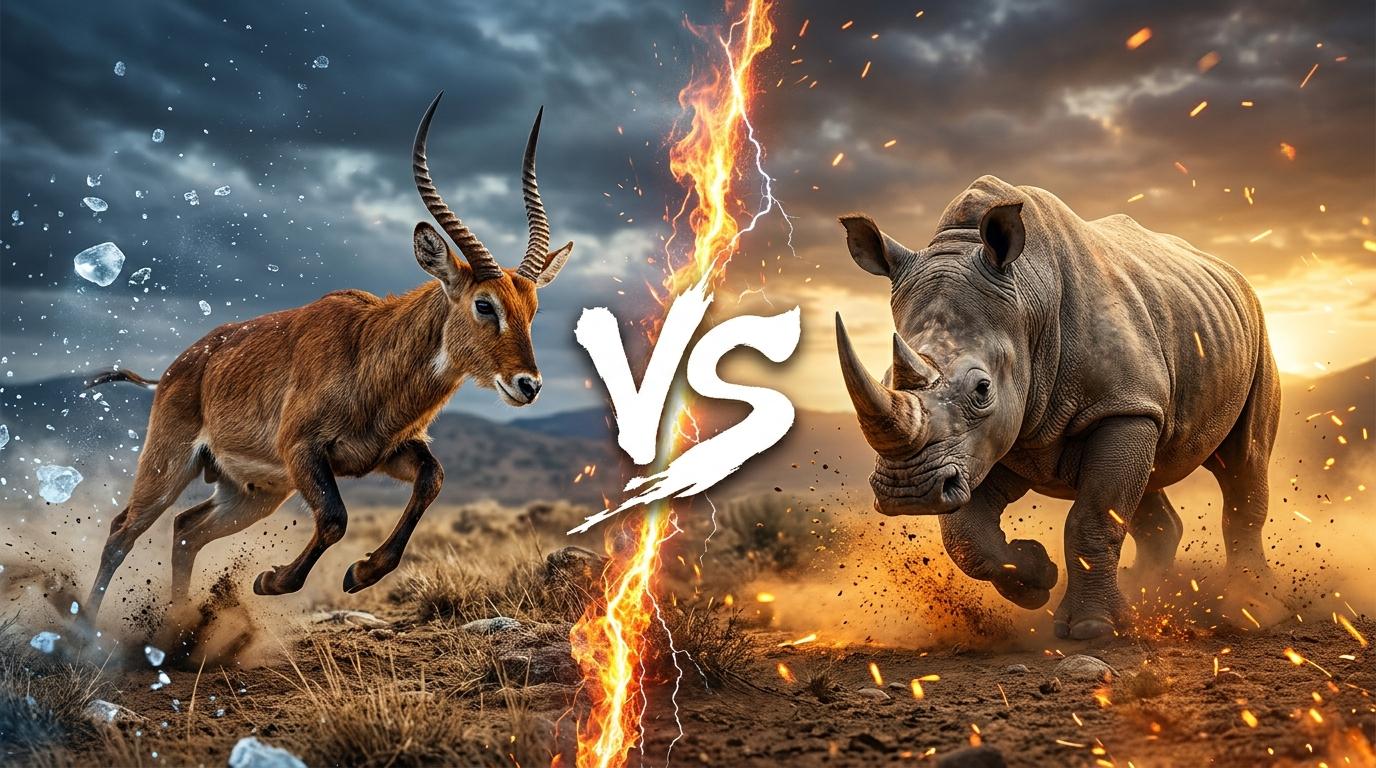
Puku vs White Rhinoceros: Who Actually Wins?
The white rhinoceros wins, and it is not close in a direct confrontation. An adult white rhino weighs roughly 1,800–2,500 kg against a puku's 60–90 kg, which is a mass gap of more than twenty to one. The rhino also carries a front horn that can exceed 60 cm, a thick dermal shield, and the ability to charge at around 40 km/h over short bursts. The puku is a wetland-edge antelope built for vigilance, quick acceleration and escape. Only males carry horns, and those are ridged and used mainly in ritual sparring with other puku. Whenever the question is who controls the space, the rhino owns it. The puku's real victory condition is never fighting at all: it reads the threat early and leaves.
Read comparison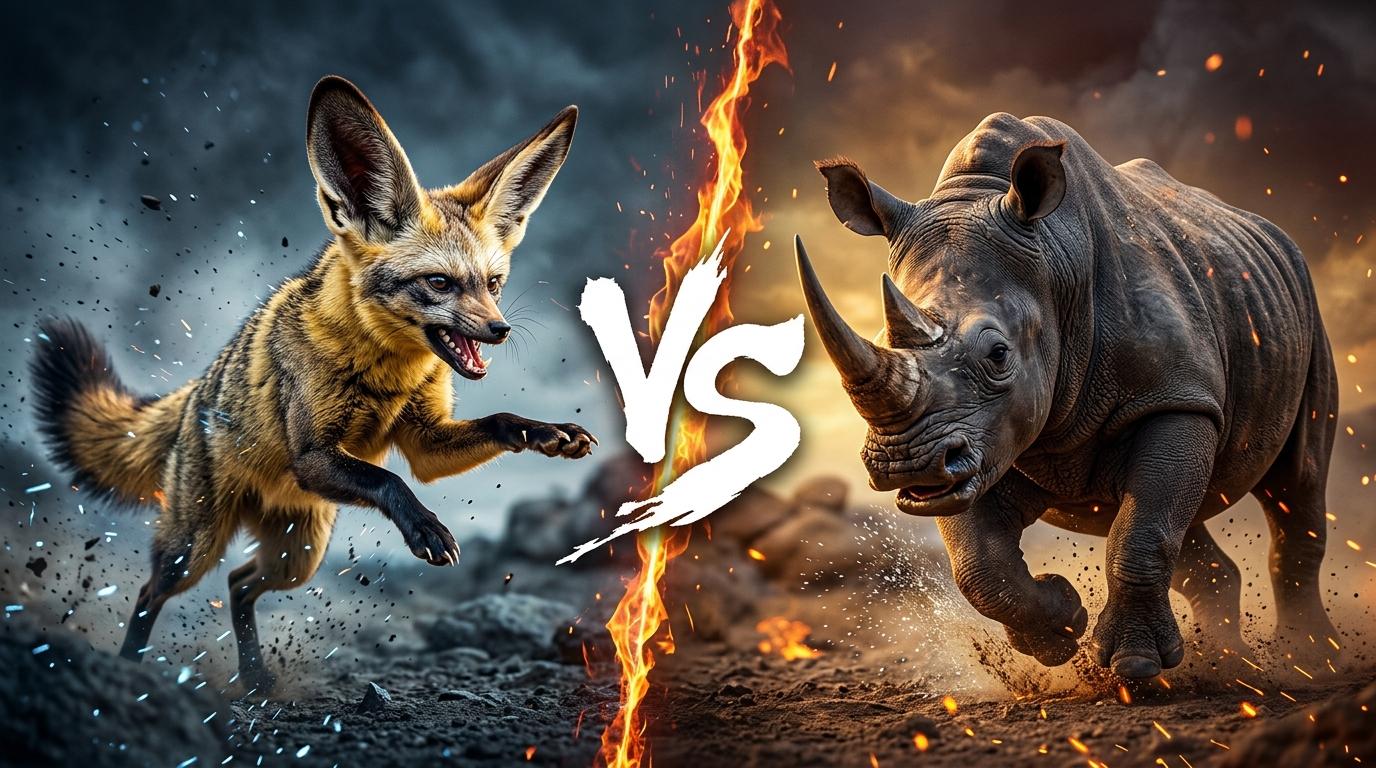
Bat-eared Fox vs Black Rhinoceros: Who Actually Wins?
The black rhinoceros wins, and it is not close. An adult black rhino weighs roughly 800–1,400 kg against a bat-eared fox's 3–5 kg, a mass gap of about 250 to 1. It carries a keratin front horn that can exceed 50 cm, thick hide over a heavy skeleton, and a famously short-fused charge. The fox's real gifts are oversized ears that detect termites underground, a mouth with up to 50 small insect-crushing teeth, and zigzag evasion. None of that can injure a rhino. The fox 'wins' only by leaving, and in any scenario where the two must actually contest space, the rhino controls the outcome.
Read comparison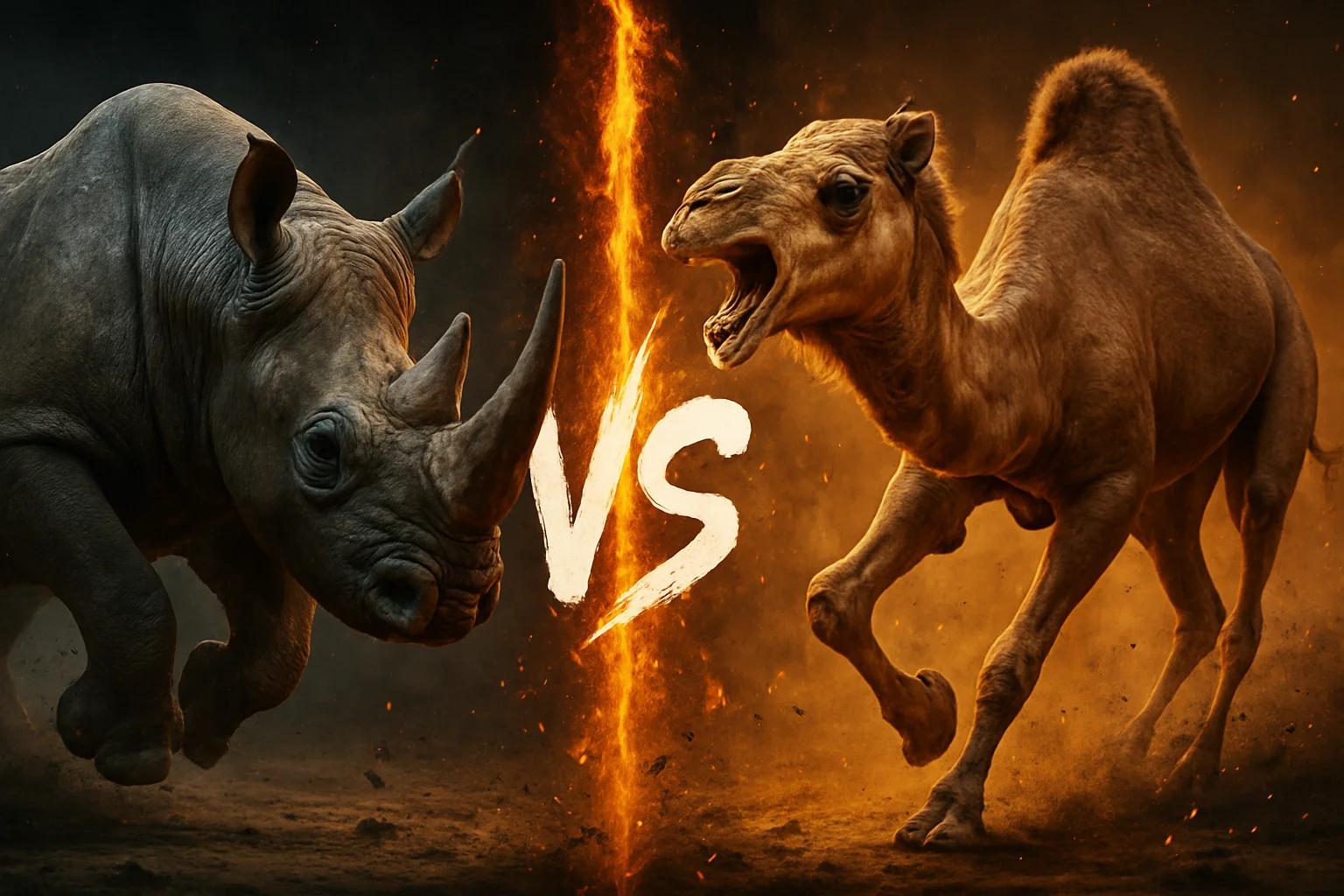
Black Rhinoceros vs Dromedary Camel: Who Actually Wins?
The black rhinoceros wins, and it is not especially close. An adult black rhino weighs roughly 800–1,400 kg against a dromedary's 400–600 kg. It carries a front horn that can exceed 50 cm and skin up to about 2 cm thick across the flanks and shoulders, and it is one of Africa's most notoriously quick-tempered large mammals, prone to charging first and investigating later. A dromedary's real weapons are a bite from large canine-like teeth, a powerful kick, and the ability to lean its full weight onto an opponent. Those tools are dangerous to people and to other camels. Against a low-slung, horn-led tank that charges at up to about 50 km/h, they lack the penetration and the mass to matter. The camel's genuine edges are heat and water endurance and long-distance walking, and those decide survival contests, not a head-on clash.
Read comparison
Discussion
What do you think?
Share your reasoning with other readers. Be civil and stick to the animals.
Sign in to join the discussion.
Sign inNo comments yet. Start the conversation.