


Bombardier Beetle vs Death's-head Hawkmoth: Who Actually Wins?
Bombardier beetle vs death's-head hawkmoth: a boiling chemical cannon meets a skull-marked, honey-raiding flier. See who wins a battle, the key traits, scenarios, and the FAQ.
Bombardier Beetle vs Death's-head Hawkmoth
Matchup winner
Bombardier Beetle
Quick verdict
Start with the direct answer, then use the structured comparison below to see what changes the outcome.
The Bombardier Beetle wins. In a real ground-level confrontation, Brachinus crepitans carries the only true weapon in this matchup: a twin-chamber abdominal reactor that mixes hydroquinones and hydrogen peroxide with enzymes and fires a pulsed, roughly 100°C jet of irritating benzoquinone spray it can aim in nearly any direction. Add a hard-shelled carabid body and grasping predatory mandibles, and the beetle controls any fight that happens within its reach. The Death's-head Hawkmoth is larger, faster, and remarkably sophisticated. It squeaks to startle threats, wears a skull-like thoracic pattern, and uses chemical camouflage to raid beehives. But it is a nectar and honey feeder with a short, stout proboscis, not a fighter. Its best move is to leave. So the moth wins escapes and aerial contexts, while the beetle wins anything that resembles a fight.
Read the full explanation
Bombardier Beetle wins any contact-range battle thanks to its aimable, near-boiling chemical spray and armored body.
Death's-head Hawkmoth is bigger and far faster, but it has no offensive weapon. Its defenses are bluff, camouflage, and flight.
If the moth is airborne and simply leaves, there is no fight to win, which is the moth's real survival strategy.
Overall edge goes to the beetle: it is the only one built to hurt the other.
Reader vote
Who do you think wins?
Pick a side — no account needed. Results update live.
No votes yet — be the first to call it.
Editorial note
Why people disagree
Size bias: the hawkmoth's wingspan of roughly 10–13 cm dwarfs a beetle around 1 cm long, so many assume bigger means stronger.
Chemical firepower
Only the beetle can deliver a damaging, repellent attack on contact. That decides any close engagement.
Close-range durability
Moth wings tear and scale-coated bodies absorb spray poorly, while beetle armor shrugs off flailing contact.
Escape velocity
The moth decides whether a fight happens at all, and that is its single biggest advantage.
Read the full explanation +
The skull marking and loud squeak make the moth look and sound menacing, but both are psychological defenses, not weapons.
Some people count 'flying away' as a win. In a battle frame, avoiding the fight doesn't defeat the opponent.
Comparison FAQ
Short, direct answers to the next questions readers usually ask after the headline verdict.
Would a bombardier beetle beat a death's-head hawkmoth?+
Yes, in any real contact fight. Its aimable, roughly 100°C chemical spray and hard body give it the only effective offense in the matchup.
Which is stronger, the bombardier beetle or the death's-head hawkmoth?+
The moth is much bigger and has more raw mass and flight power. The beetle is stronger where it counts in combat, because it has a chemical weapon, armor, and mandibles.
Can the death's-head hawkmoth hurt a bombardier beetle?+
Not meaningfully. Adults feed on nectar and honey with a short proboscis and have no biting or stinging attack.
Why is the death's-head hawkmoth still dangerous to underestimate?+
It is a fast, long-distance flier that can avoid fights entirely. It also startles predators with its squeak and skull marking, and it uses chemical mimicry to raid beehives without being stung to death.
How hot is the bombardier beetle's spray?+
Close to the boiling point of water, about 100°C, released in rapid pulses from a reaction chamber in its abdomen.
Head-to-head species stats
These are the same core AnimalDex stat dimensions used on the dedicated animal pages, pulled side by side so the matchup is faster to scan.
Bombardier Beetle
Tier CDeath's-head Hawkmoth
Tier DTrait-by-trait comparison
Only the categories that matter to this matchup are included. The goal is not filler stats, but the real design differences that change the result.
Pulsed ~100°C benzoquinone jet, aimable
Chemical firepower
Bombardier Beetle
Hive-masking scent chemistry, no offense
Chemical firepower
Bombardier Beetle
Hardened elytra and compact armored body
Close-range durability
Bombardier Beetle
Robust for a moth, but soft scales and wings
Close-range durability
Bombardier Beetle
Quick runner, flies reluctantly
Escape velocity
Death's-head Hawkmoth
Powerful, fast long-distance migrant flier
Escape velocity
Death's-head Hawkmoth
Audible 'pop' with every spray
Bluff and deterrence
Death's-head Hawkmoth
Skull pattern plus startling squeak
Bluff and deterrence
Death's-head Hawkmoth
Nocturnal ground predator with mandibles
Ground-level control
Bombardier Beetle
Feeds and rests, not built for grappling
Ground-level control
Bombardier Beetle
Tiny, about 1 cm
Raw mass
Death's-head Hawkmoth
One of Europe's heaviest moths
Raw mass
Death's-head Hawkmoth
How the verdict forms
Verdict timeline
01 · Chemical firepower
Bombardier Beetle
02 · Close-range durability
Bombardier Beetle
03 · Escape velocity
Death's-head Hawkmoth
04 · Bluff and deterrence
Death's-head Hawkmoth
05 · Ground-level control
Bombardier Beetle
06 · Raw mass
Death's-head Hawkmoth
Change the conditions
Scenario breakdown
This is where shallow battle content usually fails. Terrain, spacing, timing, and engagement style can change the answer.
Scenario lean
Bombardier Beetle
Verdict confidence
82%
Beetle sprays first and owns the terrain.
In tight ground cover the moth can't open its wings freely, and the beetle operates in its native hunting zone. Any contact triggers a hot, aimed blast to the moth's head or body. The moth has no counterattack, so it must flee or absorb repeated pulses.
AnimalDex field profiles
Explore these animals
Bombardier Beetle
Brachinus crepitans
Woodland edge, grassland, scrub, and moist ground cover.
Death's-head Hawkmoth
Acherontia atropos
woodland edge, scrub, and cultivated landscape
Systems Intelligence & Hidden Purpose
See the animals behind this comparison as engineered biological systems: what each one is built to do, where it gains leverage, and why the matchup changes by scenario.
Specialized Hardware
Small dark body with contrasting colors, fast running beetle shape, and defensive tail-end chemical spray give the Bombardier Beetle a body plan tuned for its niche.
Systems Script
Bombardier Beetles operate in woodland edge, grassland, scrub, and moist ground cover. Their design helps them match food access, shelter, and timing inside that environment.
Strategic Insight
A fast smart response can protect a small system from a bigger threat.
Specialized Hardware
skull-like thorax marking, powerful night flight, and deep humming wingbeat give the Death's-head Hawkmoth a body plan tuned for its niche.
Systems Script
Death's-head Hawkmoths operate through woodland edge, scrub, and cultivated landscape. Their design links movement, feeding, shelter, and timing into one workable survival system.
Strategic Insight
Dense environments reward precision, patience, and the ability to read layered cover.
Final take
The Bombardier Beetle is the clear battle winner. It packs a self-contained chemical reactor and an armored frame, and the hawkmoth has no tool that answers either.
Read the full explanation
The Death's-head Hawkmoth isn't weak. It is specialized for a different problem: crossing continents, slipping into beehives, and scaring off birds and mammals with theater. Against a beetle that fights with boiling chemistry rather than eyesight, those tricks lose their power.
Bottom line: if the two meet on the ground, bet on the beetle. If the moth sees it coming, bet on the moth being gone.
Collect both animals in AnimalDex
Track the species behind this matchup, compare their real traits, and build the rivalry into your AnimalDex collection.
Related comparisons
Continue with nearby matchups to compare more real-world animal traits without dropping into junky who-wins filler.
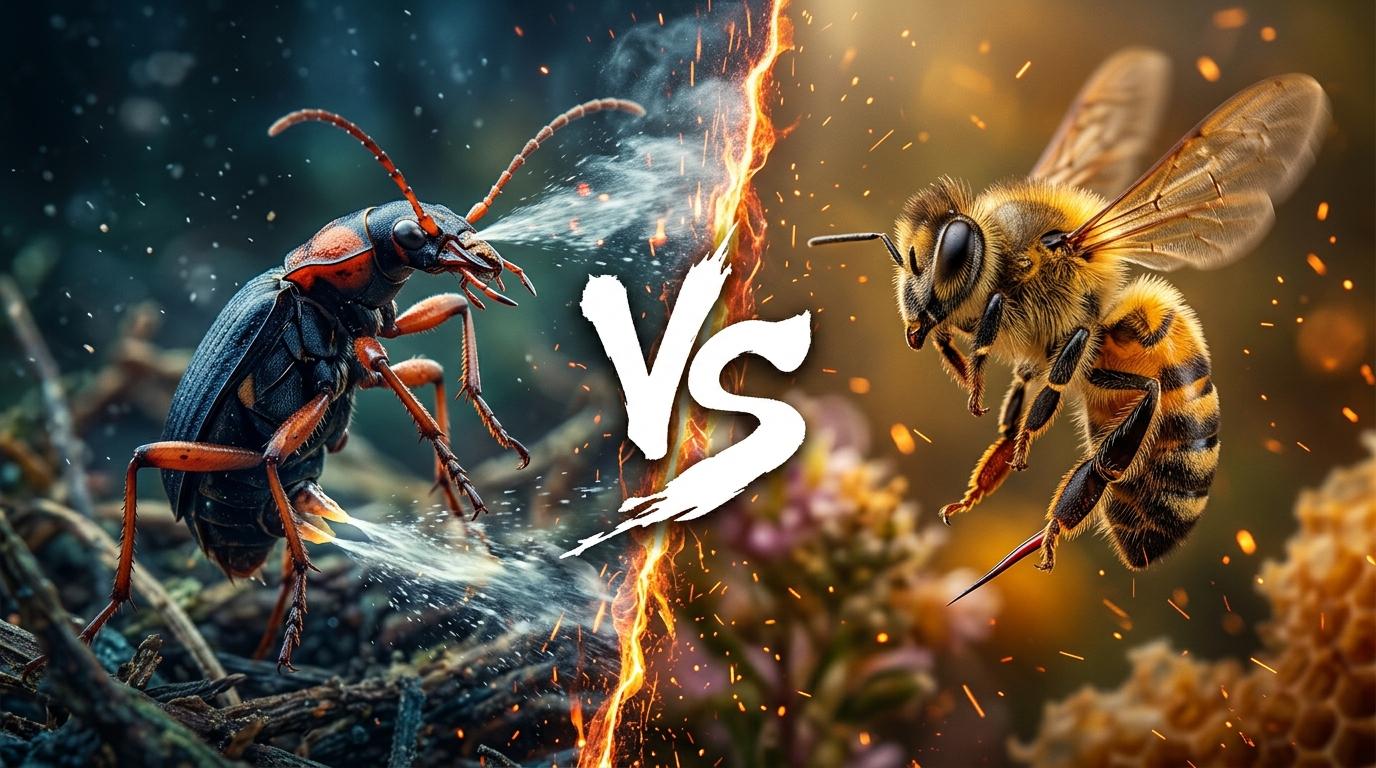
Bombardier Beetle vs Western Honey Bee: Who Actually Wins?
The bombardier beetle wins a one-on-one fight. A single western honey bee worker is a forager built to cooperate, not a solo duelist. Its sting is a defensive tool that only works on the beetle if it finds a soft joint between armor plates. The bombardier beetle (Brachinus crepitans) is a ground-dwelling predator wrapped in hardened elytra, and it carries one of the most famous chemical weapons in the insect world. It mixes stored reactants in a reinforced chamber and fires a pulsed, near-boiling blast of irritating benzoquinones at whatever grabs it. That spray reliably drives off ants, spiders and even toads. A lone bee that grapples the beetle takes a hot chemical hit to the face and antennae, which are the sensors it needs to aim and fly. The honey bee's real power is the colony. Outside the hive, the beetle's armor plus instant chemical defense beats a single bee's speed and sting.
Read comparison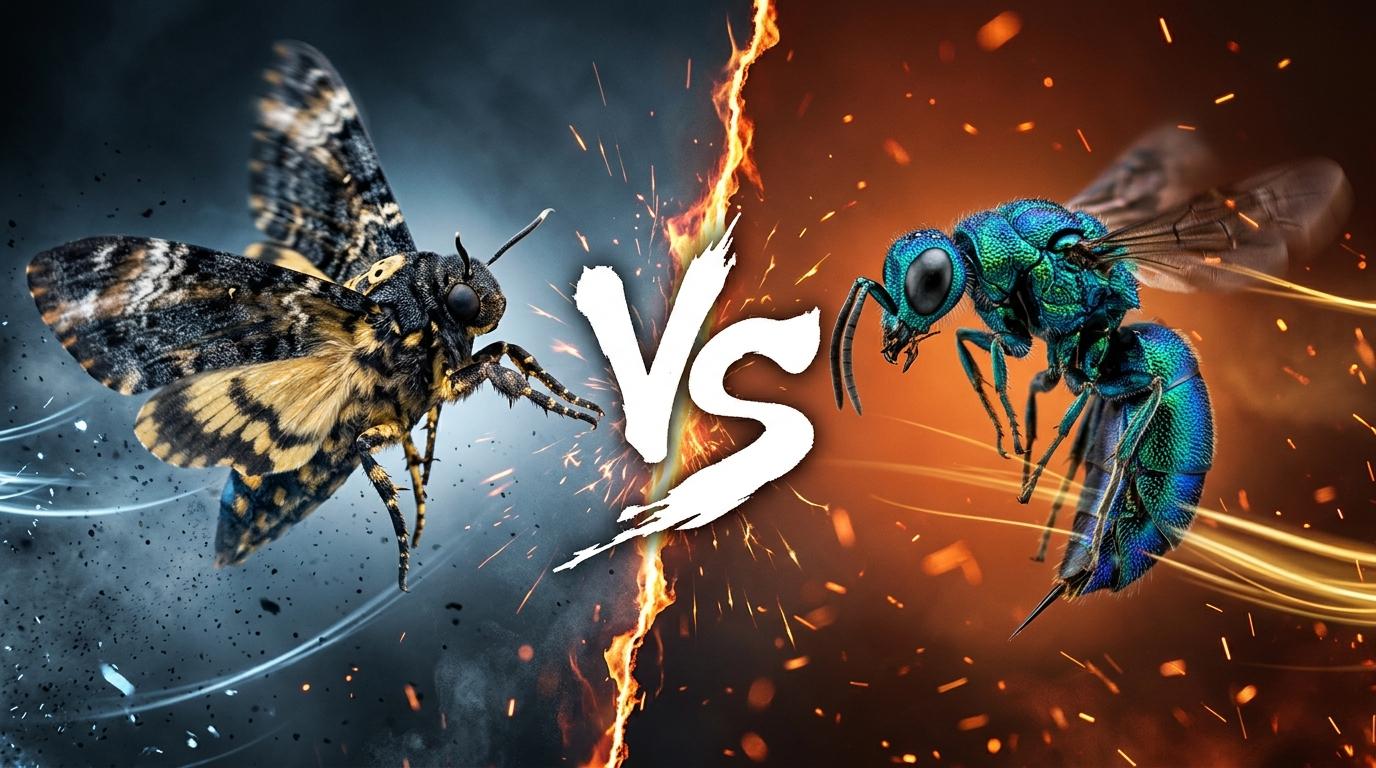
Death's-head Hawkmoth vs Cuckoo Wasp: Who Actually Wins?
The Death's-head Hawkmoth wins overall. It is a heavy, fast-flying sphinx moth with a wingspan of roughly 9–13 cm and a body many times the mass of a cuckoo wasp, which is usually under 1.5 cm long. The cuckoo wasp is a superb defensive specialist. Its pitted, metallic cuticle is extremely hard, and it can curl into a tight armored ball. But most cuckoo wasps have a reduced or non-functional sting, and their mouthparts are not built to hurt something the hawkmoth's size. Neither insect hunts the other, so a 'fight' here means a contest of displacement, endurance and escape. In that contest the hawkmoth's mass, thick scaled body, squeak-and-bluff defense and powerful flight let it dominate almost every encounter it chooses to stay in. The wasp's real victory condition is to not lose: armor up and survive.
Read comparison
Bombardier Beetle vs Golden Stag Beetle: Who Actually Wins?
The Golden Stag Beetle (Odontolabis cuvera) wins this matchup. The Bombardier Beetle (Brachinus crepitans) carries one of the most impressive defensive weapons in the insect world: a near-boiling, pulsed chemical spray that sends ants, spiders, and even toads into retreat. But that system evolved to make predators let go, not to beat a heavily armored, much larger beetle that has no interest in eating it. The bombardier is usually under a centimeter long. The golden stag is several times longer and many times heavier, with thick chitin built for wrestling rivals, so it can shrug off a burst that would rout a frog's tongue. The spray buys the bombardier an escape, not a victory. In any frame where someone has to be displaced, pinned, or pushed off ground, mass and armor decide it, and that favors the stag.
Read comparison
Death's-head Hawkmoth vs Golden Stag Beetle: Who Actually Wins?
The Golden Stag Beetle wins. In any contest that requires holding ground, the beetle's hardened elytra, armored body, and oversized male mandibles, built specifically for wrestling rivals off sap-flow branches, outclass anything the Death's-head Hawkmoth can bring to a physical exchange. The hawkmoth is the more remarkable animal in many ways. It is a fast, powerful flier, it squeaks when threatened, and it raids beehives while masked in chemical camouflage. But it has no biting weapon, only a short, stout proboscis built for piercing honeycomb, and its soft, scaled body is designed to slip away, not absorb a pinch. If the hawkmoth is forced to stay, it loses. Its real victory condition is leaving, and that is evasion, not winning.
Read comparison
Discussion
What do you think?
Share your reasoning with other readers. Be civil and stick to the animals.
Sign in to join the discussion.
Sign inNo comments yet. Start the conversation.