

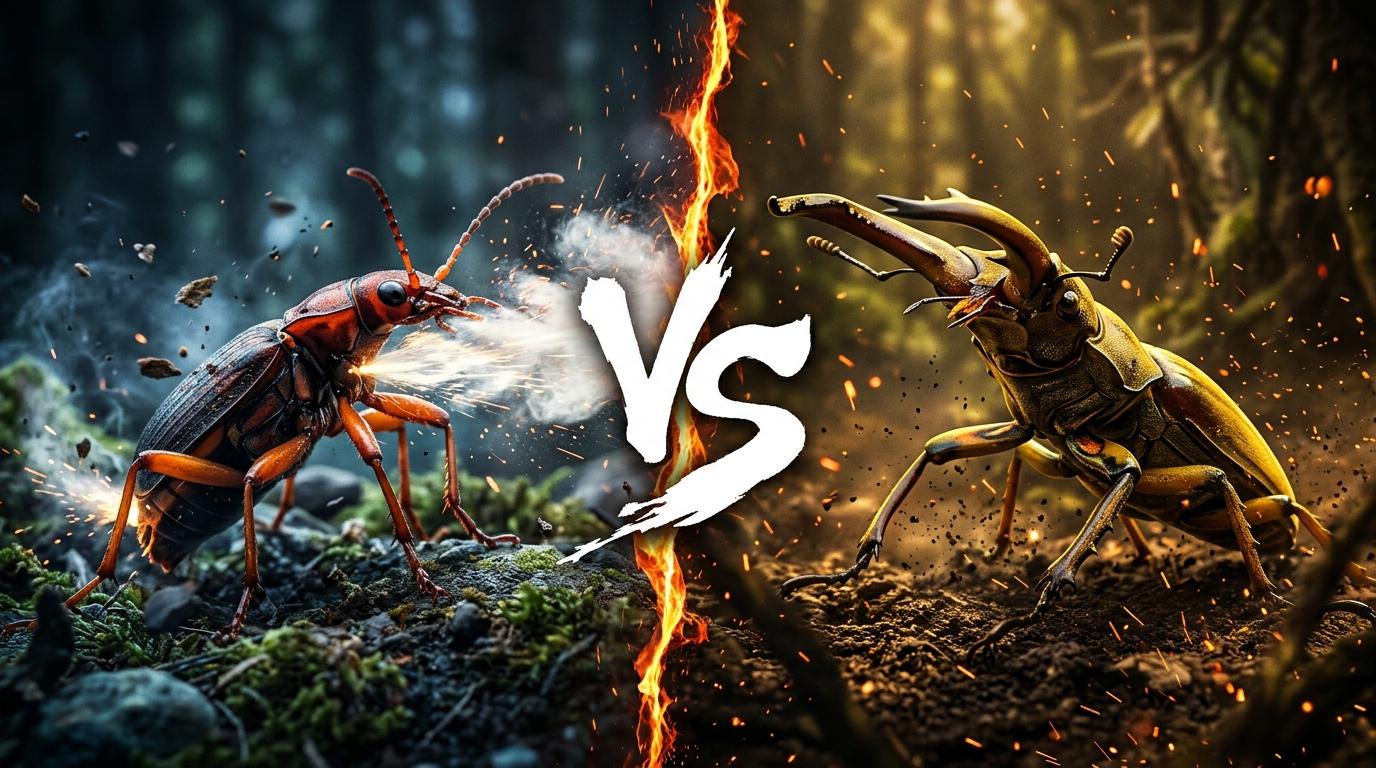
Bombardier Beetle vs Golden Stag Beetle: Who Actually Wins?
Bombardier Beetle vs Golden Stag Beetle: chemical cannon or armored heavyweight? A biology-first breakdown of strength, size, defenses, and who wins a head-to-head clash.
Bombardier Beetle vs Stag Beetle
Matchup winner
Stag Beetle
Quick verdict
Start with the direct answer, then use the structured comparison below to see what changes the outcome.
The Golden Stag Beetle (Odontolabis cuvera) wins this matchup. The Bombardier Beetle (Brachinus crepitans) carries one of the most impressive defensive weapons in the insect world: a near-boiling, pulsed chemical spray that sends ants, spiders, and even toads into retreat. But that system evolved to make predators let go, not to beat a heavily armored, much larger beetle that has no interest in eating it. The bombardier is usually under a centimeter long. The golden stag is several times longer and many times heavier, with thick chitin built for wrestling rivals, so it can shrug off a burst that would rout a frog's tongue. The spray buys the bombardier an escape, not a victory. In any frame where someone has to be displaced, pinned, or pushed off ground, mass and armor decide it, and that favors the stag.
Read the full explanation
Golden Stag Beetle wins most realistic encounters on size, armor, and leverage.
The Bombardier Beetle's boiling spray is elite, but it works as an escape tool, not a way to win fights.
The spray can make the stag recoil, which lets the bombardier survive rather than lose outright.
The two never meet in the wild: one lives on European ground, the other in Southeast Asian forest.
Reader vote
Who do you think wins?
Pick a side — no account needed. Results update live.
No votes yet — be the first to call it.
Editorial note
Why people disagree
The bombardier's chemical cannon sounds unbeatable, so people overrate a defensive weapon as an offensive one.
Size and mass
In insect contests, mass decides who gets lifted, flipped, or shoved off a branch. The stag outweighs the bombardier by a wide margin.
Chemical deterrence
The bombardier mixes hydroquinones and hydrogen peroxide with enzymes in a reaction chamber. It's one of nature's most sophisticated deterrents and almost guarantees it won't be casually handled.
Close-range durability
Stag beetles take repeated mandible squeezes from rivals. That armor dulls the spray and resists crushing pressure.
Read the full explanation +
Stag beetle mandibles look lethal, but they're mostly built for flipping rival males, not for killing, so some argue the stag can't actually 'finish' anything.
There's no natural predator-prey relationship here. 'Winning' depends on whether you score displacement, survival, or injury.
Comparison FAQ
Short, direct answers to the next questions readers usually ask after the headline verdict.
Would a Bombardier Beetle beat a Golden Stag Beetle?+
Usually not. The bombardier can spray and escape, but the golden stag's size and armor let it control any direct contest.
Which beetle is stronger?+
The Golden Stag Beetle. It is far larger and heavier and is built for wrestling and lifting rivals with its mandibles.
Can the bombardier's spray hurt a stag beetle?+
It can sting and startle, since it's hot and chemically irritating, but the stag's thick cuticle limits the damage. Expect a flinch, not a knockout.
Why is the Bombardier Beetle still dangerous if it loses?+
Its near-boiling, aimable spray deters most small predators. Even a winning opponent pays a price, and the bombardier rarely ends up as a meal.
Do these beetles ever meet in the wild?+
No. Brachinus crepitans lives in Europe, while Odontolabis cuvera is found in South and Southeast Asian forests.
Head-to-head species stats
These are the same core AnimalDex stat dimensions used on the dedicated animal pages, pulled side by side so the matchup is faster to scan.
Bombardier Beetle
Tier CStag Beetle
Tier CTrait-by-trait comparison
Only the categories that matter to this matchup are included. The goal is not filler stats, but the real design differences that change the result.
Under 1 cm, featherweight ground beetle
Size and mass
Stag Beetle
Several centimeters, heavy-bodied
Size and mass
Stag Beetle
Pulsed benzoquinone spray near 100°C, aimable
Chemical deterrence
Bombardier Beetle
No meaningful chemical weapon
Chemical deterrence
Bombardier Beetle
Thin, light cuticle for running
Close-range durability
Stag Beetle
Thick armored elytra built for wrestling
Close-range durability
Stag Beetle
Small mandibles for prey
Grappling leverage
Stag Beetle
Long mandibles for lifting and prying
Grappling leverage
Stag Beetle
Fast, nimble runner
Ground mobility
Bombardier Beetle
Slower, deliberate climber
Ground mobility
Bombardier Beetle
Spray-and-flee doctrine
Escape control
Bombardier Beetle
Holds ground, relies on bulk
Escape control
Bombardier Beetle
How the verdict forms
Verdict timeline
01 · Size and mass
Stag Beetle
02 · Chemical deterrence
Bombardier Beetle
03 · Close-range durability
Stag Beetle
04 · Grappling leverage
Stag Beetle
05 · Ground mobility
Bombardier Beetle
06 · Escape control
Bombardier Beetle
Change the conditions
Scenario breakdown
This is where shallow battle content usually fails. Terrain, spacing, timing, and engagement style can change the answer.
Scenario lean
Bombardier Beetle
Verdict confidence
82%
Bombardier survives and slips away.
In cluttered litter, the bombardier's small size and speed shine. A single spray makes the stag recoil, and the bombardier vanishes into crevices the stag can't follow. Nobody gets pinned, so the smaller beetle effectively wins by exit.
AnimalDex field profiles
Explore these animals
Bombardier Beetle
Brachinus crepitans
Woodland edge, grassland, scrub, and moist ground cover.
Stag Beetle
Lucanus cervus
Woodland, old parkland, hedgerows, and gardens with rotting timber.
Systems Intelligence & Hidden Purpose
See the animals behind this comparison as engineered biological systems: what each one is built to do, where it gains leverage, and why the matchup changes by scenario.
Specialized Hardware
Small dark body with contrasting colors, fast running beetle shape, and defensive tail-end chemical spray give the Bombardier Beetle a body plan tuned for its niche.
Systems Script
Bombardier Beetles operate in woodland edge, grassland, scrub, and moist ground cover. Their design helps them match food access, shelter, and timing inside that environment.
Strategic Insight
A fast smart response can protect a small system from a bigger threat.
Specialized Hardware
Large shiny brown-black body, huge antler-like mandibles on males, and hard wing covers give the Stag Beetle a body plan tuned for its niche.
Systems Script
Stag Beetles operate in woodland, old parkland, hedgerows, and gardens with rotting timber. Their design helps them match food access, shelter, and timing inside that environment.
Strategic Insight
What looks old and useless may actually be the foundation for the next cycle.
Final take
The Golden Stag Beetle is the overall winner. Its body is built for exactly this kind of contest: heavy, armored, and armed with lever-like mandibles that settle rivalries by displacement.
Read the full explanation
The Bombardier Beetle isn't outclassed in biology, just in purpose. Its spray is a brilliant answer to being eaten, and it will almost always walk away alive. But walking away isn't winning, and against an armored opponent several times its size, it can't take ground or hold it.
Collect both animals in AnimalDex
Track the species behind this matchup, compare their real traits, and build the rivalry into your AnimalDex collection.
Related comparisons
Continue with nearby matchups to compare more real-world animal traits without dropping into junky who-wins filler.
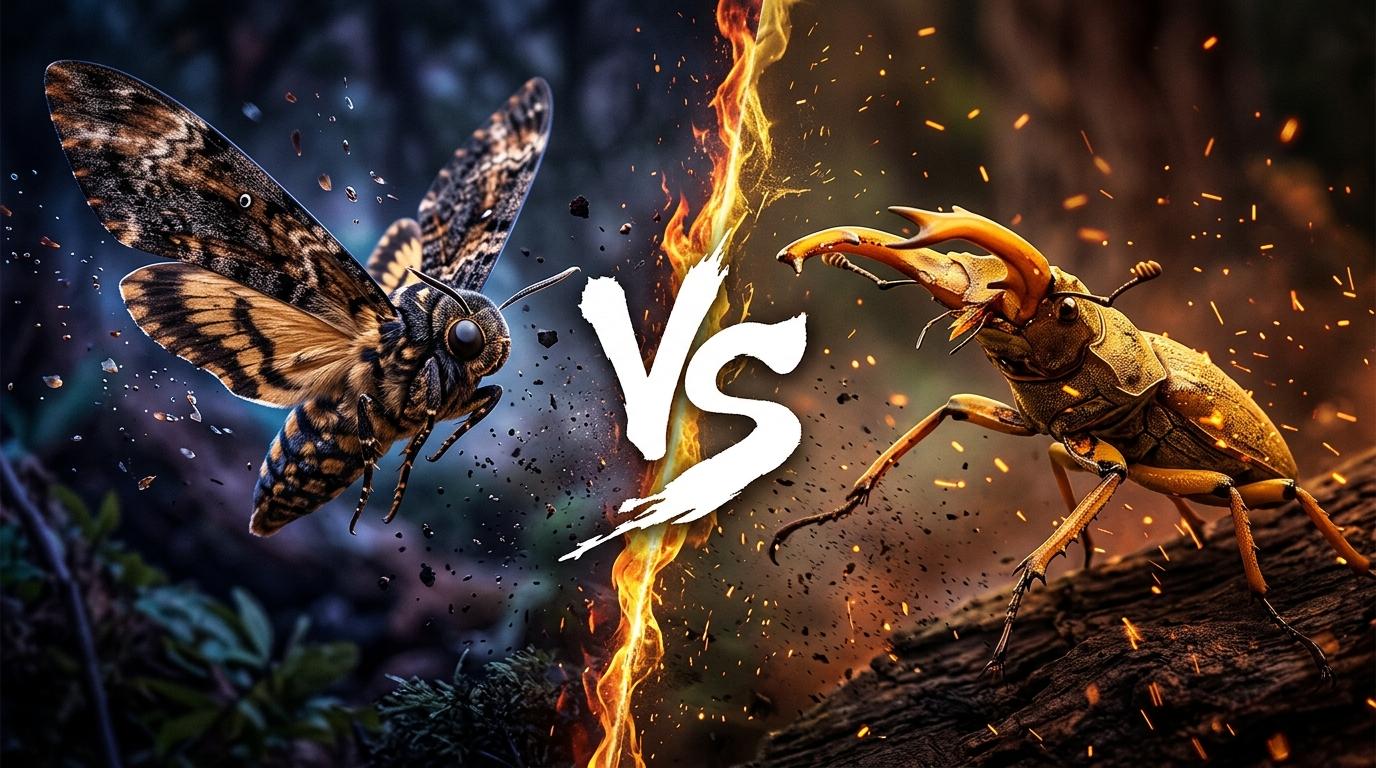
Death's-head Hawkmoth vs Golden Stag Beetle: Who Actually Wins?
The Golden Stag Beetle wins. In any contest that requires holding ground, the beetle's hardened elytra, armored body, and oversized male mandibles, built specifically for wrestling rivals off sap-flow branches, outclass anything the Death's-head Hawkmoth can bring to a physical exchange. The hawkmoth is the more remarkable animal in many ways. It is a fast, powerful flier, it squeaks when threatened, and it raids beehives while masked in chemical camouflage. But it has no biting weapon, only a short, stout proboscis built for piercing honeycomb, and its soft, scaled body is designed to slip away, not absorb a pinch. If the hawkmoth is forced to stay, it loses. Its real victory condition is leaving, and that is evasion, not winning.
Read comparison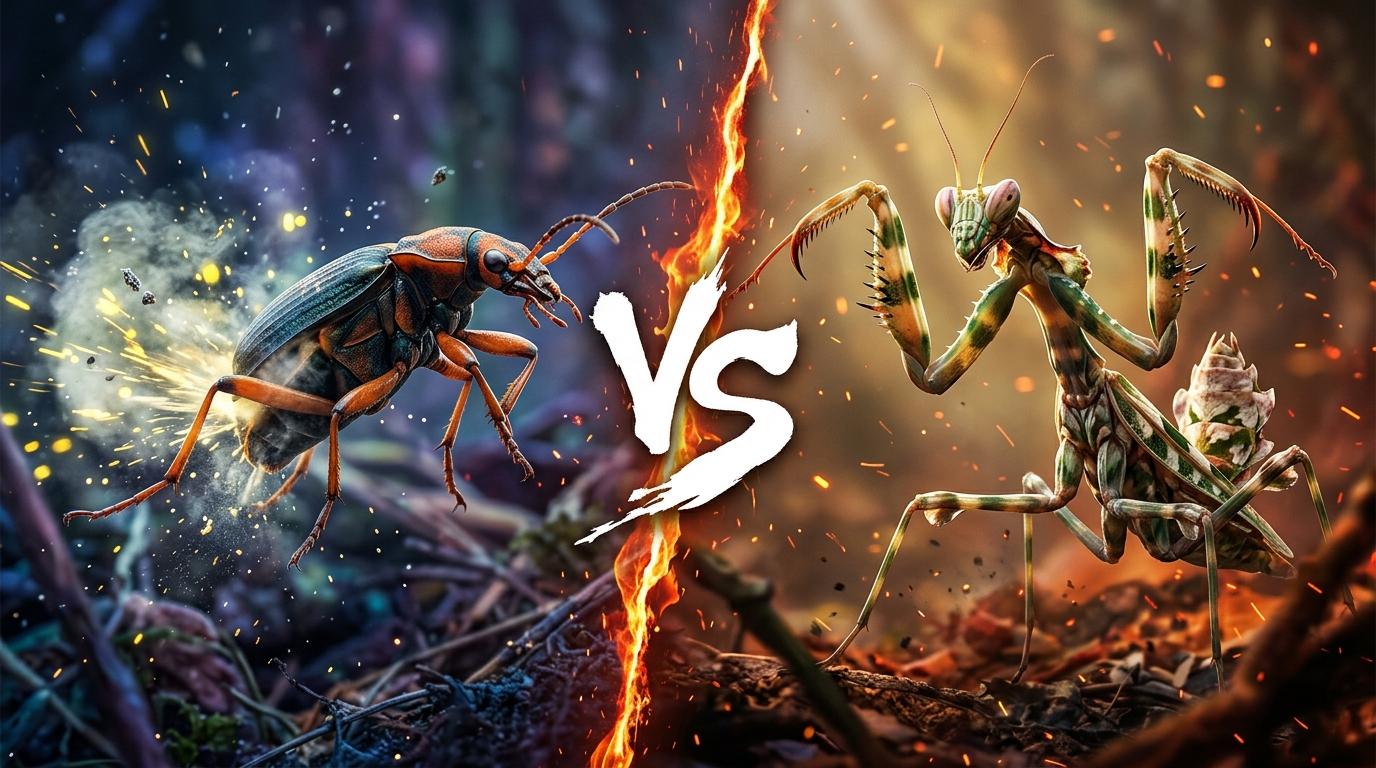
Bombardier Beetle vs Devil's Flower Mantis: Who Actually Wins?
The Bombardier Beetle wins this matchup, though not by overpowering anything. The Devil's Flower Mantis is roughly three to four times longer, has spiked raptorial forelegs, and strikes with a visual ambush system built for catching flying insects. A win for the beetle therefore means it survives and the mantis lets go. Brachinus carries a two-chamber reactor in its abdomen. When it is grabbed, it mixes stored hydroquinones and hydrogen peroxide with enzymes and fires a pulsed spray of irritating benzoquinones at about 100°C. A rotating abdominal tip lets it aim that spray at whatever is holding it, including a mantis's forelegs and face. Raptorial capture only works if the predator can keep its grip and its focus, and a scalding chemical blast to the mouthparts at point-blank range breaks both. The mantis can win, but it needs a clean head-first grab that disables the beetle before the first pulse lands. The beetle's defense has more ways to work than the mantis's attack.
Read comparison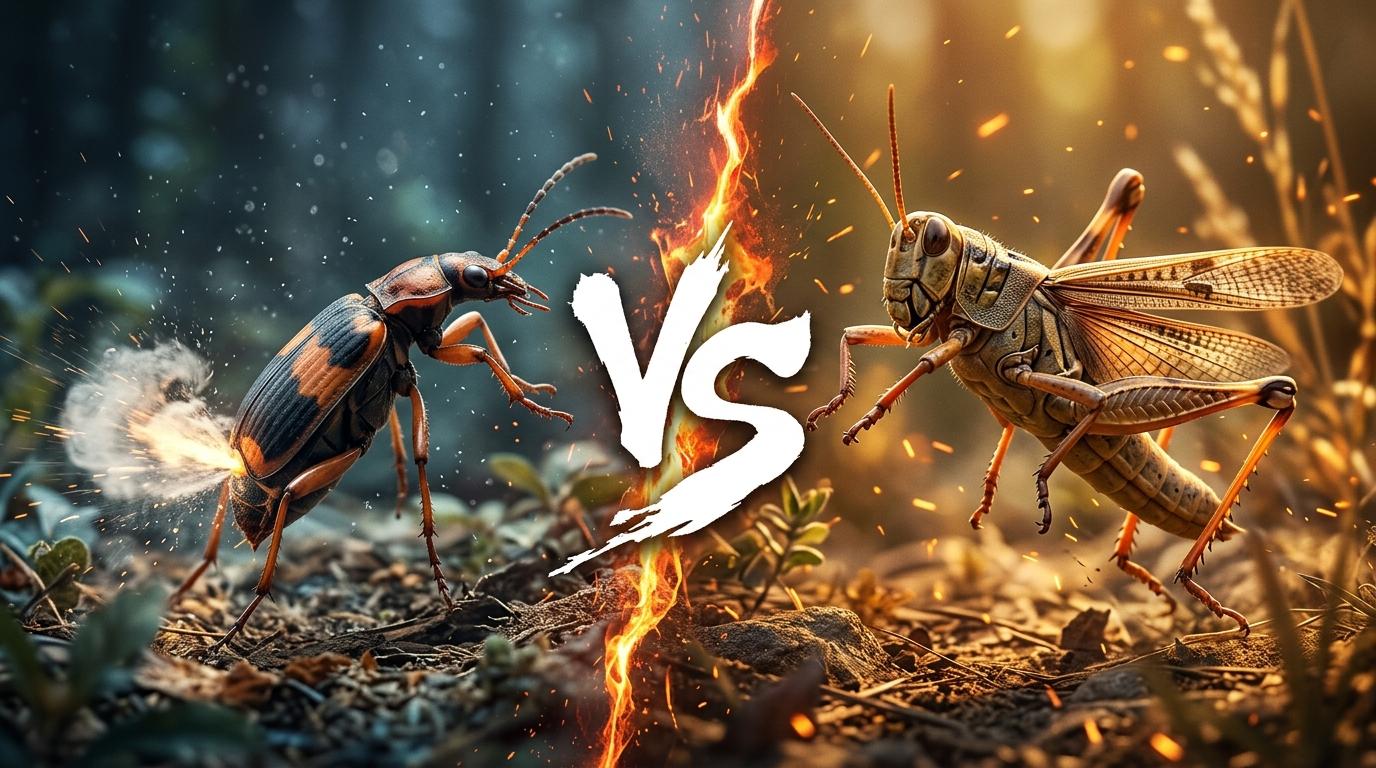
Bombardier Beetle vs Grasshopper & Locust: Who Actually Wins?
The bombardier beetle wins a one-on-one encounter. It is a ground-hunting carabid predator with sharp mandibles and one of the most famous chemical defenses on Earth: a pulsed, boiling spray of benzoquinones near 100°C, aimed from a swiveling abdominal tip. A grasshopper or locust is larger and far more mobile, with a catapult jump and strong flight, but it has no weapons that can hurt a hard-shelled beetle. Its best options are kicking with spined hind legs, spitting brown regurgitant, and leaving. In a direct contest the beetle has the attack and the defense. The grasshopper's real edge is escape, and escaping is not the same as winning. Locust swarms are an ecological superpower, but that is an advantage at landscape scale, not in a duel.
Read comparison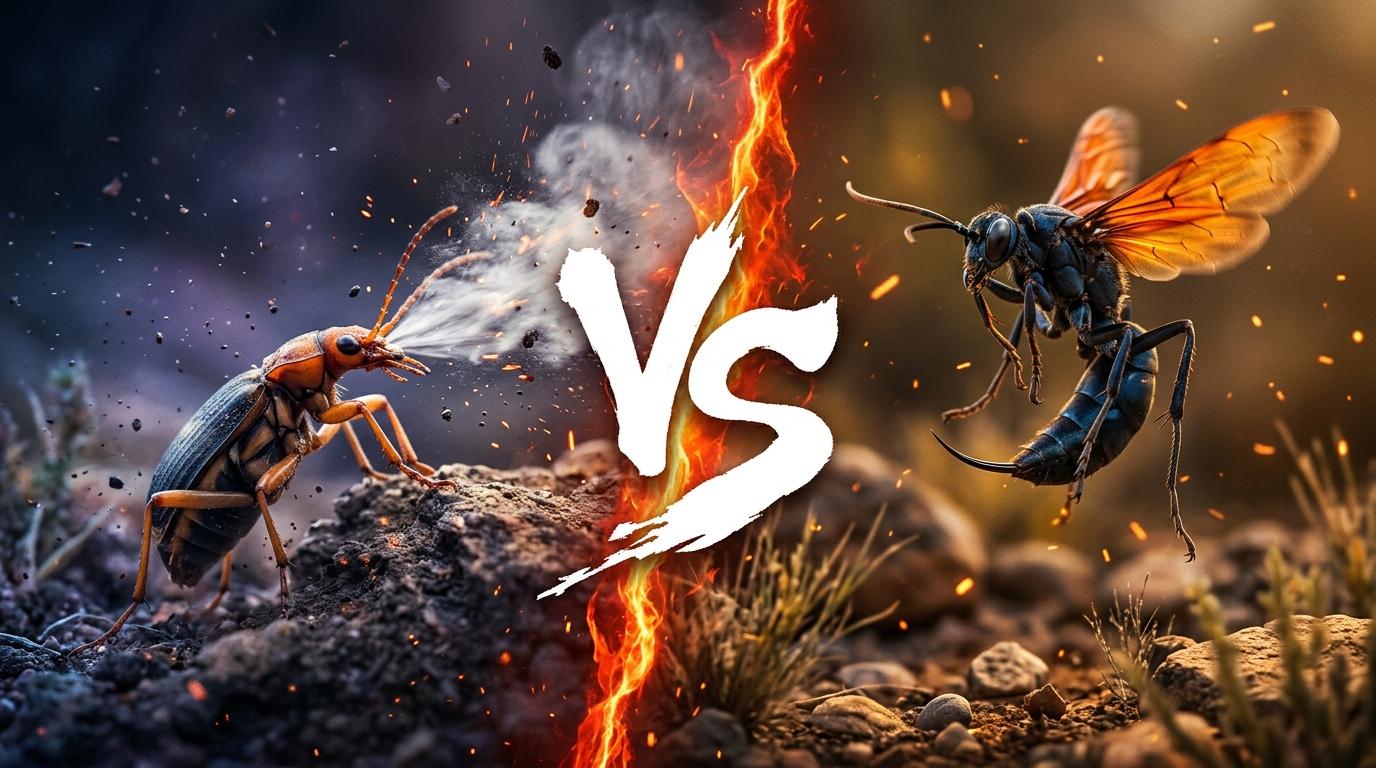
Bombardier Beetle vs Tarantula Hawk Wasp: Who Actually Wins?
The Tarantula Hawk Wasp wins clearly. At up to roughly 5 cm long, Pepsis grossa outsizes the 7 to 10 mm Brachinus crepitans several times over. It also brings a tough exoskeleton, strong grasping legs, flight, and a paralytic sting built to subdue tarantulas many times its own mass. The bombardier beetle's famous defense is a pulsed, near-100°C jet of benzoquinone it can aim almost anywhere around its body. That spray stops ants, spiders, and frogs, and it can absolutely make the wasp flinch, retreat, or clean itself. But the spray is built to repel attackers, not to kill them. The wasp can take a hit, lift off, and choose whether to re-engage. The beetle cannot outrun, outfly, or out-armor something that big. In any exchange that lasts more than a second or two, size, mobility, and a weaponized sting decide it for the wasp.
Read comparison
Discussion
What do you think?
Share your reasoning with other readers. Be civil and stick to the animals.
Sign in to join the discussion.
Sign inNo comments yet. Start the conversation.