

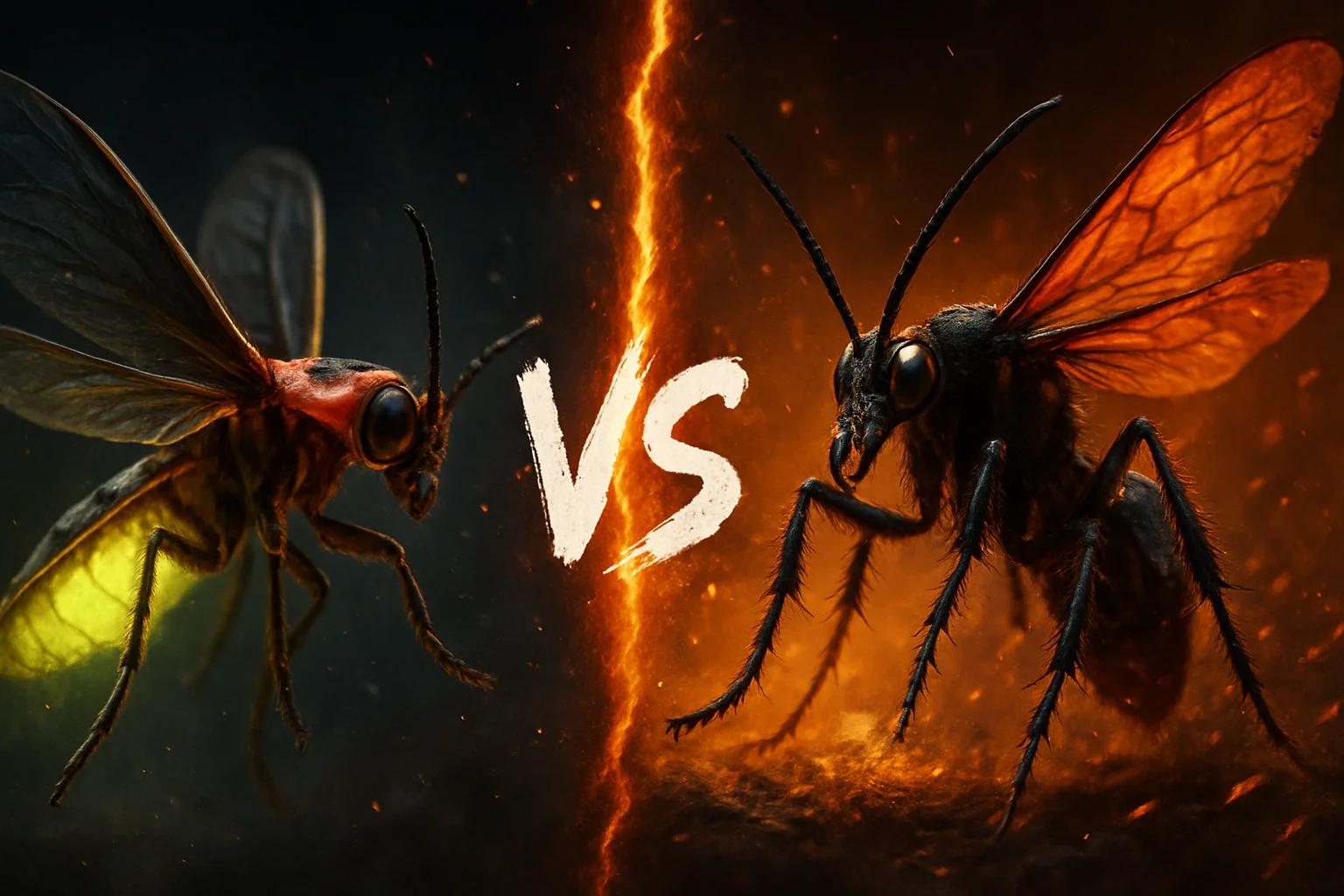
Firefly vs Tarantula Hawk Wasp: Who Actually Wins?
Firefly vs tarantula hawk wasp: a biology-first breakdown of size, venom, chemical defense, and speed, and why the giant spider-hunting wasp wins almost every matchup.
Firefly vs Tarantula Hawk Wasp
Matchup winner
Tarantula Hawk Wasp
Quick verdict
Start with the direct answer, then use the structured comparison below to see what changes the outcome.
The tarantula hawk wasp wins, and it isn't close. Pepsis grossa can reach about 5 cm with a long, flexible stinger and some of the most painful venom known in insects. It flies fast and has spiny, grappling legs built to pin and paralyze tarantulas many times its own mass. A firefly is a soft-bodied beetle around 1–2 cm long with weak jaws as an adult, and many adults barely feed at all. Its real weapon is chemical. Many fireflies carry bitter, toxic lucibufagins, and their glow is partly a warning that they taste bad. That defense works against birds, lizards and spiders that bite and swallow. It does almost nothing against a wasp that has no reason to eat the firefly and can simply overpower it. The firefly's best outcome is to avoid the fight entirely, and that is not the same as winning it.
Read the full explanation
Tarantula hawk wasp wins decisively.
It is several times longer and heavier, armored, fast, and armed with a powerful sting.
The firefly's toxic chemistry deters predators that eat it, not an attacker that just overpowers it.
Adult tarantula hawks mostly drink nectar, so a real fight is unlikely. In a forced clash, though, the wasp dominates.
Reader vote
Who do you think wins?
Pick a side — no account needed. Results update live.
No votes yet — be the first to call it.
Editorial note
Why people disagree
Fireflies are 'poisonous', and people confuse poison (harmful if eaten) with venom (injected offense).
Size and mass
Among insects, a doubling of length means far more muscle and leverage, and the wasp has that edge many times over.
Offensive weaponry
Only one of these insects has a tool that can end a fight.
Chemical deterrence
This is the firefly's one real category win. It makes the firefly a terrible meal, but it can't stop a grapple.
Read the full explanation +
Some predatory fireflies (Photuris 'femme fatales') hunt other fireflies, which makes the group sound more dangerous than it is.
Tarantula hawks rarely attack anything but tarantulas, so some argue the wasp would just ignore the firefly. That's true, but it says nothing about who would win.
Comparison FAQ
Short, direct answers to the next questions readers usually ask after the headline verdict.
Would a firefly beat a tarantula hawk wasp?+
No. The tarantula hawk is far larger, faster, armored and venomous. A firefly has no way to injure it seriously.
Which is stronger, a firefly or a tarantula hawk wasp?+
The tarantula hawk, by a wide margin. It can drag a paralyzed tarantula many times its own weight.
Is a firefly poisonous?+
Many species are. They contain lucibufagins, steroid toxins that make them distasteful or harmful to predators such as birds, lizards, and pets that eat them.
Why does the firefly stay dangerous even though it loses?+
Its toxins punish anything that tries to eat it, and some Photuris fireflies are themselves predators of other fireflies. It loses fights but often wins the 'don't eat me' game.
Do tarantula hawk wasps attack fireflies in the wild?+
Not normally. Adults drink nectar and females hunt tarantulas to feed their larvae, so this matchup is hypothetical.
Head-to-head species stats
These are the same core AnimalDex stat dimensions used on the dedicated animal pages, pulled side by side so the matchup is faster to scan.
Firefly
Tier DTarantula Hawk Wasp
Tier DTrait-by-trait comparison
Only the categories that matter to this matchup are included. The goal is not filler stats, but the real design differences that change the result.
1–2 cm, soft-bodied
Size and mass
Tarantula Hawk Wasp
Up to ~5 cm, heavily built
Size and mass
Tarantula Hawk Wasp
Weak adult mandibles
Offensive weaponry
Tarantula Hawk Wasp
Long stinger, paralytic and intensely painful venom
Offensive weaponry
Tarantula Hawk Wasp
Bitter lucibufagin toxins, reflex bleeding
Chemical deterrence
Firefly
Aposematic colors backed by its sting
Chemical deterrence
Firefly
Slow, drifting display flight
Flight and pursuit
Tarantula Hawk Wasp
Fast, agile, low hunting flight
Flight and pursuit
Tarantula Hawk Wasp
Light grip, little leverage
Grapple control
Tarantula Hawk Wasp
Spined, hooked legs built to pin tarantulas
Grapple control
Tarantula Hawk Wasp
Soft elytra, fragile body
Close-range durability
Tarantula Hawk Wasp
Tough cuticle that resists spider fangs
Close-range durability
Tarantula Hawk Wasp
How the verdict forms
Verdict timeline
01 · Size and mass
Tarantula Hawk Wasp
02 · Offensive weaponry
Tarantula Hawk Wasp
03 · Chemical deterrence
Firefly
04 · Flight and pursuit
Tarantula Hawk Wasp
05 · Grapple control
Tarantula Hawk Wasp
06 · Close-range durability
Tarantula Hawk Wasp
Change the conditions
Scenario breakdown
This is where shallow battle content usually fails. Terrain, spacing, timing, and engagement style can change the answer.
Scenario lean
Tarantula Hawk Wasp
Verdict confidence
82%
The wasp wins once contact happens.
Cover helps the firefly hide, especially if it stops glowing. But the tarantula hawk is used to searching ground clutter for burrows. Once the wasp finds the beetle, its legs and sting settle things in seconds.
AnimalDex field profiles
Explore these animals
Firefly
Lampyridae
Moist grassland, woodland edges, wetlands, gardens, and stream corridors with low nighttime disturbance.
Tarantula Hawk Wasp
Pepsis grossa
Desert scrub, dry woodland, and warm open country.
Systems Intelligence & Hidden Purpose
See the animals behind this comparison as engineered biological systems: what each one is built to do, where it gains leverage, and why the matchup changes by scenario.
Specialized Hardware
Luciferin-based light production, species-specific flash timing, and low-light visual sensitivity make fireflies highly efficient communication hardware for dark environments.
Systems Script
Fireflies turn mating, territory, and species recognition into precise light code. They show that even small organisms can coordinate behavior cleanly when signals are cheap, legible, and well-timed.
Strategic Insight
A strong signal is not necessarily a loud one. The best signals are energy-efficient, hard to confuse, and tuned to the right audience.
Specialized Hardware
Large dark body with bright wings, long dangling legs in flight, and wasp waist and curved antennae give the Tarantula Hawk Wasp a body plan tuned for its niche.
Systems Script
Tarantula Hawk Wasps operate in desert scrub, dry woodland, and warm open country. Their design helps them match food access, shelter, and timing inside that environment.
Strategic Insight
Extreme specialization can solve a problem that looks too dangerous for a generalist.
Final take
The tarantula hawk wasp is the clear winner. It is a purpose-built subduer of dangerous prey, armed with one of the insect world's most notorious stings and with the armor and grappling legs to deliver it.
Read the full explanation
The firefly isn't helpless in nature. It is just built for a different problem. Its toxins and warning light teach predators not to eat it, and it times its activity for darkness. Those are good survival tools, but they aren't fighting tools, and in a straight contest the wasp wins nearly every time.
Collect both animals in AnimalDex
Track the species behind this matchup, compare their real traits, and build the rivalry into your AnimalDex collection.
Related comparisons
Continue with nearby matchups to compare more real-world animal traits without dropping into junky who-wins filler.
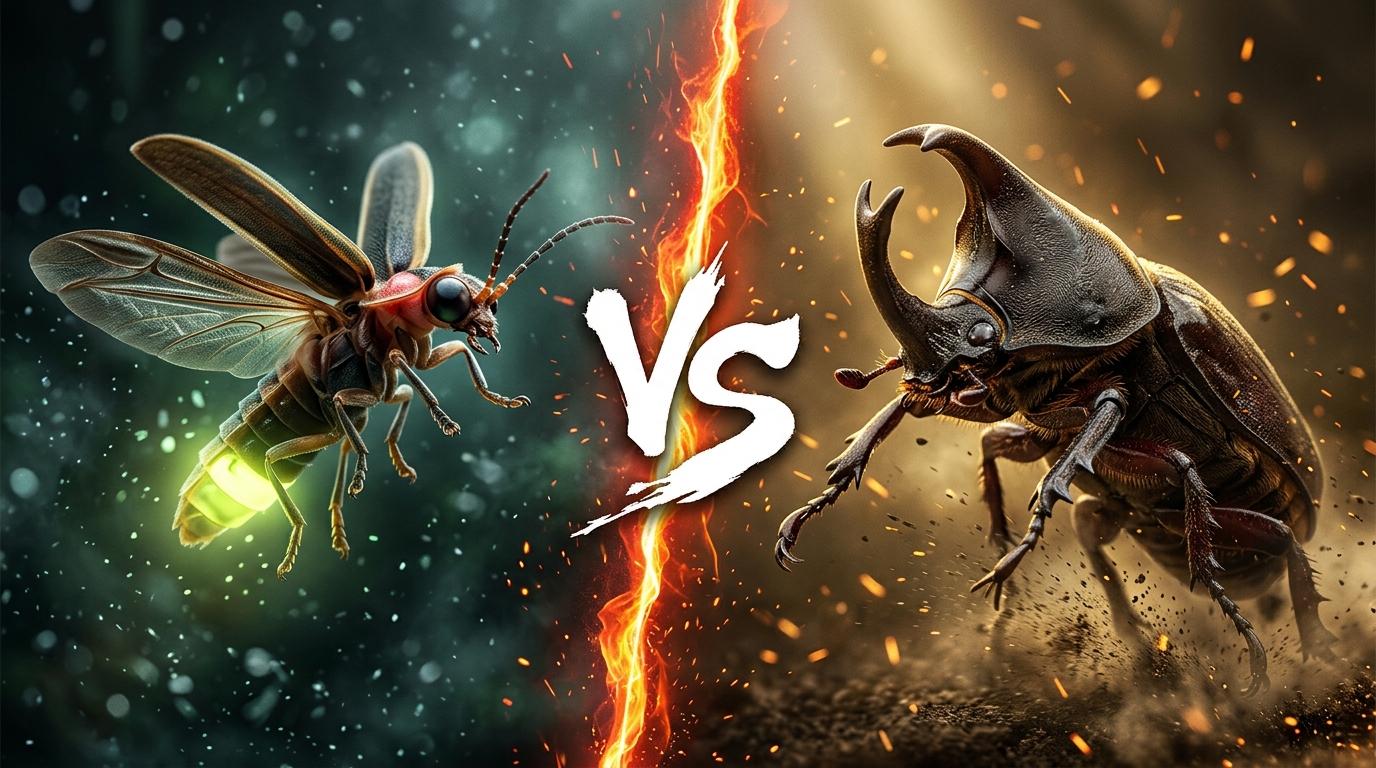
Firefly vs Rhinoceros Beetle: Who Actually Wins?
The rhinoceros beetle wins clearly. Both are beetles, but they sit at opposite ends of the order. A firefly is a soft-bodied, lightweight signaler that weighs a fraction of a gram. Its leathery wing covers are built for courtship flights, not combat. A rhinoceros beetle is a heavily armored scarab with thick, rigid elytra and a horn system evolved specifically for prying, lifting and flipping rivals. It also outweighs a firefly many times over. The firefly's real weapon is chemical. Many species carry bitter lucibufagins that make predators drop them. But a rhinoceros beetle is a plant-sap and fruit feeder, not a predator, so that toxic defense barely matters in a physical shove contest. In any forced confrontation over a branch, a sap flow or a piece of rotting fruit, the rhinoceros beetle simply levers the firefly off and keeps the spot.
Read comparison
Dung Beetle vs Firefly: Who Actually Wins?
The dung beetle wins, and it is not especially close. Both insects are beetles (order Coleoptera), but they are built for opposite jobs. Dung beetles are compact, heavily armored excavators. Many species have digging forelegs, a shovel-like head, and in some species horns that males use in shoving contests inside tunnels. The horned dung beetle Onthophagus taurus has been measured pulling roughly 1,141 times its own body weight, one of the strongest ratios recorded in any animal. Fireflies belong to a soft-bodied lineage. Their wing covers are leathery rather than hard, their bodies are lightly built, and most adults barely feed at all. Their real defense is chemical: bitter, toxic steroids called lucibufagins and reflex bleeding of distasteful blood. Those defenses deter birds and spiders far better than they stop another armored beetle with no interest in eating them. In a shoving, grappling, pinning contest, the dung beetle's armor, leverage, and raw pulling power decide it. The firefly's best outcome is a stalemate it escapes by flying away.
Read comparison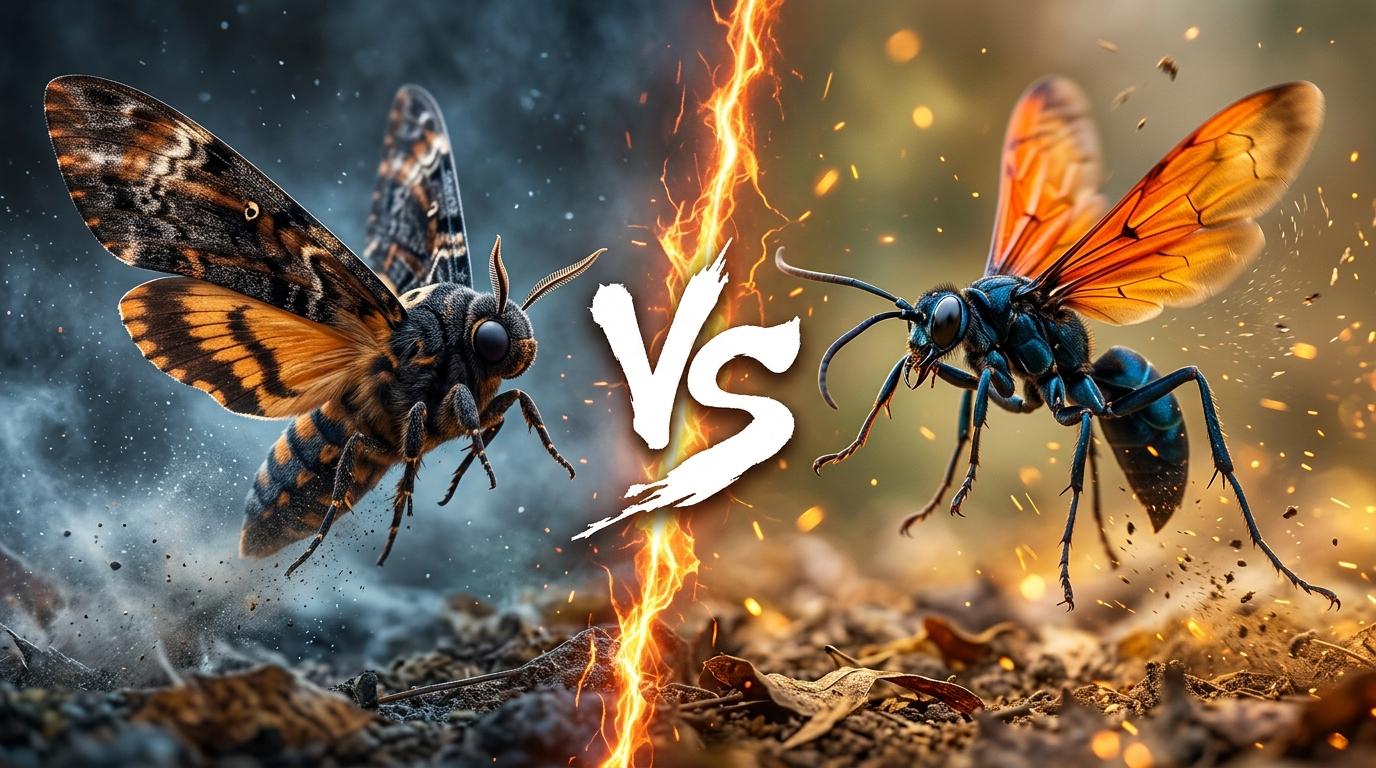
Death's-head Hawkmoth vs Tarantula Hawk Wasp: Who Actually Wins?
The Tarantula Hawk Wasp wins, and it isn't especially close in a forced fight. Pepsis grossa is a dedicated predator-grade insect. It carries a long sting, reportedly among the most painful insect stings known, along with strong mandibles, a hard warning-colored exoskeleton, and a hunting routine built around subduing tarantulas that outweigh it many times over. The Death's-head Hawkmoth is a remarkable animal, with a big body, powerful flight, a bee-scent disguise, and a squeak that startles attackers, but its entire kit is built for raiding, deceiving, and escaping rather than fighting. It has no sting and no real biting weapon, and its stout proboscis is a feeding tool. If the two lock up, the wasp's weapons decide it. The moth's best result is never letting the fight start.
Read comparison
Firefly vs Jumping Spider: Who Actually Wins?
The firefly wins this matchup, but not by fighting. The tan jumping spider (Platycryptus undatus) has every hunting advantage: excellent eyesight, a precise pounce, venom, and problem-solving that is remarkable for an animal its size. Many fireflies, however, carry lucibufagins, bitter defensive steroids. When grabbed, they can also reflex-bleed foul-tasting hemolymph. In feeding studies, jumping spiders such as Phidippus often bite fireflies and then reject them, and some learn to avoid them altogether. Here, 'winning' means the firefly survives the encounter and the spider gives up the meal. Most realistic encounters end that way: the spider's intelligence works against it, because a smart predator learns quickly that this glowing beetle isn't worth eating.
Read comparison
Discussion
What do you think?
Share your reasoning with other readers. Be civil and stick to the animals.
Sign in to join the discussion.
Sign inNo comments yet. Start the conversation.