

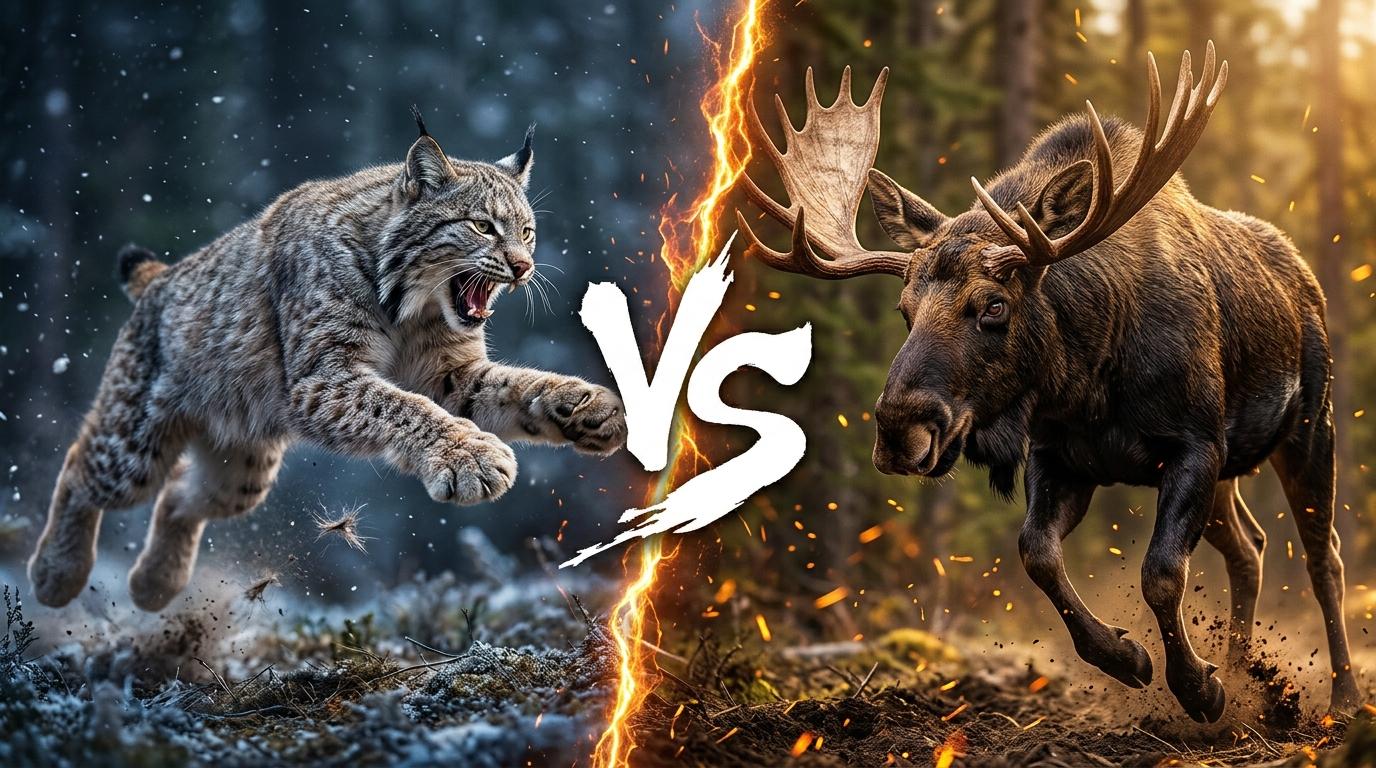
Canada Lynx vs Moose (Eurasian Elk): Who Actually Wins?
Canada lynx vs moose: a biology-first look at size, weapons, and behavior to settle who would win, and why the mismatch is so lopsided.
Canada Lynx vs Moose
Matchup winner
Moose
Quick verdict
Start with the direct answer, then use the structured comparison below to see what changes the outcome.
The moose (Eurasian elk, Alces alces) wins decisively. An adult moose weighs roughly 380–700 kg, about 40 to 60 times the mass of a 8–14 kg Canada lynx. It fights with sharp front hooves that can kill wolves, and bulls carry broad antlers for part of the year. The lynx is a superb snowshoe-hare specialist, with huge snowshoe paws, keen hearing, and a fast ambush pounce. But its bite and claws are scaled for prey weighing a few kilograms, not an animal with thick hide, a dense winter coat, and a body taller at the shoulder than a person. The lynx has no realistic way to bring down a healthy adult moose. A close encounter is far more likely to injure the cat than the deer. Lynx have taken newborn moose calves on rare occasions, but against an adult the moose controls every meaningful frame.
Read the full explanation
Moose wins: roughly 50x heavier, with lethal front-hoof strikes.
The lynx is built to kill snowshoe hares, not large ungulates.
Even a cow moose guarding a calf will charge and stomp predators.
The lynx's real edge is avoidance: it can climb, hide, and slip away.
Reader vote
Who do you think wins?
Pick a side — no account needed. Results update live.
No votes yet — be the first to call it.
Editorial note
Why people disagree
Lynx sounds like a fierce wild cat, so people picture it acting like a cougar or tiger. In reality it is a mid-sized hare specialist.
Mass and frame
At this size gap, the lynx's bite cannot reach anything vital and its grip cannot hold.
Explosive power
Moose hoof strikes deliver bone-breaking force. The lynx's pounce is tuned to pin a 1.5 kg hare.
Weapon system
The moose's weapons work at a distance the lynx must close to attack, so the cat absorbs strikes before it can land anything.
Read the full explanation +
Some assume predators always beat prey. But moose regularly repel wolves and bears, so 'prey' does not mean helpless.
Deep snow seems to favor the light-footed lynx. It does help the lynx move, but it doesn't give the cat the killing power to finish a moose.
Comparison FAQ
Short, direct answers to the next questions readers usually ask after the headline verdict.
Would a Canada lynx beat a moose in a fight?+
No. An adult moose outweighs a lynx roughly 40 to 60 times and can kill it with a single front-hoof strike. The lynx cannot inflict a fatal wound on a healthy adult.
Which is stronger, a lynx or a moose?+
The moose, by an enormous margin. It is the largest deer species, with powerful legs capable of injuring wolves and bears.
Do lynx ever hunt moose?+
Very rarely, and only newborn or very young calves when the mother isn't defending them. Adult moose are not lynx prey.
Why is a lynx still dangerous despite losing?+
Within its own niche, it is a precise, stealthy killer of hares, grouse, and occasionally small deer fawns. Its claws and bite can seriously injure animals near its own size, and it is very hard to catch thanks to climbing and snow mobility.
Is a Eurasian elk the same as a moose?+
Yes. In Europe, Alces alces is called the elk. In North America the same species is called moose, and 'elk' refers to the wapiti.
Head-to-head species stats
These are the same core AnimalDex stat dimensions used on the dedicated animal pages, pulled side by side so the matchup is faster to scan.
Canada Lynx
Tier BMoose
Tier BTrait-by-trait comparison
Only the categories that matter to this matchup are included. The goal is not filler stats, but the real design differences that change the result.
8–14 kg, compact build
Mass and frame
Moose
380–700 kg, up to ~2 m at shoulder
Mass and frame
Moose
Short, springy pounce
Explosive power
Moose
Driving charge plus downward hoof strikes
Explosive power
Moose
Sharp claws and a neck-bite for small prey
Weapon system
Moose
Front hooves year-round, antlers on bulls
Weapon system
Moose
Elite stalking, silent snowshoe paws
Ambush control
Canada Lynx
Big ears, sharp smell, vigilant mother instincts
Ambush control
Canada Lynx
Light frame, vulnerable to one solid kick
Close-range durability
Moose
Thick hide, dense coat, massive musculature
Close-range durability
Moose
Tree climbing, floating over deep snow
Escape options
Canada Lynx
Long-legged wading, strong swimming
Escape options
Canada Lynx
How the verdict forms
Verdict timeline
01 · Mass and frame
Moose
02 · Explosive power
Moose
03 · Weapon system
Moose
04 · Ambush control
Canada Lynx
05 · Close-range durability
Moose
06 · Escape options
Canada Lynx
Change the conditions
Scenario breakdown
This is where shallow battle content usually fails. Terrain, spacing, timing, and engagement style can change the answer.
Scenario lean
Moose
Verdict confidence
82%
Moose wins: stealth gets the lynx close but not lethal.
Dense spruce cover lets the lynx stalk unseen. But its ambush kill relies on a throat or nape bite that its jaws cannot deliver through a moose's neck mass. A startled moose wheels and strikes with its front hooves, and the lynx's best move is to retreat up a tree.
AnimalDex field profiles
Explore these animals
Canada Lynx
Lynx canadensis
Boreal forest, snowy woodland, and sub-Arctic forest systems.
Moose
Alces alces
Boreal forest, wetlands, willow thickets, and lake edges.
Systems Intelligence & Hidden Purpose
See the animals behind this comparison as engineered biological systems: what each one is built to do, where it gains leverage, and why the matchup changes by scenario.
Specialized Hardware
Ear tufts and short black-tipped tail, very large furry feet, and long legs and thick winter coat give the Canada Lynx a body plan tuned for its niche.
Systems Script
Canada Lynxs operate in boreal forest, snowy woodland, and sub-Arctic forest systems. Their design helps them match food access, shelter, and timing inside that environment.
Strategic Insight
Specialized footing can decide the whole contest when the ground is difficult.
Specialized Hardware
Long legs and tall shoulder height, large drooping nose and heavy head, and broad paddle-shaped antlers on adult males give the Moose a body plan tuned for its niche.
Systems Script
Mooses operate in boreal forest, wetlands, willow thickets, and lake edges. Their design helps them match food access, shelter, and timing inside that environment.
Strategic Insight
Height becomes useful when it opens paths and food that smaller bodies cannot reach.
Final take
This isn't close. The Canada lynx is an exquisitely tuned predator, but its tuning points at snowshoe hares, and its population famously rises and falls with the hare cycle. The moose is the largest living deer, built to defend itself against wolves and bears.
Read the full explanation
The lynx's genius is efficiency: low-cost stalking, quiet movement, and knowing what not to attack. A lynx that picked a fight with an adult moose would be breaking its own survival logic. The moose wins on mass, weapons, and durability, and the lynx wisely never tests it.
Collect both animals in AnimalDex
Track the species behind this matchup, compare their real traits, and build the rivalry into your AnimalDex collection.
Related comparisons
Continue with nearby matchups to compare more real-world animal traits without dropping into junky who-wins filler.

Canada Lynx vs Grizzly Bear: Who Actually Wins?
The grizzly bear wins, and it is not close. An adult grizzly typically weighs 180–360 kg against a Canada lynx's 8–14 kg, so the bear can outweigh the cat by twenty to forty times. The lynx is a precision snowshoe-hare specialist. It is built for silent stalking, deep-snow flotation and short pounces on prey smaller than itself. The grizzly is a shoulder-humped digging and crushing machine. It has 5–10 cm claws, a bite strong enough to crack bone, and a thick hide and fat layer that shrug off small-predator slashes. In any direct confrontation the lynx's best move is to avoid the bear entirely by climbing, slipping away or ceding a carcass. In nature that is exactly what lynx do.
Read comparison
Canada Lynx vs Eurasian Lynx: Who Actually Wins?
The Eurasian lynx wins, and it isn't especially close in a straight confrontation. It is the largest lynx species. Adult males commonly weigh 18–30 kg, against roughly 8–14 kg for a Canada lynx, so it often brings double the body mass. Its build is made for killing roe deer and chamois, prey many times heavier than the snowshoe hares that dominate the Canada lynx's diet. That means heavier forelimbs, a stronger bite, and practiced experience controlling large, struggling animals. The Canada lynx has its own strengths. Its enormous snowshoe paws, low body weight and agility make it superbly efficient in deep, soft snow, which is the only setting where it can push the matchup. But in close contact, mass, bite force and large-prey grappling skill decide the outcome, and the Eurasian lynx owns all three.
Read comparison
American Marten vs Moose (Eurasian Elk): Who Actually Wins?
The moose wins, and it isn't close. An adult moose (Alces alces, called the elk in Europe) weighs roughly 400–700 kg and stands about 2 m at the shoulder. It defends itself with front-hoof strikes that can seriously injure wolves and bears, and bulls add heavy antlers. The American marten weighs about 0.5–1.3 kg. It is a superb climber and a fast, precise killer of voles, squirrels and snowshoe hares, but its bite and body mass are built for prey a fraction of its own size. A marten has no way to wound a moose meaningfully, and a moose that felt threatened could kill the marten with one stamp. The marten's real advantages are escape and agility, not offense. Any realistic encounter ends with the marten climbing a tree or the moose ignoring it.
Read comparison
Discussion
What do you think?
Share your reasoning with other readers. Be civil and stick to the animals.
Sign in to join the discussion.
Sign inNo comments yet. Start the conversation.