

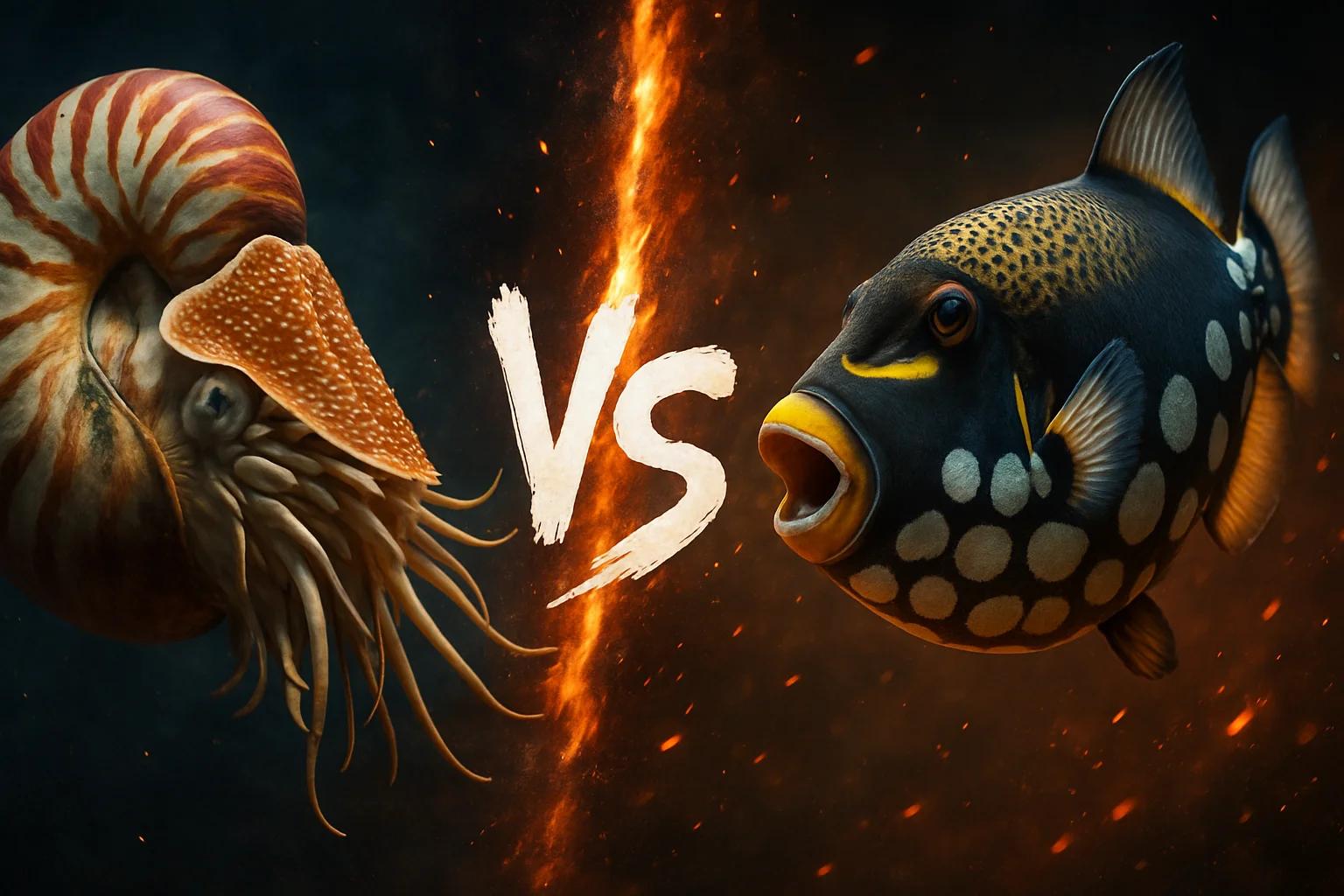
Chambered Nautilus vs Clown Triggerfish: Who Actually Wins?
Chambered nautilus vs clown triggerfish: a biology-first breakdown of shells, beaks, speed and reef aggression to answer who would win.
Chambered Nautilus vs Clown Triggerfish
Matchup winner
Clown Triggerfish
Quick verdict
Start with the direct answer, then use the structured comparison below to see what changes the outcome.
The clown triggerfish wins this matchup clearly. It is a reef predator built to crack armor. Its fused, chisel-like teeth and powerful jaws exist to bite through sea urchins, crabs and mollusk shells. It has the speed, agility and aggressive temperament to keep attacking until something gives. The chambered nautilus is a living fossil designed for survival, not combat. Its coiled shell, slow jet propulsion and deep-water lifestyle help it avoid fights rather than win them. Its parrot-like beak and dozens of grasping tentacles are real tools, but they suit scavenging, not trading blows with a fish that treats shelled animals as food. If the two share space on a reef slope, the triggerfish controls the engagement.
Read the full explanation
Clown triggerfish wins: its teeth and jaws are specialized for breaking shells.
The triggerfish is faster, more maneuverable and far more aggressive.
The nautilus survives by living deep, migrating vertically and avoiding contact, not by fighting.
The nautilus's beak and tentacles can still deliver a nasty grab if it is cornered.
Reader vote
Who do you think wins?
Pick a side — no account needed. Results update live.
No votes yet — be the first to call it.
Editorial note
Why people disagree
The nautilus shell looks like perfect armor, but it is thin, gas-filled and brittle compared with what triggerfish crack every day.
Armor-breaking bite
The triggerfish's whole feeding toolkit targets hard-shelled prey, which is exactly what a nautilus is.
Protective armor
The shell is the nautilus's best asset and can absorb glancing attacks, but repeated focused bites expose its limits.
Mobility and maneuvering
Whoever picks the angle of attack picks the weak point. The triggerfish can strike the shell opening repeatedly.
Read the full explanation +
Cephalopods have a reputation for intelligence and danger, inherited from octopuses and squid. The nautilus is the slow, ancient branch of the family.
Depth changes everything: in the nautilus's 300 m daytime zone, the triggerfish rarely appears, so a real encounter usually means the nautilus has risen into shallower reef water at night.
Comparison FAQ
Short, direct answers to the next questions readers usually ask after the headline verdict.
Would a clown triggerfish beat a chambered nautilus?+
Yes. The clown triggerfish's shell-cracking teeth, speed and aggression give it a decisive edge in any direct encounter.
Which is stronger, the nautilus or the triggerfish?+
The triggerfish has far stronger jaws relative to its size and much more muscular, controlled swimming. The nautilus's strength is mainly in its tentacle grip.
Can a triggerfish break a nautilus shell?+
A nautilus shell is relatively thin, so repeated focused bites from a triggerfish can damage it, especially at the aperture edge. Triggerfish routinely crack urchins and crustaceans.
Why is the nautilus still dangerous even if it loses?+
Its sharp beak and dozens of adhesive tentacles can grab and bite an attacker that gets too close to the shell opening. Its buoyancy control also lets it escape to depths where the triggerfish cannot follow.
Do they meet in the wild?+
Rarely. Their ranges overlap in the Indo-Pacific, but nautiluses spend the day hundreds of meters deep and only rise toward shallower slopes at night.
Head-to-head species stats
These are the same core AnimalDex stat dimensions used on the dedicated animal pages, pulled side by side so the matchup is faster to scan.
Chambered Nautilus
Tier CClown Triggerfish
Tier CTrait-by-trait comparison
Only the categories that matter to this matchup are included. The goal is not filler stats, but the real design differences that change the result.
Sharp keratin beak for scavenged flesh
Armor-breaking bite
Clown Triggerfish
Fused chisel teeth that crack urchins and shells
Armor-breaking bite
Clown Triggerfish
Coiled, chambered aragonite shell
Protective armor
Chambered Nautilus
Tough plated skin and locking dorsal spine
Protective armor
Chambered Nautilus
Slow jet propulsion, awkward turns
Mobility and maneuvering
Clown Triggerfish
Precise fin-driven hovering and darting
Mobility and maneuvering
Clown Triggerfish
Cautious scavenger, retreats when threatened
Aggressive drive
Clown Triggerfish
Notoriously combative and territorial
Aggressive drive
Clown Triggerfish
Up to ~90 adhesive tentacles
Close-range grappling
Chambered Nautilus
No grappling limbs, bite-and-retreat
Close-range grappling
Chambered Nautilus
Buoyancy control, descends to deep water
Escape strategy
Chambered Nautilus
Wedges into crevices with its locking spine
Escape strategy
Chambered Nautilus
How the verdict forms
Verdict timeline
01 · Armor-breaking bite
Clown Triggerfish
02 · Protective armor
Chambered Nautilus
03 · Mobility and maneuvering
Clown Triggerfish
04 · Aggressive drive
Clown Triggerfish
05 · Close-range grappling
Chambered Nautilus
06 · Escape strategy
Chambered Nautilus
Change the conditions
Scenario breakdown
This is where shallow battle content usually fails. Terrain, spacing, timing, and engagement style can change the answer.
Scenario lean
Clown Triggerfish
Verdict confidence
82%
Triggerfish dominates its home turf.
Among coral and crevices, the triggerfish knows every angle and can pin the slow nautilus against structure. Territorial home-field advantage combines with agility, and the nautilus cannot use buoyancy to escape efficiently with a reef above and around it.
AnimalDex field profiles
Explore these animals
Chambered Nautilus
Nautilus pompilius
Deep reef slopes and upper continental shelf drop-offs with access to shelter and cooler water.
Clown Triggerfish
Balistoides conspicillum
coral reef, lagoon, and tropical drop-off
Systems Intelligence & Hidden Purpose
See the animals behind this comparison as engineered biological systems: what each one is built to do, where it gains leverage, and why the matchup changes by scenario.
Specialized Hardware
Gas-filled shell chambers, simple but effective sensory setup, and vertical migration behavior make nautiluses depth-management hardware.
Systems Script
Nautiluses occupy a slow, deliberate niche in deep reef-adjacent waters, turning buoyancy control into long-term stability. They are proof that elegant engineering does not always need novelty to remain viable.
Strategic Insight
A durable system often comes from careful calibration, not constant reinvention.
Specialized Hardware
bold black body with white spots, yellow snout pattern, and trigger-spine reef defense give the Clown Triggerfish a body plan tuned for its niche.
Systems Script
Clown Triggerfishs operate through coral reef, lagoon, and tropical drop-off. Their design links movement, feeding, shelter, and timing into one workable survival system.
Strategic Insight
In moving water, the best systems use flow, visibility, and depth instead of fighting every current.
Final take
The clown triggerfish is the clear winner. Its body is a toolkit for opening armored prey: strong jaws, chisel teeth, precise fin control and a temper to match. The nautilus brings a shell, a beak and many tentacles, but those evolved for patient scavenging in the deep.
Read the full explanation
The nautilus is not helpless. Its tentacle grip and beak can punish a careless attacker, and its mastery of buoyancy has kept its lineage alive for roughly 500 million years. Its winning move is to avoid the fight entirely by staying deep, where reef predators like the triggerfish rarely go.
Collect both animals in AnimalDex
Track the species behind this matchup, compare their real traits, and build the rivalry into your AnimalDex collection.
Related comparisons
Continue with nearby matchups to compare more real-world animal traits without dropping into junky who-wins filler.
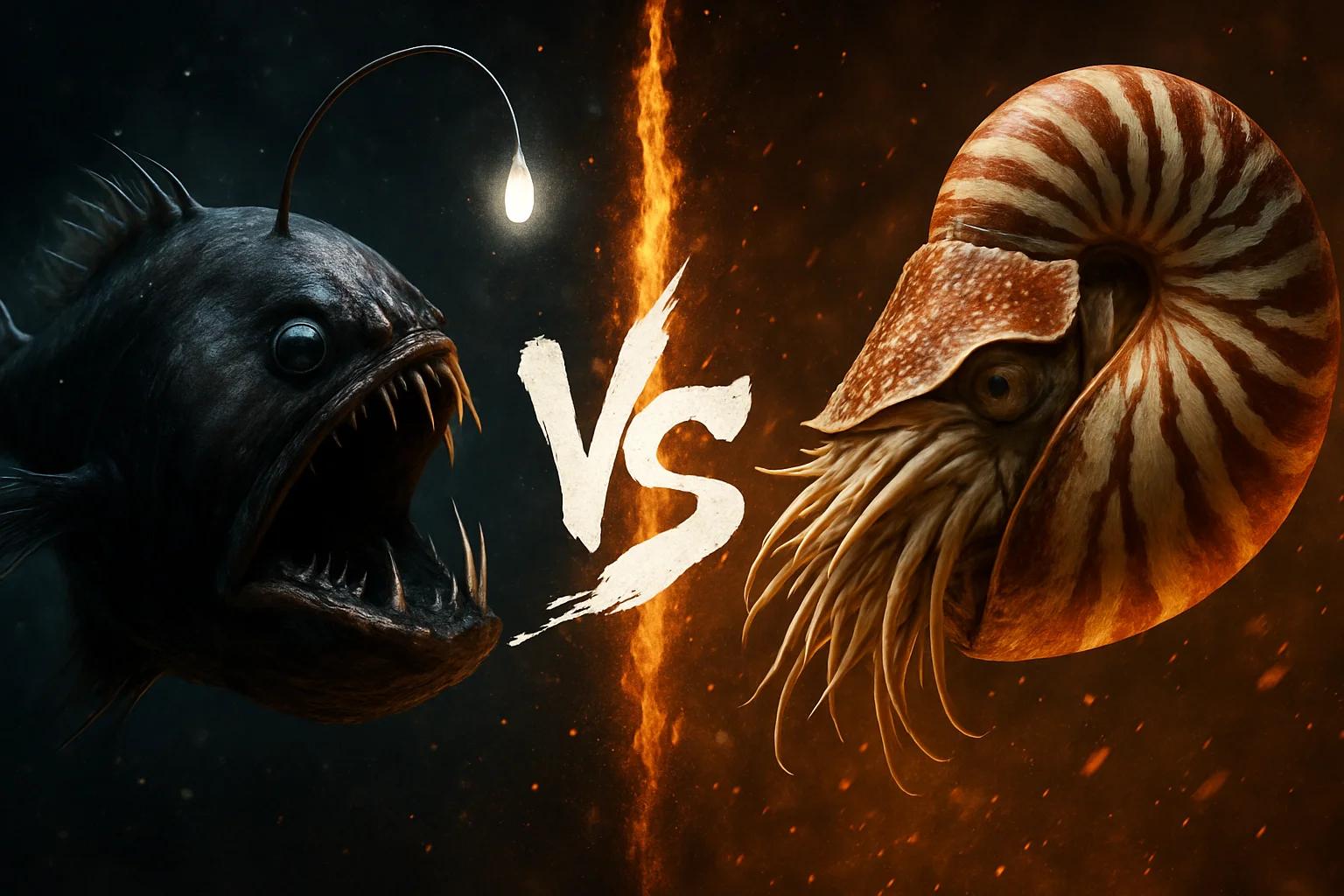
Black Seadevil vs Chambered Nautilus: Who Actually Wins?
The Chambered Nautilus wins this one, and it wins by refusing to be eaten more than by overpowering anything. The Black Seadevil is the scarier-looking predator. Females carry a glowing bacterial lure, hinged needle teeth, and a stretchy stomach that can swallow prey longer than their own roughly 18 cm body. That whole system is built for soft-bodied fish and crustaceans that drift into reach, though. An adult nautilus is a 15–20 cm coiled shell of calcium carbonate. It can pull its soft body inside and seal the opening with a leathery hood, and the anglerfish's teeth have no way to crack or pry that armor. The nautilus also has a sharp, parrot-like beak and dozens of grasping tentacles, and it eats carrion and slow animals. Against a flabby, weak-muscled ambusher that mostly hangs motionless in the dark, that gives the nautilus real counter-damage. The seadevil holds more threat on paper, but the nautilus controls the actual outcome. The verdict comes with an honest caveat: the two rarely if ever meet, and a fight between them would be slow, short, and mostly decided by armor.
Read comparison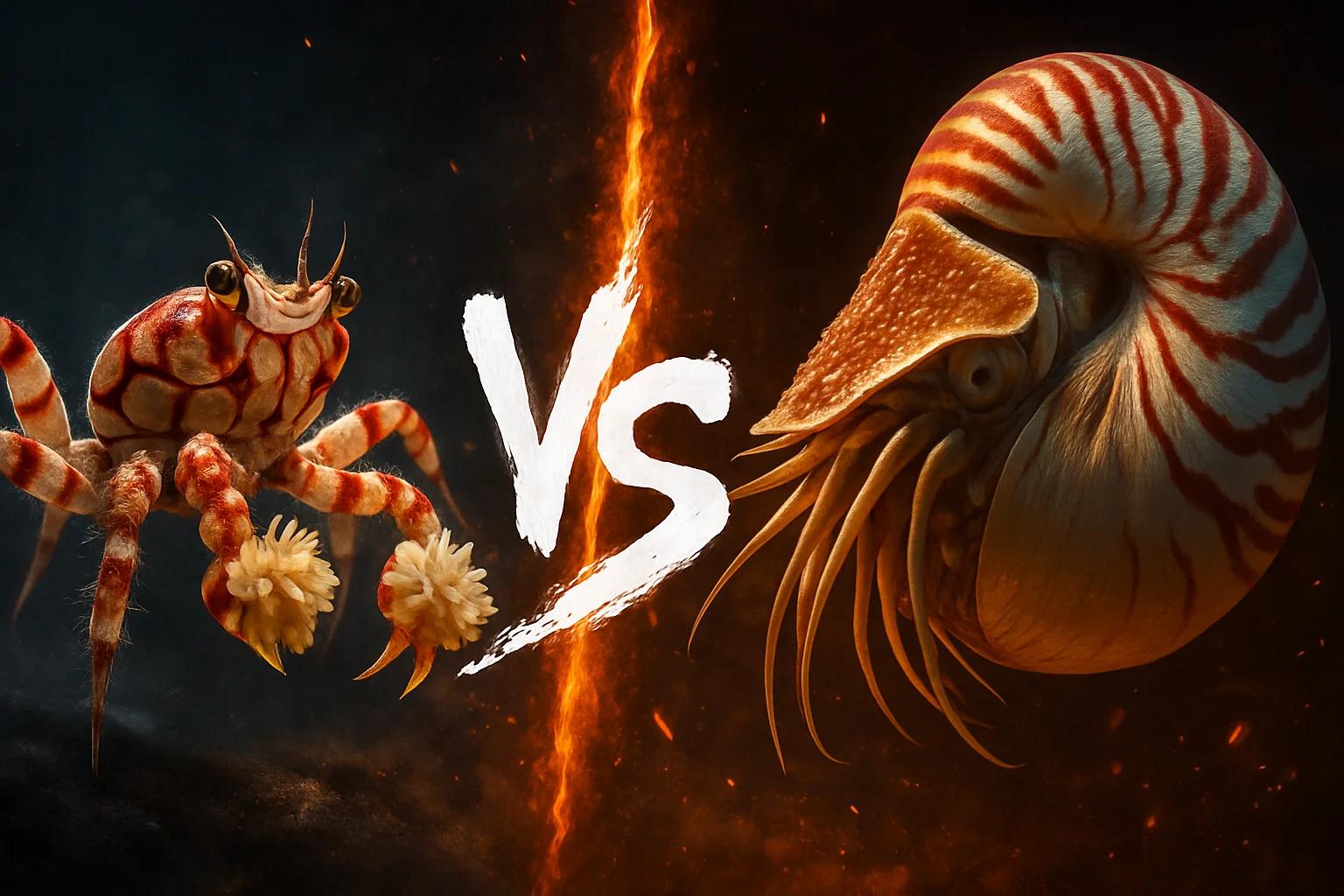
Boxer Crab vs Chambered Nautilus: Who Actually Wins?
The chambered nautilus wins this matchup, and it isn't especially close. A boxer crab is a thumbnail-sized reef crab, roughly 1–2.5 cm across, that carries tiny sea anemones in its claws as stinging pom-poms. That's a clever defensive trick for deterring small fish. The nautilus brings a shell around 15–20 cm across, dozens of grasping tentacles, and a hard, parrot-like beak built for cracking crustaceans. Nautiluses are active scavengers and predators that routinely eat crabs and molted shells. The boxer crab's anemones deliver a mild sting that can sting soft tissue, but the nautilus can avoid it by closing its hood and attacking from a different angle. The crab has no way to get through ten-plus centimeters of chambered armor. The nautilus doesn't need speed or cunning to win. Its size, its armor, and a beak made for exactly this kind of prey settle the question.
Read comparison
Discussion
What do you think?
Share your reasoning with other readers. Be civil and stick to the animals.
Sign in to join the discussion.
Sign inNo comments yet. Start the conversation.