

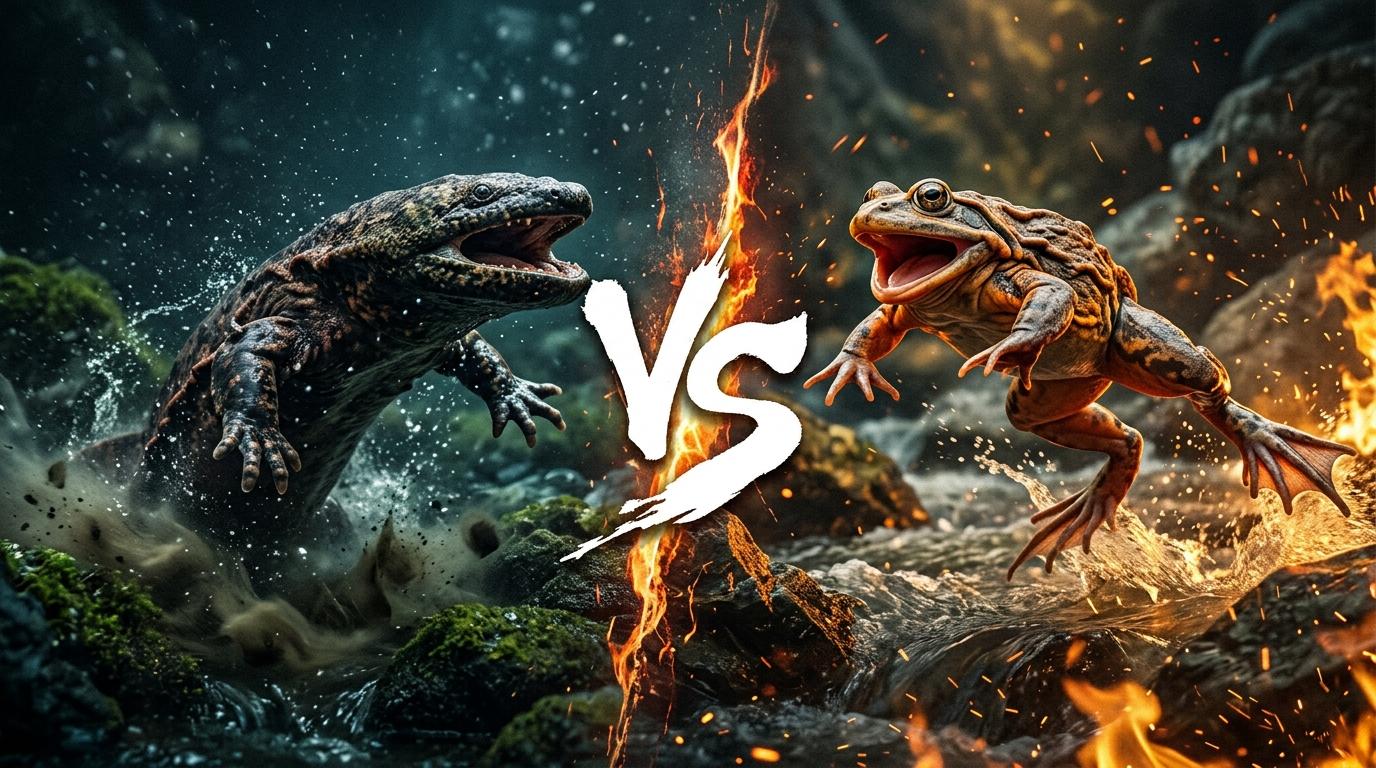
Chinese Giant Salamander vs Titicaca Water Frog: Who Actually Wins?
Chinese giant salamander vs Titicaca water frog: a biology-first look at size, bite, and aquatic hunting to show who wins and why it isn't close.
Chinese Giant Salamander vs Titicaca Water Frog
Matchup winner
Chinese Giant Salamander
Quick verdict
Start with the direct answer, then use the structured comparison below to see what changes the outcome.
The Chinese giant salamander wins clearly. It is the world's largest amphibian, reaching well over a metre and tens of kilograms, while the Titicaca water frog usually weighs a few hundred grams at most. The salamander is a patient, suction-feeding ambush predator. It sits motionless on a riverbed, senses vibrations through lateral-line organs, and snaps shut with a wide mouth lined with small teeth that grip slippery prey. Frogs and similar amphibians are already within its natural prey range. The Titicaca frog's real superpowers are physiological. Its baggy, heavily folded skin lets it absorb oxygen in cold, thin-air lake water, which is a survival strategy rather than a combat one. In almost any shared-water encounter, the frog becomes a meal, not a rival.
Read the full explanation
Chinese giant salamander wins decisively in nearly every realistic scenario.
Mass gap: roughly 20–50 kg vs under 1 kg.
The salamander's ambush bite is built to seize prey of exactly the frog's size and shape.
The Titicaca frog excels at surviving harsh water, not at fighting.
Reader vote
Who do you think wins?
Pick a side — no account needed. Results update live.
No votes yet — be the first to call it.
Editorial note
Why people disagree
Both look like sluggish, wrinkly amphibians, so people assume a slow, even scrap. The size difference is enormous.
Raw mass
Between amphibians with no venom or armour, mass largely decides who can swallow or pin whom.
Ambush control
The salamander is engineered to ambush mid-sized aquatic animals; the frog is engineered to graze small prey.
Bite and grip
Once seized, a slick frog has little leverage to escape a mouth that wide.
Read the full explanation +
The Titicaca frog's 'scrotum frog' fame and dramatic skin folds make it seem tougher than it is. Those folds are for breathing, not armour.
Some point to cold, low-oxygen Titicaca water as home-field advantage. That decides survival over weeks, not a short encounter.
Comparison FAQ
Short, direct answers to the next questions readers usually ask after the headline verdict.
Would a Chinese giant salamander beat a Titicaca water frog?+
Yes. The salamander is dozens of times heavier and is an ambush predator that naturally eats frog-sized animals. It wins almost every time.
Which is stronger, the Chinese giant salamander or the Titicaca water frog?+
The Chinese giant salamander, by a huge margin. It is the largest amphibian on Earth, with a powerful bite and heavy body.
Can the Titicaca water frog hurt a giant salamander?+
Not meaningfully. It lacks venom, claws, or a strong bite. Its toxin-free skin is built for breathing, not defence.
Why is the Titicaca frog still dangerous to underestimate?+
Its danger is ecological, not combative. In cold, low-oxygen water it outlasts other amphibians and thrives where predators struggle. That endurance is a survival weapon.
Do these animals ever meet in the wild?+
No. The giant salamander lives in Chinese mountain streams, and the Titicaca frog lives only in the Lake Titicaca basin in Peru and Bolivia.
Head-to-head species stats
These are the same core AnimalDex stat dimensions used on the dedicated animal pages, pulled side by side so the matchup is faster to scan.
Chinese Giant Salamander
Tier BTiticaca Water Frog
Tier CTrait-by-trait comparison
Only the categories that matter to this matchup are included. The goal is not filler stats, but the real design differences that change the result.
Up to ~1.8 m, often 20–50 kg
Raw mass
Chinese Giant Salamander
Typically under 0.5 kg, rarely ~1 kg
Raw mass
Chinese Giant Salamander
Motionless bottom-sitter with explosive suction strike
Ambush control
Chinese Giant Salamander
Bottom-dwelling forager of snails and invertebrates
Ambush control
Chinese Giant Salamander
Broad jaws, rows of small teeth, powerful snap
Bite and grip
Chinese Giant Salamander
Weak jaws suited to small invertebrates
Bite and grip
Chinese Giant Salamander
Lateral-line vibration sensing, chemical cues
Sensory detection in murky water
Chinese Giant Salamander
Good aquatic senses for small prey
Sensory detection in murky water
Chinese Giant Salamander
Skin breathing, prefers cool oxygenated streams
Low-oxygen endurance
Titicaca Water Frog
Elite skin-fold respiration, push-up 'ventilation' behaviour
Low-oxygen endurance
Titicaca Water Frog
Thick, slimy, heavy body; tolerates injury
Close-range durability
Chinese Giant Salamander
Loose, thin skin, small frame
Close-range durability
Chinese Giant Salamander
How the verdict forms
Verdict timeline
01 · Raw mass
Chinese Giant Salamander
02 · Ambush control
Chinese Giant Salamander
03 · Bite and grip
Chinese Giant Salamander
04 · Sensory detection in murky water
Chinese Giant Salamander
05 · Low-oxygen endurance
Titicaca Water Frog
06 · Close-range durability
Chinese Giant Salamander
Change the conditions
Scenario breakdown
This is where shallow battle content usually fails. Terrain, spacing, timing, and engagement style can change the answer.
Scenario lean
Chinese Giant Salamander
Verdict confidence
82%
Salamander ambush ends it fast.
Among rocks and crevices, the giant salamander does exactly what it evolved for: it waits motionless, detects movement through its lateral line, and strikes with a suction gulp. A frog foraging along the bottom is inside the strike envelope before it registers danger.
AnimalDex field profiles
Explore these animals
Chinese Giant Salamander
Andrias davidianus
Cool mountain streams, rocky rivers, and deep freshwater pools with high oxygen levels.
Titicaca Water Frog
Telmatobius culeus
high-altitude lake and reedbed shallows
Systems Intelligence & Hidden Purpose
See the animals behind this comparison as engineered biological systems: what each one is built to do, where it gains leverage, and why the matchup changes by scenario.
Specialized Hardware
Massive flattened body, sensory skin folds, and low-light aquatic hunting design make this salamander bottom-channel hardware for fast freshwater systems.
Systems Script
It occupies cold river systems as a quiet apex amphibian, converting hidden structure into predatory leverage. Its decline also makes one point painfully clear: specialized hardware collapses fast when the channel is redesigned.
Strategic Insight
Do not mistake ancient design for outdated design. Some systems are optimized so tightly they fail only when the operating environment is broken.
Specialized Hardware
deeply wrinkled water-breathing skin, large lake-dwelling body, and cold high-altitude aquatic life give the Titicaca Water Frog a body plan tuned for its niche.
Systems Script
Titicaca Water Frogs operate through high-altitude lake and reedbed shallows. Their design links movement, feeding, shelter, and timing into one workable survival system.
Strategic Insight
Good design turns a difficult habitat into usable ground.
Final take
The Chinese giant salamander is the clear winner. Massive size, a wide gripping bite, and an ambush system tuned for aquatic prey put the Titicaca water frog squarely in its diet range. No realistic encounter flips the outcome.
Read the full explanation
The frog's story is about endurance, not aggression. Its baggy skin is one of the most elegant oxygen-harvesting adaptations among amphibians, and in its own cold, thin-air lake it outlasts visitors. Both species are critically endangered, threatened by overharvest, pollution, and habitat loss, which makes understanding them more important than imagining them fighting.
Collect both animals in AnimalDex
Track the species behind this matchup, compare their real traits, and build the rivalry into your AnimalDex collection.
Related comparisons
Continue with nearby matchups to compare more real-world animal traits without dropping into junky who-wins filler.
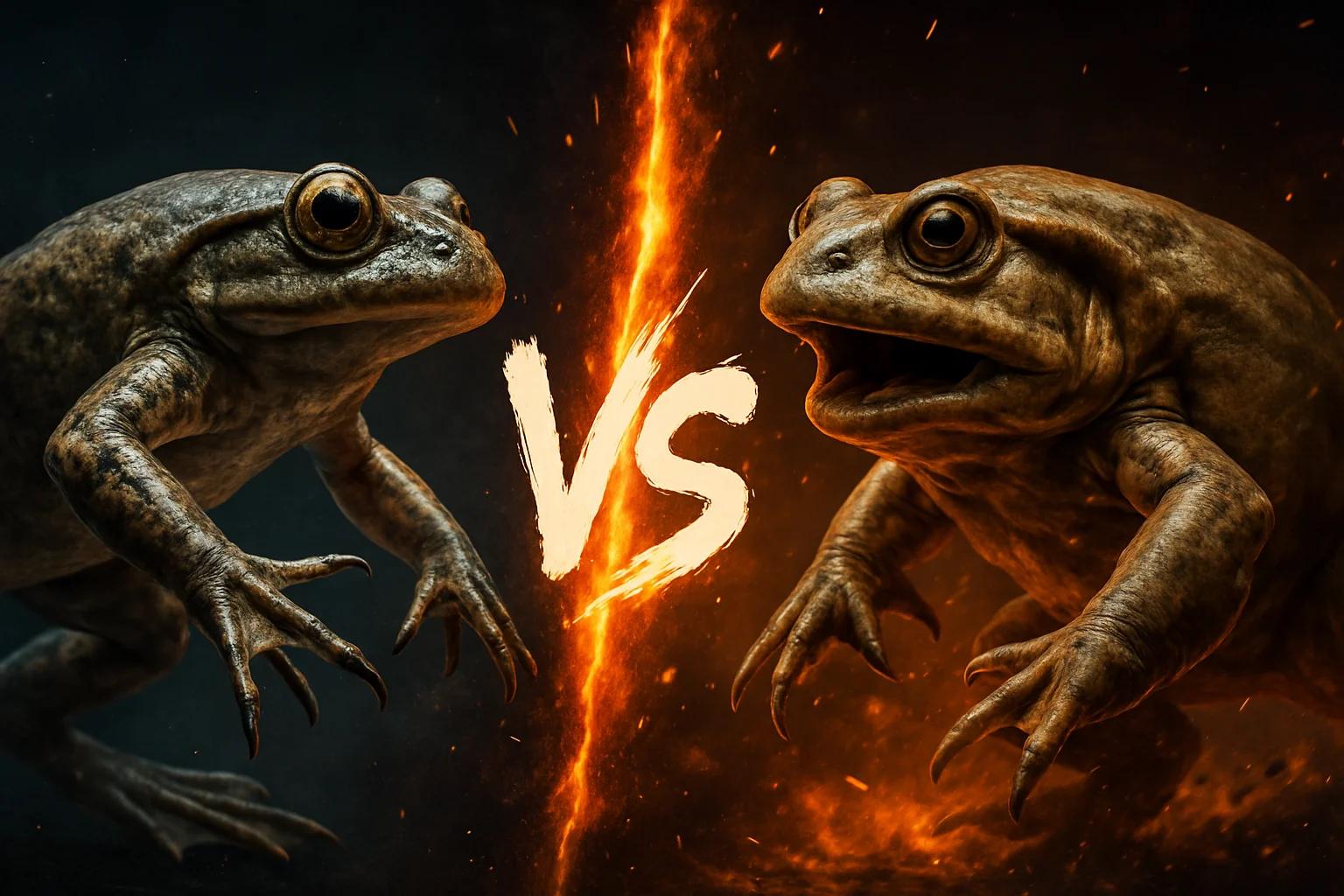
Lake Oku Clawed Frog vs Titicaca Water Frog: Who Actually Wins?
The Titicaca Water Frog wins, and size decides it. Telmatobius culeus is one of the largest fully aquatic frogs on Earth. Its snout-to-vent length can reach about 14 cm, and its loose, heavily folded skin gives it real bulk. The Lake Oku Clawed Frog (Xenopus longipes) is a tiny specialist at roughly 3 to 4 cm. The clawed frog is quicker and carries sharp keratinized toe tips and a lateral-line sense that reads water movement. Those tools help it escape and forage, not overpower a frog several times its length and many times its mass. The Titicaca frog is a gape-driven bottom predator that eats amphipods, snails, and small fish. In any sustained encounter, that much size and mouth simply outclass anything the clawed frog can do. The smaller frog's best outcome is a clean getaway, not a win.
Read comparison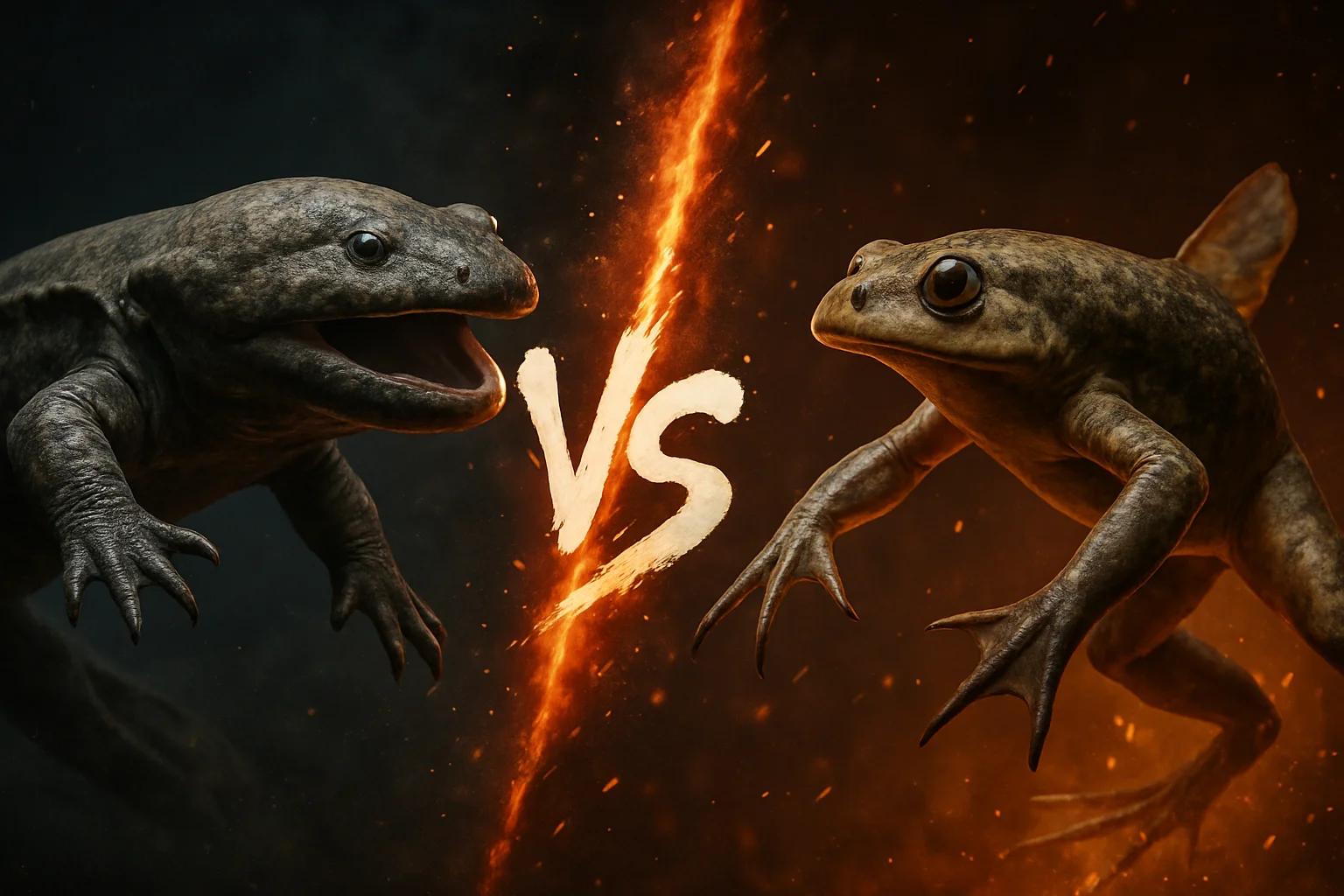
Chinese Giant Salamander vs Lake Oku Clawed Frog: Who Actually Wins?
The Chinese giant salamander wins decisively. It can reach well over a meter long and tens of kilograms, while the Lake Oku clawed frog is a fully aquatic frog only a few centimeters long. The salamander is a patient ambush predator. It sits motionless in rocky stream pools, senses vibrations through sensory nodes along its head and body, and engulfs prey with a fast suction gape that easily fits frogs, fish, crabs, and insects. The Lake Oku clawed frog has sharp water senses, a slippery body, and quick kicks, so it can escape when it detects danger early and has open water. Once it is within strike range, though, it has no weapon that can hurt a salamander that weighs thousands of times more. This is really a predator-and-prey outcome, not an even fight.
Read comparison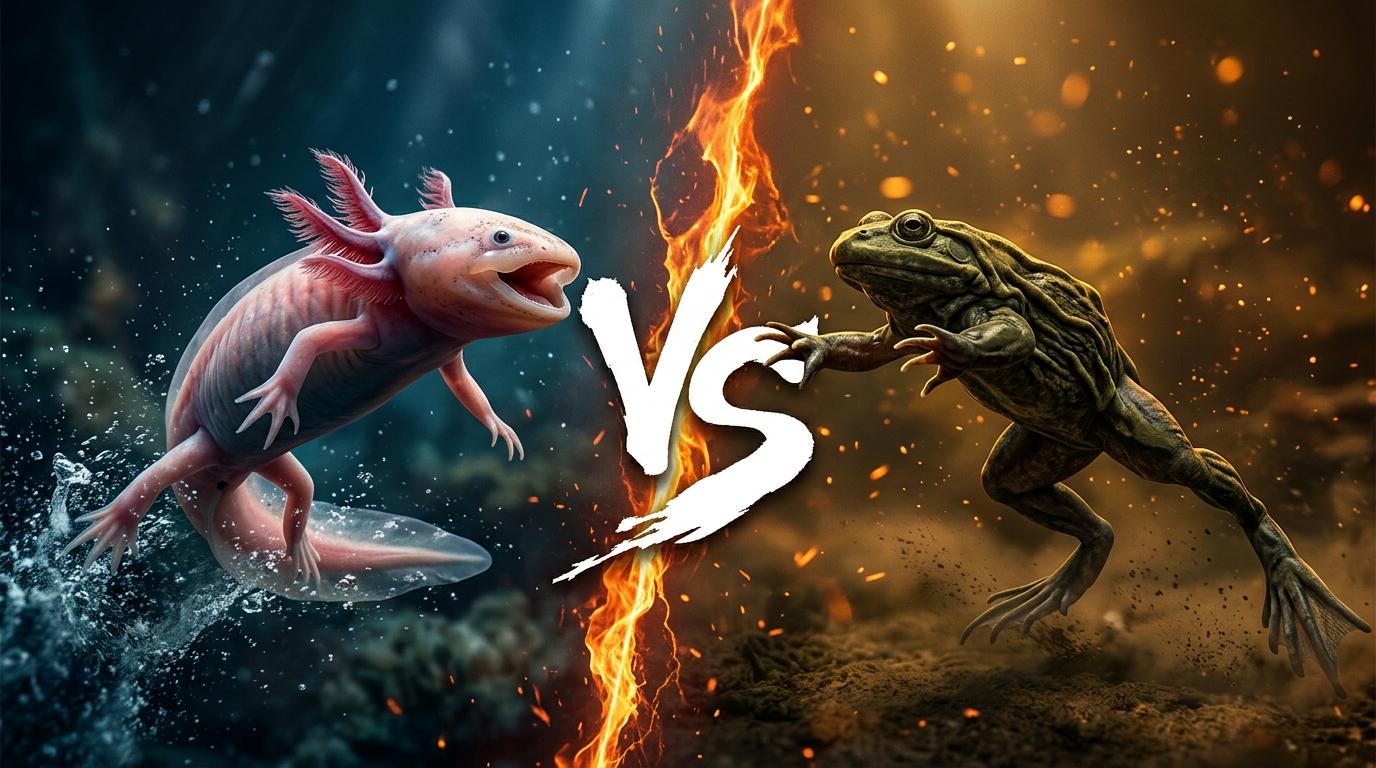
Axolotl vs Titicaca Water Frog: Who Actually Wins?
The axolotl wins, but only narrowly. This is a contest between two critically endangered aquatic oddballs built for still, cold water rather than combat, and neither one would normally pick a fight. The axolotl's edge comes from three things. It has a longer, more muscular body that commonly reaches 23–30 cm, while the frog's typical body runs well under that. It has a wide suction-gape that snaps shut fast on anything mouth-sized. And it can regenerate limbs, gills and even parts of organs, so nips that would cripple most amphibians barely slow it down. The Titicaca water frog is no pushover. Its powerful hind legs deliver real kicks, and heavyweight individuals can outweigh a small axolotl. But it is a slow, low-energy specialist that breathes mostly through its loose skin folds. That skin is a huge, fragile surface that suffers in any prolonged scuffle, especially in warmer or less oxygenated water. Over a sustained encounter, the axolotl's reach, grip and recovery tip the outcome.
Read comparison
Discussion
What do you think?
Share your reasoning with other readers. Be civil and stick to the animals.
Sign in to join the discussion.
Sign inNo comments yet. Start the conversation.