

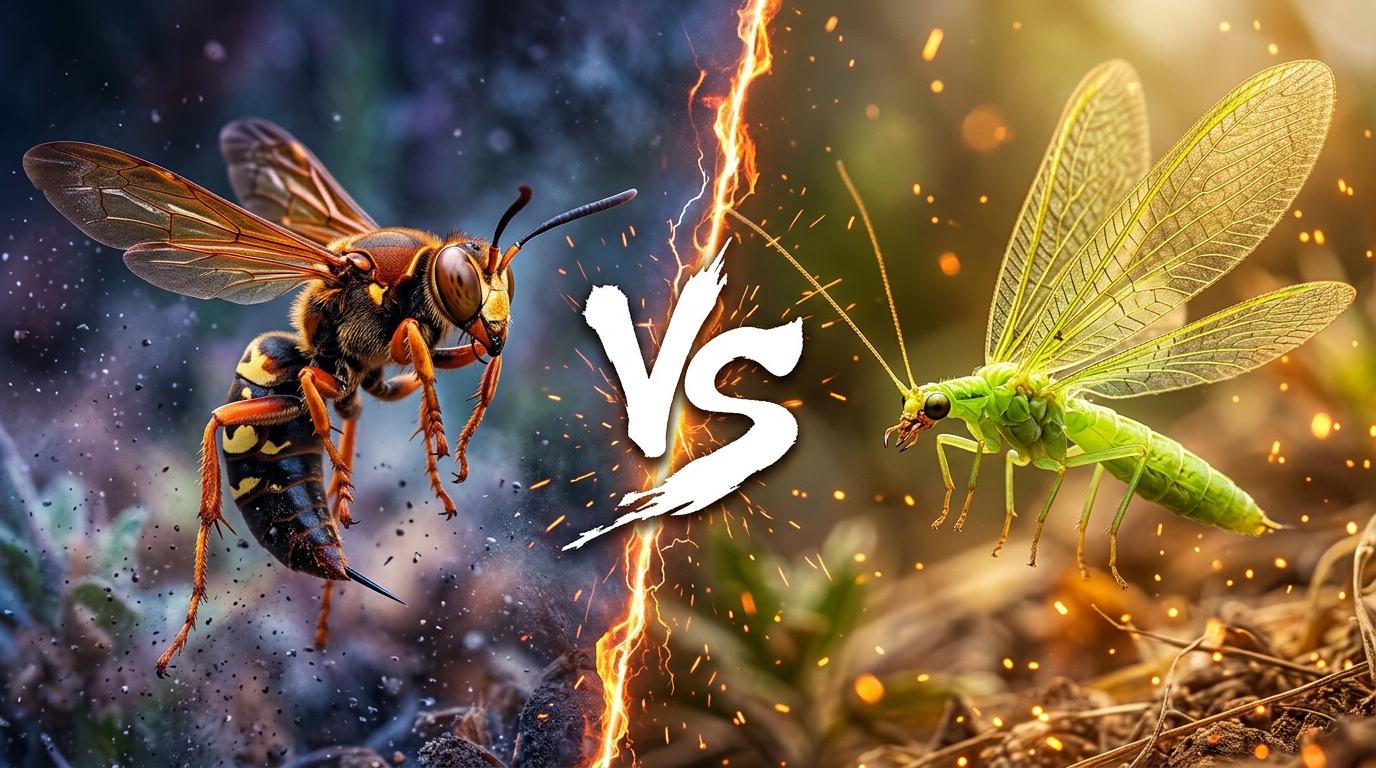
Cicada Killer Wasp vs Green Lacewing: Who Actually Wins?
Cicada killer wasp vs common green lacewing: a biology-first breakdown of size, venom, flight and defenses, and why the giant digger wasp wins decisively.
Cicada Killer Wasp vs Green Lacewing
Matchup winner
Cicada Killer Wasp
Quick verdict
Start with the direct answer, then use the structured comparison below to see what changes the outcome.
The Cicada Killer Wasp wins, and it isn't close. At roughly 3–5 cm long with a heavy, armored body, it outweighs the delicate, 1–2 cm Common Green Lacewing many times over. Females carry a paralytic stinger built to subdue cicadas far larger than themselves, and their flight muscles are strong enough to haul that prey through the air. The adult lacewing is a soft-bodied, fluttering insect that mostly feeds on nectar, pollen and honeydew. Its real weapons are a foul-smelling defensive secretion, ultrasound-sensitive ears for dodging bats, and fragile-looking wings that let it drop and tumble out of trouble. In a forced encounter the wasp's mass, armor and venom overwhelm anything the lacewing can do. The lacewing's best outcome is escape, not victory.
Read the full explanation
Cicada Killer Wasp wins: it is far bigger, armored, and armed with paralytic venom.
An adult lacewing has no meaningful offensive weapon against a wasp this size.
The lacewing's defenses are a foul odor and evasive flight, which are tools for escaping, not fighting.
The real lacewing 'predator' is its larva, the aphid lion, and it hunts aphids, not wasps.
Reader vote
Who do you think wins?
Pick a side — no account needed. Results update live.
No votes yet — be the first to call it.
Editorial note
Why people disagree
Lacewing larvae are famously fierce 'aphid lions,' so people sometimes give the adult credit for the larva's reputation.
Body mass and frame
At insect scale, a size gap this large decides grappling contests almost by itself.
Weapon kit
Venom built to drop a cicada works with huge overkill on a lacewing.
Close-range durability
The lacewing can't absorb a single committed grab or bite.
Read the full explanation +
Cicada killers look terrifying, but males can't sting and females rarely bother anything that isn't a cicada. Some readers mistake that low aggression for weakness.
Some argue a lacewing would simply never be caught. That's fair for open-air survival, but it isn't the same as winning a fight.
Comparison FAQ
Short, direct answers to the next questions readers usually ask after the headline verdict.
Would a cicada killer wasp beat a green lacewing?+
Yes, decisively. The wasp is many times heavier, armored, and females carry paralytic venom. A lacewing has no weapon that can seriously hurt it.
Which is stronger, a cicada killer or a lacewing?+
The cicada killer, by a huge margin. Females can fly while carrying cicadas heavier than themselves, while adult lacewings are fragile insects that mostly feed on nectar, pollen and honeydew.
Do cicada killers hunt lacewings?+
No. Cicada killers specialize in cicadas to provision their nests, so a fight between these two would be unusual in nature.
Why is the lacewing still dangerous?+
Not to the wasp, but to garden pests. Its larvae, called aphid lions, devour aphids and other soft insects. Adults defend themselves with a foul odor and bat-dodging evasive flight.
Can a cicada killer sting people?+
Females can, but they rarely do unless handled or stepped on. Males have no stinger at all, even though they guard territory aggressively.
Head-to-head species stats
These are the same core AnimalDex stat dimensions used on the dedicated animal pages, pulled side by side so the matchup is faster to scan.
Cicada Killer Wasp
Tier DGreen Lacewing
Tier CTrait-by-trait comparison
Only the categories that matter to this matchup are included. The goal is not filler stats, but the real design differences that change the result.
3–5 cm, heavy-bodied
Body mass and frame
Cicada Killer Wasp
1–2 cm, featherweight
Body mass and frame
Cicada Killer Wasp
Paralytic stinger (females), strong mandibles
Weapon kit
Cicada Killer Wasp
Small mouthparts, no sting
Weapon kit
Cicada Killer Wasp
Thick chitin, compact build
Close-range durability
Cicada Killer Wasp
Soft body, delicate veined wings
Close-range durability
Cicada Killer Wasp
Strong flier that can lift heavy prey
Flight power
Cicada Killer Wasp
Slow, fluttering, mostly nocturnal
Flight power
Cicada Killer Wasp
Relies on power, not stealth
Escape tricks
Green Lacewing
Ultrasound hearing, drop-and-tumble evasion
Escape tricks
Green Lacewing
None notable beyond the sting
Chemical deterrence
Green Lacewing
Foul-smelling defensive secretion
Chemical deterrence
Green Lacewing
How the verdict forms
Verdict timeline
01 · Body mass and frame
Cicada Killer Wasp
02 · Weapon kit
Cicada Killer Wasp
03 · Close-range durability
Cicada Killer Wasp
04 · Flight power
Cicada Killer Wasp
05 · Escape tricks
Green Lacewing
06 · Chemical deterrence
Green Lacewing
Change the conditions
Scenario breakdown
This is where shallow battle content usually fails. Terrain, spacing, timing, and engagement style can change the answer.
Scenario lean
Cicada Killer Wasp
Verdict confidence
82%
The wasp wins any contact that actually happens.
Leaves give the camouflaged green lacewing places to hide and freeze. But once the two insects touch, the size and armor gap takes over. A single grab with the wasp's mandibles or one sting ends the encounter.
AnimalDex field profiles
Explore these animals
Cicada Killer Wasp
Sphecius speciosus
sandy soil, meadow, and open woodland edge
Green Lacewing
Chrysoperla carnea
garden, meadow, and woodland edge
Systems Intelligence & Hidden Purpose
See the animals behind this comparison as engineered biological systems: what each one is built to do, where it gains leverage, and why the matchup changes by scenario.
Specialized Hardware
large amber-winged body, powerful cicada-hauling flight, and burrow-provisioning hunting give the Cicada Killer Wasp a body plan tuned for its niche.
Systems Script
Cicada Killer Wasps operate through sandy soil, meadow, and open woodland edge. Their design links movement, feeding, shelter, and timing into one workable survival system.
Strategic Insight
Dense environments reward precision, patience, and the ability to read layered cover.
Specialized Hardware
delicate green body, golden eyes, and aphid-hunting larval jaws give the Green Lacewing a body plan tuned for its niche.
Systems Script
Green Lacewings operate through garden, meadow, and woodland edge. Their design links movement, feeding, shelter, and timing into one workable survival system.
Strategic Insight
Dense environments reward precision, patience, and the ability to read layered cover.
Final take
The Cicada Killer Wasp is the clear winner. It holds overwhelming advantages in size, armor, flight power and venom. This is a heavyweight specialist hunter against a delicate nectar-feeder whose whole survival strategy is not being caught.
Read the full explanation
The lacewing still deserves respect. Its larvae are some of the most effective aphid predators in the garden, and the adult's ultrasonic hearing and chemical defense make it a skilled survivor. Survival skill just isn't fighting power.
Collect both animals in AnimalDex
Track the species behind this matchup, compare their real traits, and build the rivalry into your AnimalDex collection.
Related comparisons
Continue with nearby matchups to compare more real-world animal traits without dropping into junky who-wins filler.

Green Lacewing vs Wheel Bug: Who Actually Wins?
The Wheel Bug wins, and it isn't close. Arilus cristatus is one of North America's largest assassin bugs, reaching about 3–4 cm. It has a toughened body, a cog-like armored crest and a stout curved beak that injects paralyzing, tissue-digesting saliva. The adult Common Green Lacewing is a delicate, soft-bodied flier about 1–2 cm long that feeds mostly on nectar, pollen and honeydew. The famous 'aphid lion' predator is the lacewing's larva, not the adult. The lacewing's real assets are fast, fluttery flight, ultrasound-sensitive wings and a foul-smelling defensive secretion. Those tools help it avoid a fight. They don't help it win one. Once the Wheel Bug's forelegs close and its beak goes in, the encounter is effectively over within seconds.
Read comparison
Green Lacewing vs Wasp Mantidfly: Who Actually Wins?
The Wasp Mantidfly (Climaciella brunnea) wins this matchup clearly. It is the larger, faster, more heavily armed insect. Its mantis-style raptorial forelegs are built to snatch and pin flying prey, and its paper-wasp mimicry signals danger to anything watching. The Common Green Lacewing (Chrysoperla carnea) is a superb pest-control specialist, but the adult is a delicate nectar-and-pollen feeder with no grasping weapons. Its real predatory power belongs to its larva, the 'aphid lion.' In an adult-versus-adult contest, the lacewing's best tools are escape: ultrasound-sensitive wings, a defensive odor and a quick drop. The mantidfly's best tool is a strike. A strike beats a dodge most of the time.
Read comparison
Cicada Killer Wasp vs Monarch Butterfly: Who Actually Wins?
The cicada killer wasp wins clearly. It is a heavy-bodied, 3–5 cm hunting wasp with powerful flight muscles, grasping legs, strong mandibles, and, in females, a paralyzing sting built to subdue cicadas several times its own mass. The monarch has none of that hardware. It has no bite, no sting, and no grip. Its real weapon is chemistry: the cardenolide toxins it stores from milkweed. Those toxins punish vertebrate predators like birds that eat it, but they do nothing to stop a wasp that overpowers it physically. Cicada killers don't hunt butterflies, so a real encounter is rare. Forced into a contest, though, the wasp controls the outcome by a wide margin, and the monarch's best result is simply escaping.
Read comparison
Cicada Killer Wasp vs Zebra Swallowtail: Who Actually Wins?
The Cicada Killer Wasp wins clearly. It is one of North America's largest wasps, built around a paralytic stinger, strong grasping legs, and the flight power to carry a cicada heavier than itself. The Zebra Swallowtail has no weapon at all. Its defenses are a fast, erratic, gliding flight and a body made mildly distasteful by compounds from pawpaw leaves eaten as a caterpillar. Those traits help against birds that learn to avoid bad-tasting prey. They do not help against an armored, venom-equipped insect in direct contact. The butterfly's only real path to 'winning' is never being caught, and in fact the two rarely interact, because cicada killers hunt cicadas, not butterflies. In any forced confrontation, the wasp controls the outcome.
Read comparison
Discussion
What do you think?
Share your reasoning with other readers. Be civil and stick to the animals.
Sign in to join the discussion.
Sign inNo comments yet. Start the conversation.