


Clown Triggerfish vs Mandarinfish: Who Actually Wins?
Clown triggerfish vs mandarinfish: a biology-first look at size, bite, armor, and toxic slime to settle who wins this reef matchup.
Clown Triggerfish vs Mandarinfish
Matchup winner
Clown Triggerfish
Quick verdict
Start with the direct answer, then use the structured comparison below to see what changes the outcome.
The clown triggerfish wins clearly. At up to about 50 cm, it is many times longer and heavier than a mandarinfish, which tops out around 6–7 cm. It also carries crushing beak-like teeth built to break crabs, urchins, and shells, plus a locking dorsal spine and armored scales. It is one of the reef's most notoriously aggressive, territorial fish. The mandarinfish is a slow, hovering micro-predator that picks copepods off rubble. Its defense is chemical, not physical: a thick, foul-smelling mucus coat and bright warning colors that tell predators it tastes terrible. That slime is a real deterrent and often makes fish spit it out. But it does not stop a determined, armored triggerfish from harassing, nipping, or driving it off. In a contest, size, bite, and aggression decide it.
Read the full explanation
Clown triggerfish wins: far bigger, armored, with a shell-crushing bite.
The mandarinfish has no physical weapons, only a toxic, bad-tasting slime coat.
The mandarinfish's real win condition is avoidance: hiding in rubble and being unpleasant to eat.
Triggerfish dominance is behavioral too. It is a famously territorial bully.
Reader vote
Who do you think wins?
Pick a side — no account needed. Results update live.
No votes yet — be the first to call it.
Editorial note
Why people disagree
Some assume bright warning colors mean the mandarinfish is dangerous to fight. Its toxin deters eating, not combat.
Size and mass
An order-of-magnitude size gap decides nearly every physical interaction on the reef.
Crushing bite
Only one of these fish has a mouth that can injure the other.
Close-range durability
The triggerfish can wedge into crevices and shrug off contact. The mandarinfish relies on not being touched.
Read the full explanation +
Aquarium keepers know triggers attack almost anything, so some call it a mismatch. Others point out that many predators really do reject mandarin slime.
'Winning' can mean killing or eating, or simply surviving. On survival, the mandarinfish's hide-and-repel strategy is more respectable than its size suggests.
Comparison FAQ
Short, direct answers to the next questions readers usually ask after the headline verdict.
Would a clown triggerfish beat a mandarinfish?+
Yes. The triggerfish is vastly larger, armored, and equipped with shell-crushing teeth, so it would easily dominate or injure a mandarinfish in any real confrontation.
Which is stronger, clown triggerfish or mandarinfish?+
The clown triggerfish, by far. Its jaws crack urchins and crustaceans, while the mandarinfish's tiny mouth is built for sucking up copepods.
Is the mandarinfish poisonous?+
Its skin mucus is foul-smelling and toxic, and many predators reject it after tasting it. That makes it dangerous to eat, though not dangerous to fight.
Why does the losing mandarinfish stay dangerous?+
A predator that bites or swallows it may get a mouthful of noxious slime. That teaches reef fish to avoid it, so its chemistry protects it even though it cannot win a fight.
Can they live together in an aquarium?+
Generally no. Clown triggerfish are aggressive and will harass small, slow fish like mandarins.
Head-to-head species stats
These are the same core AnimalDex stat dimensions used on the dedicated animal pages, pulled side by side so the matchup is faster to scan.
Clown Triggerfish
Tier CMandarinfish
Tier CTrait-by-trait comparison
Only the categories that matter to this matchup are included. The goal is not filler stats, but the real design differences that change the result.
Up to ~50 cm, deep-bodied
Size and mass
Clown Triggerfish
~6–7 cm, slender
Size and mass
Clown Triggerfish
Fused, chisel-like teeth that crack urchins and crabs
Crushing bite
Clown Triggerfish
Tiny protrusible mouth for copepods
Crushing bite
Clown Triggerfish
Tough plate-like scales, locking 'trigger' spine
Close-range durability
Clown Triggerfish
Scaleless skin under protective mucus
Close-range durability
Clown Triggerfish
None notable
Chemical deterrence
Mandarinfish
Foul, toxic slime and aposematic colors
Chemical deterrence
Mandarinfish
Notoriously combative, attacks intruders
Territorial aggression
Clown Triggerfish
Peaceful, avoids conflict
Territorial aggression
Clown Triggerfish
Hides in crevices at night
Rubble concealment
Mandarinfish
Lives inside coral rubble, rarely strays
Rubble concealment
Mandarinfish
How the verdict forms
Verdict timeline
01 · Size and mass
Clown Triggerfish
02 · Crushing bite
Clown Triggerfish
03 · Close-range durability
Clown Triggerfish
04 · Chemical deterrence
Mandarinfish
05 · Territorial aggression
Clown Triggerfish
06 · Rubble concealment
Mandarinfish
Change the conditions
Scenario breakdown
This is where shallow battle content usually fails. Terrain, spacing, timing, and engagement style can change the answer.
Scenario lean
Mandarinfish
Verdict confidence
82%
Mandarinfish survives by vanishing.
In dense branching rubble, the mandarinfish can slip into gaps too small for a 50 cm triggerfish. Combined with its distasteful slime, it can avoid harm entirely. This is a survival win, not a dominance win.
AnimalDex field profiles
Explore these animals
Clown Triggerfish
Balistoides conspicillum
coral reef, lagoon, and tropical drop-off
Mandarinfish
Synchiropus splendidus
coral reef rubble and sheltered lagoon habitat
Systems Intelligence & Hidden Purpose
See the animals behind this comparison as engineered biological systems: what each one is built to do, where it gains leverage, and why the matchup changes by scenario.
Specialized Hardware
bold black body with white spots, yellow snout pattern, and trigger-spine reef defense give the Clown Triggerfish a body plan tuned for its niche.
Systems Script
Clown Triggerfishs operate through coral reef, lagoon, and tropical drop-off. Their design links movement, feeding, shelter, and timing into one workable survival system.
Strategic Insight
In moving water, the best systems use flow, visibility, and depth instead of fighting every current.
Specialized Hardware
electric blue and orange pattern, hovering reef glide, and tiny mouth for small prey give the Mandarinfish a body plan tuned for its niche.
Systems Script
Mandarinfishs operate through coral reef rubble and sheltered lagoon habitat. Their design links movement, feeding, shelter, and timing into one workable survival system.
Strategic Insight
In moving water, the best systems use flow, visibility, and depth instead of fighting every current.
Final take
The clown triggerfish is the clear winner. It brings mass, armor, a crushing bite, and a combative temperament, while the mandarinfish brings none of the physical tools needed to fight back.
Read the full explanation
Still, the mandarinfish is no pushover in the broader evolutionary sense. Its toxic slime and warning colors let a tiny, slow fish thrive among predators. It wins by never being worth the trouble, not by winning fights.
Collect both animals in AnimalDex
Track the species behind this matchup, compare their real traits, and build the rivalry into your AnimalDex collection.
Related comparisons
Continue with nearby matchups to compare more real-world animal traits without dropping into junky who-wins filler.
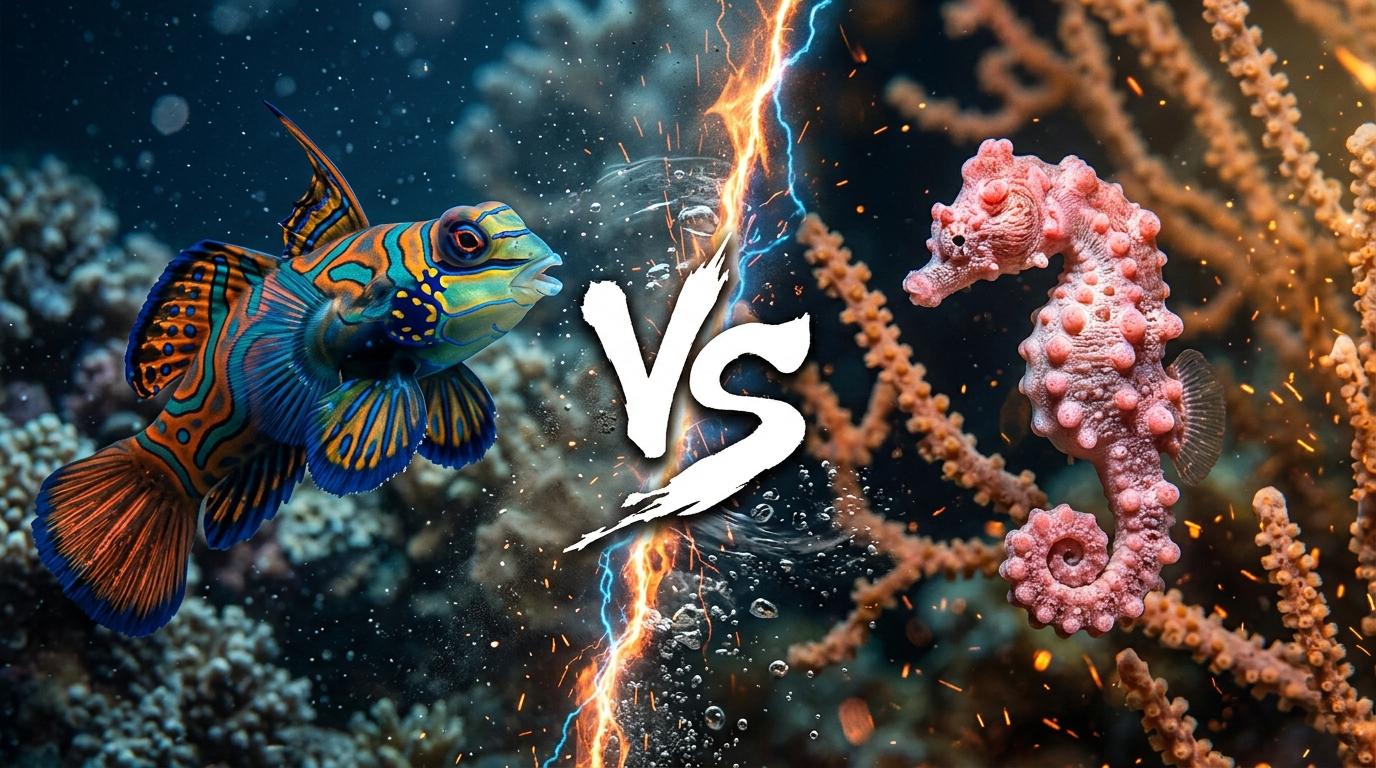
Mandarinfish vs Pygmy Seahorse: Who Actually Wins?
The mandarinfish wins clearly. At roughly 6–7 cm it is about three times longer and many times heavier than a 2 cm pygmy seahorse. It moves with agile, hovering fin control, and its skin is coated in a foul-smelling, toxic mucus that makes it unpleasant to bite or mouth. The pygmy seahorse has no weapons, almost no speed, and no real way to push back. It survives through near-perfect camouflage on its gorgonian sea fan, gripping with a prehensile tail and simply never being noticed. In any situation where the two actually meet and contest space, the mandarinfish's size, mobility and chemical armor decide it. The pygmy seahorse's only win condition is to avoid the encounter entirely.
Read comparison
Clown Triggerfish vs Humphead Wrasse: Who Actually Wins?
The humphead wrasse wins, and it isn't close once size enters the equation. A big adult Cheilinus undulatus can grow to about 2 meters and more than 150 kg. That is many times the bulk of a clown triggerfish, which tops out near 50 cm. The wrasse's thick lips and heavy pharyngeal jaws are built to crush armored prey. It routinely eats spiny, toxic animals like crown-of-thorns starfish, boxfish and sea urchins. That makes the triggerfish's main defense, a locking dorsal spine and tough scale armor, far less of a deterrent than it would be against mid-sized reef fish. The clown triggerfish is one of the reef's most notoriously aggressive residents. It has a beak-like set of teeth that can bite through shells and coral. In a burrow it can wedge itself in place, and in short bursts it fights with real spite. But aggression can't overcome a size and jaw-strength gap this wide. The triggerfish's best outcome is a stalemate from cover, not a win.
Read comparison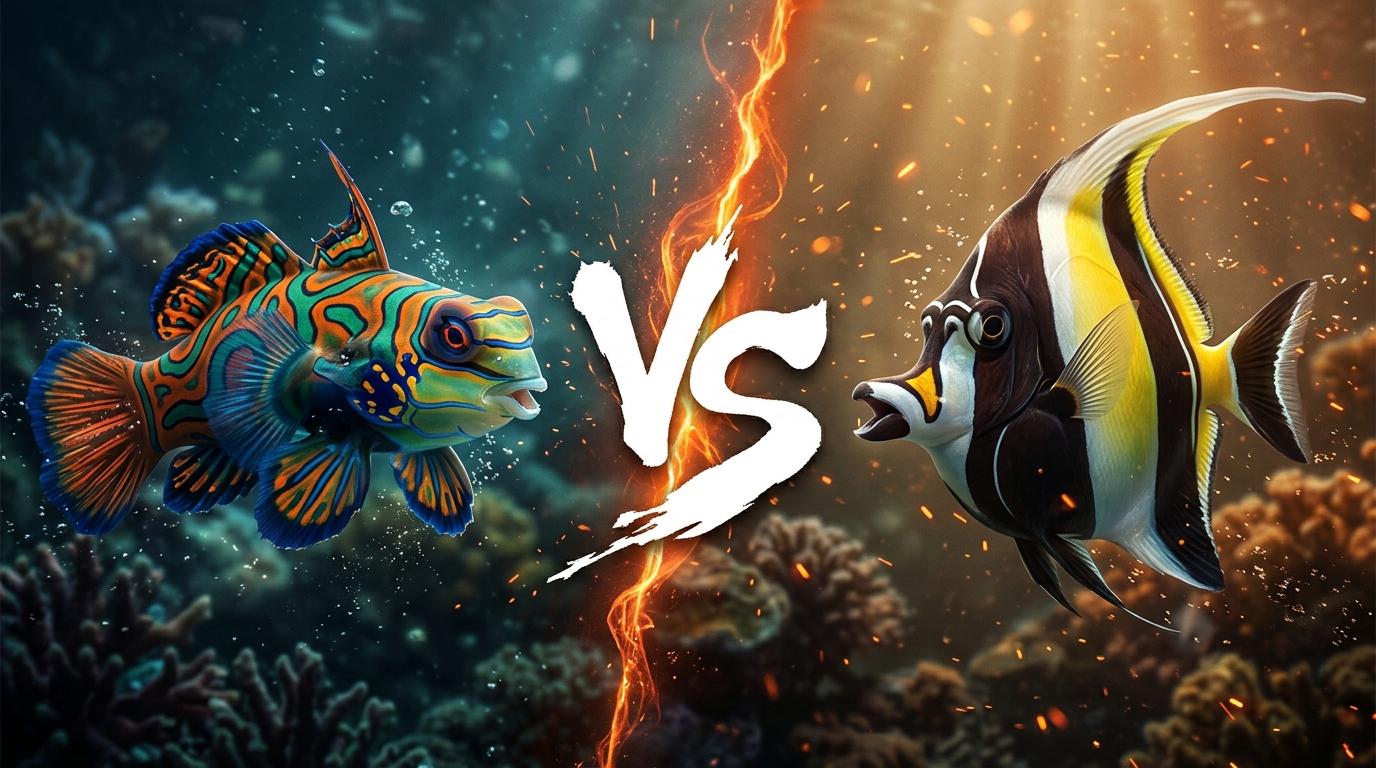
Mandarinfish vs Moorish Idol: Who Actually Wins?
The Mandarinfish wins, though it is not a fighter in the usual sense. A Moorish Idol is roughly three times longer, much faster, and far more mobile in open water. It also has no weapon that can solve the Mandarinfish's real defense: a scaleless body coated in foul-tasting, toxic-reported mucus, backed by a spiny gill-cover. The Mandarinfish lives tucked into rubble and coral branches and is built to be left alone. Most reef predators that sample one learn to avoid it. The Moorish Idol is a sponge-picking grazer with a tweezer snout and no scalpel spine like its surgeonfish relatives. It has no reason to press an attack and no tool to finish one. Contact between them ends with the Idol backing off and the Mandarinfish keeping its patch of reef, which makes the Mandarinfish the clear territorial winner.
Read comparison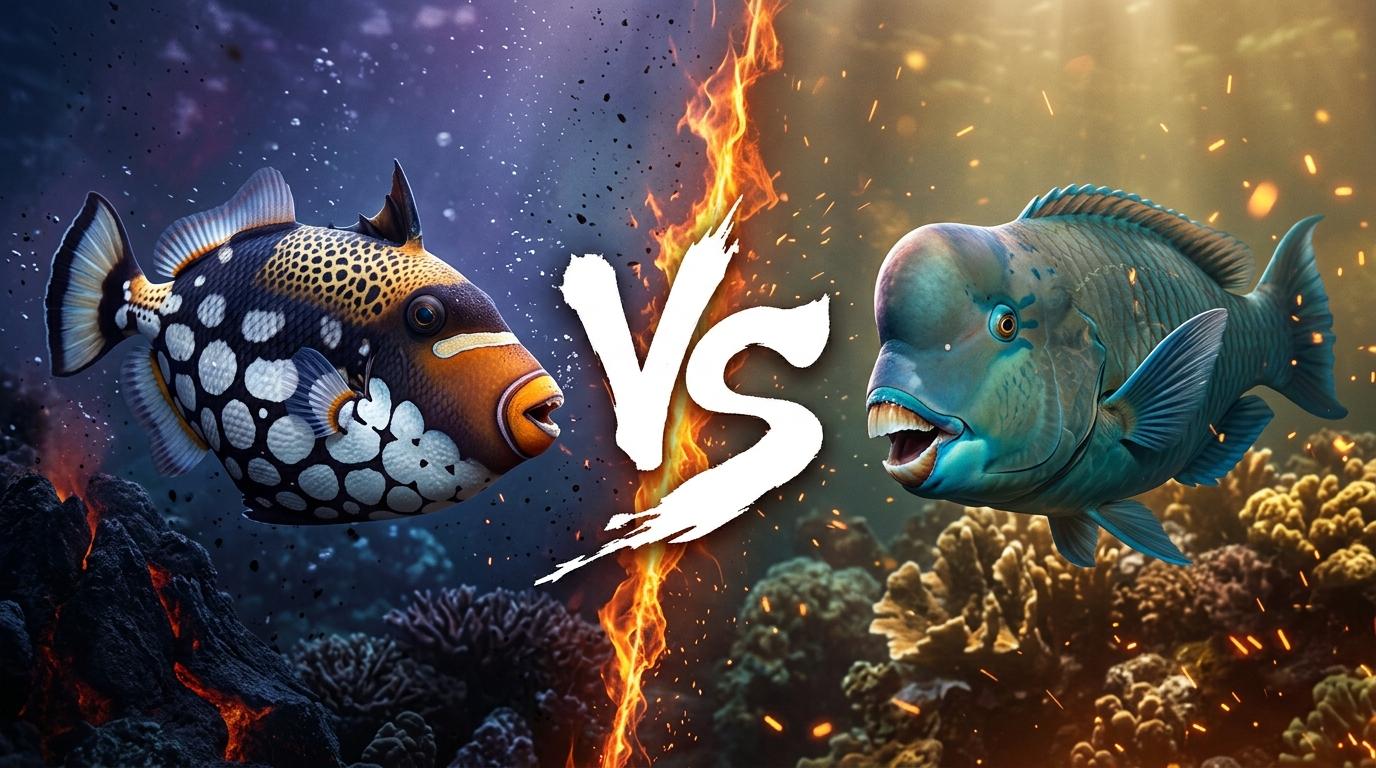
Clown Triggerfish vs Humphead Parrotfish: Who Actually Wins?
The humphead parrotfish wins this matchup overall. The clown triggerfish is the more aggressive fighter for its size, with crushing jaws built to crack sea urchins and a locking dorsal spine that wedges it into reef crevices. But the humphead parrotfish can exceed a meter in length and weigh over 40 kg, while the triggerfish usually stays under about 50 cm. The parrotfish also has a fused beak that bites chunks out of solid coral and a bony forehead that males use in documented head-ramming contests. A triggerfish can nip fins and defend a hole, but it cannot meaningfully injure a body that large. When the parrotfish commits to a shove or a ram, the size gap decides the contest.
Read comparison
Discussion
What do you think?
Share your reasoning with other readers. Be civil and stick to the animals.
Sign in to join the discussion.
Sign inNo comments yet. Start the conversation.