

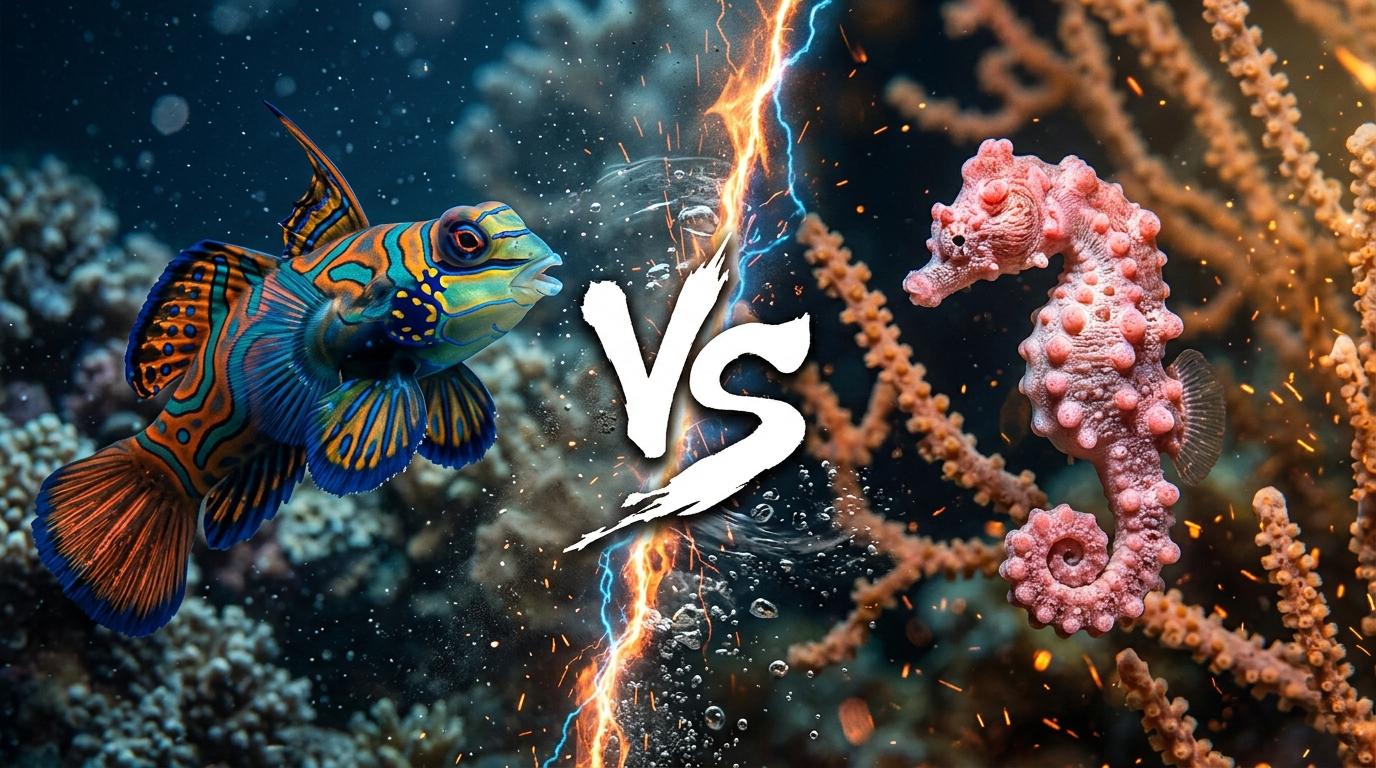
Mandarinfish vs Pygmy Seahorse: Who Actually Wins?
Mandarinfish vs pygmy seahorse: a biology-first breakdown of size, toxic mucus, camouflage and reef behavior to settle which tiny reef icon comes out ahead.
Mandarinfish vs Pygmy Seahorse
Matchup winner
Mandarinfish
Quick verdict
Start with the direct answer, then use the structured comparison below to see what changes the outcome.
The mandarinfish wins clearly. At roughly 6–7 cm it is about three times longer and many times heavier than a 2 cm pygmy seahorse. It moves with agile, hovering fin control, and its skin is coated in a foul-smelling, toxic mucus that makes it unpleasant to bite or mouth. The pygmy seahorse has no weapons, almost no speed, and no real way to push back. It survives through near-perfect camouflage on its gorgonian sea fan, gripping with a prehensile tail and simply never being noticed. In any situation where the two actually meet and contest space, the mandarinfish's size, mobility and chemical armor decide it. The pygmy seahorse's only win condition is to avoid the encounter entirely.
Read the full explanation
Mandarinfish wins: it has about 3x the length, far more mass and much better mobility.
Its toxic, smelly skin mucus makes it close to untouchable for a tiny animal.
The pygmy seahorse has no offense. Its defense is invisibility on a sea fan.
The seahorse only 'wins' by never being found.
Reader vote
Who do you think wins?
Pick a side — no account needed. Results update live.
No votes yet — be the first to call it.
Editorial note
Why people disagree
Both are tiny, peaceful-looking reef fish, so some readers assume a contest between them would be even.
Body mass and reach
At this scale, a threefold length gap means a huge difference in mass and shoving power.
Chemical armor
The mandarinfish's mucus discourages predators, so even contact works against an attacker.
Maneuvering control
Mobility lets the mandarinfish choose when and where contact happens.
Read the full explanation +
The pygmy seahorse's camouflage is so extreme that some argue being unfindable counts as winning.
Neither species naturally fights the other. Mandarinfish eat copepods and seahorses pick plankton, so any matchup is hypothetical.
Comparison FAQ
Short, direct answers to the next questions readers usually ask after the headline verdict.
Who would win, a mandarinfish or a pygmy seahorse?+
The mandarinfish. It has decisive advantages in size, mobility and toxic mucus.
Which is stronger?+
The mandarinfish, by a wide margin. It is about three times longer and far heavier.
Why is the pygmy seahorse still hard to beat?+
Its camouflage on sea fans makes it nearly impossible to find. An opponent that cannot locate it cannot contest it.
Do they fight in the wild?+
Not meaningfully. They live in different microhabitats and eat different small prey.
Head-to-head species stats
These are the same core AnimalDex stat dimensions used on the dedicated animal pages, pulled side by side so the matchup is faster to scan.
Mandarinfish
Tier CPygmy Seahorse
Tier CTrait-by-trait comparison
Only the categories that matter to this matchup are included. The goal is not filler stats, but the real design differences that change the result.
~6–7 cm, stocky dragonet build
Body mass and reach
Mandarinfish
~2 cm, fragile and bony-plated
Body mass and reach
Mandarinfish
Toxic, foul-smelling skin mucus
Chemical armor
Mandarinfish
None known
Chemical armor
Mandarinfish
Hovering pectoral-fin precision
Maneuvering control
Mandarinfish
Near-sessile, slow dorsal fin
Maneuvering control
Mandarinfish
Bright warning colors, highly visible
Camouflage mastery
Pygmy Seahorse
Tubercles that match its host gorgonian
Camouflage mastery
Pygmy Seahorse
Rests on rubble using its pelvic fins
Anchoring grip
Pygmy Seahorse
Prehensile tail locked onto a fan
Anchoring grip
Pygmy Seahorse
How the verdict forms
Verdict timeline
01 · Body mass and reach
Mandarinfish
02 · Chemical armor
Mandarinfish
03 · Maneuvering control
Mandarinfish
04 · Camouflage mastery
Pygmy Seahorse
05 · Anchoring grip
Pygmy Seahorse
Change the conditions
Scenario breakdown
This is where shallow battle content usually fails. Terrain, spacing, timing, and engagement style can change the answer.
Scenario lean
Pygmy Seahorse
Verdict confidence
82%
The seahorse survives by staying unseen.
On its host gorgonian, the pygmy seahorse's camouflage is so good that the mandarinfish may never register it. Here, not being found is the only realistic victory, and the seahorse achieves it.
AnimalDex field profiles
Explore these animals
Mandarinfish
Synchiropus splendidus
coral reef rubble and sheltered lagoon habitat
Pygmy Seahorse
Hippocampus bargibanti
gorgonian coral reef and tropical seafan habitat
Systems Intelligence & Hidden Purpose
See the animals behind this comparison as engineered biological systems: what each one is built to do, where it gains leverage, and why the matchup changes by scenario.
Specialized Hardware
electric blue and orange pattern, hovering reef glide, and tiny mouth for small prey give the Mandarinfish a body plan tuned for its niche.
Systems Script
Mandarinfishs operate through coral reef rubble and sheltered lagoon habitat. Their design links movement, feeding, shelter, and timing into one workable survival system.
Strategic Insight
In moving water, the best systems use flow, visibility, and depth instead of fighting every current.
Specialized Hardware
coral-matching body bumps, upright drifting posture, and tiny grasping tail give the Pygmy Seahorse a body plan tuned for its niche.
Systems Script
Pygmy Seahorses operate through gorgonian coral reef and tropical seafan habitat. Their design links movement, feeding, shelter, and timing into one workable survival system.
Strategic Insight
In moving water, the best systems use flow, visibility, and depth instead of fighting every current.
Final take
The mandarinfish is the clear winner. It is bigger, faster and chemically defended, so it controls any encounter between the two.
Read the full explanation
The pygmy seahorse's survival strategy is brilliant but entirely passive. It wins only the contests that never start.
Collect both animals in AnimalDex
Track the species behind this matchup, compare their real traits, and build the rivalry into your AnimalDex collection.
Related comparisons
Continue with nearby matchups to compare more real-world animal traits without dropping into junky who-wins filler.
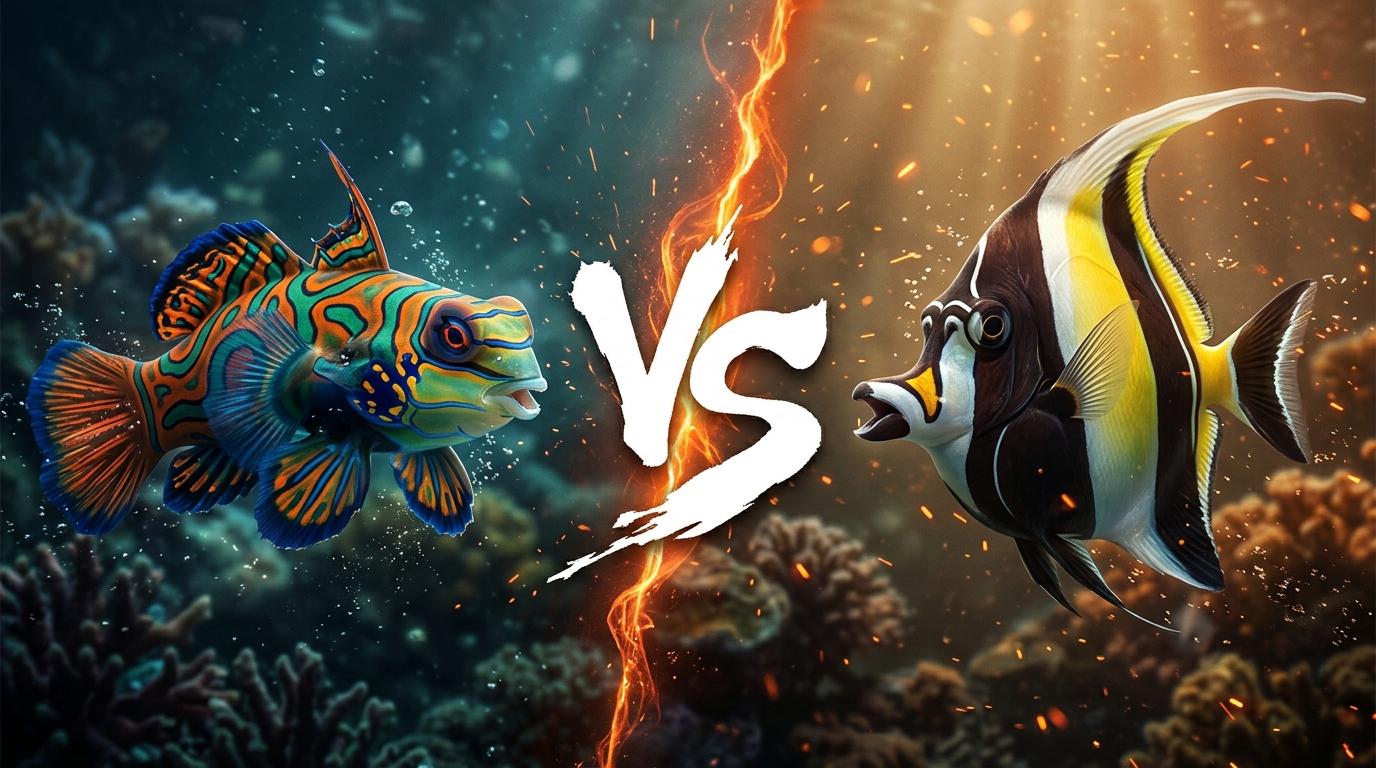
Mandarinfish vs Moorish Idol: Who Actually Wins?
The Mandarinfish wins, though it is not a fighter in the usual sense. A Moorish Idol is roughly three times longer, much faster, and far more mobile in open water. It also has no weapon that can solve the Mandarinfish's real defense: a scaleless body coated in foul-tasting, toxic-reported mucus, backed by a spiny gill-cover. The Mandarinfish lives tucked into rubble and coral branches and is built to be left alone. Most reef predators that sample one learn to avoid it. The Moorish Idol is a sponge-picking grazer with a tweezer snout and no scalpel spine like its surgeonfish relatives. It has no reason to press an attack and no tool to finish one. Contact between them ends with the Idol backing off and the Mandarinfish keeping its patch of reef, which makes the Mandarinfish the clear territorial winner.
Read comparison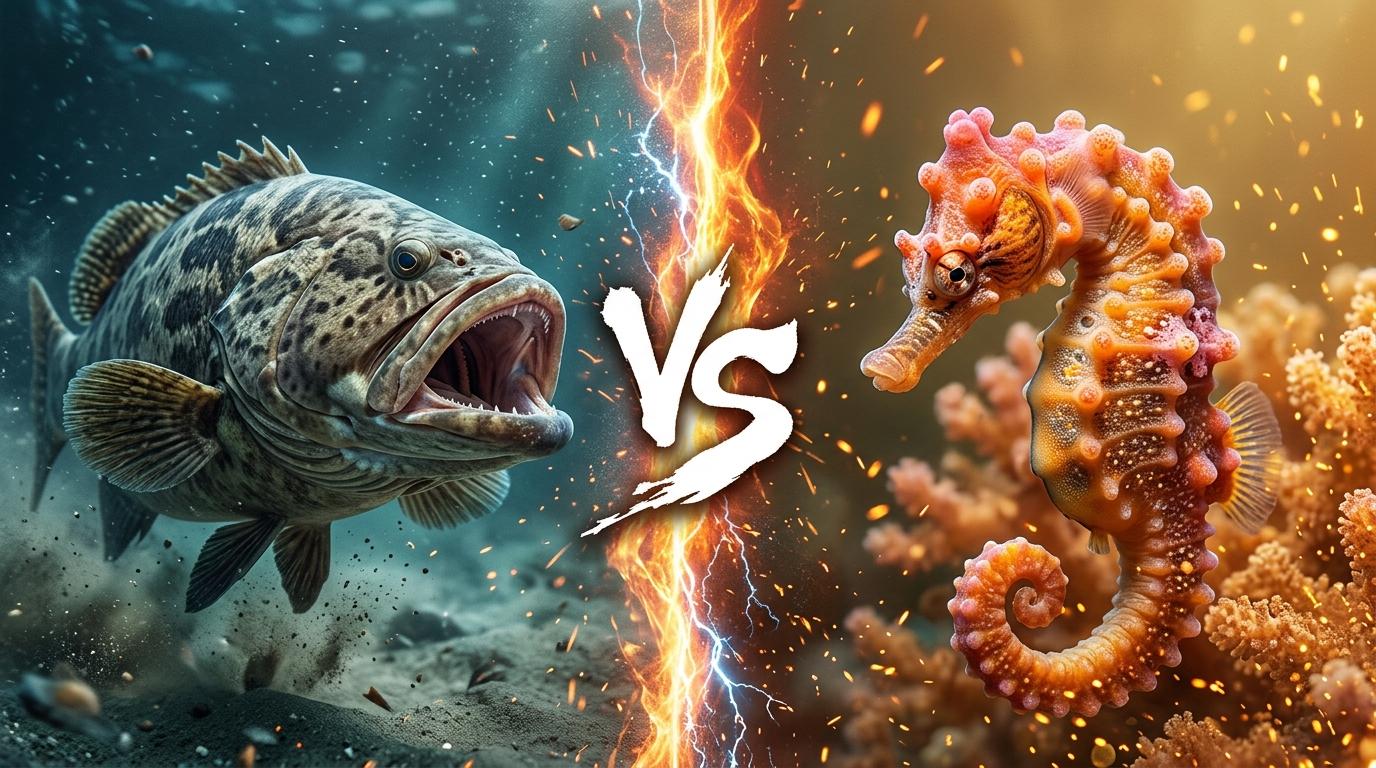
Giant Grouper vs Pygmy Seahorse: Who Actually Wins?
The Giant Grouper wins, and the gap is enormous. Epinephelus lanceolatus is the largest bony fish on coral reefs. It can reach about 2.7 m and several hundred kilograms, and it feeds by opening a cavernous mouth that creates suction strong enough to swallow lobsters, fish, and even small sharks in a single gulp. Hippocampus bargibanti is usually under 2.5 cm long. It has no bite, no armor that matters at this scale, and almost no swimming speed. In any encounter where the grouper commits, the contest ends in a fraction of a second. The pygmy seahorse's real strength is not fighting at all. It is near-perfect camouflage on gorgonian sea fans, which means it is rarely noticed in the first place. That is a survival win, not a battle win, so the overall verdict goes clearly to the grouper.
Read comparison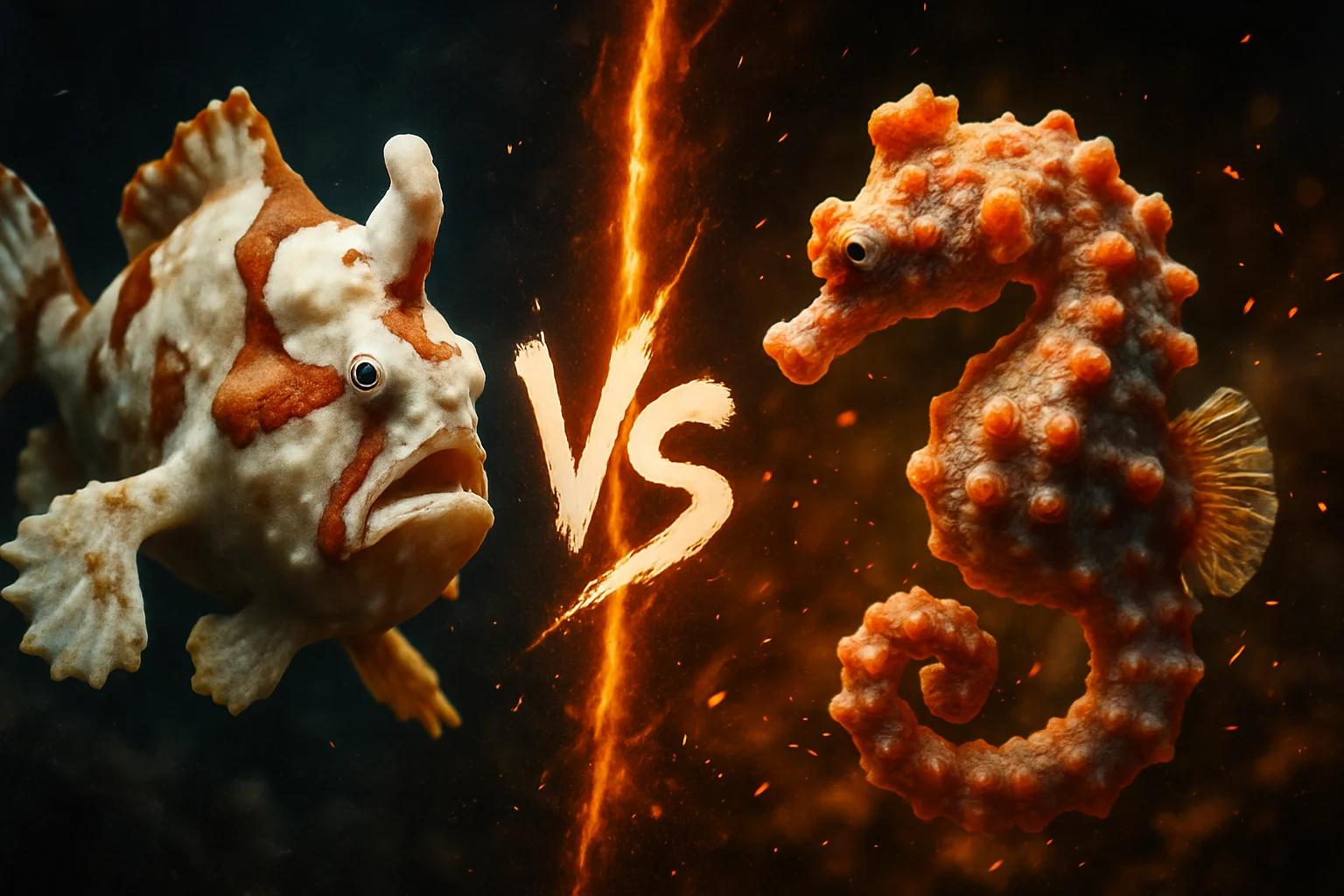
Warty Frogfish vs Pygmy Seahorse: Who Actually Wins?
The warty frogfish wins clearly. At roughly 10–12 cm against a pygmy seahorse barely 2 cm long, the frogfish has about a 5–6x length advantage. It also has one of the fastest feeding strikes recorded in any vertebrate: a mouth-expanding gulp that can engulf prey in a few milliseconds and handle prey nearly its own size. The pygmy seahorse has no bite, no venom, no spines and no meaningful escape speed. Its real weapon is never being noticed. It matches the knobby pink or yellow polyps of its gorgonian sea fan so precisely that the species was only discovered by accident on a collected fan. If the frogfish detects it, the encounter ends in one gulp. The seahorse's only winning line is invisibility, so it can survive, but it cannot beat the frogfish.
Read comparison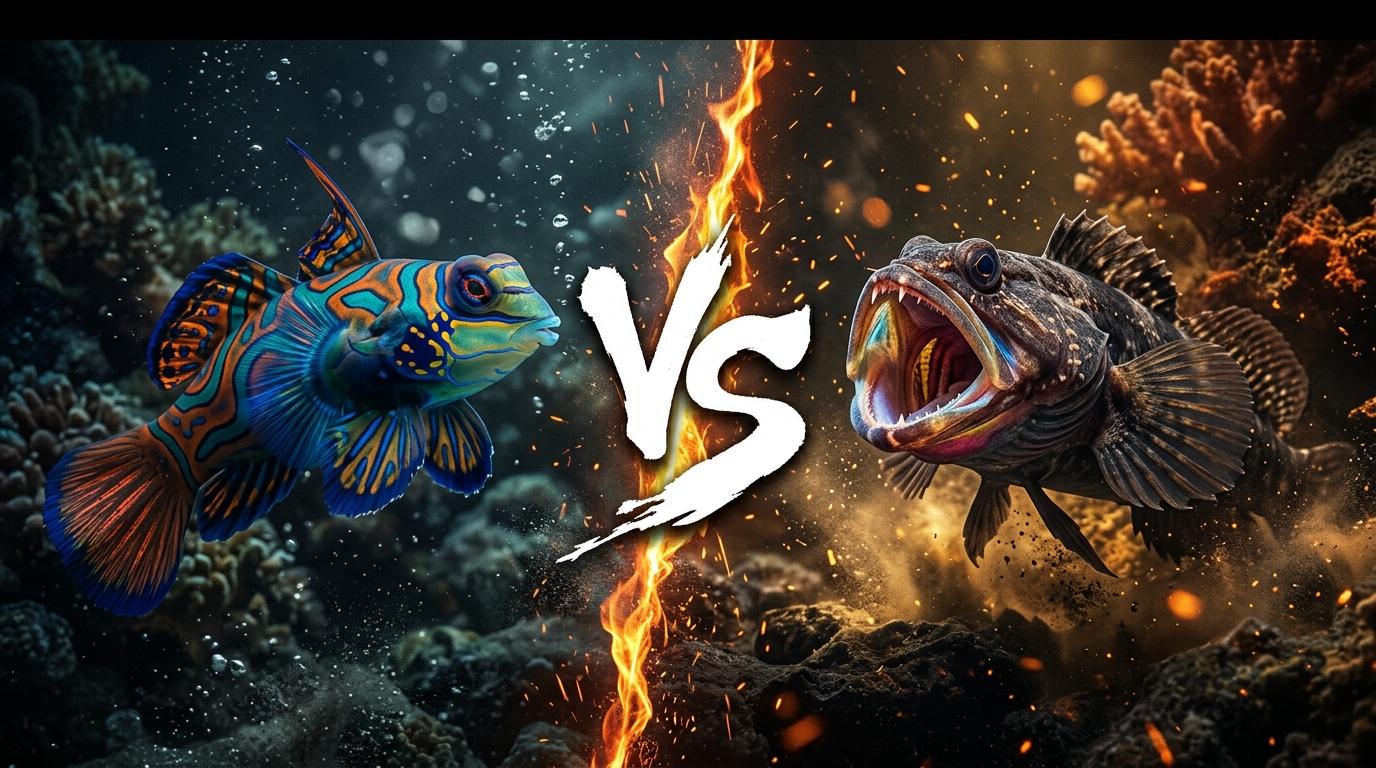
Mandarinfish vs Sarcastic Fringehead: Who Actually Wins?
The Sarcastic Fringehead wins clearly. It can reach about 30 cm, while a mandarinfish tops out around 6–7 cm, so the fringehead is roughly four times longer and many times heavier. It also carries the decisive weapon: an enormous, flaring mouth packed with needle-like teeth. It uses that mouth in mouth-to-mouth shoving contests with rivals and in lunges at anything that approaches its shelter. The mandarinfish is a slow, scaleless dragonet built for picking copepods off rubble. Its real defense is a coat of foul-tasting, toxic mucus that discourages predators from swallowing it. That chemical shield makes it a costly target, but it does not let the mandarinfish win a contest. It works by making attackers spit it out. In a forced encounter at a fringehead's den, the fringehead controls the space, the reach and the outcome. In any calm open setting, the mandarinfish's only winning move is to not be worth the effort.
Read comparison
Discussion
What do you think?
Share your reasoning with other readers. Be civil and stick to the animals.
Sign in to join the discussion.
Sign inNo comments yet. Start the conversation.