


Common Loon vs Trumpeter Swan: Who Actually Wins?
Common Loon vs Trumpeter Swan: a biology-first look at size, weapons, water tactics and territorial behavior to settle which North American waterbird wins.
Common Loon vs Trumpeter Swan
Matchup winner
Trumpeter Swan
Quick verdict
Start with the direct answer, then use the structured comparison below to see what changes the outcome.
The Trumpeter Swan wins this matchup overall. North America's heaviest native waterfowl weighs roughly 10–13 kg against a loon's 3–6 kg. It has a wingspan near 2.5 m and bony wrist joints that deliver bruising wing strikes, so it controls any surface confrontation. Swans are famously aggressive nest defenders and will drive intruders off breeding ponds. The loon is no pushover. Its dagger bill, dense near-solid bones and elite diving let it strike from below and vanish, and loons do sometimes injure other birds this way. In a sustained contest for territory, though, the swan's mass, reach and stubborn defense outlast the loon's hit-and-dive tactics.
Read the full explanation
Trumpeter Swan wins overall on size, reach and wing-strike power.
The swan outweighs the loon about 2–3 to 1 and has a far larger wingspan.
The loon's best weapon is an underwater ambush with its spear-like bill.
On the surface or near a nest, the swan holds the edge. Underwater, the loon calls the shots.
Reader vote
Who do you think wins?
Pick a side — no account needed. Results update live.
No votes yet — be the first to call it.
Editorial note
Why people disagree
Loons are fierce territorial fighters with a lethal stabbing bill, so many people assume they can kill anything their size or larger.
Mass and frame
Raw mass decides shoving, pinning and absorbing blows on the water's surface.
Primary weapon
The loon's bill is more precise. The swan's wing blows land from range and repeat without exposing its body.
Underwater control
The loon can choose when and where to engage by striking from below.
Read the full explanation +
Swans look serene, which hides how hard their wing blows land and how relentlessly they defend nests.
The answer depends on where the fight happens. A diving specialist and a surface heavyweight barely share the same arena.
Comparison FAQ
Short, direct answers to the next questions readers usually ask after the headline verdict.
Would a Trumpeter Swan beat a Common Loon in a fight?+
Yes, usually. The swan's greater size, reach and wing strikes win surface fights and territorial contests.
Which bird is stronger, a loon or a swan?+
The Trumpeter Swan is far stronger. It is roughly two to three times heavier and has much more powerful wings.
Why is the loon still dangerous to a swan?+
Its dagger bill and diving skill let it stab from below without warning. Loons are known to injure or kill other waterbirds this way.
Do loons and swans actually fight in the wild?+
They sometimes share lakes and can clash over space. Most encounters end with displays, chases or the loon diving away.
Head-to-head species stats
These are the same core AnimalDex stat dimensions used on the dedicated animal pages, pulled side by side so the matchup is faster to scan.
Common Loon
Tier CTrumpeter Swan
Tier CTrait-by-trait comparison
Only the categories that matter to this matchup are included. The goal is not filler stats, but the real design differences that change the result.
3–6 kg, compact torpedo body
Mass and frame
Trumpeter Swan
10–13 kg, long-necked heavyweight
Mass and frame
Trumpeter Swan
Dagger bill built for stabbing
Primary weapon
Trumpeter Swan
Bony wrist wing strikes plus a gripping bill
Primary weapon
Trumpeter Swan
Dives 60+ m, rear-set feet, dense bones
Underwater control
Common Loon
Dabbles and tips up; cannot pursue underwater
Underwater control
Common Loon
About 1.3 m wingspan, short neck
Reach and wingspan
Trumpeter Swan
About 2.5 m wingspan, very long neck
Reach and wingspan
Trumpeter Swan
Fierce, ritualized displays and lunges
Territorial resolve
Trumpeter Swan
Relentless pair-based nest defense
Territorial resolve
Trumpeter Swan
Instant dives, fast underwater turns
Agility and evasion
Common Loon
Powerful but slower to turn
Agility and evasion
Common Loon
How the verdict forms
Verdict timeline
01 · Mass and frame
Trumpeter Swan
02 · Primary weapon
Trumpeter Swan
03 · Underwater control
Common Loon
04 · Reach and wingspan
Trumpeter Swan
05 · Territorial resolve
Trumpeter Swan
06 · Agility and evasion
Common Loon
Change the conditions
Scenario breakdown
This is where shallow battle content usually fails. Terrain, spacing, timing, and engagement style can change the answer.
Scenario lean
Trumpeter Swan
Verdict confidence
82%
The swan dominates surface combat.
On the surface the swan's mass, wingspan and long neck let it bludgeon and drive the loon. The loon's one defense is to dive, which ends the fight rather than winning it.
AnimalDex field profiles
Explore these animals
Common Loon
Gavia immer
Clear northern lakes during breeding and coastal marine waters in winter.
Trumpeter Swan
Cygnus buccinator
Lakes, ponds, marshes, and slow river systems with aquatic plants.
Systems Intelligence & Hidden Purpose
See the animals behind this comparison as engineered biological systems: what each one is built to do, where it gains leverage, and why the matchup changes by scenario.
Specialized Hardware
Spear-like bill, checkered black-and-white breeding plumage, and sits low in the water give the Common Loon a body plan tuned for its niche.
Systems Script
Common Loons operate in clear northern lakes during breeding and coastal marine waters in winter. Their design helps them match food access, shelter, and timing inside that environment.
Strategic Insight
Quiet environments reveal more when the system is built to slip below the surface.
Specialized Hardware
Huge white body and long neck, all-black bill, and powerful wingbeats during takeoff give the Trumpeter Swan a body plan tuned for its niche.
Systems Script
Trumpeter Swans operate in lakes, ponds, marshes, and slow river systems with aquatic plants. Their design helps them match food access, shelter, and timing inside that environment.
Strategic Insight
A clear signal carries farther when the environment is quiet enough to hear it.
Final take
The Trumpeter Swan is the clear overall winner. It controls the surface, the shallows and the nesting grounds where real conflicts between these birds happen.
Read the full explanation
The Common Loon stays dangerous and nearly impossible to pin down. Its underwater strikes can wound, and it can always escape. The swan simply owns more of the contested space.
Collect both animals in AnimalDex
Track the species behind this matchup, compare their real traits, and build the rivalry into your AnimalDex collection.
Related comparisons
Continue with nearby matchups to compare more real-world animal traits without dropping into junky who-wins filler.
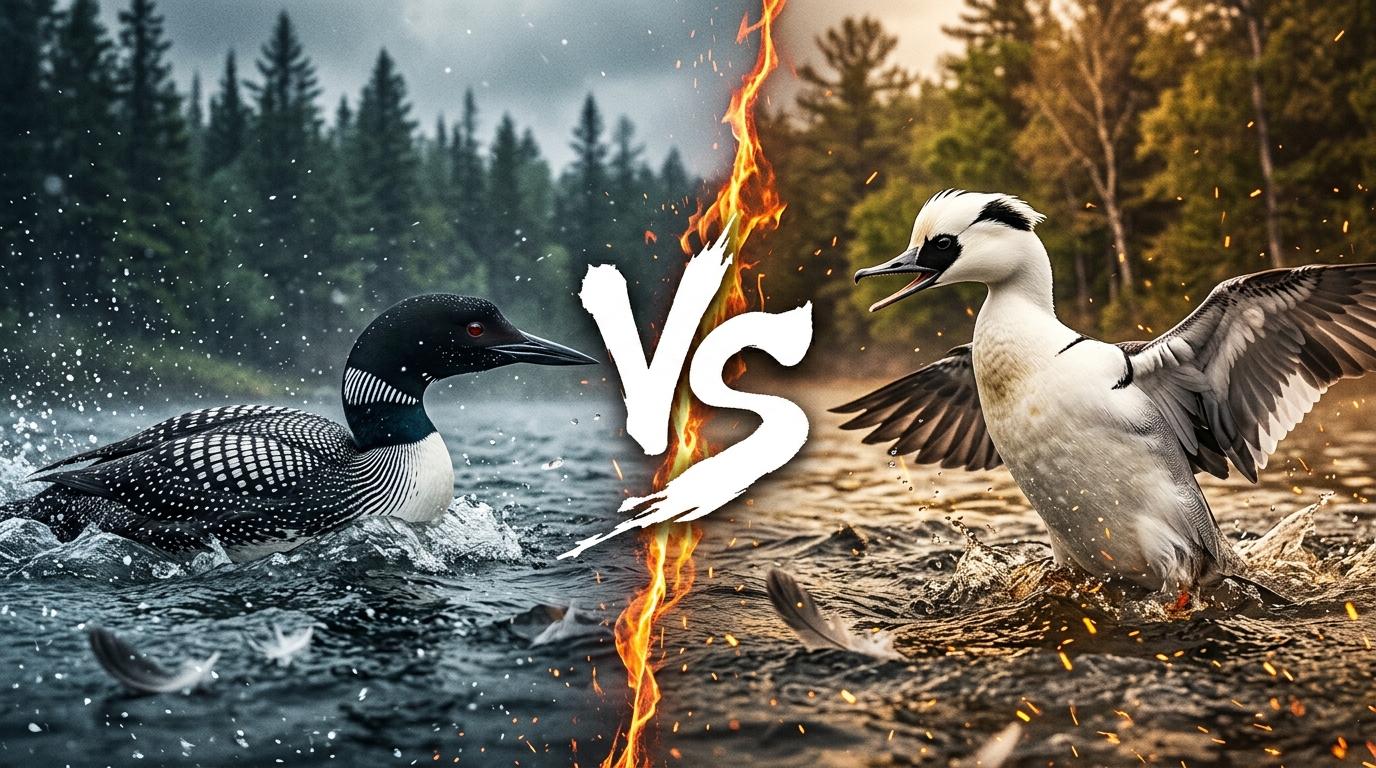
Common Loon vs Smew: Who Actually Wins?
The Common Loon wins clearly. An adult loon weighs roughly 2.7 to 6 kg, which is about four to eight times the mass of a smew at around 0.5 to 0.9 kg. It also carries a dagger-like bill built for stabbing, and it belongs to one of the most territorially aggressive waterbird groups in North America. Loons routinely drive off ducks, geese and even other loons by charging and stabbing at them from underwater. The smew is a quick, agile little sawbill with serrated mandibles made for gripping slippery fish, not for fighting. It cannot absorb a loon's attack or answer it. The smew's best result in any realistic meeting is escape, because it is lighter, takes flight far more easily, and can slip into tight cover. That makes it hard to catch, but it never makes it the winner.
Read comparison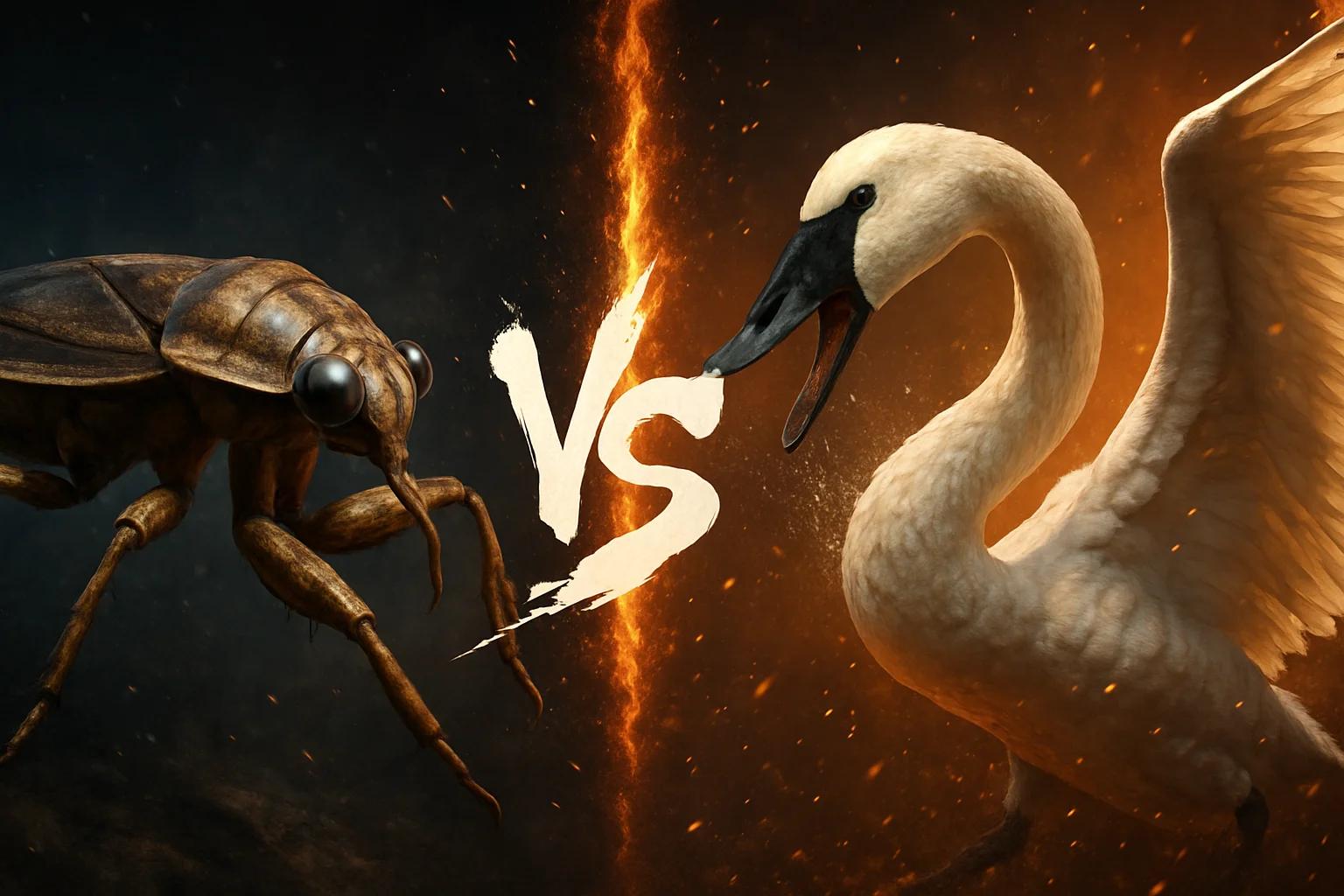
Giant Water Bug vs Trumpeter Swan: Who Actually Wins?
The Trumpeter Swan wins, and it isn't close. North America's heaviest native waterfowl weighs around 7–13 kg with a wingspan near 2.4 m, while Lethocerus americanus is a 4–6 cm insect weighing a few grams. The giant water bug is a superb ambush predator. Its raptorial forelegs and piercing beak inject digestive saliva that can kill fish, frogs, and even small ducklings, but its whole toolkit is built for prey smaller than or near its own scale. An adult swan is thousands of times heavier, armored in dense plumage, and feeds by upending to strip submerged vegetation, where it may simply crush, swallow, or ignore the bug. The bug can deliver a famously painful bite, but it has no way to turn that into lethal damage against a bird this large.
Read comparison
Discussion
What do you think?
Share your reasoning with other readers. Be civil and stick to the animals.
Sign in to join the discussion.
Sign inNo comments yet. Start the conversation.