

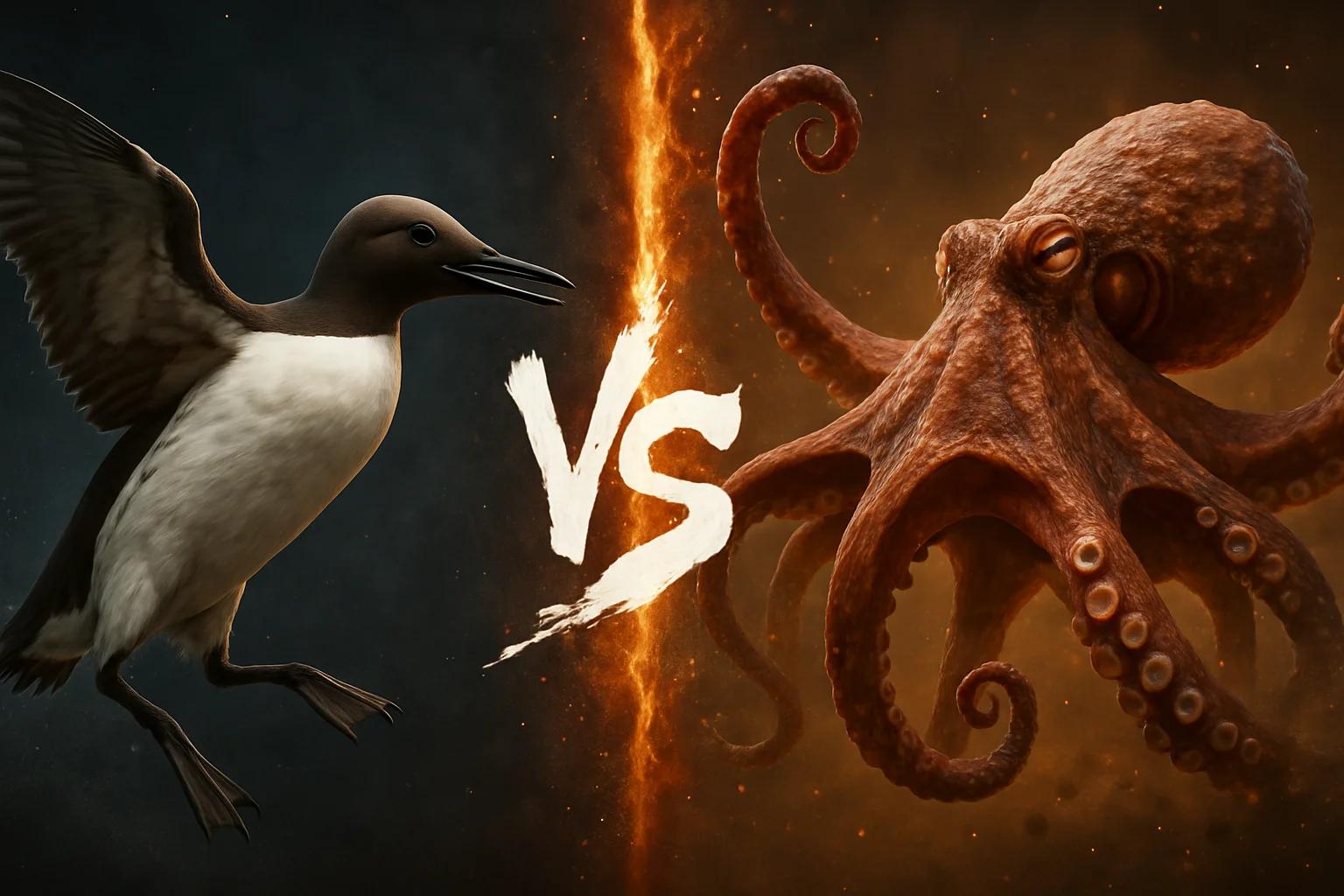
Common Murre vs Giant Pacific Octopus: Who Actually Wins?
Common Murre vs Giant Pacific Octopus: a biology-first breakdown of who wins between a deep-diving seabird and the largest octopus on Earth, and why the setting decides it.
Common Murre vs Giant Pacific Octopus
Matchup winner
Giant Pacific Octopus
Quick verdict
Start with the direct answer, then use the structured comparison below to see what changes the outcome.
The Giant Pacific Octopus wins this matchup, and it isn't especially close once contact happens. A large adult can top 15 kg with arm spans over 4 m, against a murre of roughly 1 kg. Each of its eight arms carries hundreds of suckers that grip independently, and its beak and venomous saliva are built to dismantle armored crabs. The Common Murre is a superb wing-propelled diver that can reach 100–180 m, but its weapons are a dagger-like bill and speed, both made for snatching small fish, not for breaking a grappling hold. The murre's real advantage is that it never has to engage. It's faster in open water and can leave the scene through the surface. Any encounter that turns into a struggle, especially near rocky reef, belongs to the octopus.
Read the full explanation
Giant Pacific Octopus wins any real fight: it is 10–50x heavier and built to grapple.
The murre is faster and more agile in open water, so its best result is escaping.
Near rocks and kelp, the octopus is an ambush specialist and the murre has nowhere to go.
There are records of large octopuses seizing and drowning seabirds, gulls included, at the surface.
Reader vote
Who do you think wins?
Pick a side — no account needed. Results update live.
No votes yet — be the first to call it.
Editorial note
Why people disagree
Murres are elite divers, so people assume a bird that reaches 150 m can handle anything down there. Diving skill is a commute, not a combat skill.
Size and mass
In a grappling contest underwater, mass and reach settle things early, and the octopus has an overwhelming lead in both.
Grip and restraint
Once the octopus has a hold, the murre has no way to pry itself loose.
Burst speed and maneuvering
Speed is the murre's only real card. It decides whether contact ever happens.
Read the full explanation +
Octopuses look soft and boneless, which hides how strong all that sucker-lined muscle is.
Many matchups are imagined in open water, where the murre can win by leaving. Surviving an encounter and winning a fight are different things.
Comparison FAQ
Short, direct answers to the next questions readers usually ask after the headline verdict.
Would a Common Murre beat a Giant Pacific Octopus?+
No. If they make contact, the octopus wins. The murre's best result is avoiding a grip and escaping.
Which is stronger, a murre or a giant Pacific octopus?+
The octopus, by a wide margin. It can be more than 10 times the murre's weight, and its suckers can hold onto struggling crabs and fish.
Can an octopus really kill a seabird?+
Yes. Large octopuses have been recorded seizing and drowning seabirds, including gulls, at the surface.
Why is the murre still dangerous?+
Its sharp bill can stab the octopus's eyes and soft tissue, and its speed lets it avoid ambushes in open water. A wary murre is hard to catch.
Do they actually meet in the wild?+
Their ranges overlap in the North Pacific. A murre diving near rocky habitat could come close to an octopus den, but direct conflict is probably uncommon.
Head-to-head species stats
These are the same core AnimalDex stat dimensions used on the dedicated animal pages, pulled side by side so the matchup is faster to scan.
Common Murre
Tier CGiant Pacific Octopus
Tier CTrait-by-trait comparison
Only the categories that matter to this matchup are included. The goal is not filler stats, but the real design differences that change the result.
~1 kg, ~40 cm long
Size and mass
Giant Pacific Octopus
Typically 10–15 kg, exceptional records far larger; arm span 3–4+ m
Size and mass
Giant Pacific Octopus
None beyond bill and feet
Grip and restraint
Giant Pacific Octopus
Eight arms with roughly 2,000+ independently controlled suckers
Grip and restraint
Giant Pacific Octopus
Wing-propelled 'underwater flight', fast and agile
Burst speed and maneuvering
Common Murre
Jet-propulsion bursts, slow to keep up
Burst speed and maneuvering
Common Murre
Sharp bill for stabbing small fish
Lethal tools
Giant Pacific Octopus
Parrot-like beak plus venomous, tissue-softening saliva
Lethal tools
Giant Pacific Octopus
Visual hunter in open water
Ambush control
Giant Pacific Octopus
Can change color and texture almost instantly to blend into rock
Ambush control
Giant Pacific Octopus
Can surface and fly away
Escape hatch
Common Murre
Stays submerged; dens in rock
Escape hatch
Common Murre
How the verdict forms
Verdict timeline
01 · Size and mass
Giant Pacific Octopus
02 · Grip and restraint
Giant Pacific Octopus
03 · Burst speed and maneuvering
Common Murre
04 · Lethal tools
Giant Pacific Octopus
05 · Ambush control
Giant Pacific Octopus
06 · Escape hatch
Common Murre
Change the conditions
Scenario breakdown
This is where shallow battle content usually fails. Terrain, spacing, timing, and engagement style can change the answer.
Scenario lean
Giant Pacific Octopus
Verdict confidence
82%
Octopus, decisively.
In cover, the octopus is camouflaged and anchored to the rock. A murre chasing fish close to the reef gives up its speed advantage to work in tight spaces. Once one arm makes contact, more arms follow and the murre is held below the surface. A breath-holding diver pinned underwater runs out of time quickly.
AnimalDex field profiles
Explore these animals
Common Murre
Uria aalge
rocky sea cliffs and cold coastal ocean
Giant Pacific Octopus
Enteroctopus dofleini
rocky reef, kelp forest, and cold coastal sea floor
Systems Intelligence & Hidden Purpose
See the animals behind this comparison as engineered biological systems: what each one is built to do, where it gains leverage, and why the matchup changes by scenario.
Specialized Hardware
upright seabird posture, wing-powered underwater diving, and crowded cliff colony nesting give the Common Murre a body plan tuned for its niche.
Systems Script
Common Murres operate through rocky sea cliffs and cold coastal ocean Their design links movement, shelter, feeding, and survival into one workable system.
Strategic Insight
A system can reuse the same tool in different environments if the design is tight enough.
Specialized Hardware
huge arm span, shape-shifting camouflage, and complex problem-solving behavior give the Giant Pacific Octopus a body plan tuned for its niche.
Systems Script
Giant Pacific Octopuss operate through rocky reef, kelp forest, and cold coastal sea floor Their design links movement, shelter, and feeding into one workable survival system.
Strategic Insight
Distributed control becomes even more impressive when the body itself stays adaptable.
Final take
The Giant Pacific Octopus is the clear winner. It is much heavier, its arms are made to restrain prey, its beak and venom are made to finish it, and its camouflage lets it decide when an encounter starts.
Read the full explanation
The Common Murre is still an impressive animal. It is one of the best divers among birds and is fast and efficient underwater. Its strategy is to move, keep its distance and get out through the surface. That keeps it alive, but it doesn't help it win a fight.
Collect both animals in AnimalDex
Track the species behind this matchup, compare their real traits, and build the rivalry into your AnimalDex collection.
Related comparisons
Continue with nearby matchups to compare more real-world animal traits without dropping into junky who-wins filler.
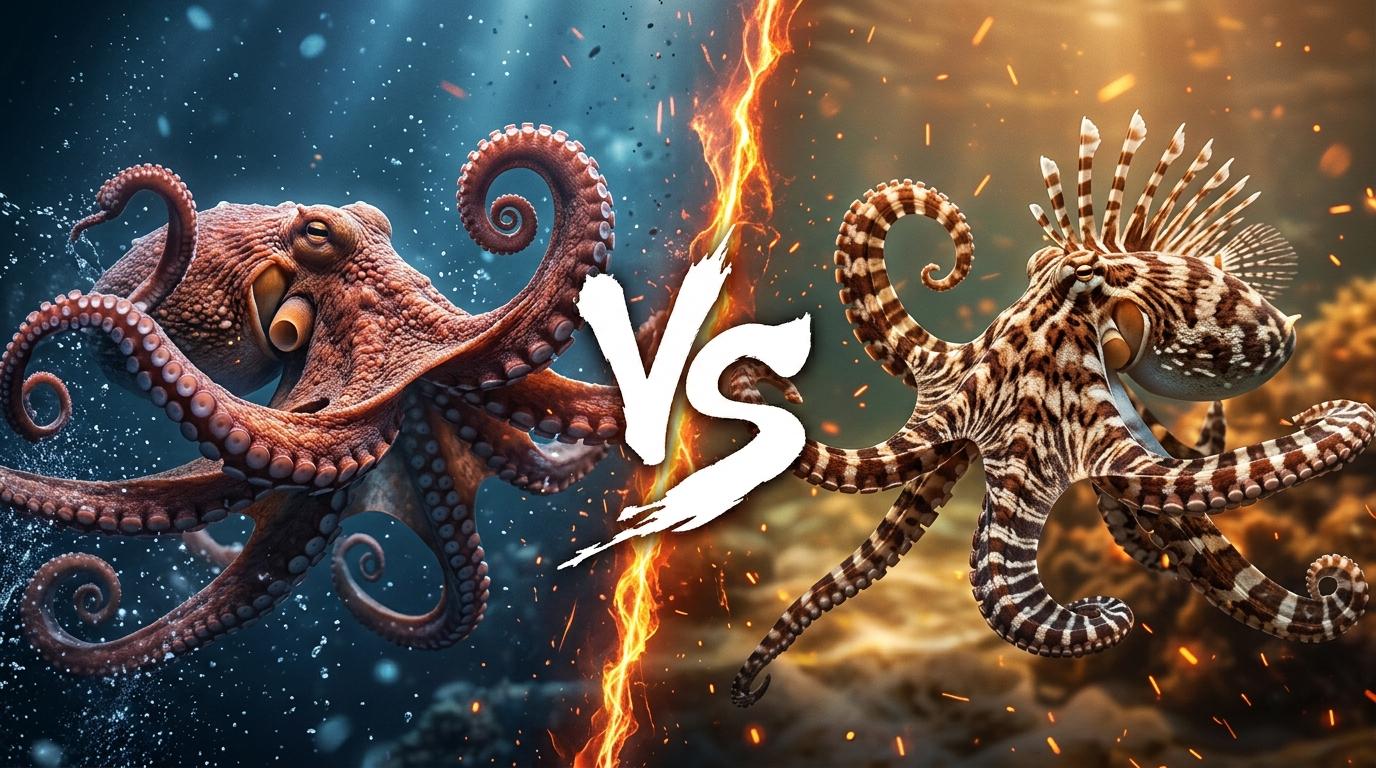
Giant Pacific Octopus vs Mimic Octopus: Who Actually Wins?
The Giant Pacific Octopus wins, and it isn't close in a physical contest. Adults commonly weigh 15–50 kg with arm spans past 4 m, while the Mimic Octopus usually weighs well under half a kilogram with an arm span around 60 cm. That makes the giant roughly a hundred times heavier, with thousands of powerful suckers able to pin and dismantle crabs, sharks and other octopuses. It also has a hard beak and venomous saliva built for cracking armored prey. The Mimic Octopus is a brilliant deception specialist that impersonates lionfish, sea snakes and flatfish. But its tricks evolved to fool fish predators in Indo-Pacific sand flats, not to stop a cold-water cephalopod that recognizes octopus-sized prey by touch. In any engagement where the two are close enough to touch, mass and grip settle it. The Mimic's only real wins come from never being caught.
Read comparison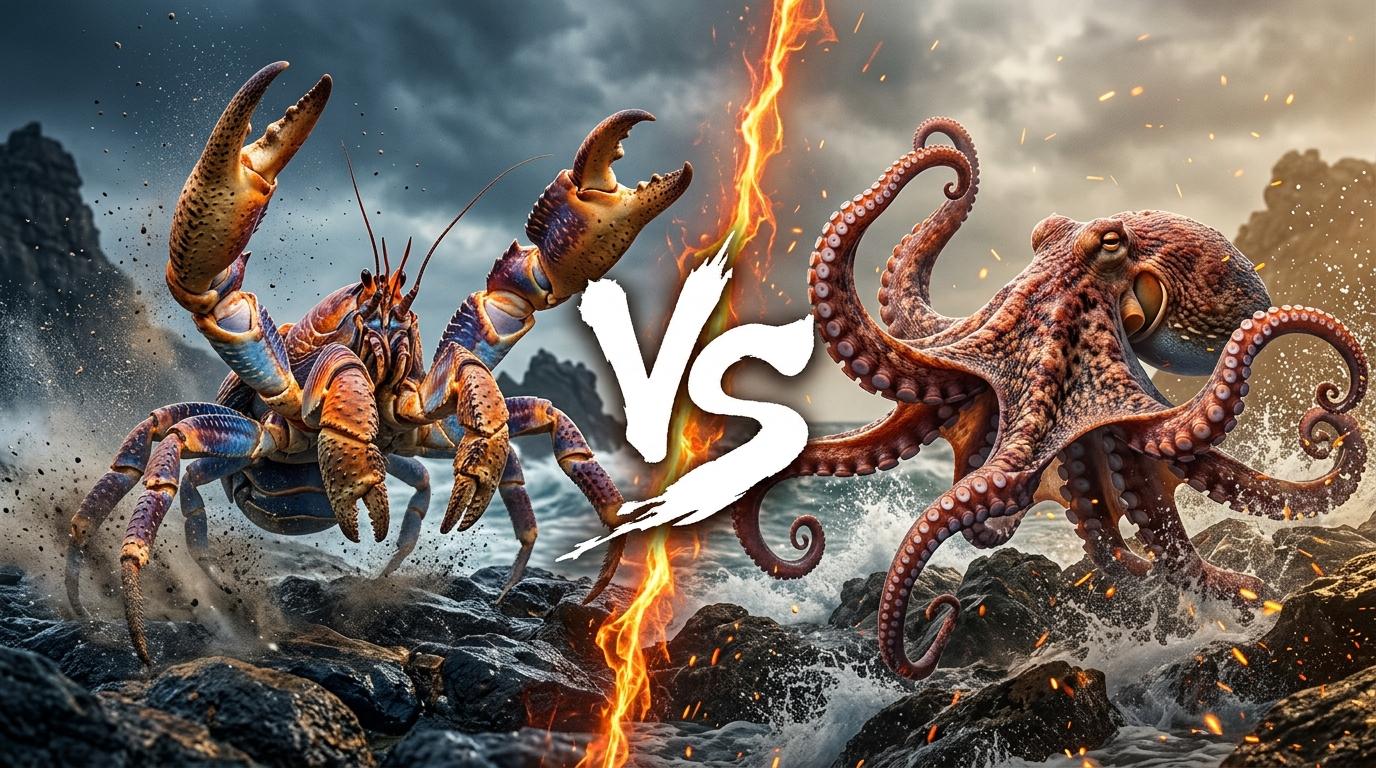
Coconut Crab vs Giant Pacific Octopus: Who Actually Wins?
The Giant Pacific Octopus wins this matchup overall, and it is not especially close in the setting where the two could realistically meet: water. The octopus is many times heavier, commonly 15 kg or more against a coconut crab's maximum of about 4 kg. Its arm span runs to several meters, lined with hundreds of suckers that can pin a target from every angle at once. Most importantly, the octopus is a specialist crab hunter. It has a hard parrot-like beak, a tongue-like radula that can drill through shell, and venomous saliva that weakens prey from the inside. The coconut crab carries one of the strongest pinches measured in any crustacean, and a well-placed claw can sever an arm. But an adult coconut crab breathes air through modified gill chambers and drowns if it stays submerged. Once it is in the water, it is fighting the clock, the grapple, and an animal built to dismantle armored prey. Flip the setting to dry land and the crab takes over, because the octopus quickly loses strength, coordination, and oxygen out of water. That is a habitat edge, though, not a combat edge. On balance, the octopus has the better toolkit for actually ending a fight.
Read comparison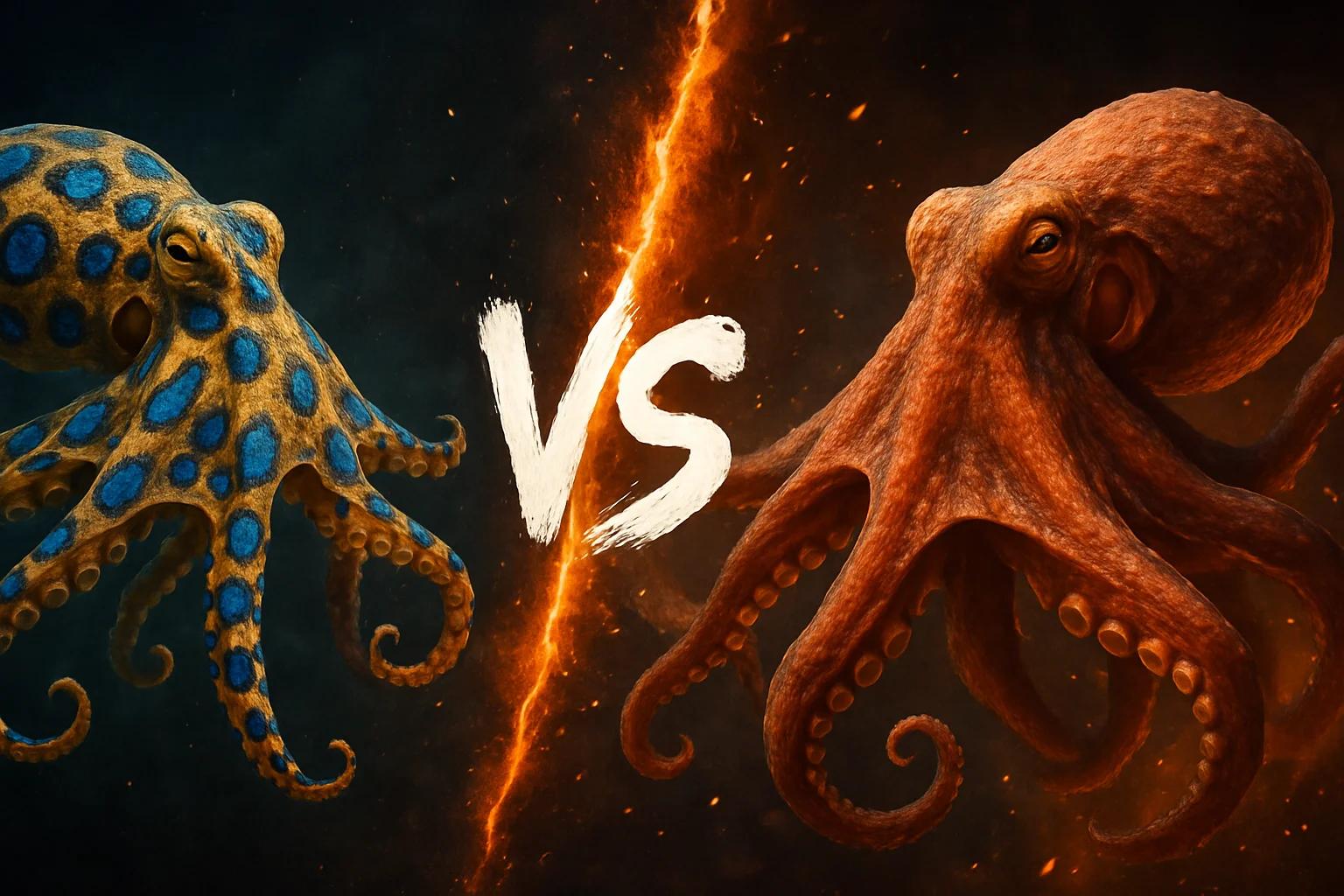
Blue-ringed Octopus vs Giant Pacific Octopus: Who Actually Wins?
The Giant Pacific Octopus wins most realistic encounters. A large adult can weigh well over a hundred times as much as a Blue-ringed Octopus. Its arms reach farther than the smaller animal's whole world, and it can control prey from a distance with hundreds of strong suckers before any beak contact happens. The Blue-ringed Octopus carries one of the ocean's most potent neurotoxins, tetrodotoxin, in its saliva. But that toxin is delivered by a bite, and a bite requires getting the beak onto soft tissue. A giant octopus that pins it arm-first and keeps it away from its mantle denies that chance. The upset path is real: one solid bite could plausibly disable even a giant. This is a decisive size-and-control win with a genuine venom asterisk, not a mismatch.
Read comparison
Discussion
What do you think?
Share your reasoning with other readers. Be civil and stick to the animals.
Sign in to join the discussion.
Sign inNo comments yet. Start the conversation.