

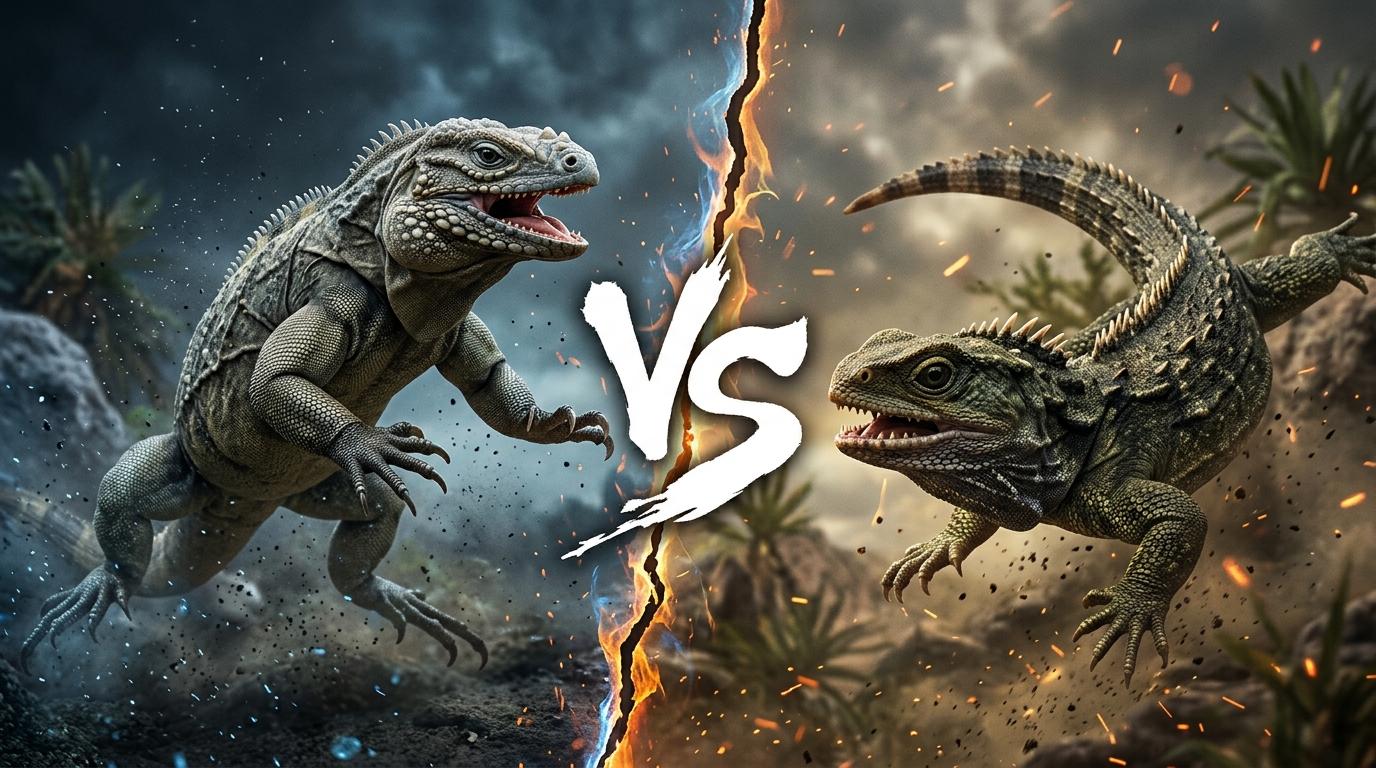
Cuban Rock Iguana vs Tuatara: Who Actually Wins?
Cuban rock iguana vs tuatara: a biology-first breakdown of size, bite, armor and temperament, and why the bigger Caribbean lizard takes the overall edge.
Cuban Rock Iguana vs Tuatara
Matchup winner
Cuban Rock Iguana
Quick verdict
Start with the direct answer, then use the structured comparison below to see what changes the outcome.
The Cuban rock iguana wins this matchup. It is the larger animal by a wide margin. Adults commonly run 1.2–1.5 m long and can weigh several kilograms, while a big male tuatara tops out near 60 cm and about 1 kg. The iguana also brings a muscular whip-tail, strong limbs built for scrambling over limestone, and a territorial streak honed by head-bobbing, shoving disputes with rival males. The tuatara is no pushover. Its shearing bite, with a lower jaw that slides forward between two rows of upper teeth, can lacerate skin, and its cold-tolerant, patient temperament makes it hard to rattle. But it is built as a slow, low-energy nocturnal ambusher of insects and seabird chicks, not as a wrestler of an animal four or five times its mass. In most realistic encounters the iguana's size, reach and warm-weather stamina decide things before the tuatara's bite can matter.
Read the full explanation
Cuban rock iguana wins overall, mainly on size, mass and tail power.
The iguana is roughly 2–3x longer and several times heavier than an adult tuatara.
The tuatara's slicing bite and cold-night activity give it real edges in burrow and nighttime frames.
Neither animal seeks fights outside its own species. This is a hypothetical biology comparison.
Reader vote
Who do you think wins?
Pick a side — no account needed. Results update live.
No votes yet — be the first to call it.
Editorial note
Why people disagree
Tuatara fans point to its unique shearing jaw and living-fossil toughness, but bite design does not erase a large weight gap.
Size and body mass
In reptile contests, mass decides who can pin, shove and absorb bites. The iguana carries a decisive margin here.
Bite design
The tuatara's jaw saws as it closes, making each bite more damaging per kilogram of animal.
Tail whip and reach
A whip-tail lets the iguana punish an approach before the opponent can close to bite range.
Read the full explanation +
Temperature matters hugely. On a cool night the tuatara is active while the iguana is sluggish, so context can flip the result.
Both are rare island specialists that would never meet in the wild, so people fill the gap with guesswork rather than biology.
Comparison FAQ
Short, direct answers to the next questions readers usually ask after the headline verdict.
Would a Cuban rock iguana beat a tuatara in a fight?+
Usually yes. The iguana is far larger and stronger and would win most warm-weather encounters, though a tuatara defending its burrow on a cold night could hold it off.
Which is stronger, a Cuban rock iguana or a tuatara?+
The Cuban rock iguana. It is several times heavier, with powerful limbs and a muscular tail, giving it much more raw strength.
Why is the tuatara still dangerous even though it loses?+
Its jaw slides forward as it closes, slicing like a saw, and it stays active in cold temperatures that slow most reptiles. A bite to the face or toes can do real damage.
Do Cuban rock iguanas and tuataras ever meet in the wild?+
No. Cuban rock iguanas live in Cuba and nearby islands, while tuatara live only in New Zealand. This is a hypothetical comparison.
Is a tuatara a lizard?+
No. The tuatara is the last surviving member of the order Rhynchocephalia, a lineage separate from lizards and snakes for over 200 million years.
Head-to-head species stats
These are the same core AnimalDex stat dimensions used on the dedicated animal pages, pulled side by side so the matchup is faster to scan.
Cuban Rock Iguana
Tier CTuatara
Tier BTrait-by-trait comparison
Only the categories that matter to this matchup are included. The goal is not filler stats, but the real design differences that change the result.
Up to ~1.5 m, multi-kilogram adults
Size and body mass
Cuban Rock Iguana
Up to ~60 cm, around 1 kg
Size and body mass
Cuban Rock Iguana
Serrated leaf-cutting teeth, strong grip
Bite design
Tuatara
Sliding shear bite, tooth-ridge jaw
Bite design
Tuatara
Long, muscular defensive whip
Tail whip and reach
Cuban Rock Iguana
Shorter tail, minimal striking use
Tail whip and reach
Cuban Rock Iguana
Needs sun heat to perform
Cold-weather readiness
Tuatara
Active at temperatures as low as ~5–7°C
Cold-weather readiness
Tuatara
Frequent male display and shoving bouts
Territorial aggression
Cuban Rock Iguana
Defends burrows, slower to escalate
Territorial aggression
Cuban Rock Iguana
Thick-scaled, dorsal crest, big frame
Close-range durability
Cuban Rock Iguana
Tough granular skin, compact body
Close-range durability
Cuban Rock Iguana
How the verdict forms
Verdict timeline
01 · Size and body mass
Cuban Rock Iguana
02 · Bite design
Tuatara
03 · Tail whip and reach
Cuban Rock Iguana
04 · Cold-weather readiness
Tuatara
05 · Territorial aggression
Cuban Rock Iguana
06 · Close-range durability
Cuban Rock Iguana
Change the conditions
Scenario breakdown
This is where shallow battle content usually fails. Terrain, spacing, timing, and engagement style can change the answer.
Scenario lean
Cuban Rock Iguana
Verdict confidence
82%
Clear iguana win.
Sun-warmed, the iguana reaches peak muscle performance. Its reach, tail and mass let it control spacing and overpower the smaller tuatara, which is also out of its preferred thermal and time window.
AnimalDex field profiles
Explore these animals
Cuban Rock Iguana
Cyclura nubila
dry forest, rocky shore, and scrub habitat
Tuatara
Sphenodon punctatus
Coastal forest, shrubland, and predator-free island sanctuary habitat.
Systems Intelligence & Hidden Purpose
See the animals behind this comparison as engineered biological systems: what each one is built to do, where it gains leverage, and why the matchup changes by scenario.
Specialized Hardware
heavy gray basking body, short horned facial scales, and rocky coastal territorial movement give the Cuban Rock Iguana a body plan tuned for its niche.
Systems Script
Cuban Rock Iguanas operate through dry forest, rocky shore, and scrub habitat. Their design links movement, feeding, shelter, and timing into one workable survival system.
Strategic Insight
Harsh places reward efficiency, timing, and bodies that waste very little.
Specialized Hardware
Spiny crest along the back, stout lizard-like body, and slow growth and long lifespan give the Tuatara a body plan tuned for its niche.
Systems Script
Tuataras operate in coastal forest, shrubland, and predator-free island sanctuary habitat. Their design helps them match food access, shelter, and timing inside that environment.
Strategic Insight
Some of the rarest systems matter because they preserve an old design almost nowhere else remains.
Final take
The Cuban rock iguana is the overall winner. Size, tail reach and a territorial temperament give it control in most frames, especially daytime and open ground.
Read the full explanation
The tuatara earns respect as a specialist. In cold, dark, confined spaces its thermal tolerance and saw-like bite flip the odds. Even so, it is an endurance-and-patience animal, not a heavyweight brawler, and the iguana's physical margin is too large to overcome in a general contest.
Collect both animals in AnimalDex
Track the species behind this matchup, compare their real traits, and build the rivalry into your AnimalDex collection.
Related comparisons
Continue with nearby matchups to compare more real-world animal traits without dropping into junky who-wins filler.
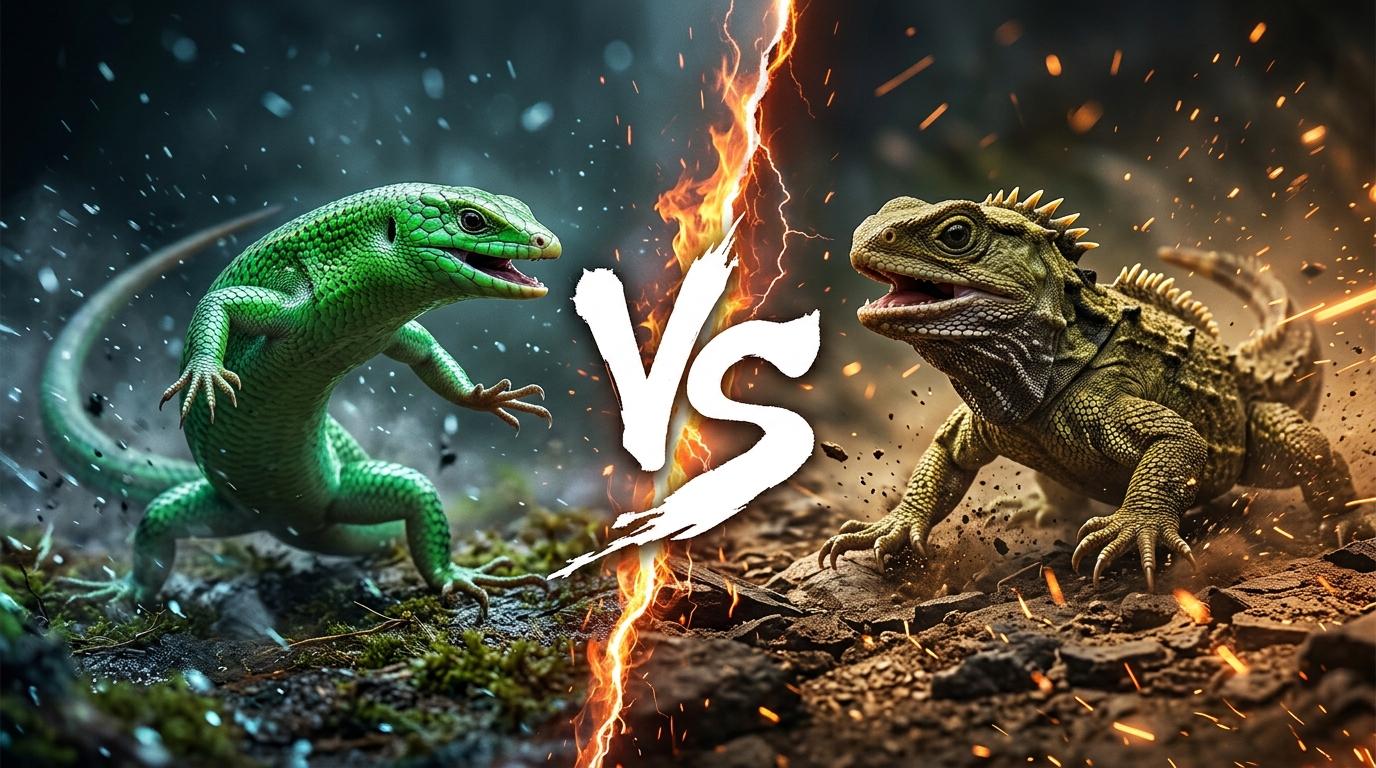
Emerald Tree Skink vs Tuatara: Who Actually Wins?
The tuatara wins clearly. New Zealand's living relic is roughly two to three times longer than the emerald tree skink and many times heavier. Adults reach about 50–80 cm and up to around 1 kg, against a slender skink of roughly 20–25 cm. The tuatara also has a shearing bite built on fused, wedge-like teeth, and it already eats small lizards, seabird chicks, and large invertebrates. A bright green skink sits comfortably inside its prey range. The emerald tree skink's real edge is evasion. It is quicker, highly arboreal, and alert by day, so if it sees the tuatara coming and has a branch to climb, it simply leaves. Once the two are in contact on the ground, though, size, jaw power, and the tuatara's patient sit-and-wait strike decide it fast.
Read comparison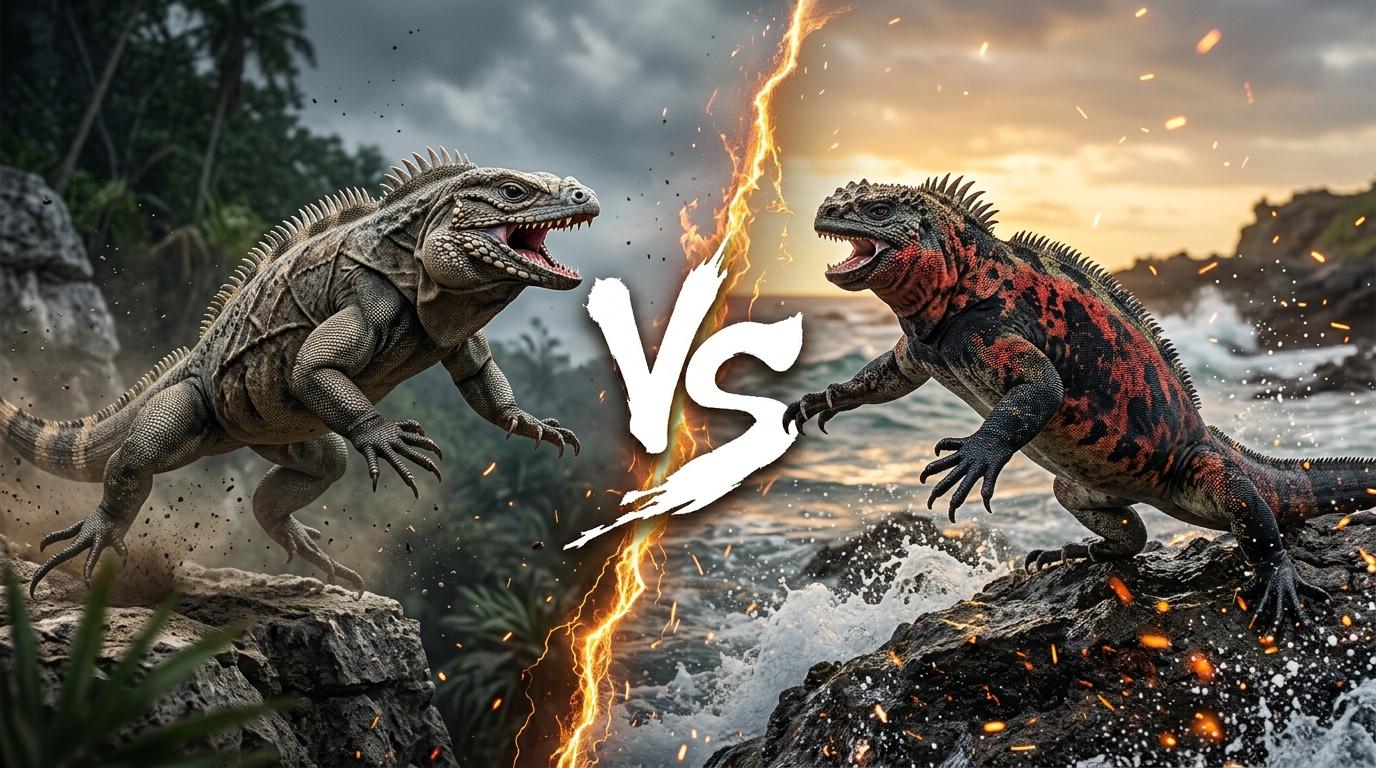
Cuban Rock Iguana vs Marine Iguana: Who Actually Wins?
The Cuban rock iguana wins this matchup in most realistic frames. It is the bulkier lizard, with large males reaching roughly 1.5 m in total length and several kilograms of mass. It has a heavier head and stronger jaws, and it lives in a territorial land system where males routinely settle disputes with head-bobbing, lateral displays, shoving and biting. The marine iguana is a remarkable specialist. It dives for algae and tolerates cold Pacific water, and it handles salt with nasal glands that sneeze out brine. But its blunt snout and small, tricuspid teeth are built to scrape algae off rock, not to win land grappling contests. Male marine iguanas do head-butt rivals over lekking territories, and they are tough, but their pushing contests are ritualized and lower on damage. Away from the surf, the rock iguana's mass, grip and bite carry the fight.
Read comparison
Discussion
What do you think?
Share your reasoning with other readers. Be civil and stick to the animals.
Sign in to join the discussion.
Sign inNo comments yet. Start the conversation.