

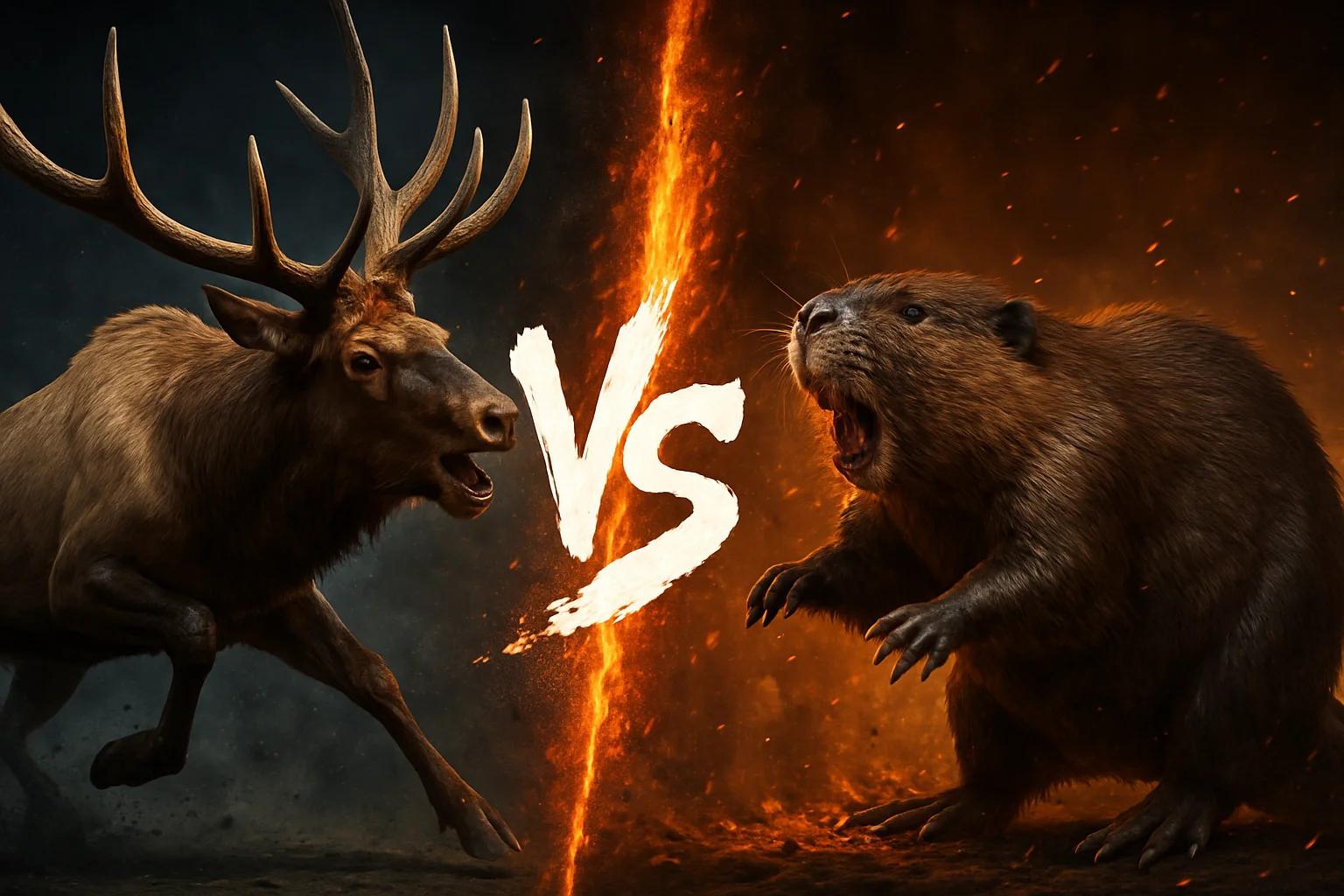
Elk vs North American Beaver: Who Actually Wins?
Elk vs beaver: who would win? A biology-first comparison of size, antlers, hooves, teeth and habitat. Find out why the elk wins on land and why the beaver still owns the pond.
Elk vs North American Beaver
Matchup winner
Elk
Quick verdict
Start with the direct answer, then use the structured comparison below to see what changes the outcome.
The elk wins clearly. A bull elk weighs roughly 320–330 kg (700+ lb) and stands about 1.5 m at the shoulder. It carries branching antlers and sharp front hooves that it uses for real combat and predator defense. A large North American beaver tops out around 20–30 kg and is built for gnawing, swimming and engineering, not fighting. The beaver's orange, iron-reinforced incisors can cause serious wounds, and it is formidable in water. In any land encounter, though, the elk's mass, reach, speed and striking power decide things quickly. The realistic outcome is not a duel. It is a beaver retreating to water, or an elk driving off a nuisance with a hoof strike.
Read the full explanation
Elk win: they are roughly 10–15 times heavier, with antlers and striking hooves.
Beavers are not fighters. Their defense is water, lodges and escape.
Beaver incisors are dangerous at close range, so the elk can still get hurt.
In deep water the beaver controls the encounter, but it would retreat rather than attack.
Reader vote
Who do you think wins?
Pick a side — no account needed. Results update live.
No votes yet — be the first to call it.
Editorial note
Why people disagree
Beaver bites have injured dogs and people, so some readers overrate the beaver as a fighter.
Raw mass
A weight gap this large means the beaver cannot absorb or redirect a single committed blow.
Weapon reach
The elk can hit from a distance the beaver cannot close safely.
Bite damage
This is the beaver's single real threat: deep, slicing bites to legs.
Read the full explanation +
Elk are grazers, which makes people forget that bulls are seasoned combatants with lethal headgear.
Water changes everything: a pond-edge scenario feels far closer than an open meadow.
Comparison FAQ
Short, direct answers to the next questions readers usually ask after the headline verdict.
Would an elk beat a beaver in a fight?+
Yes. On land an elk would win easily through hoof strikes and antlers. A real beaver would retreat to water long before a fight began.
Which is stronger, an elk or a beaver?+
The elk, by a huge margin. It is more than ten times heavier and built for combat and long-distance running.
Why is a beaver still dangerous to an elk?+
Its incisors are self-sharpening and strong enough to cut hardwood, so a bite to a leg could cause a deep, infection-prone wound.
Do elk and beavers interact in the wild?+
Yes, mostly indirectly. Both depend on willow and aspen. Elk browsing can limit beaver food, while beaver dams create the wetlands elk use.
Head-to-head species stats
These are the same core AnimalDex stat dimensions used on the dedicated animal pages, pulled side by side so the matchup is faster to scan.
Elk
Tier BNorth American Beaver
Tier CTrait-by-trait comparison
Only the categories that matter to this matchup are included. The goal is not filler stats, but the real design differences that change the result.
Bulls ~320–330 kg
Raw mass
Elk
~16–30 kg
Raw mass
Elk
Antlers plus forward hoof strikes
Weapon reach
Elk
Incisors only, at contact range
Weapon reach
Elk
Grinding herbivore teeth
Bite damage
North American Beaver
Chisel incisors that fell trees
Bite damage
North American Beaver
Up to ~65–70 km/h
Ground speed
Elk
Slow, waddling on land
Ground speed
Elk
Strong swimmer, but exposed
Aquatic control
North American Beaver
Holds breath ~15 min, agile underwater
Aquatic control
North American Beaver
Rut battles, wolf defense
Combat experience
Elk
Territorial scuffles with other beavers
Combat experience
Elk
How the verdict forms
Verdict timeline
01 · Raw mass
Elk
02 · Weapon reach
Elk
03 · Bite damage
North American Beaver
04 · Ground speed
Elk
05 · Aquatic control
North American Beaver
06 · Combat experience
Elk
Change the conditions
Scenario breakdown
This is where shallow battle content usually fails. Terrain, spacing, timing, and engagement style can change the answer.
Scenario lean
Elk
Verdict confidence
82%
Decisive elk win.
With no water nearby, the beaver is slow and exposed. The elk can strike with its front hooves or drive in with its antlers. The beaver's only option is a desperate bite, and the elk's reach makes even that hard to land.
AnimalDex field profiles
Explore these animals
Elk
Cervus canadensis
mountain meadow, open forest, valley grassland, and river-edge habitat
North American Beaver
Castor canadensis
Rivers, streams, ponds, and wetland systems with woody vegetation.
Systems Intelligence & Hidden Purpose
See the animals behind this comparison as engineered biological systems: what each one is built to do, where it gains leverage, and why the matchup changes by scenario.
Specialized Hardware
huge sweeping antlers on males, deep bugling breeding calls, and long-distance herd travel give the Elk a body plan tuned for its niche.
Systems Script
Elks operate through mountain meadow, open forest, valley grassland, and river-edge habitat Their design links movement, shelter, and feeding into one workable survival system.
Strategic Insight
A far-carrying signal matters most when a system is spread over a large space.
Specialized Hardware
Large orange front teeth, flat paddle-shaped tail, and dense waterproof fur give the North American Beaver a body plan tuned for its niche.
Systems Script
North American Beavers operate in rivers, streams, ponds, and wetland systems with woody vegetation. Their design helps them match food access, shelter, and timing inside that environment.
Strategic Insight
Some of the strongest systems are built by improving the habitat, not just by surviving inside it.
Final take
The elk is the clear winner. Mass, reach and genuine combat hardware put it in a different weight class from a rodent built for logging and swimming.
Read the full explanation
The beaver's power is environmental, not martial. It reshapes entire valleys, and in water it is untouchable. In a head-to-head on land, it loses.
Collect both animals in AnimalDex
Track the species behind this matchup, compare their real traits, and build the rivalry into your AnimalDex collection.
Related comparisons
Continue with nearby matchups to compare more real-world animal traits without dropping into junky who-wins filler.
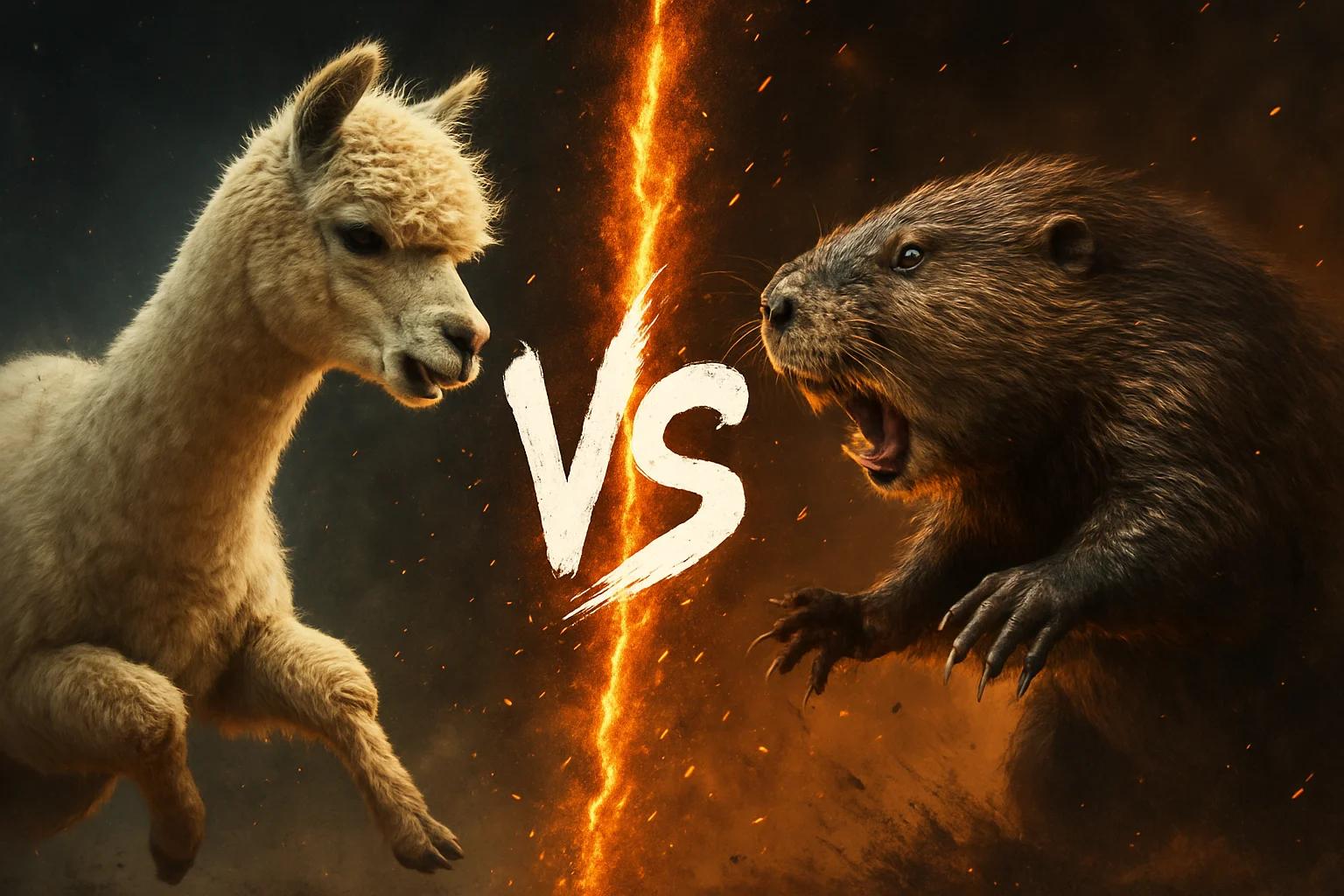
Alpaca vs North American Beaver: Who Actually Wins?
The alpaca wins most realistic matchups, and the reason is mass and reach. An adult alpaca weighs roughly 48–84 kg and stands about 0.9 m at the shoulder. A large North American beaver weighs about 11–32 kg and stays low to the ground. On open land, the alpaca can chest-ram, stomp, and kick from above, and intact males carry sharp 'fighting teeth' built for herd disputes. The beaver brings the most dangerous single weapon in the matchup: self-sharpening, iron-reinforced orange incisors that can slice through hardwood and cause deep wounds. But the beaver is slow and awkward out of water, and it is built to escape rather than brawl. Once you move the contest into a pond, the result flips completely. Few matchups are this lopsided by terrain, but land is where the alpaca lives, and it is where most readers picture the encounter.
Read comparison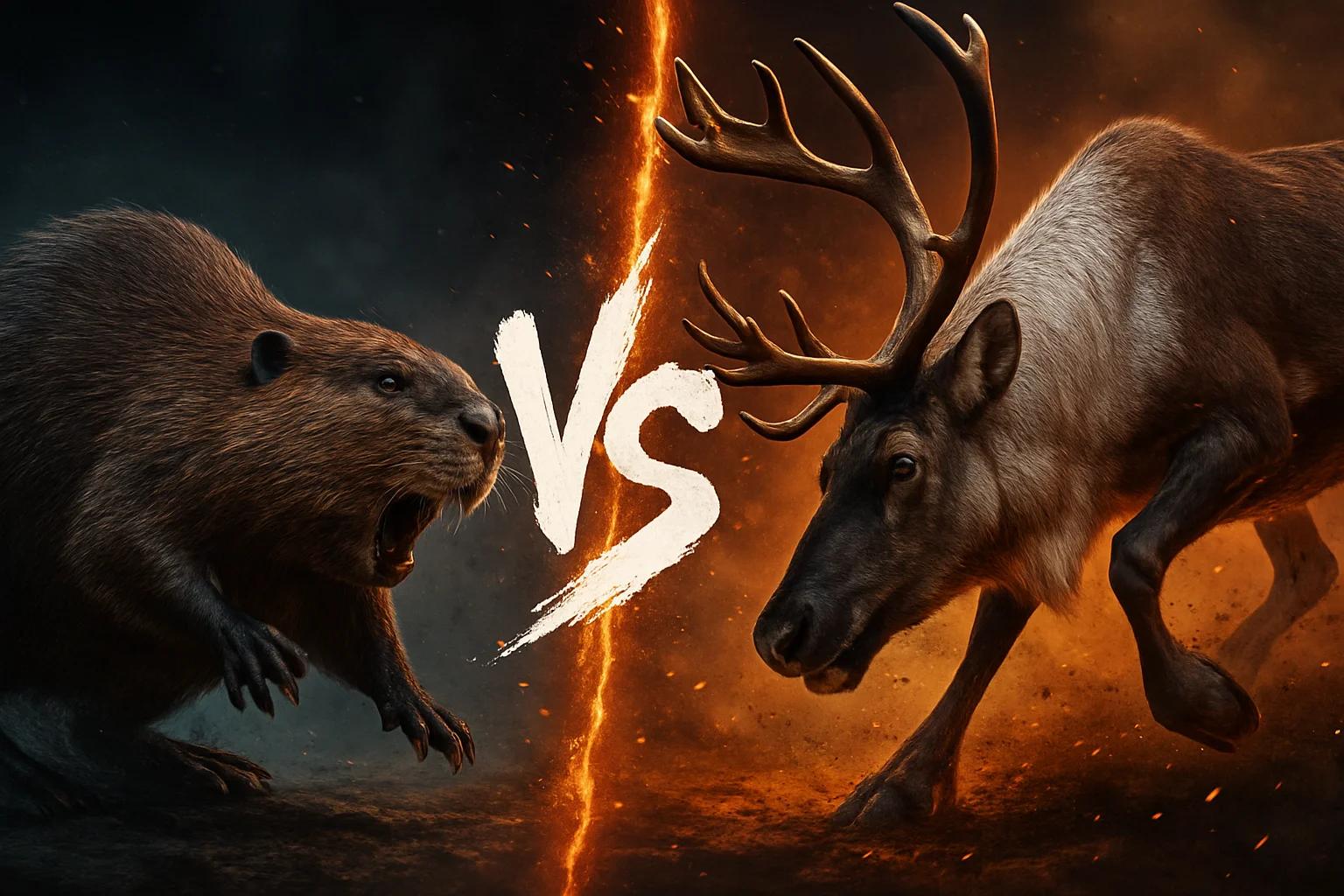
Beaver vs Reindeer: Who Actually Wins?
The reindeer wins this matchup clearly. An adult reindeer weighs roughly 80–180 kg against a beaver's 15–30 kg, stands far taller, and carries antlers built for shoving contests plus sharp-edged hooves that strike hard and fast. Both sexes can grow antlers, which is unusual among deer. On open ground the reindeer's mass, reach and speed of around 60–80 km/h in bursts leave the beaver with no workable angle. The beaver's chisel incisors are genuinely dangerous and can open deep wounds. But a beaver's real defense is not fighting. It is water, and on land it is a slow, low-slung rodent facing an animal five to ten times its weight. Only at the pond's edge, where the beaver simply dives and vanishes, does the reindeer's advantage stop mattering.
Read comparison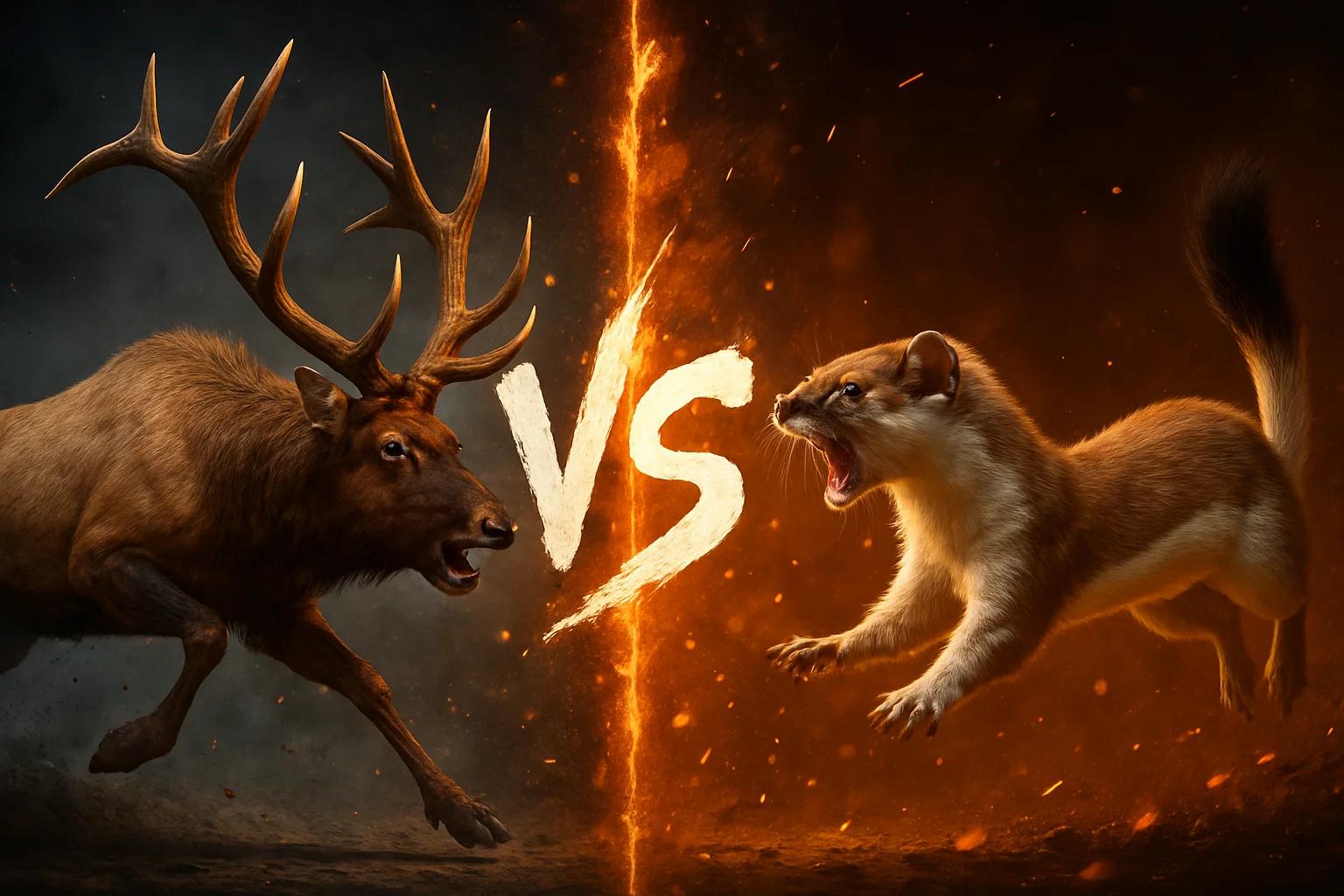
Elk vs Stoat: Who Actually Wins?
The elk wins, and it is not close. A bull elk can weigh 300 to 450 kg against a stoat's roughly 100 to 350 grams, a mass gap of more than a thousand to one. Antlers, sharp front hooves, and a body built to absorb blows from rival bulls give the elk overwhelming offense and durability. The stoat is a superb small-mammal killer, finishing rabbits several times its own weight with a precise bite to the back of the skull. That technique depends on reaching vital points on prey whose anatomy it can actually overpower, and an elk's neck, hide, and skull are far beyond its jaws. The realistic outcome is that the elk ignores, stomps, or drives off the stoat, while the stoat's best result is escaping unharmed.
Read comparison
Discussion
What do you think?
Share your reasoning with other readers. Be civil and stick to the animals.
Sign in to join the discussion.
Sign inNo comments yet. Start the conversation.