

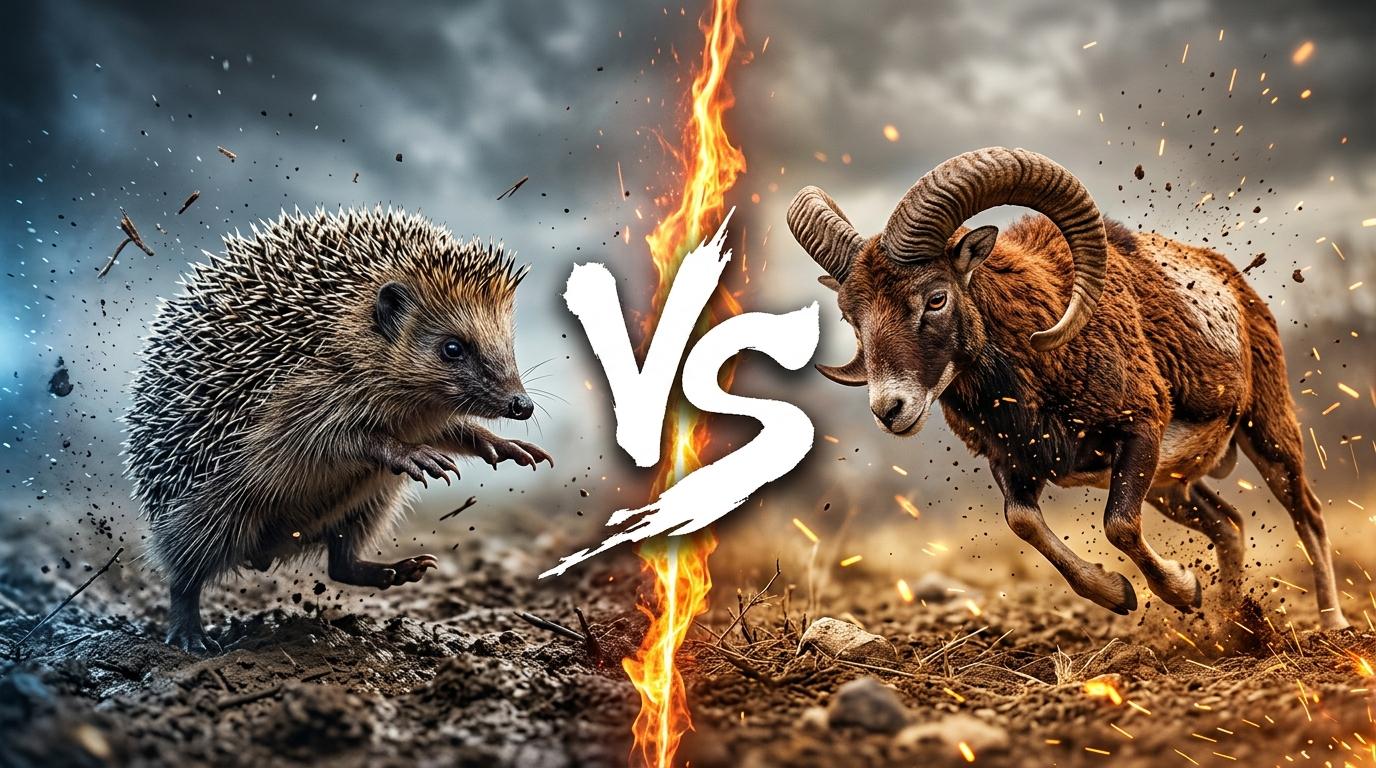
European Hedgehog vs Mouflon: Who Actually Wins?
European hedgehog vs mouflon: a spiny one-kilogram insectivore against a horned wild sheep up to fifty times its weight. A biology-first breakdown of who wins, who controls the ground, and why the hedgehog is never a free target.
European Hedgehog vs Mouflon
Matchup winner
Mouflon
Quick verdict
Start with the direct answer, then use the structured comparison below to see what changes the outcome.
The mouflon wins, and it isn't close on the main question: who controls the encounter? An adult mouflon weighs roughly 25–55 kg against a European hedgehog's 0.6–1.2 kg. Rams carry heavy spiralled horns built for head-on clashes, and every mouflon stands on sharp, hard hooves on legs made for fast, sure-footed travel over rough ground. The hedgehog has no way to drive off, outrun or injure a sheep enough to change its behaviour. Its whole strategy is to roll into a tight ball of about 5,000–7,000 spines and wait for the threat to lose interest. That makes the hedgehog very hard to finish and unpleasant to touch, but it is a stall, not a win. The mouflon can stamp, butt, shove the ball aside or simply hold the patch of grazing. In any realistic contest over space, the sheep decides what happens, while the hedgehog only decides how much it costs to get there.
Read the full explanation
Mouflon wins: it is roughly 30–50x heavier, with horns and hard hooves.
The hedgehog cannot meaningfully hurt or chase off a mouflon. It can only armour up and outlast.
Spines make the hedgehog a painful, low-reward target, so many real encounters end with the mouflon just walking away.
In dense hedgerow cover at night, the hedgehog can stay safely out of reach, but that is survival, not victory.
Reader vote
Who do you think wins?
Pick a side — no account needed. Results update live.
No votes yet — be the first to call it.
Editorial note
Why people disagree
'Can't be beaten' gets confused with 'wins.' A rolled hedgehog is famously hard to crack, but the mouflon still owns the ground.
Explosive power
Only the mouflon can put real force into an opponent. Rams are built to absorb and deliver horn-to-horn clashes.
Mass advantage
A gap this large means the mouflon can shove, pin or stamp without ever needing technique.
Passive armour
This is the hedgehog's one elite trait. It turns every contact into a cost for the attacker.
Read the full explanation +
Mouflon are herbivores with no reason to kill a hedgehog. Some readers count 'the sheep loses interest' as a hedgehog victory.
Hooves are underrated. People picture horns, but a stamping hoof is the more realistic threat to a small curled animal.
Comparison FAQ
Short, direct answers to the next questions readers usually ask after the headline verdict.
Who would win, a hedgehog or a mouflon?+
The mouflon. It is dozens of times heavier, with horns and hooves the hedgehog cannot counter. The hedgehog can only curl up and wait.
Which is stronger, a hedgehog or a mouflon?+
The mouflon, by a huge margin. The hedgehog is strong for its size, especially in the muscles it uses to roll up, but it has nowhere near the absolute force of a wild sheep.
Could a mouflon kill a hedgehog?+
Repeated stamping could injure or kill one, but mouflon are herbivores and have no reason to try. Most real encounters end with the sheep ignoring it or moving on.
Why is the hedgehog still dangerous to a mouflon?+
Its spines can jab a sensitive muzzle, lips or nose. That makes investigating a curled hedgehog painful, which is usually enough to stop any further contact.
Is there any scenario where the hedgehog wins?+
In dense cover it can stay completely out of reach and come through untouched. That counts as a survival win, but not as control of the encounter.
Head-to-head species stats
These are the same core AnimalDex stat dimensions used on the dedicated animal pages, pulled side by side so the matchup is faster to scan.
European Hedgehog
Tier CMouflon
Tier CTrait-by-trait comparison
Only the categories that matter to this matchup are included. The goal is not filler stats, but the real design differences that change the result.
Short scurries and a quick defensive curl
Explosive power
Mouflon
Horned head-butts and fast bursts on rough ground
Explosive power
Mouflon
About 1 kg
Mass advantage
Mouflon
About 25–55 kg
Mass advantage
Mouflon
Thousands of keratin spines plus a muscular roll-up
Passive armour
European Hedgehog
Thick coat and horn base, no dedicated armour
Passive armour
European Hedgehog
Slow, low-endurance walker
Escape mobility
Mouflon
Fast, agile mountain-slope runner
Escape mobility
Mouflon
Slips into hedges, leaf litter and burrow-like nests
Cover exploitation
European Hedgehog
Prefers open slopes and needs visibility
Cover exploitation
European Hedgehog
Curl first, check later
Threat assessment
Mouflon
Herd vigilance, quick to spot and judge intruders
Threat assessment
Mouflon
How the verdict forms
Verdict timeline
01 · Explosive power
Mouflon
02 · Mass advantage
Mouflon
03 · Passive armour
European Hedgehog
04 · Escape mobility
Mouflon
05 · Cover exploitation
European Hedgehog
06 · Threat assessment
Mouflon
Change the conditions
Scenario breakdown
This is where shallow battle content usually fails. Terrain, spacing, timing, and engagement style can change the answer.
Scenario lean
Mouflon
Verdict confidence
82%
Mouflon controls everything.
On open grassland there is nowhere for the hedgehog to hide. The mouflon can approach, nudge, stamp or shove the curled ball from a position of total mobility. Spines punish a careless muzzle, but hooves and horns don't need to grip anything. The hedgehog's best case is being left alone.
AnimalDex field profiles
Explore these animals
European Hedgehog
Erinaceus europaeus
Gardens, hedgerows, woodland edge, grassland, and suburban green spaces.
Mouflon
Ovis gmelini musimon
rocky grassland, mountain scrub, and Mediterranean slope
Systems Intelligence & Hidden Purpose
See the animals behind this comparison as engineered biological systems: what each one is built to do, where it gains leverage, and why the matchup changes by scenario.
Specialized Hardware
Back covered in short stiff spines, pointed snout and tiny eyes, and low waddling walk at night give the European Hedgehog a body plan tuned for its niche.
Systems Script
European Hedgehogs operate in gardens, hedgerows, woodland edge, grassland, and suburban green spaces. Their design helps them match food access, shelter, and timing inside that environment.
Strategic Insight
Compact protection can create safety without needing size.
Specialized Hardware
heavy curling horns, stocky hill-grazing body, and rocky slope flocking give the Mouflon a body plan tuned for its niche.
Systems Script
Mouflons operate through rocky grassland, mountain scrub, and Mediterranean slope. Their design links movement, feeding, shelter, and timing into one workable survival system.
Strategic Insight
In steep terrain, balance and route control matter more than brute force.
Final take
The mouflon is the clear winner. It brings mass, mobility, horns and hooves, while the hedgehog brings a single brilliant defensive trick. In any contest decided by who controls space, the sheep wins.
Read the full explanation
Still, the hedgehog's armour explains why it has survived next to far larger animals for millions of years. It doesn't need to win fights. It only needs to make itself not worth the effort. Against a herbivore with no reason to press the attack, that strategy often works in practice, even though it loses on paper.
Collect both animals in AnimalDex
Track the species behind this matchup, compare their real traits, and build the rivalry into your AnimalDex collection.
Related comparisons
Continue with nearby matchups to compare more real-world animal traits without dropping into junky who-wins filler.

Chamois vs Mouflon: Who Actually Wins?
The mouflon wins a straight fight more often than not. The two are close in body weight, with adult males of both species commonly in the 30–55 kg range, so the result comes down to weapon design. The mouflon ram is a dedicated collision specialist. Heavy spiral horns, a reinforced skull and a thick neck let it absorb repeated head-on impacts and drive through an opponent's center line. The chamois carries short, backward-hooked horns built for raking and hooking an opponent's flank or belly. That weapon can wound badly, but it needs space, angle and timing to land. In a close-quarters exchange, the mouflon's frontal armor and shoving mass usually take that time away. The chamois holds a real edge in speed, agility and steep terrain. On a cliff face the matchup flips, which is why this isn't a blowout. On neutral ground the ram's battering-ram build is the deciding trait.
Read comparison
Eurasian Lynx vs Mouflon: Who Actually Wins?
The Eurasian lynx wins this matchup, and not by accident: mouflon are on the lynx's actual menu. Lynx regularly kill roe deer, chamois, and young ungulates of similar or larger size, and wild sheep are well within that range. A 18–30 kg lynx built for stalking cover, explosive short bursts, and a precise throat bite meets a 25–50 kg mountain sheep whose defenses are vigilance, sure-footed escape, and horns evolved mainly for ramming rivals head-on, not for fending off a cat clamped to its neck. If the lynx closes the gap unseen, the contest is usually over in seconds. The mouflon's real wins come from detection and terrain: spot the cat early on open rock, and it simply leaves. A mature ram can also punish a sloppy frontal approach.
Read comparison
Discussion
What do you think?
Share your reasoning with other readers. Be civil and stick to the animals.
Sign in to join the discussion.
Sign inNo comments yet. Start the conversation.