

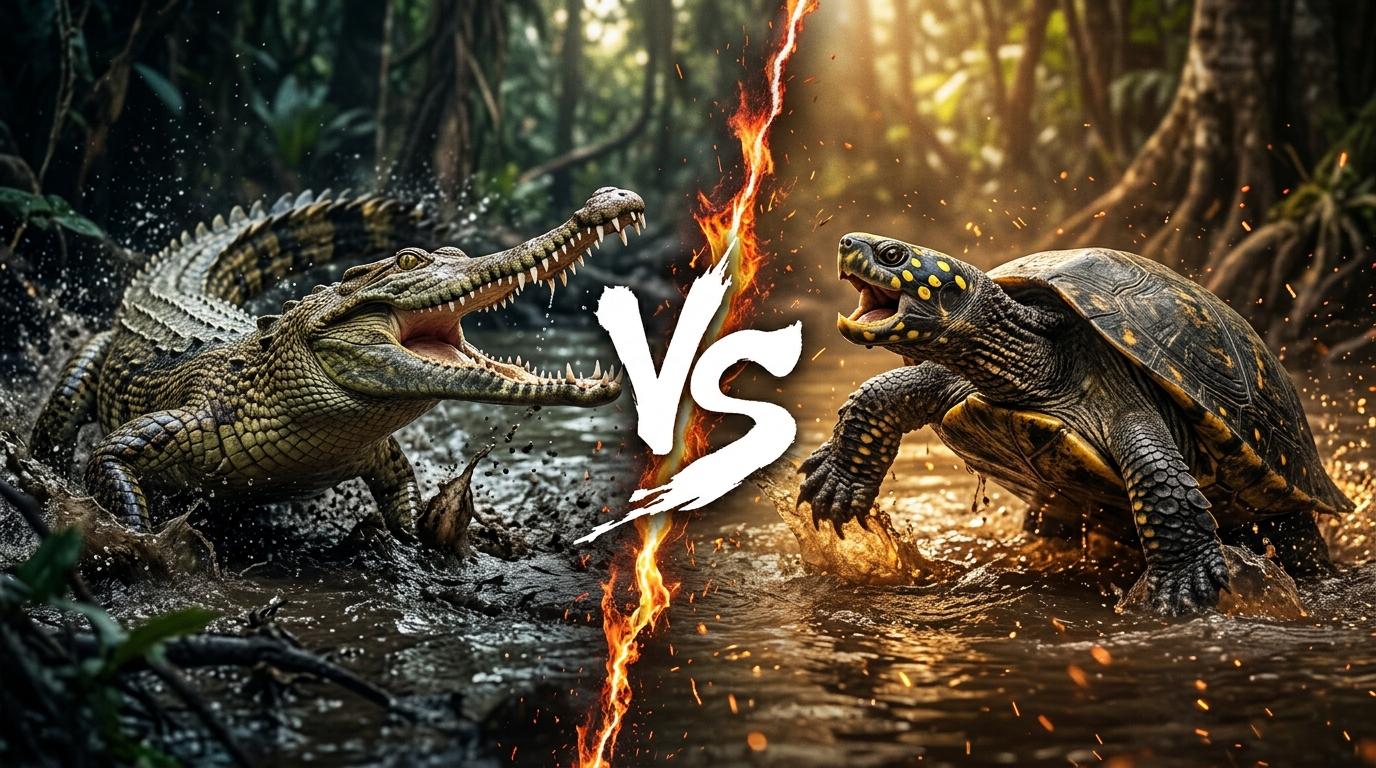
False Gharial vs Yellow-spotted River Turtle: Who Actually Wins?
False gharial vs yellow-spotted river turtle: a biology-first look at size, bite, armor, and habitat. See why the Southeast Asian crocodilian is the clear winner, and why the shell still matters.
False Gharial vs Yellow-spotted River Turtle
Matchup winner
False Gharial
Quick verdict
Start with the direct answer, then use the structured comparison below to see what changes the outcome.
The false gharial wins clearly. An adult Tomistoma typically reaches 3 to 4 meters, sometimes more, and can weigh well over 100 kg. A yellow-spotted river turtle carries a carapace of roughly 35 to 45 cm and weighs under 10 kg. The gharial's slender snout is built for fast sideways snaps at fish rather than shell-crushing, so this is not an instant kill. The turtle's armor and ability to withdraw its head sideways buy it real time. Still, mass, reach, a toothed grip, death-roll torque, and aquatic patience all belong to the crocodilian. The turtle's best outcome is surviving a grab or escaping, not winning.
Read the full explanation
Winner: False Gharial. It has roughly 10 to 20 times the body mass, plus long jaws and full crocodilian strength in water.
The turtle's shell is a genuine defense. The gharial's narrow, fish-adapted snout struggles to crack a big adult carapace quickly.
The turtle 'wins' only by escaping: slipping into murky water, wedging under cover, or being too awkward to bother with.
In real ecology they never meet. The false gharial lives in Southeast Asia and Podocnemis unifilis in South America, so this is a hypothetical.
Reader vote
Who do you think wins?
Pick a side — no account needed. Results update live.
No votes yet — be the first to call it.
Editorial note
Why people disagree
Shell mythology: some readers assume armor equals invincibility. Others assume any crocodilian bite crushes anything. The truth sits in between because the false gharial's snout is a fishing tool, not a nutcracker.
Size and mass advantage
An order-of-magnitude mass gap means the gharial dictates position, depth, and momentum throughout the encounter.
Strike reach and jaw speed
The gharial can seize the turtle before the turtle can do anything meaningful in return.
Shell-cracking ability
This is the turtle's one real edge. A narrow snout makes it slow to break a hard carapace, which drags the fight out.
Read the full explanation +
'Winning' vs 'surviving': the turtle can plausibly survive an encounter, which some count as a moral victory. A battle page judges control, and the gharial holds it.
Snout shape confusion: people lump the false gharial with true gharials as harmless fish-eaters. Tomistoma has a broader diet and has taken larger vertebrates, so it is more capable than its delicate look suggests.
Comparison FAQ
Short, direct answers to the next questions readers usually ask after the headline verdict.
Would a false gharial beat a yellow-spotted river turtle?+
Yes. The false gharial would win in nearly every realistic fight thanks to its massive size advantage, long jaws, and aquatic power. The turtle's best outcome is escape.
Which is stronger, the false gharial or the yellow-spotted river turtle?+
The false gharial, by a wide margin. It outweighs the turtle many times over, and its body, tail, and neck muscles generate far more force.
Can a false gharial crack a turtle shell?+
Not easily. Its slim, fish-adapted snout is less suited to crushing than the broad jaws of crocodiles that eat turtles regularly. It can still damage limbs, the head, or a smaller turtle's shell, and prolonged shaking can overcome a large one.
Why is the yellow-spotted river turtle still dangerous to underestimate?+
Its hard carapace and plastron resist bites, it tucks its head sideways under the shell, and it is quick to dive or wedge into cover. That combination makes it a costly, slow target, and the predator spends energy for no reward if the turtle gets away.
Do false gharials and yellow-spotted river turtles live together?+
No. The false gharial lives in Southeast Asian swamp rivers in Malaysia, Indonesia, and Brunei. The yellow-spotted river turtle lives in Amazon and Orinoco basin rivers in South America.
Head-to-head species stats
These are the same core AnimalDex stat dimensions used on the dedicated animal pages, pulled side by side so the matchup is faster to scan.
False Gharial
Tier AYellow-spotted River Turtle
Tier BTrait-by-trait comparison
Only the categories that matter to this matchup are included. The goal is not filler stats, but the real design differences that change the result.
3–4+ m, often 100+ kg
Size and mass advantage
False Gharial
Shell ~35–45 cm, under 10 kg
Size and mass advantage
False Gharial
Long, fast sideways snout sweep
Strike reach and jaw speed
False Gharial
Short neck, slow bite
Strike reach and jaw speed
False Gharial
Narrow snout, built more for grip than crushing
Shell-cracking ability
Yellow-spotted River Turtle
N/A, defensive only
Shell-cracking ability
Yellow-spotted River Turtle
Osteoderm-studded hide
Close-range durability
Yellow-spotted River Turtle
Domed bony carapace and plastron, side-neck tuck
Close-range durability
Yellow-spotted River Turtle
Powerful tail drive, death roll, long breath-holds
Aquatic control
False Gharial
Competent swimmer, can rest on the bottom
Aquatic control
False Gharial
Ambush-oriented, less agile in tight spaces
Evasion and concealment
Yellow-spotted River Turtle
Small profile, can dive, wedge, or bask-drop
Evasion and concealment
Yellow-spotted River Turtle
How the verdict forms
Verdict timeline
01 · Size and mass advantage
False Gharial
02 · Strike reach and jaw speed
False Gharial
03 · Shell-cracking ability
Yellow-spotted River Turtle
04 · Close-range durability
Yellow-spotted River Turtle
05 · Aquatic control
False Gharial
06 · Evasion and concealment
Yellow-spotted River Turtle
Change the conditions
Scenario breakdown
This is where shallow battle content usually fails. Terrain, spacing, timing, and engagement style can change the answer.
Scenario lean
False Gharial
Verdict confidence
82%
The gharial wins but works for it.
Cover favors the smaller animal, and the turtle can wedge among roots to deny a clean grip. The false gharial evolved to hunt among drowned vegetation in peat-swamp rivers, though. Its slender snout probes gaps and sweeps sideways. Once it secures a grip on a limb or shell edge, it drags the turtle into open water, and the cover advantage disappears.
AnimalDex field profiles
Explore these animals
False Gharial
Tomistoma schlegelii
swamp forest, peatland river, and flooded lowland wetland
Yellow-spotted River Turtle
Podocnemis unifilis
large river, oxbow lake, and flooded forest
Systems Intelligence & Hidden Purpose
See the animals behind this comparison as engineered biological systems: what each one is built to do, where it gains leverage, and why the matchup changes by scenario.
Specialized Hardware
long narrow fish-catching snout, river-specialist crocodilian body, and quiet blackwater ambush give the False Gharial a body plan tuned for its niche.
Systems Script
False Gharials operate through swamp forest, peatland river, and flooded lowland wetland. Their design links movement, feeding, shelter, and timing into one workable survival system.
Strategic Insight
Dense environments reward precision, patience, and the ability to read layered cover.
Specialized Hardware
yellow facial spotting, flat river-adapted shell, and sandbank nesting migrations give the Yellow-spotted River Turtle a body plan tuned for its niche.
Systems Script
Yellow-spotted River Turtles operate through large river, oxbow lake, and flooded forest. Their design links movement, feeding, shelter, and timing into one workable survival system.
Strategic Insight
Dense environments reward precision, patience, and the ability to read layered cover.
Final take
The false gharial is the clear winner. It is far larger, holds a long-reach toothed grip, and controls the water with rolls and tail power. The yellow-spotted river turtle has nothing to hurt it with.
Read the full explanation
The fight is still more interesting than a mismatch suggests. Tomistoma's narrow snout is engineered for fast-swimming prey, not armored ones. A healthy adult turtle in a closed shell is a slow, frustrating meal, and many real crocodilian–turtle encounters end with the turtle escaping.
In short, the gharial wins the battle, while the turtle's survival strategy of armor, alertness, and quick retreats wins enough individual encounters to keep its lineage going.
Collect both animals in AnimalDex
Track the species behind this matchup, compare their real traits, and build the rivalry into your AnimalDex collection.
Related comparisons
Continue with nearby matchups to compare more real-world animal traits without dropping into junky who-wins filler.
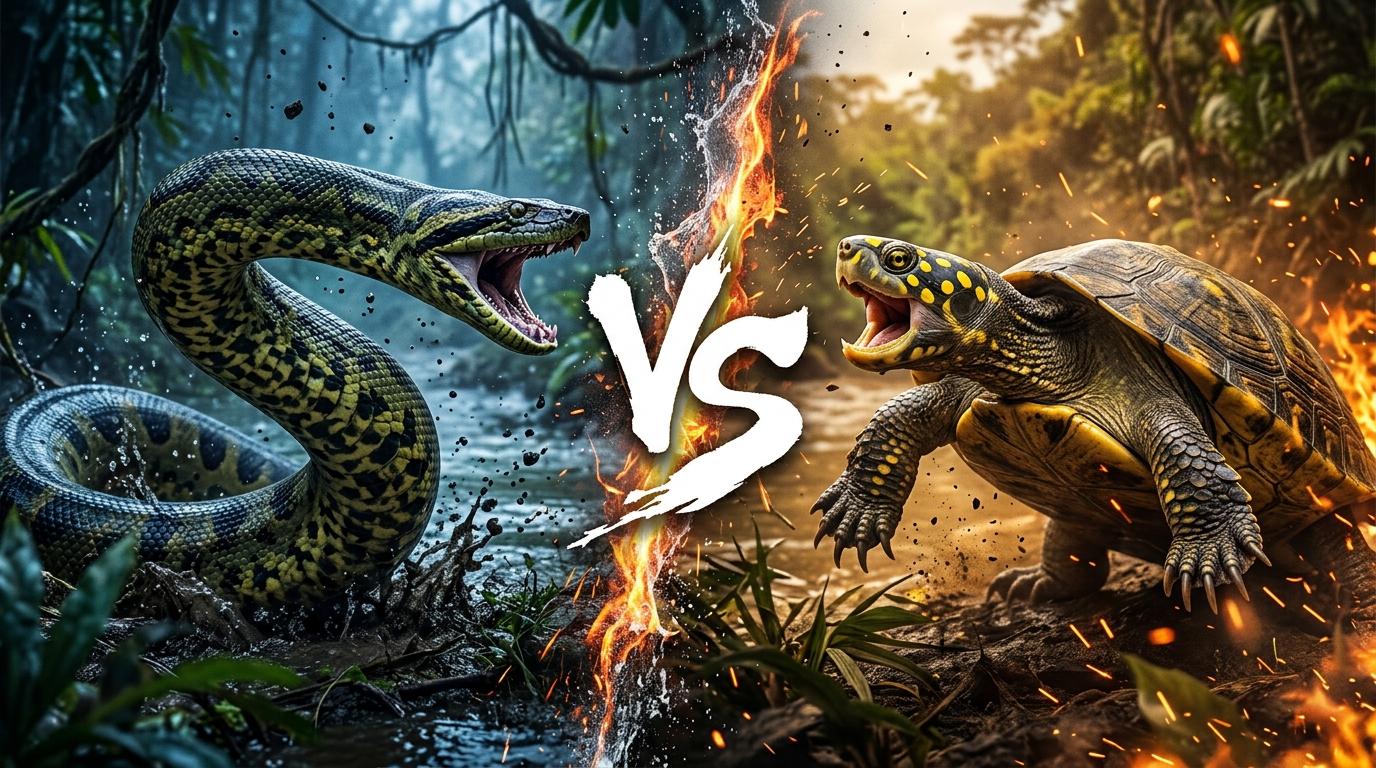
Green Anaconda vs Yellow-spotted River Turtle: Who Actually Wins?
The green anaconda wins, and it isn't especially close. The heaviest snake on Earth can exceed 5 m and 70+ kg of pure constricting muscle. The yellow-spotted river turtle is a mostly herbivorous side-necked turtle, with adult shells typically 30–45 cm and weights in the single-digit kilograms. Anacondas are ambush predators of Amazonian waterways that take caimans, capybaras, and turtles. The turtle's shell blocks crushing and biting but does nothing against being seized, wrapped, and swallowed whole. Its best weapons are a sharp-edged beak, quick retreat into murky water, and a hard-to-handle shape. Those can make a small anaconda give up, but against a big adult the size gap decides it.
Read comparison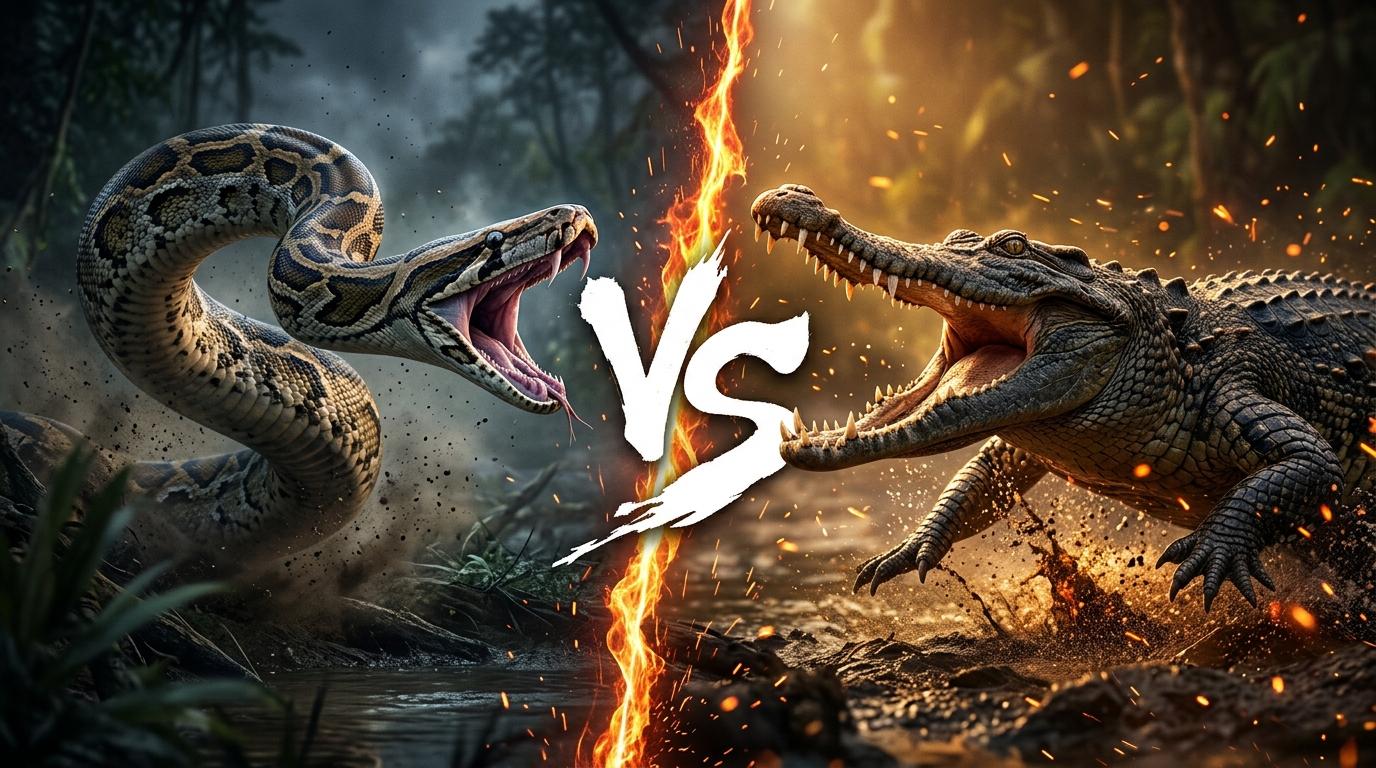
Burmese Python vs False Gharial: Who Actually Wins?
The false gharial wins most realistic encounters. A large Tomistoma can reach 4–5 m and well over 200 kg. Its bony osteoderm armor, death-roll torque and powerful tail all work against the Burmese python's main weapon, constriction. Constriction kills by shutting down blood circulation, and that works best on warm-blooded prey with soft ribcages. A crocodilian with a stiff, plated body and a slow, oxygen-tolerant metabolism resists it far better. The python's real chance is an ambush on land, where it secures the coils before the gharial can roll or reach water. That window is narrow. Near water, which is where a false gharial actually lives, the reptile with armor, a long bite and a home-field advantage takes the matchup.
Read comparison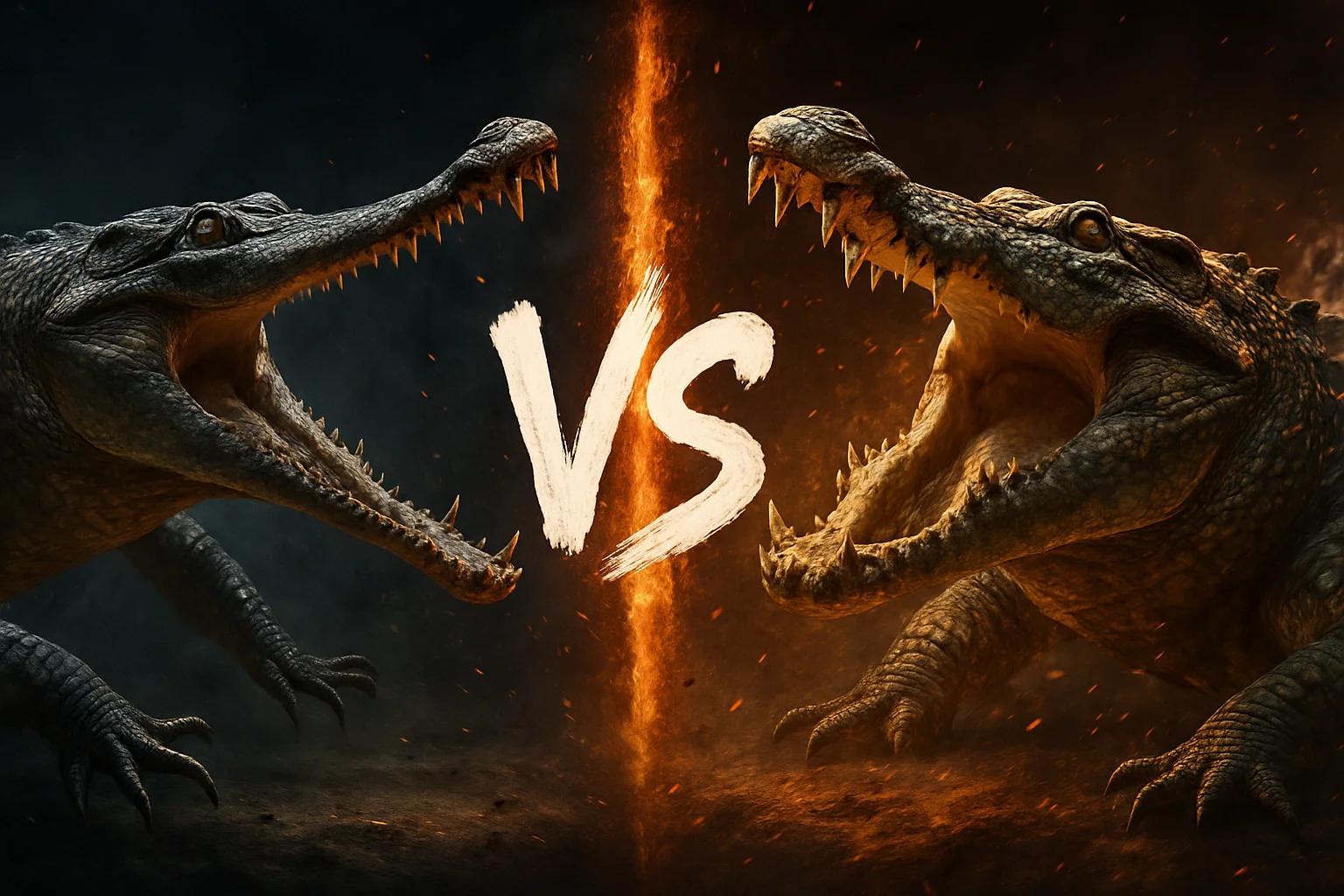
False Gharial vs Siamese Crocodile: Who Actually Wins?
The false gharial wins more often than not. A big male false gharial commonly reaches about 4 to 5 meters, and much of that length is a heavy, muscular body and tail rather than just snout. Most adult Siamese crocodiles run about 2.5 to 3.5 meters and carry less total mass. In deep, slow, tannin-dark water, where the false gharial lives, that extra length gives it real advantages. It has more reach, more momentum in a lunge, and more weight to drive an opponent under. The Siamese crocodile is not a pushover. Its broad, reinforced skull is better built for twisting, crushing, and close-quarters wrestling, and a smaller or mid-sized false gharial could lose to a determined adult. But between typical large adults, size and aquatic leverage give the false gharial the edge.
Read comparison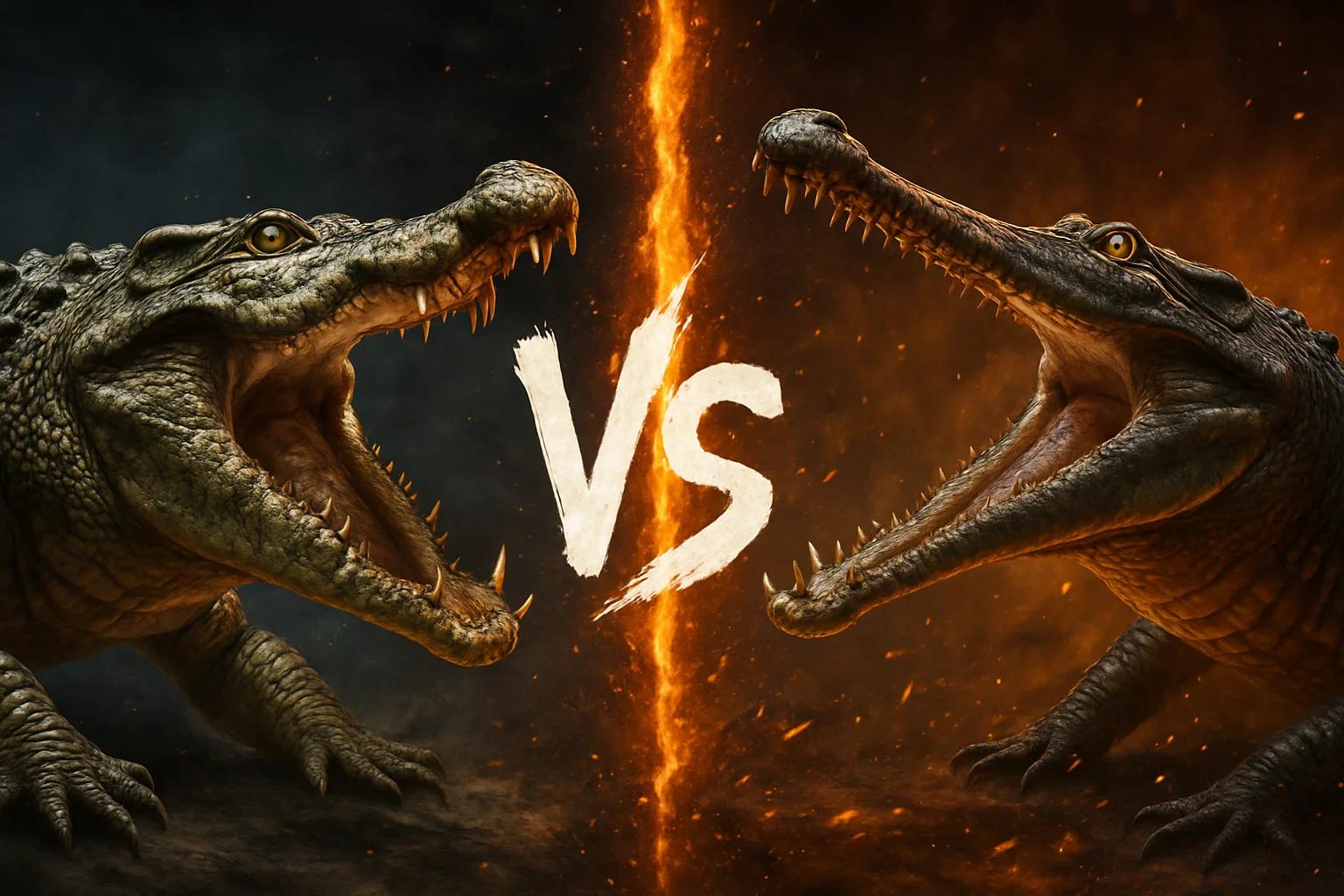
Cuban Crocodile vs False Gharial: Who Actually Wins?
The false gharial wins overall. This is a matchup between a compact, famously aggressive brawler and a much larger, long-bodied water specialist. The Cuban crocodile has the sturdier skull, a broad heavy snout built for crushing, and unusual agility on land, so it would be favored on dry ground. But crocodilian contests are decided mostly by mass, reach and how well each animal handles water. Adult male false gharials commonly reach 4–5 m and can roughly double the weight of a large Cuban crocodile, which typically tops out around 3–3.5 m. In deep, slow water, where both animals naturally fight, that extra length and weight lets the false gharial pin, roll and outlast a smaller opponent. The Cuban crocodile's attitude is real, but it is spending energy against a body that simply has more of everything.
Read comparison
Discussion
What do you think?
Share your reasoning with other readers. Be civil and stick to the animals.
Sign in to join the discussion.
Sign inNo comments yet. Start the conversation.