

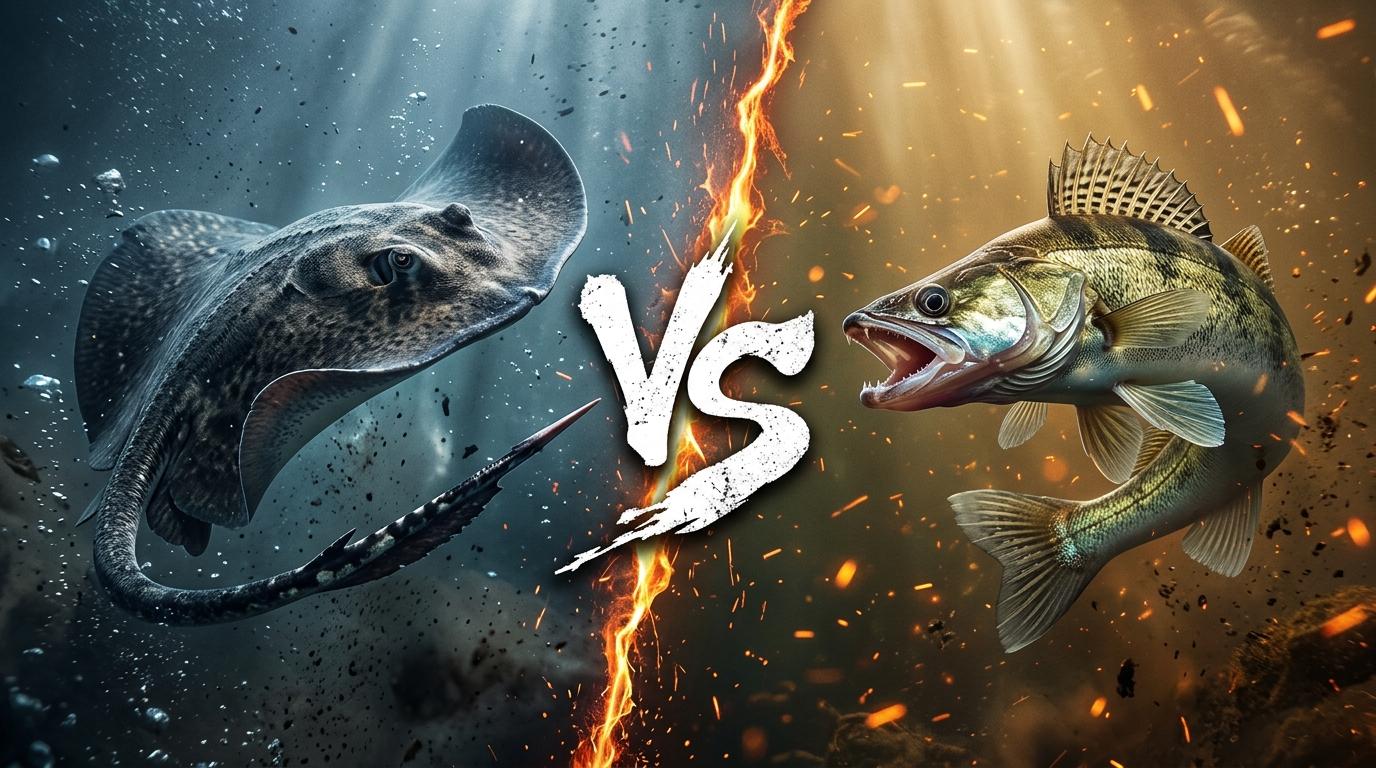
Giant Freshwater Stingray vs Zander: Who Actually Wins?
Giant freshwater stingray vs zander: a biology-first look at size, armor, venom and predatory skill, and why the Mekong's river giant wins this freshwater matchup.
Giant Freshwater Stingray vs Zander
Matchup winner
Giant Freshwater Stingray
Quick verdict
Start with the direct answer, then use the structured comparison below to see what changes the outcome.
The giant freshwater stingray wins, and it isn't close. Urogymnus polylepis is one of the largest freshwater fishes on Earth. Adults can span over 2 meters across the disc and weigh several hundred kilograms. A big zander tops out around 10–20 kg. The stingray has a broad, heavy body, a tough denticle-studded back, and a long serrated, venomous tail spine. All of that turns a zander's best weapon, a fast lunge with fang-like teeth meant for slim prey fish, into a bad gamble. The zander is the sharper hunter: it sees better in low light, coordinates better in murky water, and moves faster in short bursts. But it has no way to grip, swallow, or disable an animal many times its mass. The likely outcome is that the zander breaks off or gets pinned and punished, not a drawn-out fight.
Read the full explanation
Giant freshwater stingray wins: it outweighs the zander by roughly 10–30x.
Its venomous tail spine and armored disc give a zander nothing safe to bite.
The zander is the better active predator, but it is built for prey smaller than itself.
Zander's only real edge: speed and low-light vision let it avoid the fight entirely.
Reader vote
Who do you think wins?
Pick a side — no account needed. Results update live.
No votes yet — be the first to call it.
Editorial note
Why people disagree
Zander have a fierce reputation among anglers, and 'apex predator of the river' gets confused with 'can beat anything in the river.'
Sheer mass
In water, mass is momentum and stability. The zander can't move, flip, or pin something this heavy.
Burst strike speed
Speed lets the zander pick its moment, either to strike or, more realistically, to leave.
Close-range durability
The zander's needle teeth are made for gripping slippery fish, not for breaking through a giant ray's hide.
Read the full explanation +
Rays look passive and flat, so people underestimate how much power and weaponry sit in a giant ray's disc and tail.
Many readers have never seen the size gap: a trophy zander could lie across a large stingray's back with room to spare.
Comparison FAQ
Short, direct answers to the next questions readers usually ask after the headline verdict.
Would a giant freshwater stingray beat a zander?+
Yes. Its overwhelming size, tough skin, and venomous tail spine make it the clear winner in any direct contact.
Which is stronger, a giant freshwater stingray or a zander?+
The stingray, by a wide margin. It can be dozens of times heavier, and its muscular disc can pull back against heavy fishing tackle for hours.
Can a zander hurt a giant stingray?+
It might leave shallow bite marks, but its teeth are made for gripping slim fish, not for wounding a thick-skinned ray hundreds of kilograms in weight.
Why is the zander still dangerous?+
To prey its own size and smaller, it is very dangerous: fast, sharp-eyed in dim water, and armed with fang-like teeth. Its spiny dorsal fin also deters its own predators. It just isn't built to take on giants.
Do these two fish ever meet in the wild?+
No. Giant freshwater stingrays live in Southeast Asian rivers like the Mekong, while zander are native to Europe and western Asia. This is a hypothetical matchup.
Head-to-head species stats
These are the same core AnimalDex stat dimensions used on the dedicated animal pages, pulled side by side so the matchup is faster to scan.
Giant Freshwater Stingray
Tier AZander
Tier CTrait-by-trait comparison
Only the categories that matter to this matchup are included. The goal is not filler stats, but the real design differences that change the result.
Up to ~300 kg, disc over 2 m
Sheer mass
Giant Freshwater Stingray
Usually 2–10 kg, rarely ~20 kg
Sheer mass
Giant Freshwater Stingray
Powerful but deliberate disc thrusts
Burst strike speed
Zander
Explosive torpedo lunge
Burst strike speed
Zander
Thick skin with tough dorsal denticles
Close-range durability
Giant Freshwater Stingray
Scaled, slim, unarmored body
Close-range durability
Giant Freshwater Stingray
Long serrated venomous tail spine
Defensive weaponry
Giant Freshwater Stingray
Canine-like teeth, spiny dorsal fin
Defensive weaponry
Giant Freshwater Stingray
Electroreception and smell along the bottom
Low-light hunting senses
Zander
Light-reflecting tapetum, keen dusk vision
Low-light hunting senses
Zander
Can bury in sand and clamp down
Substrate control
Giant Freshwater Stingray
Midwater cruiser, little bottom leverage
Substrate control
Giant Freshwater Stingray
How the verdict forms
Verdict timeline
01 · Sheer mass
Giant Freshwater Stingray
02 · Burst strike speed
Zander
03 · Close-range durability
Giant Freshwater Stingray
04 · Defensive weaponry
Giant Freshwater Stingray
05 · Low-light hunting senses
Zander
06 · Substrate control
Giant Freshwater Stingray
Change the conditions
Scenario breakdown
This is where shallow battle content usually fails. Terrain, spacing, timing, and engagement style can change the answer.
Scenario lean
Giant Freshwater Stingray
Verdict confidence
82%
Stingray dominates on its home ground.
On sand or mud the ray's flat body sits close to the bottom, its back faces the attacker, and its tail is free to swing. A zander attacking from above meets only armored skin and a spine. Its lunge-and-grip style has nothing to work with.
AnimalDex field profiles
Explore these animals
Giant Freshwater Stingray
Urogymnus polylepis
large muddy river, estuary, and deep tropical freshwater channel
Zander
Sander lucioperca
river, reservoir, and deep freshwater lake habitat
Systems Intelligence & Hidden Purpose
See the animals behind this comparison as engineered biological systems: what each one is built to do, where it gains leverage, and why the matchup changes by scenario.
Specialized Hardware
huge river-floor disc body, long whip-like tail, and bottom-hugging camouflage give the Giant Freshwater Stingray a body plan tuned for its niche.
Systems Script
Giant Freshwater Stingrays operate through large muddy river, estuary, and deep tropical freshwater channel. Their design links movement, feeding, shelter, and timing into one workable survival system.
Strategic Insight
Where water controls movement, position and timing often matter more than speed.
Specialized Hardware
elongated predatory body, spiny dorsal fins, and dim-water ambush hunting give the Zander a body plan tuned for its niche.
Systems Script
Zanders operate through river, reservoir, and deep freshwater lake habitat. Their design links movement, feeding, shelter, and timing into one workable survival system.
Strategic Insight
Where water controls movement, position and timing often matter more than speed.
Final take
The giant freshwater stingray wins because the size gap in this matchup is huge. The zander is an excellent predator, but it is built to swallow fish smaller than itself, and the stingray is a heavy, armored, venomous animal that weighs as much as a large mammal.
Read the full explanation
The zander's real strengths are speed, low-light vision, and good judgment. In practice those keep it out of this fight rather than winning it. In the river, the smart outcome is the zander swimming away.
Collect both animals in AnimalDex
Track the species behind this matchup, compare their real traits, and build the rivalry into your AnimalDex collection.
Related comparisons
Continue with nearby matchups to compare more real-world animal traits without dropping into junky who-wins filler.

Giant Freshwater Stingray vs Yangtze Finless Porpoise: Who Actually Wins?
The Giant Freshwater Stingray wins. This is a mismatch of mass and weaponry. Urogymnus polylepis can reach 2 m across and is often estimated at 300 kg or more, though weights above roughly 300 kg rest on few verified specimens. It also carries a serrated, venom-coated tail spine up to 30–38 cm long that can puncture flesh and bone. The Yangtze finless porpoise is quick, highly intelligent and steers well with echolocation, but it tops out around 1.5–2 m long and only about 40–70 kg. It has no armor, no weapon beyond its jaws, and it must surface to breathe. In any frame where the two actually make contact, the ray's bulk, its habit of pinning itself to the bottom and its spine decide the result. The porpoise's realistic 'win' is refusing to engage at all, and refusing to fight is not the same as winning one.
Read comparison
Banded Archerfish vs Giant Freshwater Stingray: Who Actually Wins?
The Giant Freshwater Stingray wins, and it is not close. This river giant can reach about 2 meters across and weigh around 300 kg. It carries a serrated, venomous tail spine and lives on the bottom of big tropical rivers. The Banded Archerfish is usually about 15–25 cm long and weighs a few hundred grams. Its famous weapon is a precise jet of water that knocks insects off leaves above the surface. That makes it a brilliant hunter of tiny prey, but useless against a fish thousands of times heavier. The archerfish's real strengths are its eyes and its aim. The ray's strengths are mass, armor, sensing and a defensive weapon. In any real meeting, the ray controls the outcome. The archerfish's best result is to avoid notice entirely.
Read comparison
Common Carp vs Zander: Who Actually Wins?
The zander wins this matchup overall. It is a true piscivore. Its long canine fangs are built to seize fish, its tapetum-backed eyes let it hunt in murky and low-light water, and a fast-start pikeperch body lets it strike before prey reacts. The common carp is a bottom-sifting omnivore with no weapons beyond mass, tough scales, and stamina. That makes it extremely hard to finish, and a fully grown carp often outweighs any zander nearby. In a size-matched encounter, though, initiative belongs to the predator: the zander chooses when and how contact happens, and the carp can only absorb and flee. The carp's real edge is that big adults outgrow the zander's menu entirely.
Read comparison
Discussion
What do you think?
Share your reasoning with other readers. Be civil and stick to the animals.
Sign in to join the discussion.
Sign inNo comments yet. Start the conversation.