

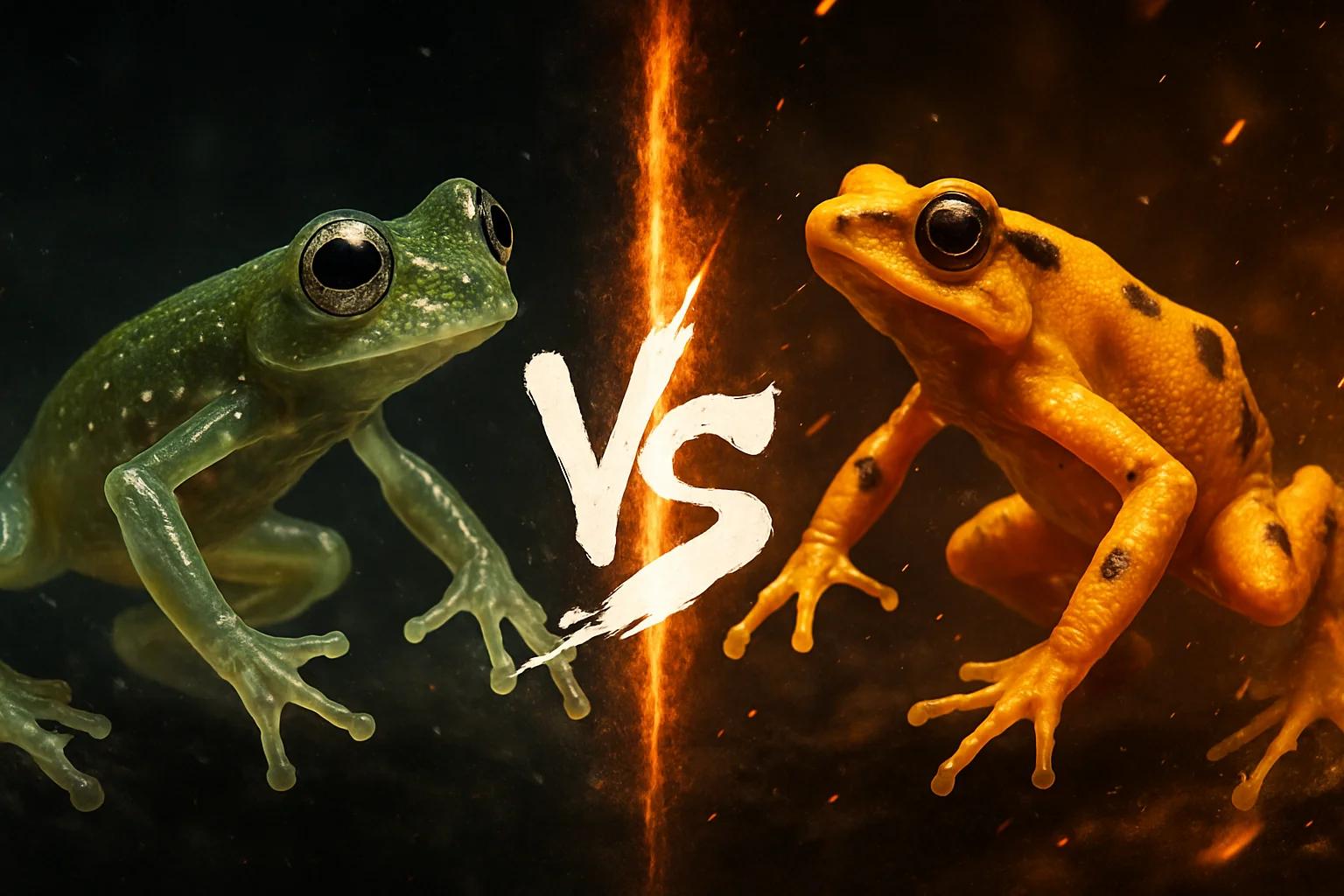
Glass Frog vs Panamanian Golden Frog: Who Actually Wins?
Glass frog vs Panamanian golden frog: a biology-first look at territorial wrestling, toxic defense, agility and habitat to decide who wins this rainforest frog matchup.
Glass Frog vs Panamanian Golden Frog
Matchup winner
Glass Frog
Quick verdict
Start with the direct answer, then use the structured comparison below to see what changes the outcome.
The glass frog wins this matchup on points. Neither frog is built to hurt the other, so the contest comes down to frog-on-frog dominance: shoving, clinging, out-positioning and holding a perch. Glass frogs have a real edge there. Many species have males that actively defend calling sites over streams, and some grapple hanging upside down from leaves. A few species even carry bony humeral spines on the upper arm used in those bouts. The Panamanian golden frog's famous weapon is skin toxin, including zetekitoxin, which works against predators that bite or swallow it. In a rival standoff where nobody is eating anybody, that toxin does little. The golden frog is a slow, deliberate, ground-and-rock walker, and the glass frog is a quicker, grippier leaf-and-branch climber. The glass frog takes control of the space and pushes the golden frog off the contested spot. The golden frog loses the shove but stays unbeatable as prey, which is why it wins only when the question becomes 'who survives being attacked?'
Read the full explanation
Overall winner: Glass Frog. Its quicker climbing and perch-defending behavior win a rival-style contest.
The golden frog's toxins are elite predator defense, but they don't win a wrestling bout.
Size is closer than many people assume, since golden frogs can match or exceed many glass frog species in length. Agility and grip decide this one more than mass does.
If the question is 'who could a predator safely eat?', the golden frog is far more dangerous.
Reader vote
Who do you think wins?
Pick a side — no account needed. Results update live.
No votes yet — be the first to call it.
Editorial note
Why people disagree
Toxicity feels like strength. People assume the poisonous frog automatically wins, but poison is a deterrent, not an attack.
Perch-grapple control
In a frog dispute, whoever holds the perch and keeps their grip wins, and glass frogs fight for exactly that.
Chemical deterrence
This makes the golden frog a nightmare for predators, but it barely matters in a non-biting rival contest.
Agility and repositioning
Mobility lets the glass frog choose angles and escape bad positions.
Read the full explanation +
Body size varies a lot across Centrolenidae. Some glass frogs are tiny, while golden frogs are relatively chunky, so who looks bigger depends on which glass frog you picture.
The golden frog's bold colors and arm-waving signals look confident. That reads as dominance to people, even though its strategy is to warn rivals off rather than engage them.
Comparison FAQ
Short, direct answers to the next questions readers usually ask after the headline verdict.
Would a glass frog beat a Panamanian golden frog in a fight?+
Usually yes. In a perch or territory contest, the glass frog's agility, grip and territorial wrestling habits give it the edge.
Which frog is stronger?+
The golden frog is often the bulkier frog and is hard to dislodge on flat ground. The glass frog is the more effective fighter because it uses grip and leverage well.
Isn't the golden frog's poison enough to win?+
Not in a rival contest. Its toxins deter animals that bite or swallow it, and frog dominance bouts rarely involve that kind of contact.
Why does the losing golden frog stay dangerous?+
Its skin toxins are among the most potent known in frogs. Any predator that ignores its warning colors risks serious poisoning, so the golden frog loses the shove but stays nearly untouchable as prey.
Do these frogs actually meet in the wild?+
Both live in Panamanian rainforest streams, so overlap is plausible. However, golden frogs are now critically endangered and possibly extinct in the wild.
Head-to-head species stats
These are the same core AnimalDex stat dimensions used on the dedicated animal pages, pulled side by side so the matchup is faster to scan.
Glass Frog
Tier CPanamanian Golden Frog
Tier ATrait-by-trait comparison
Only the categories that matter to this matchup are included. The goal is not filler stats, but the real design differences that change the result.
Leaf-hanging territorial wrestler
Perch-grapple control
Glass Frog
Ground-level clasp and wave signaler
Perch-grapple control
Glass Frog
Little to no notable toxin
Chemical deterrence
Panamanian Golden Frog
Potent skin toxins, aposematic gold
Chemical deterrence
Panamanian Golden Frog
Quick climber, sticky toe pads
Agility and repositioning
Glass Frog
Slow, deliberate walker
Agility and repositioning
Glass Frog
Mostly small, varies by species
Body mass
Panamanian Golden Frog
Compact, often comparable or larger
Body mass
Panamanian Golden Frog
Translucent belly, leaf camouflage
Concealment
Glass Frog
Built to be seen
Concealment
Glass Frog
How the verdict forms
Verdict timeline
01 · Perch-grapple control
Glass Frog
02 · Chemical deterrence
Panamanian Golden Frog
03 · Agility and repositioning
Glass Frog
04 · Body mass
Panamanian Golden Frog
05 · Concealment
Glass Frog
Change the conditions
Scenario breakdown
This is where shallow battle content usually fails. Terrain, spacing, timing, and engagement style can change the answer.
Scenario lean
Glass Frog
Verdict confidence
82%
Glass frog's home turf, a clear win.
Leaves overhanging streams are exactly where glass frog males call and defend sites. Toe pads and comfort working upside down let it pry and push a rival off the edge. The golden frog is out of its element on thin, swaying vegetation.
AnimalDex field profiles
Explore these animals
Glass Frog
Centrolenidae
Cloud forest and humid tropical stream corridors with clean flowing water.
Panamanian Golden Frog
Atelopus zeteki
cloud forest, spray zone, and mountain stream
Systems Intelligence & Hidden Purpose
See the animals behind this comparison as engineered biological systems: what each one is built to do, where it gains leverage, and why the matchup changes by scenario.
Specialized Hardware
Semi-transparent body tissues, underside leaf use, and streamside egg-guarding behavior make glass frogs stealth hardware for wet tropical margins.
Systems Script
Glass frogs tie forest leaves to stream reproduction, turning delicate microhabitats into viable nurseries. Their niche works because concealment and site choice reinforce each other.
Strategic Insight
When the environment is noisy, the cleanest strategy can be to remove obvious edges from your profile.
Specialized Hardware
bright yellow body, semaphore foot-waving signals, and fast mountain-stream life give the Panamanian Golden Frog a body plan tuned for its niche.
Systems Script
Panamanian Golden Frogs operate through cloud forest, spray zone, and mountain stream. Their design links movement, feeding, shelter, and timing into one workable survival system.
Strategic Insight
In steep terrain, balance and route control matter more than brute force.
Final take
The glass frog wins because this is a contest of position, and glass frogs are specialists at taking and holding position. Its climbing hardware and territorial behavior fit the actual mechanics of a frog-versus-frog dispute.
Read the full explanation
The Panamanian golden frog isn't weak. It simply plays a different game. Its gold skin is a contract with predators, saying 'eat me and regret it.' Against a rival that isn't trying to eat it, that contract never gets enforced.
Both frogs face a far bigger threat than each other. Chytrid fungus has devastated Atelopus, and the golden frog now survives largely through conservation breeding programs.
Collect both animals in AnimalDex
Track the species behind this matchup, compare their real traits, and build the rivalry into your AnimalDex collection.
Related comparisons
Continue with nearby matchups to compare more real-world animal traits without dropping into junky who-wins filler.
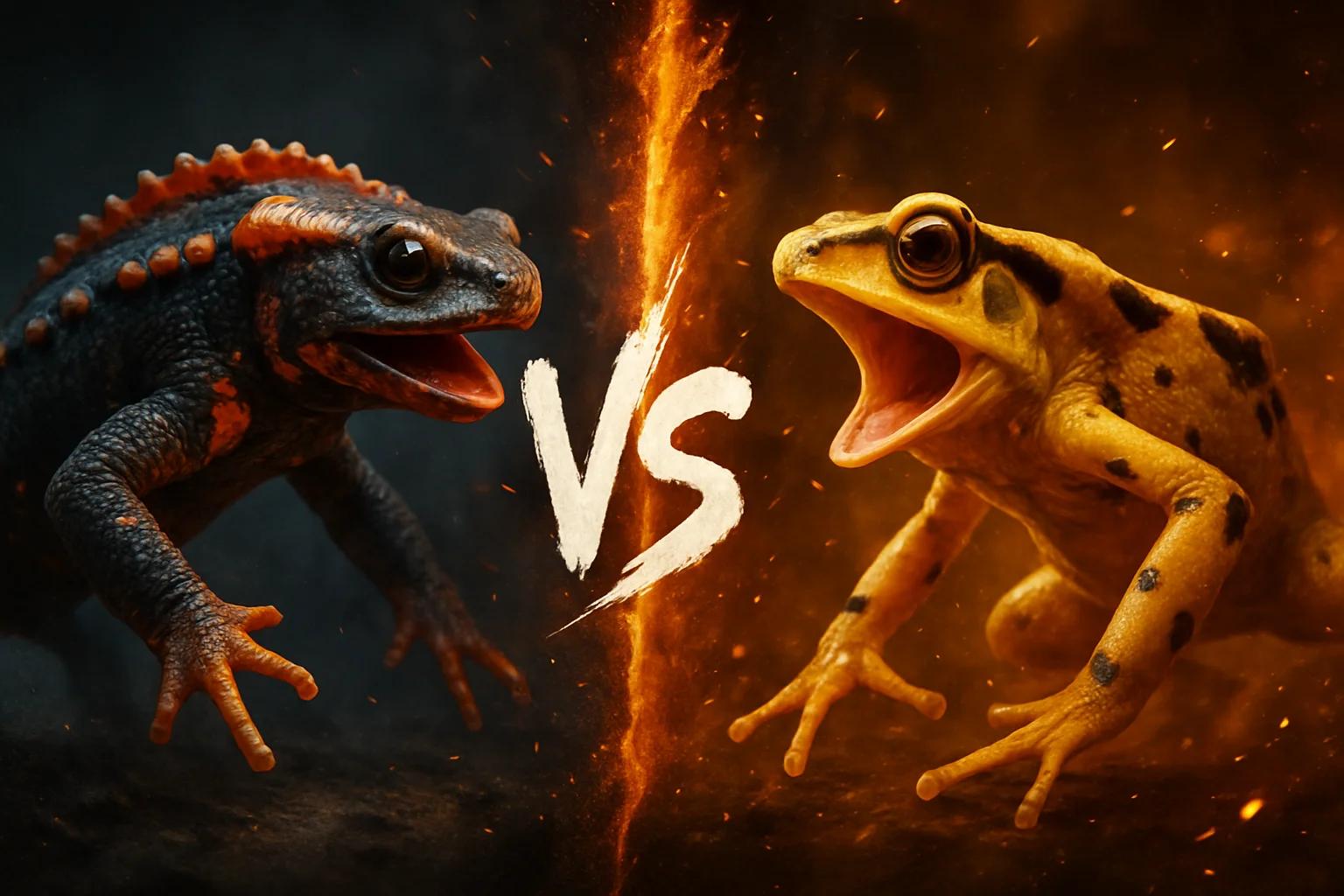
Emperor Newt vs Panamanian Golden Frog: Who Actually Wins?
The Emperor Newt wins. Neither animal is built to fight, but a clash between them comes down to mass, armor, and staying power, and the newt has all three. At roughly 15–17 cm long with a bony, warty skull ridge and rib tips that can press against poison glands along its flanks, Tylototriton shanjing outweighs a 3.5–6 cm Panamanian golden frog many times over. The golden frog's skin carries zetekitoxin and related compounds, and its bright yellow is an honest warning. But the newt is also chemically defended, its slow, deliberate body tolerates contact well, and a frog that size has no way to physically move it. The likely outcome is not a kill. The frog gives way, and the newt holds the space.
Read comparison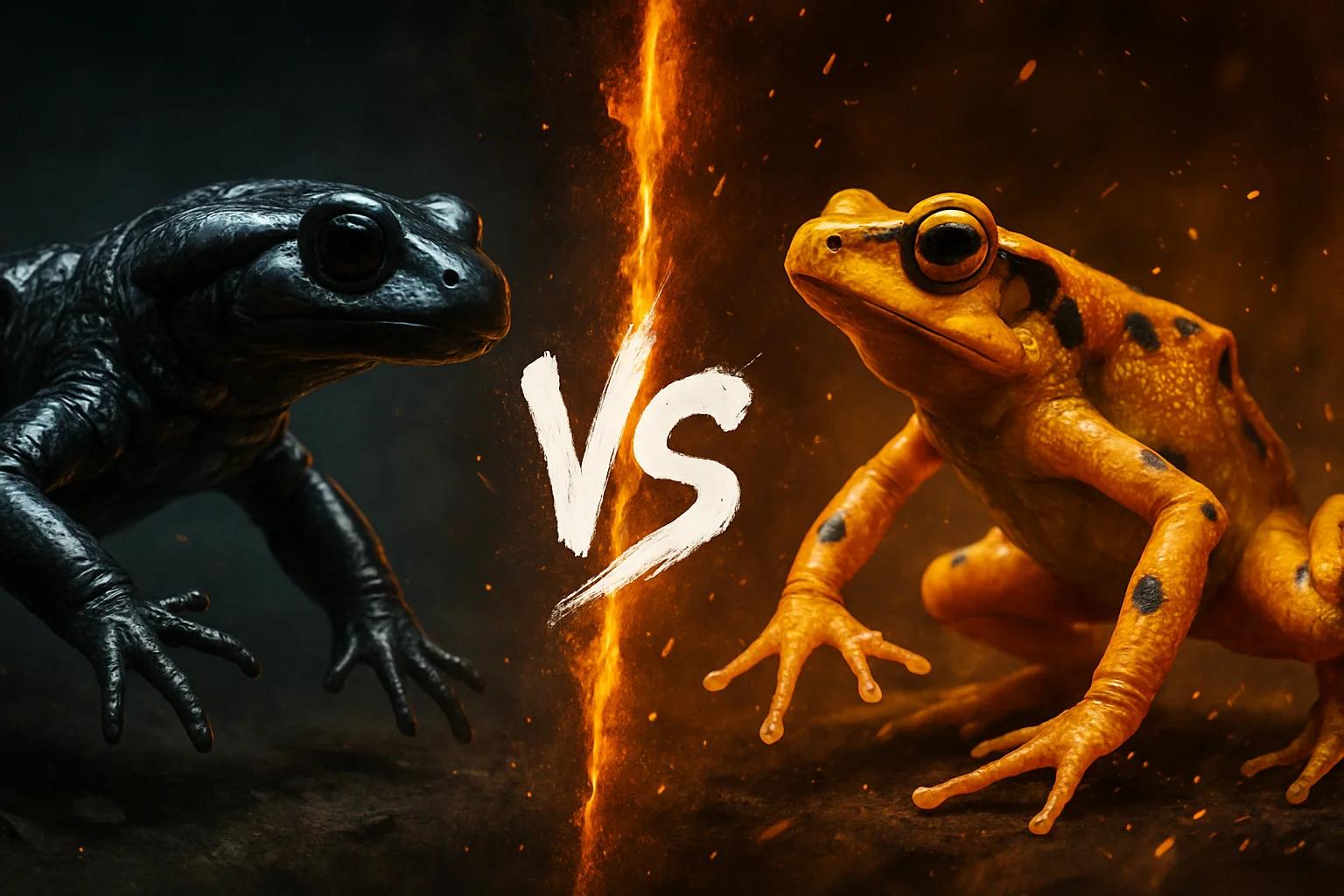
Alpine Salamander vs Panamanian Golden Frog: Who Actually Wins?
The Alpine Salamander wins this one, though not by a knockout. Both animals are small, slow, toxic amphibians built to discourage attackers rather than defeat them, so the real question is which defensive system holds up better at close range. The salamander's advantages decide it. It is roughly two to three times the frog's body length and several times its mass. It has a long, low, tough-skinned frame. Its parotoid glands are loaded with samandarine-type alkaloids that act as a dense chemical wall. The Panamanian Golden Frog carries zetekitoxin, one of the most potent amphibian toxins known, and advertises it with blazing yellow warning colors. But its toxin is purely a deterrent. It cannot push, pin, or outlast a heavier opponent. In a cool, damp encounter where neither side runs, the salamander's mass, grip and staying power tip the outcome. The frog remains far more dangerous to anything that bites it.
Read comparison
Discussion
What do you think?
Share your reasoning with other readers. Be civil and stick to the animals.
Sign in to join the discussion.
Sign inNo comments yet. Start the conversation.