

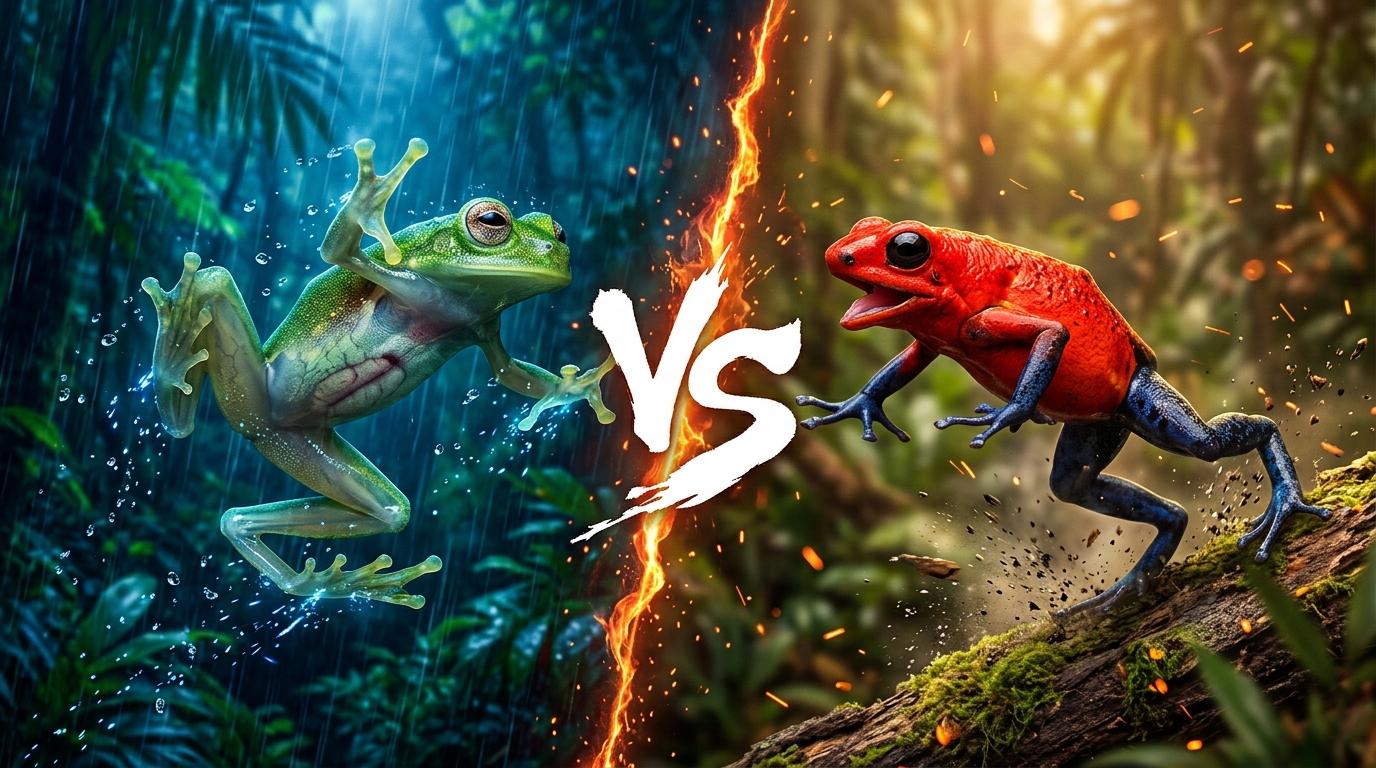
Glass Frog vs Strawberry Poison Dart Frog: Who Actually Wins?
Glass frog vs strawberry poison dart frog: a biology-first look at size, territorial wrestling, toxins, and habitat to find which tiny rainforest frog wins.
Glass Frog vs Strawberry Poison Dart Frog
Matchup winner
Glass Frog
Quick verdict
Start with the direct answer, then use the structured comparison below to see what changes the outcome.
The glass frog wins most realistic matchups, though this is a contest of shoving, not killing. Many glass frogs match or outsize the 2-centimeter strawberry poison dart frog, carry longer limbs, and grip with wide toe pads. In their home terrain of streamside leaves at night, they are far more mobile. Male glass frogs of several species defend calling perches by wrestling, sometimes while hanging upside down from foliage. That lets a glass frog pry a rival off a leaf and claim the space. The strawberry poison dart frog is a fierce little wrestler on the forest floor. Its skin alkaloids make it dangerous to eat, but they are passive. They deter predators and do nothing to win a pushing match against a frog that has no interest in eating it. Toxins protect the dart frog without beating the glass frog. Reach, grip, and three-dimensional movement decide the outcome.
Read the full explanation
Overall winner: Glass Frog, thanks to a size, limb, and climbing advantage in most encounters.
Neither frog can seriously injure the other. A 'win' means displacing a rival from a perch or patch.
The strawberry poison dart frog's toxins stop predators, not wrestling opponents.
On flat leaf litter in daylight, the dart frog's home-field aggression narrows the gap.
Reader vote
Who do you think wins?
Pick a side — no account needed. Results update live.
No votes yet — be the first to call it.
Editorial note
Why people disagree
Many people assume 'poisonous' means 'deadly fighter', but dart frog alkaloids are a defense against being eaten, not a weapon.
Body size and reach
In frog wrestling, a longer frame and limbs give leverage to pin or pry a rival off a surface.
Grip and vertical control
Whoever holds the surface better controls the fight, because losing grip means losing the perch.
Territorial aggression
The dart frog brings more daytime confrontational energy and will commit to a scrap quickly.
Read the full explanation +
The dart frog's bright red warning color and bold daytime behavior look dominant, while the glass frog's quiet transparency reads as weakness.
The two species rarely meet. One lives on leaves above streams at night, the other on the forest floor by day, so the answer depends heavily on where you stage the encounter.
Comparison FAQ
Short, direct answers to the next questions readers usually ask after the headline verdict.
Would a glass frog beat a strawberry poison dart frog in a fight?+
Usually, yes. In most realistic settings, especially on leaves or at night, the glass frog's size, reach, and grip let it out-wrestle and displace the dart frog. Neither is likely to injure the other.
Which frog is stronger, the glass frog or the strawberry poison dart frog?+
Most glass frog species are physically stronger in practical terms because they tend to be larger and longer-limbed. The dart frog is compact and scrappy but lacks leverage.
Can the poison dart frog's toxin hurt a glass frog?+
Only if the glass frog tried to eat it, which it wouldn't. The alkaloids sit passively in the skin. They are not injected and do not act as an attack weapon during wrestling.
Why is the strawberry poison dart frog still dangerous even if it loses?+
Its skin alkaloids, acquired from a diet of mites and ants, make it distasteful or toxic to many predators. Its bright colors warn them off. It is also highly territorial and will confront intruders on its ground territory.
Do glass frogs and strawberry poison dart frogs live in the same place?+
Their ranges overlap in parts of Central America, but they use the forest differently. Glass frogs live on vegetation over streams at night, while strawberry poison dart frogs live on the forest floor and low plants by day, so direct clashes are rare.
Is it safe to touch a strawberry poison dart frog?+
It's best not to. Its toxins are milder than those of the most dangerous dart frogs, but they can irritate mucous membranes or broken skin. Handling also stresses the frog.
Head-to-head species stats
These are the same core AnimalDex stat dimensions used on the dedicated animal pages, pulled side by side so the matchup is faster to scan.
Glass Frog
Tier CStrawberry Poison Dart Frog
Tier DTrait-by-trait comparison
Only the categories that matter to this matchup are included. The goal is not filler stats, but the real design differences that change the result.
Roughly 2–3 cm in many species, larger in some, with long slender limbs
Body size and reach
Glass Frog
About 1.7–2.4 cm, compact and short-limbed
Body size and reach
Glass Frog
Broad adhesive toe discs, at home on the undersides of leaves
Grip and vertical control
Glass Frog
Capable climber but mostly a leaf-litter and low-stem forager
Grip and vertical control
Glass Frog
Males defend calling sites and egg clutches, and some wrestle upside down
Territorial aggression
Strawberry Poison Dart Frog
Males defend ground territories vigorously and wrestle intruders head-to-head
Territorial aggression
Strawberry Poison Dart Frog
Essentially none; relies on concealment
Chemical defense
Strawberry Poison Dart Frog
Diet-derived skin alkaloids such as pumiliotoxins
Chemical defense
Strawberry Poison Dart Frog
Translucent skin, and while sleeping it can pack red blood cells into its liver to become more transparent
Concealment tech
Glass Frog
Aposematic red-and-blue warning colors that advertise rather than hide
Concealment tech
Glass Frog
Agile leaper between leaves and branches
Leap and escape mobility
Glass Frog
Short hops, deliberate ground movement
Leap and escape mobility
Glass Frog
How the verdict forms
Verdict timeline
01 · Body size and reach
Glass Frog
02 · Grip and vertical control
Glass Frog
03 · Territorial aggression
Strawberry Poison Dart Frog
04 · Chemical defense
Strawberry Poison Dart Frog
05 · Concealment tech
Glass Frog
06 · Leap and escape mobility
Glass Frog
Change the conditions
Scenario breakdown
This is where shallow battle content usually fails. Terrain, spacing, timing, and engagement style can change the answer.
Scenario lean
Glass Frog
Verdict confidence
82%
Glass frog, convincingly.
This is the glass frog's arena. Adhesive toe discs and long limbs let it hold the underside or edge of a leaf while working a rival loose. It already wrestles other males for these perches. The dart frog can climb but lacks the reach and the inverted-grip skill. It ends up dislodged and dropping to lower vegetation.
AnimalDex field profiles
Explore these animals
Glass Frog
Centrolenidae
Cloud forest and humid tropical stream corridors with clean flowing water.
Strawberry Poison Dart Frog
Oophaga pumilio
rainforest floor, leaf litter, and humid tropical understory
Systems Intelligence & Hidden Purpose
See the animals behind this comparison as engineered biological systems: what each one is built to do, where it gains leverage, and why the matchup changes by scenario.
Specialized Hardware
Semi-transparent body tissues, underside leaf use, and streamside egg-guarding behavior make glass frogs stealth hardware for wet tropical margins.
Systems Script
Glass frogs tie forest leaves to stream reproduction, turning delicate microhabitats into viable nurseries. Their niche works because concealment and site choice reinforce each other.
Strategic Insight
When the environment is noisy, the cleanest strategy can be to remove obvious edges from your profile.
Specialized Hardware
bright red or orange warning colors, tiny tropical body, and careful parental transport of tadpoles give the Strawberry Poison Dart Frog a body plan tuned for its niche.
Systems Script
Strawberry Poison Dart Frogs operate through rainforest floor, leaf litter, and humid tropical understory Their design links movement, shelter, and feeding into one workable survival system.
Strategic Insight
A system can invest heavily in a small number of vulnerable outcomes.
Final take
The Glass Frog takes this matchup. It is not more dangerous. It is better built for the only kind of 'fight' these frogs actually have: a contest of grip, leverage, and position. Longer limbs, sticky toe discs, and real experience wrestling rivals on leaves give it the edge in three of the four scenarios.
Read the full explanation
The Strawberry Poison Dart Frog is no pushover. It is one of the most combative small frogs in Central America, and its warning-colored skin carries alkaloids that make predators regret a bite. Those defenses answer the question 'who gets eaten?', not 'who holds the leaf?'. On its own sunlit patch of forest floor, its courage and home-turf aggression can still send a glass frog packing.
Collect both animals in AnimalDex
Track the species behind this matchup, compare their real traits, and build the rivalry into your AnimalDex collection.
Related comparisons
Continue with nearby matchups to compare more real-world animal traits without dropping into junky who-wins filler.
Poison Dart Frog vs Strawberry Poison Dart Frog: Who Actually Wins?
The Poison Dart Frog wins overall, with moderate confidence. There is a catch: 'poison dart frog' is the whole family Dendrobatidae, and the strawberry poison dart frog (Oophaga pumilio) is one member of it. So this matchup really pits the family's typical heavyweights against one small specialist. Frogs like the dyeing dart frog (Dendrobates tinctorius) and the golden poison frog (Phyllobates terribilis) commonly reach about 4–5 cm. The strawberry frog usually measures around 2 cm. Dart frogs settle disputes by wrestling and pinning, not by poisoning each other. They carry their own skin toxins and show at least some resistance to them. In a pushing, grappling contest between thumbnail-sized animals, doubling the body length is decisive. The strawberry frog makes up for its size with ferocious territoriality and stubborn home-turf defense. That makes it the likelier winner over a defended perch, but not in an even meeting.
Read comparison
Amazon Milk Frog vs Strawberry Poison Dart Frog: Who Actually Wins?
The Amazon milk frog wins this matchup on size and leverage, but not by fighting. It is an adult treefrog roughly 6–10 cm long, while the strawberry poison dart frog tops out around 2 cm. That size gap gives the milk frog more reach, more mass and a gape large enough to engulf a frog its rival's size. The milk frog also has its own sticky, milky skin secretion that deters handlers. The strawberry dart frog's alkaloid toxins are far more potent and have real deterrent value. Still, those toxins are a defense that punishes a predator only after contact, not a weapon that wins a confrontation. In any realistic encounter, the bigger, stronger and more agile milk frog controls the space. The tiny dart frog's best outcome is being left alone, and that is exactly what its warning colors are built to achieve.
Read comparison
Desert Rain Frog vs Glass Frog: Who Actually Wins?
The glass frog wins this matchup. Neither frog is built to fight, so the result comes down to mobility, reach and reaction speed, and the glass frog leads on all three. It has long limbs, grippy adhesive toe pads and quick leaping reflexes, and males of several species defend calling perches by wrestling rivals. The desert rain frog is a stubby, short-legged burrower about 4–6 cm long. It walks rather than hops and depends on digging into sand and puffing itself up to survive. That makes it excellent at not losing to predators, but it has almost no tools for winning a contest. In a shared space, the glass frog can outmaneuver it, hold contested ground and simply leave whenever it chooses. The rain frog's best outcome is a stalemate, reached by burrowing.
Read comparison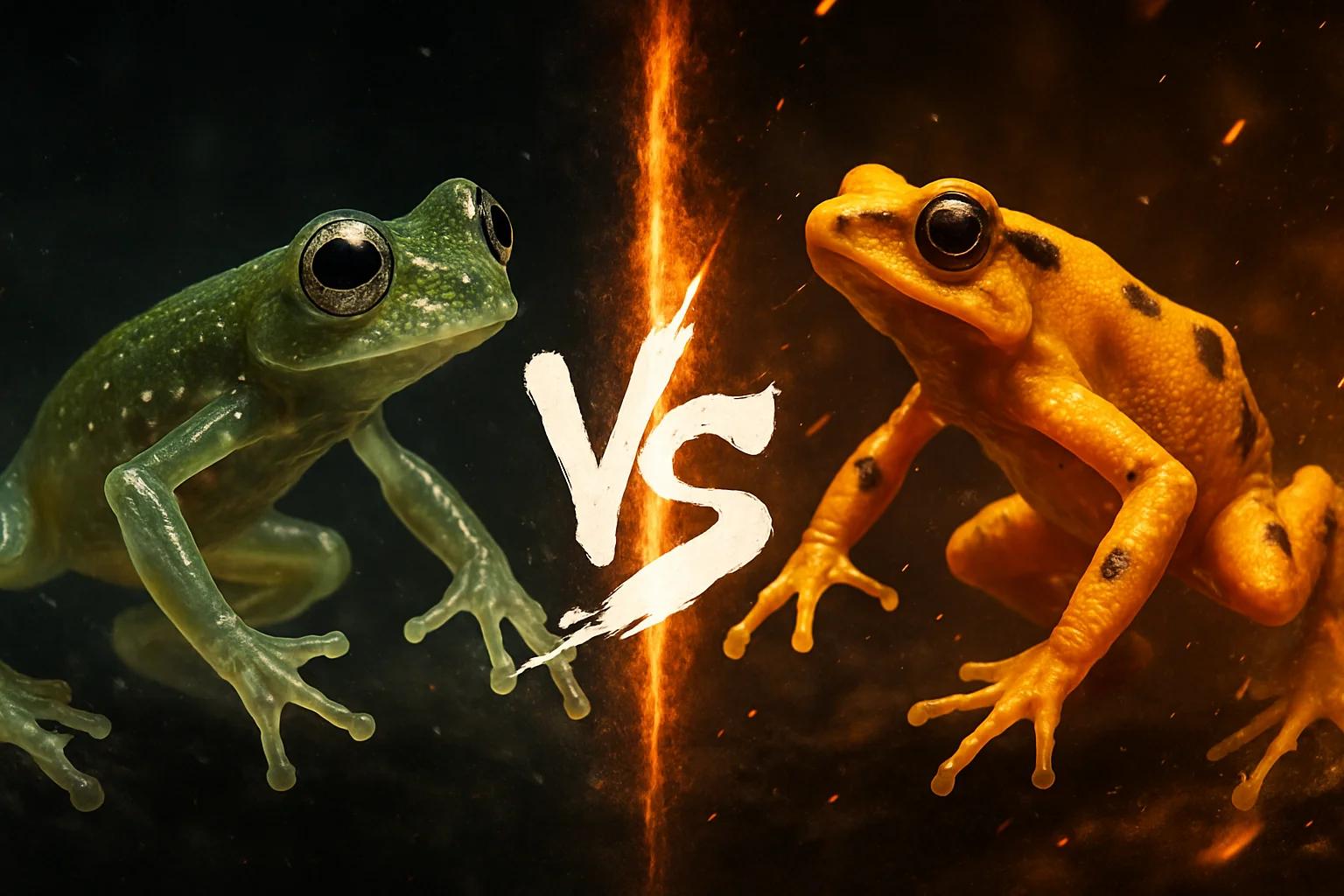
Glass Frog vs Panamanian Golden Frog: Who Actually Wins?
The glass frog wins this matchup on points. Neither frog is built to hurt the other, so the contest comes down to frog-on-frog dominance: shoving, clinging, out-positioning and holding a perch. Glass frogs have a real edge there. Many species have males that actively defend calling sites over streams, and some grapple hanging upside down from leaves. A few species even carry bony humeral spines on the upper arm used in those bouts. The Panamanian golden frog's famous weapon is skin toxin, including zetekitoxin, which works against predators that bite or swallow it. In a rival standoff where nobody is eating anybody, that toxin does little. The golden frog is a slow, deliberate, ground-and-rock walker, and the glass frog is a quicker, grippier leaf-and-branch climber. The glass frog takes control of the space and pushes the golden frog off the contested spot. The golden frog loses the shove but stays unbeatable as prey, which is why it wins only when the question becomes 'who survives being attacked?'
Read comparison
Discussion
What do you think?
Share your reasoning with other readers. Be civil and stick to the animals.
Sign in to join the discussion.
Sign inNo comments yet. Start the conversation.