

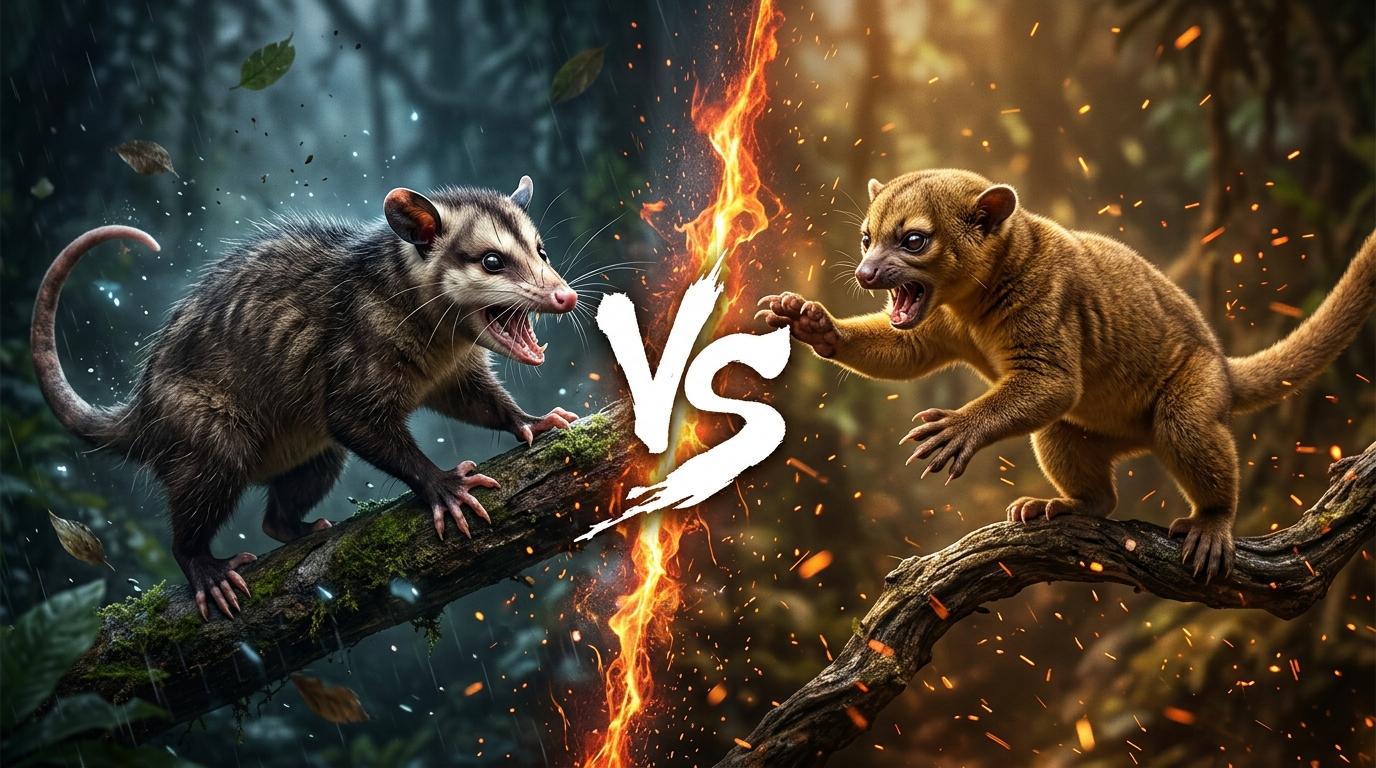
Gray Four-eyed Opossum vs Kinkajou: Who Actually Wins?
Gray four-eyed opossum vs kinkajou: a biology-first look at size, bite, climbing, and temperament to show which Neotropical night-shifter wins and why.
Gray Four-eyed Opossum vs Kinkajou
Matchup winner
Kinkajou
Quick verdict
Start with the direct answer, then use the structured comparison below to see what changes the outcome.
The kinkajou wins. Both animals work the same humid Neotropical night shift, from southern Mexico into South America, but they are built for different jobs. The gray four-eyed opossum is a scrappy, gape-mouthed predator of frogs, crabs, and insects. It usually weighs well under a kilogram. A typical adult kinkajou weighs roughly 2 to 3 kg, often several times as much as the opossum. It also has a prehensile tail, ankles that rotate so it can grip in any direction, sharp climbing claws, and a short, strong procyonid jaw. The opossum is the more naturally aggressive hunter and is the more dangerous of the two at ground level near water. Once the contest becomes a clinch, though, mass, grip, and leverage decide it, and the kinkajou has all three. In trees the gap becomes decisive.
Read the full explanation
Kinkajou wins overall, mainly because it is several times heavier and grips far better.
The four-eyed opossum is the more predatory and more willing to start a fight.
In the canopy the kinkajou's prehensile tail and reversible feet give it a lopsided edge.
On wet ground at streamside, the opossum's speed and boldness can force the kinkajou to retreat.
Reader vote
Who do you think wins?
Pick a side — no account needed. Results update live.
No votes yet — be the first to call it.
Editorial note
Why people disagree
Stat cards often list them at similar size, which hides how much heavier a real kinkajou is.
Body-mass leverage
At this scale, doubling or tripling weight decides who can pin, pull, and absorb bites.
Predatory drive
The opossum is used to subduing struggling prey, so it commits quickly and bites decisively.
Canopy control
A fighter anchored by its tail can use all four limbs and its jaws while the other animal is still holding on.
Read the full explanation +
Kinkajous look like gentle 'honey bears' and fruit eaters, so people underestimate their defensive bite and claws.
Opossums have a reputation for playing dead, but Philander is famously feisty and is a real predator, not a pushover.
Comparison FAQ
Short, direct answers to the next questions readers usually ask after the headline verdict.
Would a gray four-eyed opossum beat a kinkajou?+
Usually no. The kinkajou is substantially heavier and is an arboreal specialist, so it wins most realistic encounters, especially in trees.
Which is stronger, a kinkajou or a four-eyed opossum?+
The kinkajou. It is often two to three times heavier, with stronger limbs, a gripping tail, and a more powerful jaw.
Why is the four-eyed opossum still dangerous?+
It is an aggressive hunter with many sharp teeth and a wide gape. It commits quickly to a fight and is agile on the ground, so it can injure a kinkajou or drive it off streamside terrain.
Are kinkajous aggressive?+
They are usually calm fruit eaters, but they defend themselves fiercely, biting and clawing when cornered or when protecting a food tree.
Head-to-head species stats
These are the same core AnimalDex stat dimensions used on the dedicated animal pages, pulled side by side so the matchup is faster to scan.
Gray Four-eyed Opossum
Tier CKinkajou
Tier BTrait-by-trait comparison
Only the categories that matter to this matchup are included. The goal is not filler stats, but the real design differences that change the result.
Usually under 1 kg, slim build
Body-mass leverage
Kinkajou
Roughly 2–3 kg, dense and muscular
Body-mass leverage
Kinkajou
Active hunter of frogs, crabs, insects, small vertebrates
Predatory drive
Gray Four-eyed Opossum
Mostly fruit and nectar, rarely predatory
Predatory drive
Gray Four-eyed Opossum
Capable climber, more at home low or on the ground
Canopy control
Kinkajou
Prehensile tail, reversible hind feet, true arboreal specialist
Canopy control
Kinkajou
Up to 50 small sharp teeth, wide gape
Bite and dental kit
Kinkajou
Short strong jaw, sharp canines
Bite and dental kit
Kinkajou
Quick, terrestrial, comfortable near water
Ground-level agility
Gray Four-eyed Opossum
Clumsy and reluctant on the ground
Ground-level agility
Gray Four-eyed Opossum
Opportunistic, instinct-driven
Behavioral flexibility
Kinkajou
Curious, manipulative paws, flexible forager
Behavioral flexibility
Kinkajou
How the verdict forms
Verdict timeline
01 · Body-mass leverage
Kinkajou
02 · Predatory drive
Gray Four-eyed Opossum
03 · Canopy control
Kinkajou
04 · Bite and dental kit
Kinkajou
05 · Ground-level agility
Gray Four-eyed Opossum
06 · Behavioral flexibility
Kinkajou
Change the conditions
Scenario breakdown
This is where shallow battle content usually fails. Terrain, spacing, timing, and engagement style can change the answer.
Scenario lean
Kinkajou
Verdict confidence
82%
Kinkajou, decisively.
High in the trees, the kinkajou can anchor itself by its tail and fight with all four limbs and its jaws. The opossum has to spend effort just staying on the branch. Combined with the large weight gap, the kinkajou can shove, grapple, or simply knock the opossum loose.
AnimalDex field profiles
Explore these animals
Gray Four-eyed Opossum
Philander opossum
rainforest, secondary woodland, and streamside forest
Kinkajou
Potos flavus
tropical rainforest canopy, forest edge, and humid woodland
Systems Intelligence & Hidden Purpose
See the animals behind this comparison as engineered biological systems: what each one is built to do, where it gains leverage, and why the matchup changes by scenario.
Specialized Hardware
pale eyebrow eye-spots, prehensile tail, and night fruit-and-insect foraging give the Gray Four-eyed Opossum a body plan tuned for its niche.
Systems Script
Gray Four-eyed Opossums operate through rainforest, secondary woodland, and streamside forest. Their design links movement, feeding, shelter, and timing into one workable survival system.
Strategic Insight
Dense environments reward precision, patience, and the ability to read layered cover.
Specialized Hardware
prehensile tail for canopy balance, night-active tree climbing, and fruit-focused forest diet give the Kinkajou a body plan tuned for its niche.
Systems Script
Kinkajous operate through tropical rainforest canopy, forest edge, and humid woodland Their design links movement, shelter, and feeding into one workable survival system.
Strategic Insight
A system gets lighter and safer when grip, balance, and movement work as one.
Final take
The kinkajou is the clear overall winner. Most of the edge comes from physics: the heavier, better-anchored animal controls the clinch.
Read the full explanation
The gray four-eyed opossum is not a pushover. It is a committed little predator, and on the ground it can make a kinkajou leave. But most real encounters between these two would happen in trees, and that is the kinkajou's home.
Collect both animals in AnimalDex
Track the species behind this matchup, compare their real traits, and build the rivalry into your AnimalDex collection.
Related comparisons
Continue with nearby matchups to compare more real-world animal traits without dropping into junky who-wins filler.
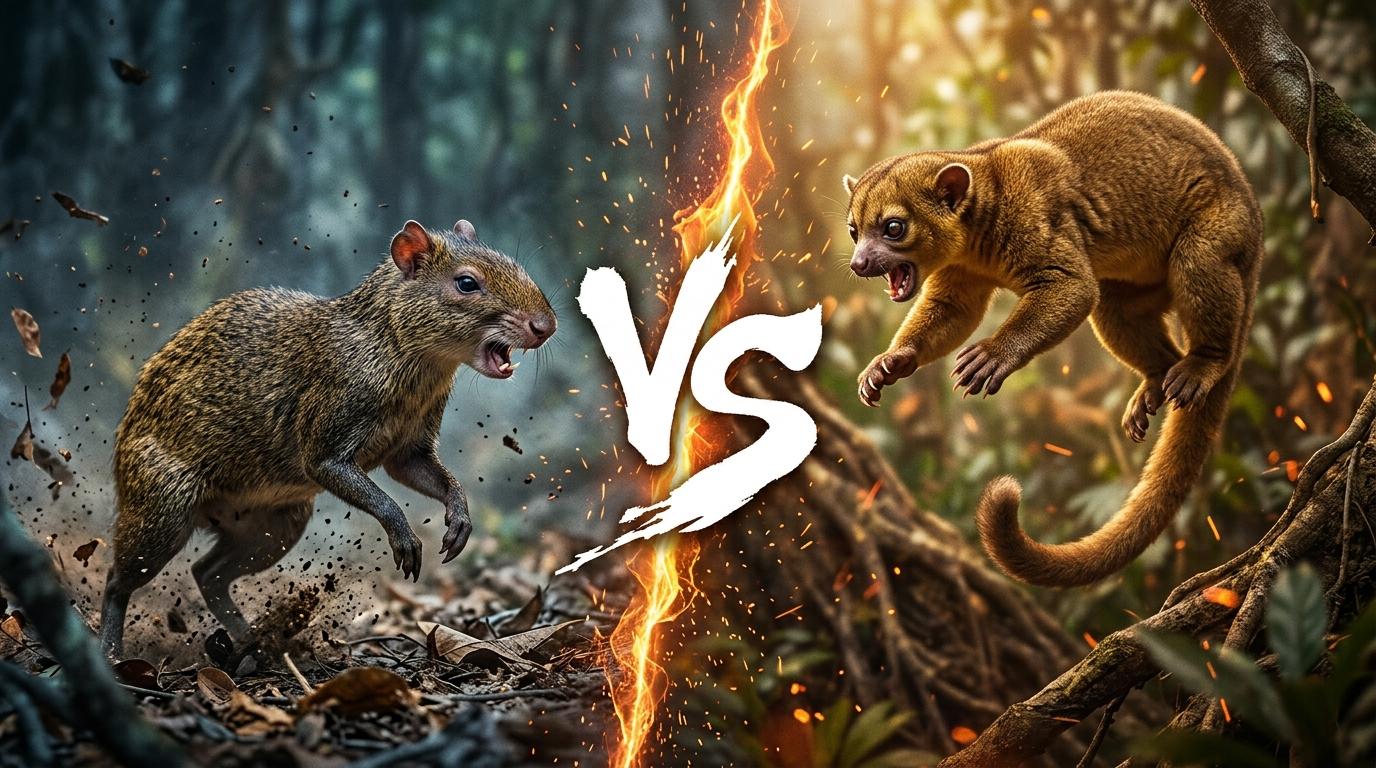
Central American Agouti vs Kinkajou: Who Actually Wins?
The kinkajou wins this matchup. The two weigh about the same, roughly 2–4.5 kg each, but the kinkajou is built very differently. It is a procyonid carnivoran with a dense, muscular body, a gripping prehensile tail, sharp curved claws and a carnivoran jaw with real canines. It is also known to be surprisingly fierce when cornered or handled. The agouti is a long-legged rodent built for one thing above all: escape. Its chisel incisors can deliver a painful bite, and its burst speed and leaping are excellent, but it has little grappling ability and no habit of holding its ground. In any encounter where the two actually make contact, the kinkajou's grip, claws and willingness to fight decide it. The agouti's best outcome is almost always a clean getaway rather than a win.
Read comparison
Gray Four-eyed Opossum vs Brown-throated Sloth: Who Actually Wins?
The Brown-throated Sloth wins this one. On paper the Gray Four-eyed Opossum looks like the fighter. It is faster, twitchier, and a genuine predator that kills frogs, insects, birds, and small mammals. But an adult sloth weighs roughly 2–6 kg, while the opossum weighs about 0.2–0.7 kg, so the sloth is several times heavier. The sloth also carries 7–10 cm hooked claws on powerful forelimbs, a grip strong enough to hang asleep for hours, and a dense, shaggy coat over tough skin that blunts small bites. The opossum's real weapons are a fast bite and a fierce attitude, and those are built for prey far smaller than an adult sloth. It can harass, it can dodge, and it can escape at will, but it has no realistic way to finish the job. The sloth only needs to land one hooked swipe or lock its grip to end the exchange. Speed decides whether a fight starts. Mass and claws decide how it ends.
Read comparison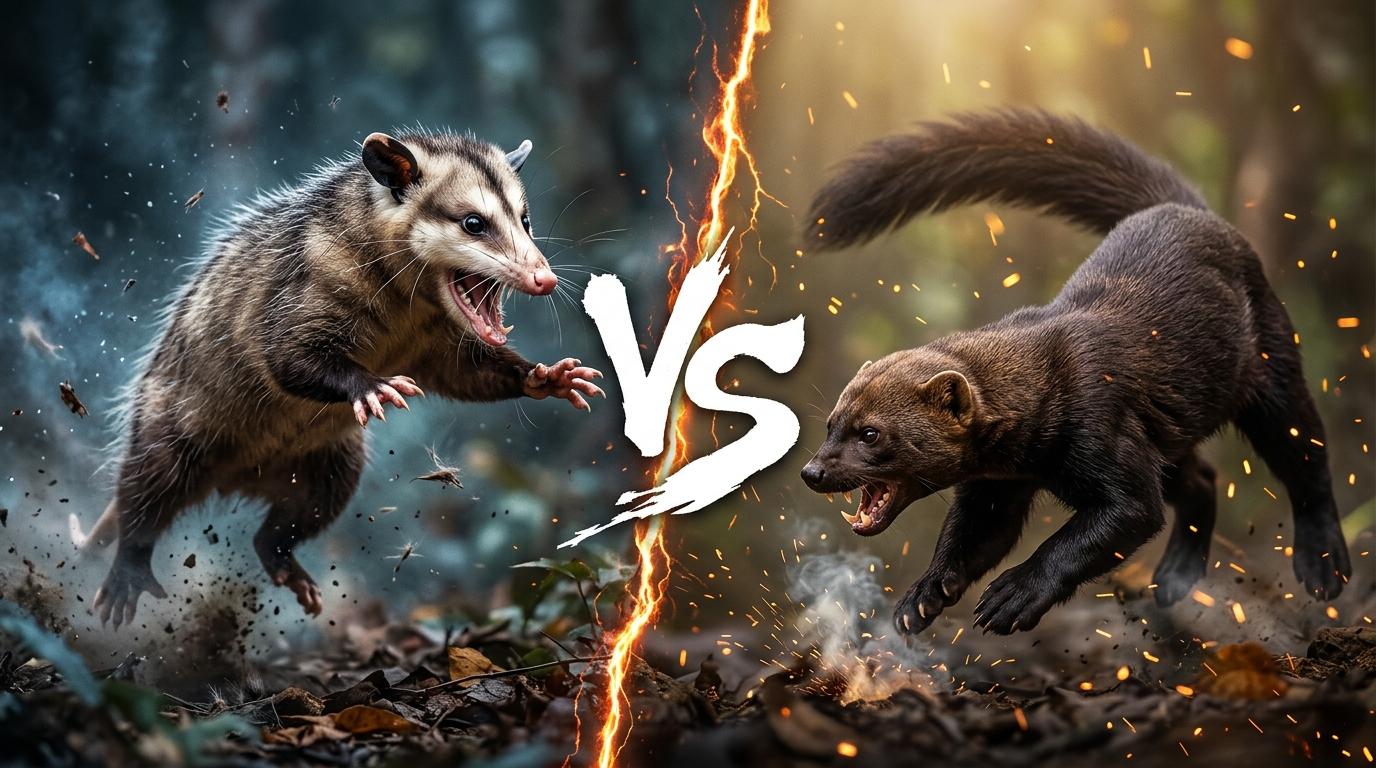
Gray Four-eyed Opossum vs Tayra: Who Actually Wins?
The tayra wins clearly. This large Neotropical weasel weighs roughly 3–6 kg and has a long, muscular body, strong neck, and a bite built for killing rodents, birds, and small mammals. The gray four-eyed opossum (Philander opossum) weighs about 0.2–0.7 kg. It is a quick, aggressive marsupial with a mouth full of sharp teeth, but it gives up close to a tenfold mass gap. The tayra climbs as well as it runs, so it can follow the opossum into trees and along the ground. It also behaves like a hunter that finishes what it starts. The opossum's best tools are a fast gape-and-hiss threat display, real bites, and escape into water or tangled cover. Those make it a costly target, not a threat to win.
Read comparison
Kinkajou vs Olingo: Who Actually Wins?
The kinkajou wins. Both are nocturnal, fruit-loving members of the raccoon family, and they are so alike that people often confuse them. They also really do meet in the same fruiting trees. In those meetings the kinkajou usually holds the branch. An adult kinkajou typically weighs about 2–3+ kg, often roughly twice the mass of a northern olingo (around 1–1.5 kg). It also has a prehensile tail that works like a fifth limb. That combination lets it anchor itself, use its claws and teeth from a stable position, and refuse to give ground. The olingo is the quicker, springier climber and the more varied hunter, so it can win a chase or avoid a confrontation. Once the encounter becomes physical, though, the kinkajou's extra mass and grip settle it.
Read comparison
Discussion
What do you think?
Share your reasoning with other readers. Be civil and stick to the animals.
Sign in to join the discussion.
Sign inNo comments yet. Start the conversation.