

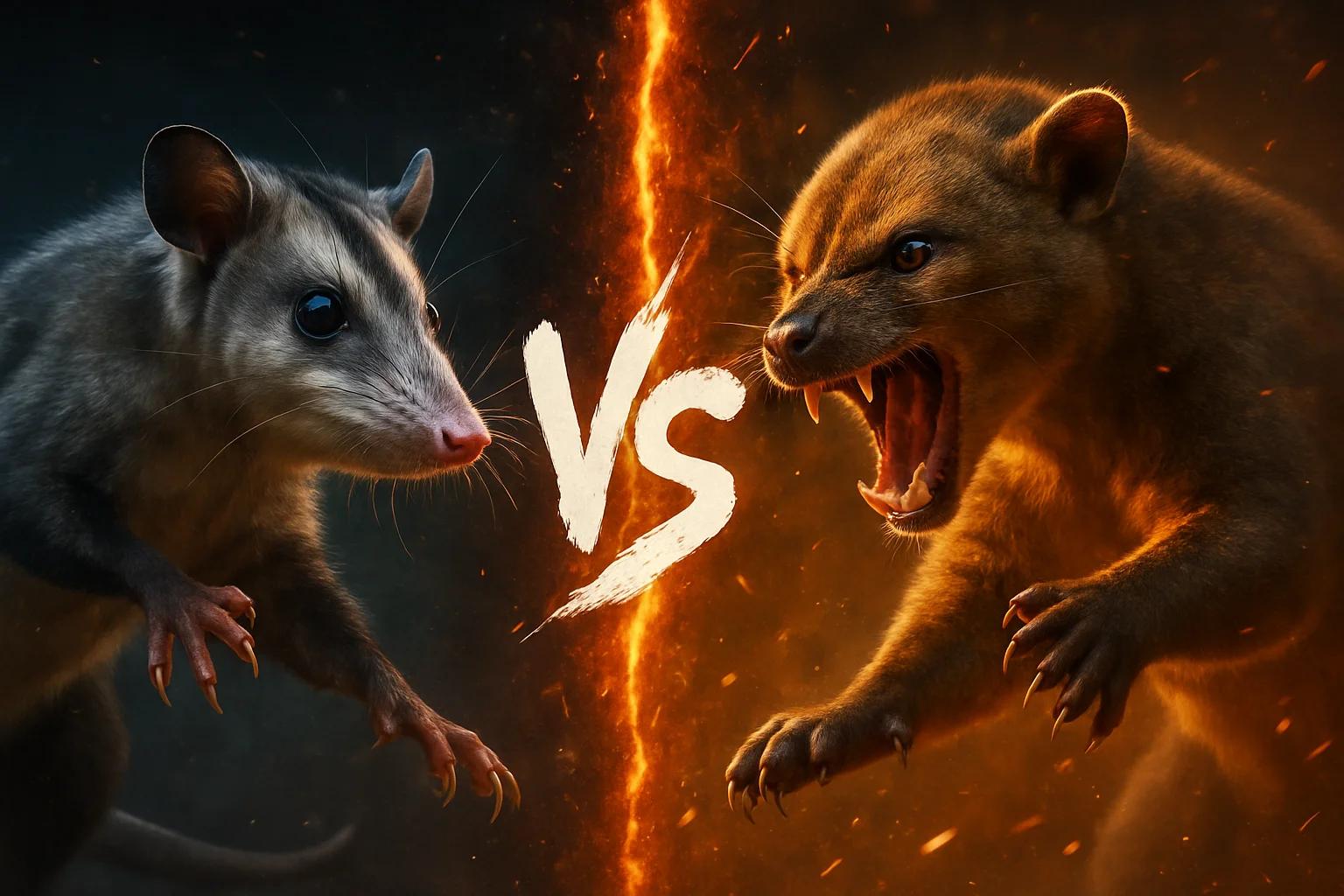
Gray Four-eyed Opossum vs Olingo: Who Actually Wins?
Gray four-eyed opossum vs olingo: a biology-first breakdown of size, bite, agility, and temperament to settle who would win, and where the opossum still flips the result.
Gray Four-eyed Opossum vs Olingo
Matchup winner
Olingo
Quick verdict
Start with the direct answer, then use the structured comparison below to see what changes the outcome.
The olingo wins overall, but not by a landslide. A northern olingo usually weighs around 1–1.5 kg, often roughly double a gray four-eyed opossum at about 0.3–0.7 kg. It brings a carnivoran skull, sharp canines, grasping forepaws, and elite canopy agility to a confrontation that would most likely happen among branches, where olingos live. The four-eyed opossum is the more committed predator per gram. It is a fierce, fast-biting hunter of frogs, crabs, and small vertebrates, with a mouth full of 50 teeth and a short fuse. On the forest floor or near water it can make the olingo regret engaging. In the frame that matters most, though, an arboreal standoff between two nocturnal Neotropical mammals, mass and climbing control beat aggression. The olingo usually ends the encounter on its own terms, either by out-muscling the opossum or by simply leaving the branch it cannot reach.
Read the full explanation
Olingo wins most realistic encounters, mainly through a size and weight edge.
Olingos are canopy specialists, while four-eyed opossums are capable climbers that favor the ground and understory.
On the ground or at a stream edge, the opossum's predatory aggression makes it a genuine threat.
Neither animal seeks this fight. Most real meetings end in a gape, a hiss, and a retreat.
Reader vote
Who do you think wins?
Pick a side — no account needed. Results update live.
No votes yet — be the first to call it.
Editorial note
Why people disagree
Stat sheets and field weights disagree. Many sources make the opossum look comparable or bigger, but measured adult olingos are typically heavier.
Body mass and frame
In small-mammal clashes, doubling body mass usually means controlling the grapple and absorbing bites better.
Bite arsenal
The opossum has more teeth, but the olingo's larger skull and canines deliver deeper, more damaging bites.
Predatory drive
The opossum is practiced at killing, so it commits faster and bites without hesitation.
Read the full explanation +
The opossum is the more predatory animal. It routinely kills live prey, while the olingo is mostly a fruit and nectar eater, so some readers assume ferocity should win.
Location decides everything. A canopy fight and a forest-floor fight produce different winners, and people rarely specify which one they mean.
Comparison FAQ
Short, direct answers to the next questions readers usually ask after the headline verdict.
Would a gray four-eyed opossum beat an olingo?+
Usually not. The olingo wins most realistic encounters thanks to a substantial weight advantage and superior canopy agility. The opossum can win on the ground or near water, where it hunts.
Which is stronger, the olingo or the four-eyed opossum?+
The olingo. It is typically about twice as heavy, with a larger skull and stronger carnivoran bite, though the opossum is fiercer for its size.
Who wins a fight in the trees?+
The olingo, clearly. It is a dedicated arboreal acrobat, while the opossum is a capable but less specialized climber.
Why is the opossum still dangerous to an olingo?+
It is an active predator with 50 teeth, a hair-trigger temper, and an intimidating gape. It commits to bites quickly, and on its own terrain that aggression can drive off a larger animal.
Do they actually meet in the wild?+
Their ranges overlap in Central and northern South American forests, and both are nocturnal. Direct conflict is rare, and most meetings end with avoidance rather than contact.
Head-to-head species stats
These are the same core AnimalDex stat dimensions used on the dedicated animal pages, pulled side by side so the matchup is faster to scan.
Gray Four-eyed Opossum
Tier COlingo
Tier CTrait-by-trait comparison
Only the categories that matter to this matchup are included. The goal is not filler stats, but the real design differences that change the result.
~0.3–0.7 kg, compact marsupial
Body mass and frame
Olingo
~1–1.5 kg, long-bodied procyonid
Body mass and frame
Olingo
50 teeth, quick snapping bites
Bite arsenal
Olingo
Carnivoran canines, stronger jaw lever
Bite arsenal
Olingo
Active hunter of frogs, crabs, rodents
Predatory drive
Gray Four-eyed Opossum
Mostly fruit and nectar, occasional prey
Predatory drive
Gray Four-eyed Opossum
Competent climber, prefers lower strata
Canopy control
Olingo
Elite arboreal acrobat, leaps between crowns
Canopy control
Olingo
Comfortable on floor, swims well
Ground and water game
Gray Four-eyed Opossum
Rarely descends, out of element
Ground and water game
Gray Four-eyed Opossum
Wide gape, hissing, bluff-heavy
Threat display and nerve
Gray Four-eyed Opossum
Alert, evasive, avoids risk
Threat display and nerve
Gray Four-eyed Opossum
How the verdict forms
Verdict timeline
01 · Body mass and frame
Olingo
02 · Bite arsenal
Olingo
03 · Predatory drive
Gray Four-eyed Opossum
04 · Canopy control
Olingo
05 · Ground and water game
Gray Four-eyed Opossum
06 · Threat display and nerve
Gray Four-eyed Opossum
Change the conditions
Scenario breakdown
This is where shallow battle content usually fails. Terrain, spacing, timing, and engagement style can change the answer.
Scenario lean
Olingo
Verdict confidence
82%
Olingo dominates its home layer.
High in the crowns, the olingo's balance, long tail used as a counterweight, and leaping ability give it total positional control. The opossum can climb but must spend effort just staying attached. A heavier animal with secure footing can shove, bite, or simply relocate, so the olingo dictates the outcome.
AnimalDex field profiles
Explore these animals
Gray Four-eyed Opossum
Philander opossum
rainforest, secondary woodland, and streamside forest
Olingo
Bassaricyon gabbii
cloud forest, rainforest, and humid woodland
Systems Intelligence & Hidden Purpose
See the animals behind this comparison as engineered biological systems: what each one is built to do, where it gains leverage, and why the matchup changes by scenario.
Specialized Hardware
pale eyebrow eye-spots, prehensile tail, and night fruit-and-insect foraging give the Gray Four-eyed Opossum a body plan tuned for its niche.
Systems Script
Gray Four-eyed Opossums operate through rainforest, secondary woodland, and streamside forest. Their design links movement, feeding, shelter, and timing into one workable survival system.
Strategic Insight
Dense environments reward precision, patience, and the ability to read layered cover.
Specialized Hardware
long balancing tail, woolly brown canopy body, and fruit-and-insect night foraging give the Olingo a body plan tuned for its niche.
Systems Script
Olingos operate through cloud forest, rainforest, and humid woodland. Their design links movement, feeding, shelter, and timing into one workable survival system.
Strategic Insight
Dense environments reward precision, patience, and the ability to read layered cover.
Final take
The olingo is the overall winner because the decisive variables, body mass, jaw strength, and control of the canopy, all point its way, and the canopy is where these two most plausibly cross paths.
Read the full explanation
The gray four-eyed opossum is not a pushover. It is the more practiced killer, the bolder bluffer, and the master of the forest floor and stream edge. Drag the encounter low and the result genuinely flips. Keep it in the trees and the olingo usually controls both the fight and the exit.
Collect both animals in AnimalDex
Track the species behind this matchup, compare their real traits, and build the rivalry into your AnimalDex collection.
Related comparisons
Continue with nearby matchups to compare more real-world animal traits without dropping into junky who-wins filler.
Gray Four-eyed Opossum vs Kinkajou: Who Actually Wins?
The kinkajou wins. Both animals work the same humid Neotropical night shift, from southern Mexico into South America, but they are built for different jobs. The gray four-eyed opossum is a scrappy, gape-mouthed predator of frogs, crabs, and insects. It usually weighs well under a kilogram. A typical adult kinkajou weighs roughly 2 to 3 kg, often several times as much as the opossum. It also has a prehensile tail, ankles that rotate so it can grip in any direction, sharp climbing claws, and a short, strong procyonid jaw. The opossum is the more naturally aggressive hunter and is the more dangerous of the two at ground level near water. Once the contest becomes a clinch, though, mass, grip, and leverage decide it, and the kinkajou has all three. In trees the gap becomes decisive.
Read comparison
Olingo vs Paca: Who Actually Wins?
The paca wins. At roughly 6–12 kg against the olingo's 1–1.5 kg, the paca brings several times the body mass, chisel-like rodent incisors built to crack hard palm nuts, and a reinforced cheek-bone chamber unique among rodents. The olingo is a nimble procyonid, a raccoon relative with sharp canines and a long balancing tail, but it is a canopy fruit-eater with no real answer to a heavier, ground-anchored animal that bites through seed shells for a living. On the forest floor, where any real collision would happen, mass and incisor force decide it. The olingo's best outcome is not winning but leaving, straight up the nearest trunk.
Read comparison
Gray Four-eyed Opossum vs Brown-throated Sloth: Who Actually Wins?
The Brown-throated Sloth wins this one. On paper the Gray Four-eyed Opossum looks like the fighter. It is faster, twitchier, and a genuine predator that kills frogs, insects, birds, and small mammals. But an adult sloth weighs roughly 2–6 kg, while the opossum weighs about 0.2–0.7 kg, so the sloth is several times heavier. The sloth also carries 7–10 cm hooked claws on powerful forelimbs, a grip strong enough to hang asleep for hours, and a dense, shaggy coat over tough skin that blunts small bites. The opossum's real weapons are a fast bite and a fierce attitude, and those are built for prey far smaller than an adult sloth. It can harass, it can dodge, and it can escape at will, but it has no realistic way to finish the job. The sloth only needs to land one hooked swipe or lock its grip to end the exchange. Speed decides whether a fight starts. Mass and claws decide how it ends.
Read comparison
Gray Four-eyed Opossum vs Tayra: Who Actually Wins?
The tayra wins clearly. This large Neotropical weasel weighs roughly 3–6 kg and has a long, muscular body, strong neck, and a bite built for killing rodents, birds, and small mammals. The gray four-eyed opossum (Philander opossum) weighs about 0.2–0.7 kg. It is a quick, aggressive marsupial with a mouth full of sharp teeth, but it gives up close to a tenfold mass gap. The tayra climbs as well as it runs, so it can follow the opossum into trees and along the ground. It also behaves like a hunter that finishes what it starts. The opossum's best tools are a fast gape-and-hiss threat display, real bites, and escape into water or tangled cover. Those make it a costly target, not a threat to win.
Read comparison
Discussion
What do you think?
Share your reasoning with other readers. Be civil and stick to the animals.
Sign in to join the discussion.
Sign inNo comments yet. Start the conversation.