

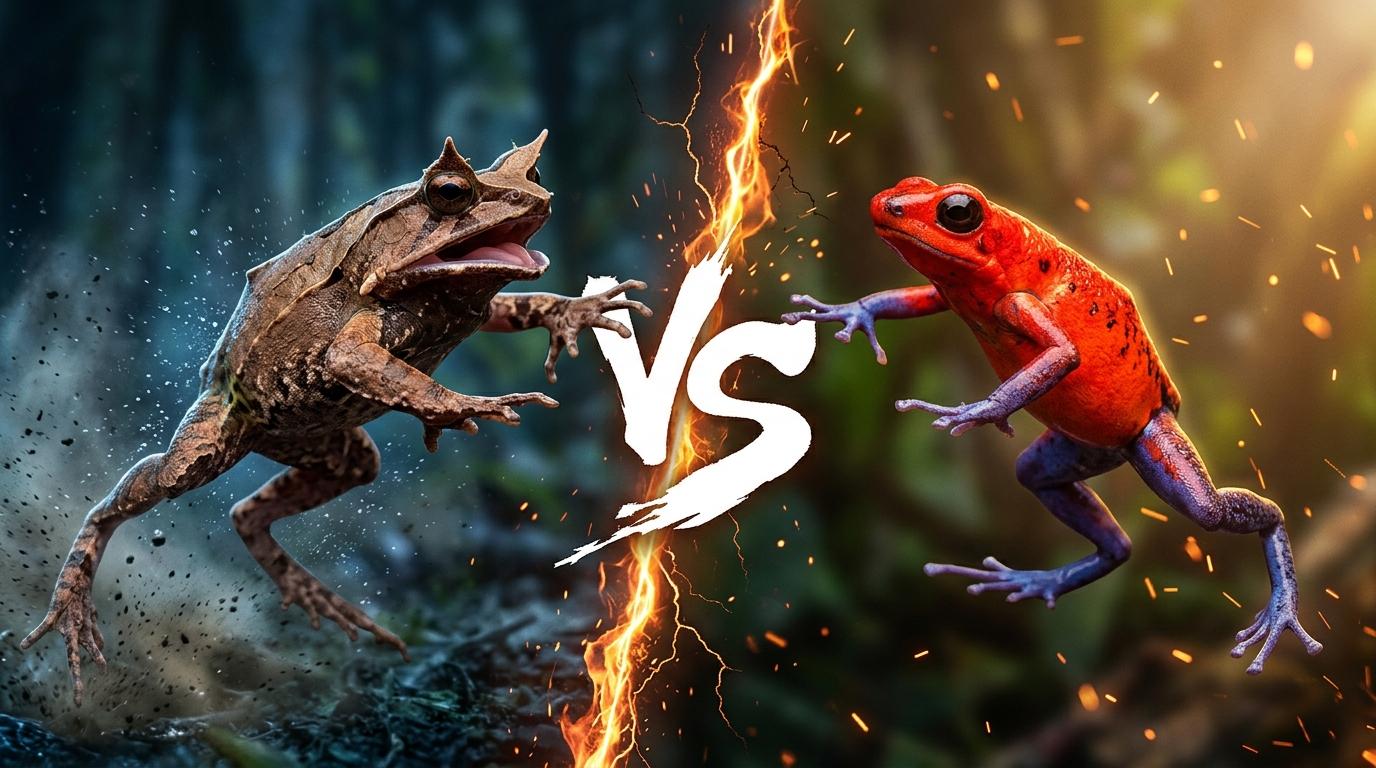
Malayan Horned Frog vs Strawberry Poison Dart Frog: Who Actually Wins?
Malayan horned frog vs strawberry poison dart frog: a leaf-litter ambush predator meets a toxic, brightly colored rainforest frog. Here is who wins, why, and why the tiny frog stays dangerous.
Malayan Horned Frog vs Strawberry Poison Dart Frog
Matchup winner
Malayan Horned Frog
Quick verdict
Start with the direct answer, then use the structured comparison below to see what changes the outcome.
The Malayan horned frog wins. This leaf-mimicking ambush predator from Southeast Asia is roughly 10–12 cm long, while the strawberry poison dart frog is a 2 cm fingertip of a frog. The horned frog also has a wide gape built to engulf prey in a single lunge, and it already eats invertebrates, small lizards and other frogs. The strawberry frog has no bite, no claws and no escape speed that matters at point-blank range. Its real weapon is defensive chemistry. It sequesters alkaloid toxins, including pumiliotoxins, from the mites and ants it eats. That chemistry does not stop the strike. It only makes the meal risky afterward. The horned frog takes the physical contest almost every time. The poison frog's chance comes later, if its toxins sicken the predator or make it spit the frog back out. In a realistic encounter the horned frog wins, but it may pay a price for winning.
Read the full explanation
Winner: Malayan horned frog. It is about 5–6 times longer, has an engulfing gape, and is a proven frog-eater.
The strawberry poison dart frog cannot injure the horned frog physically. Its only defense is skin toxins taken from its diet.
Toxins punish a predator after contact. They do not prevent a fast ambush strike.
Captive-bred strawberry frogs lose most of their toxicity, which makes the matchup even more lopsided.
Reader vote
Who do you think wins?
Pick a side — no account needed. Results update live.
No votes yet — be the first to call it.
Editorial note
Why people disagree
Poison sounds decisive, but aposematic toxins work as a deterrent over time. They teach predators to avoid bright frogs. They do not guarantee survival in a single encounter.
Size and mass gap
Among frogs, whoever can fit the other in its mouth controls the fight. Here only one can.
Ambush control
The horned frog picks the moment. The dart frog's bright color advertises where it is.
Strike weapon
Only one of these frogs can actually attack the other.
Read the full explanation +
Some readers count 'the predator gets sick later' as a win for the dart frog. In a battle frame, the first decisive outcome is the swallow.
The two species never meet in the wild. One lives in Southeast Asian forest floors and the other in Central American rainforests, so a horned frog has no evolved wariness of red-and-blue warning colors.
Comparison FAQ
Short, direct answers to the next questions readers usually ask after the headline verdict.
Would a Malayan horned frog beat a strawberry poison dart frog?+
Yes. The horned frog would almost always win by ambushing and swallowing the much smaller dart frog.
Which frog is stronger?+
The Malayan horned frog, by a wide margin. It is many times longer and heavier, with a powerful lunge and a wide gape. The strawberry frog weighs well under a gram.
Can the poison dart frog's toxin kill the horned frog?+
It could sicken the predator, and the toxins can cause it to spit the frog out. A wild strawberry frog is far less lethal than the famous golden poison frog, though, and captive-bred individuals are largely non-toxic.
Why does the loser stay dangerous?+
Its defense works after contact. Diet-derived alkaloids in its skin can cause irritation, illness or rejection, so attacking it carries a real cost.
Do these frogs ever meet in the wild?+
No. Malayan horned frogs live in Southeast Asia and strawberry poison dart frogs live in Central America. This matchup is hypothetical.
Head-to-head species stats
These are the same core AnimalDex stat dimensions used on the dedicated animal pages, pulled side by side so the matchup is faster to scan.
Malayan Horned Frog
Tier CStrawberry Poison Dart Frog
Tier DTrait-by-trait comparison
Only the categories that matter to this matchup are included. The goal is not filler stats, but the real design differences that change the result.
≈10–12 cm, heavy-bodied
Size and mass gap
Malayan Horned Frog
≈1.7–2.4 cm, featherweight
Size and mass gap
Malayan Horned Frog
Dead-leaf camouflage, sit-and-wait lunge
Ambush control
Malayan Horned Frog
Active daytime forager, conspicuous
Ambush control
Malayan Horned Frog
Enormous gape, sticky tongue, engulfing bite
Strike weapon
Malayan Horned Frog
None. Tiny mouth, built for mites
Strike weapon
Malayan Horned Frog
Minimal skin defenses
Chemical deterrence
Strawberry Poison Dart Frog
Diet-derived alkaloids such as pumiliotoxins
Chemical deterrence
Strawberry Poison Dart Frog
Crypsis: be invisible
Signal strategy
Strawberry Poison Dart Frog
Aposematism: be unmistakable
Signal strategy
Strawberry Poison Dart Frog
Solitary, low aggression outside feeding
Territorial grit
Strawberry Poison Dart Frog
Males defend calling perches and wrestle rivals
Territorial grit
Strawberry Poison Dart Frog
How the verdict forms
Verdict timeline
01 · Size and mass gap
Malayan Horned Frog
02 · Ambush control
Malayan Horned Frog
03 · Strike weapon
Malayan Horned Frog
04 · Chemical deterrence
Strawberry Poison Dart Frog
05 · Signal strategy
Strawberry Poison Dart Frog
06 · Territorial grit
Strawberry Poison Dart Frog
Change the conditions
Scenario breakdown
This is where shallow battle content usually fails. Terrain, spacing, timing, and engagement style can change the answer.
Scenario lean
Malayan Horned Frog
Verdict confidence
82%
The horned frog wins decisively.
Leaf litter is the horned frog's home terrain. Its brown, ridged body and pointed 'horns' break up its outline, so it reads as a dead leaf. A small, active frog hopping within lunge range gets engulfed before it registers the threat. Camouflage combined with a sudden strike is exactly the frame this species evolved for.
AnimalDex field profiles
Explore these animals
Malayan Horned Frog
Megophrys nasuta
rainforest floor and shaded streamside leaf litter
Strawberry Poison Dart Frog
Oophaga pumilio
rainforest floor, leaf litter, and humid tropical understory
Systems Intelligence & Hidden Purpose
See the animals behind this comparison as engineered biological systems: what each one is built to do, where it gains leverage, and why the matchup changes by scenario.
Specialized Hardware
horn-like eyelid points, leaf-litter camouflage body, and wide ambush mouth give the Malayan Horned Frog a body plan tuned for its niche.
Systems Script
Malayan Horned Frogs operate through rainforest floor and shaded streamside leaf litter. Their design links movement, feeding, shelter, and timing into one workable survival system.
Strategic Insight
Dense environments reward precision, patience, and the ability to read layered cover.
Specialized Hardware
bright red or orange warning colors, tiny tropical body, and careful parental transport of tadpoles give the Strawberry Poison Dart Frog a body plan tuned for its niche.
Systems Script
Strawberry Poison Dart Frogs operate through rainforest floor, leaf litter, and humid tropical understory Their design links movement, shelter, and feeding into one workable survival system.
Strategic Insight
A system can invest heavily in a small number of vulnerable outcomes.
Final take
The Malayan horned frog is the clear winner. It is bigger, camouflaged, armed with an engulfing mouth, and already in the habit of eating other frogs. The strawberry poison dart frog has no way to stop the strike.
Read the full explanation
The dart frog is not harmless, though. Its whole survival strategy is to be costly prey. Its color warns predators off, and its toxins enforce that warning. The horned frog wins the encounter, but a wild, toxic strawberry frog can make the meal a real gamble.
Collect both animals in AnimalDex
Track the species behind this matchup, compare their real traits, and build the rivalry into your AnimalDex collection.
Related comparisons
Continue with nearby matchups to compare more real-world animal traits without dropping into junky who-wins filler.
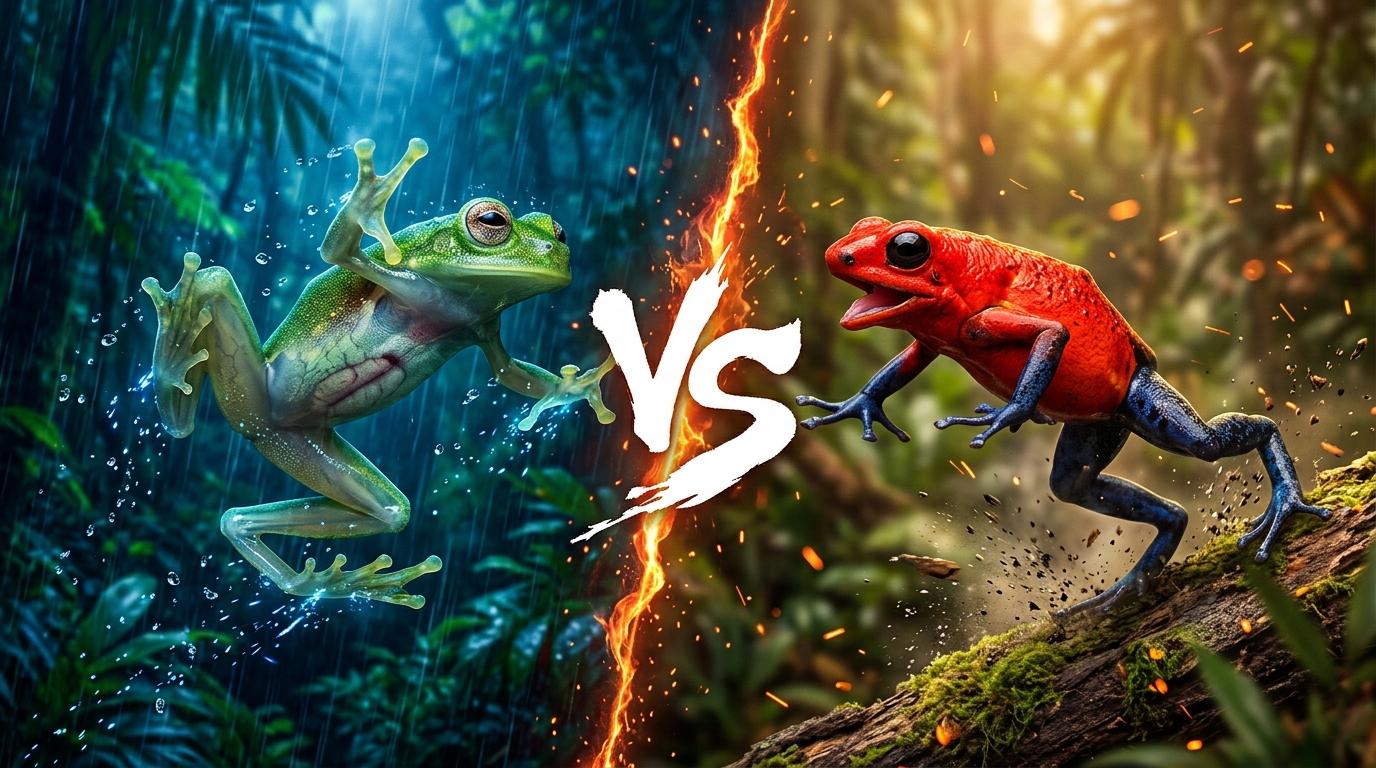
Glass Frog vs Strawberry Poison Dart Frog: Who Actually Wins?
The glass frog wins most realistic matchups, though this is a contest of shoving, not killing. Many glass frogs match or outsize the 2-centimeter strawberry poison dart frog, carry longer limbs, and grip with wide toe pads. In their home terrain of streamside leaves at night, they are far more mobile. Male glass frogs of several species defend calling perches by wrestling, sometimes while hanging upside down from foliage. That lets a glass frog pry a rival off a leaf and claim the space. The strawberry poison dart frog is a fierce little wrestler on the forest floor. Its skin alkaloids make it dangerous to eat, but they are passive. They deter predators and do nothing to win a pushing match against a frog that has no interest in eating it. Toxins protect the dart frog without beating the glass frog. Reach, grip, and three-dimensional movement decide the outcome.
Read comparison
Poison Dart Frog vs Strawberry Poison Dart Frog: Who Actually Wins?
The Poison Dart Frog wins overall, with moderate confidence. There is a catch: 'poison dart frog' is the whole family Dendrobatidae, and the strawberry poison dart frog (Oophaga pumilio) is one member of it. So this matchup really pits the family's typical heavyweights against one small specialist. Frogs like the dyeing dart frog (Dendrobates tinctorius) and the golden poison frog (Phyllobates terribilis) commonly reach about 4–5 cm. The strawberry frog usually measures around 2 cm. Dart frogs settle disputes by wrestling and pinning, not by poisoning each other. They carry their own skin toxins and show at least some resistance to them. In a pushing, grappling contest between thumbnail-sized animals, doubling the body length is decisive. The strawberry frog makes up for its size with ferocious territoriality and stubborn home-turf defense. That makes it the likelier winner over a defended perch, but not in an even meeting.
Read comparison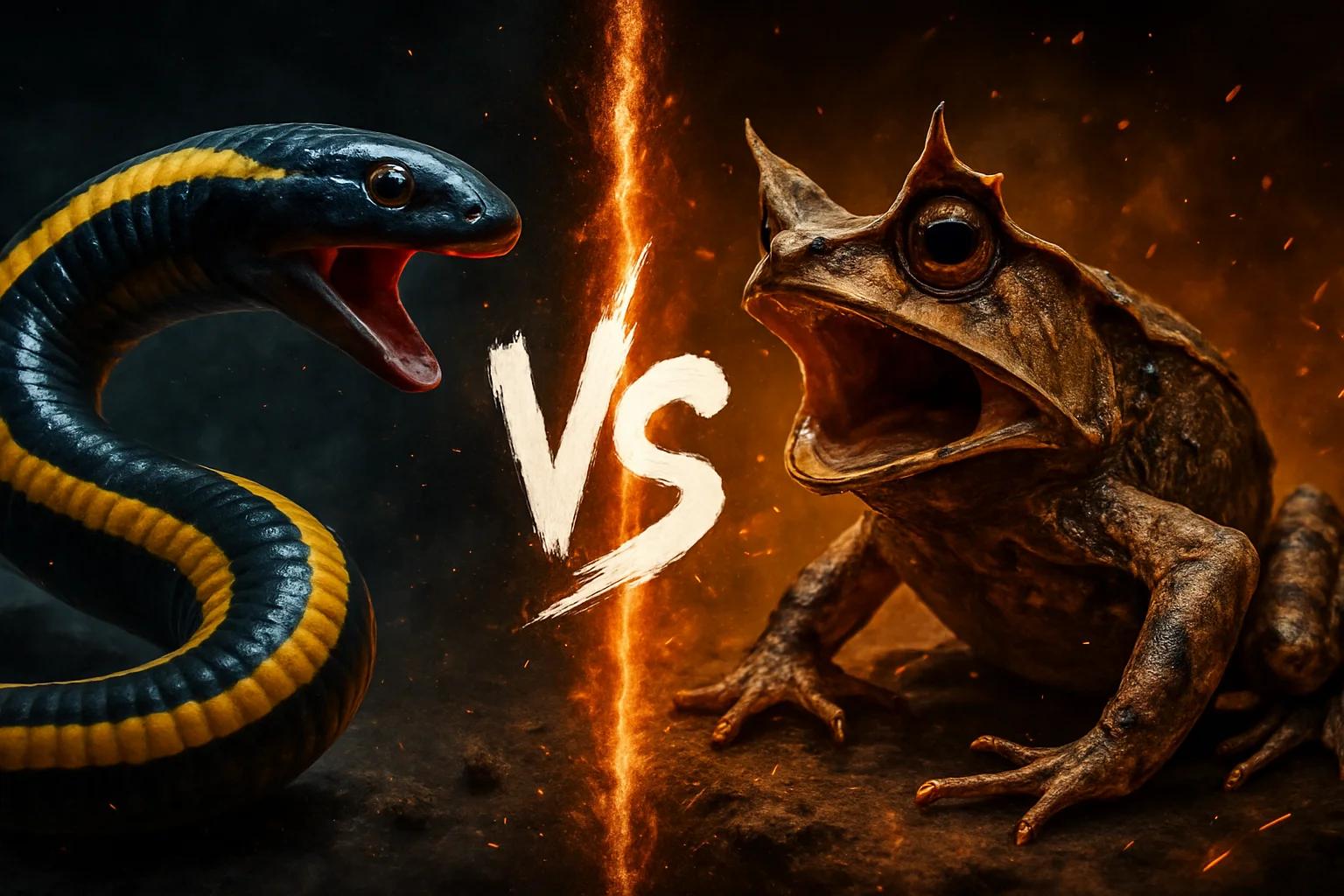
Yellow-banded Caecilian vs Malayan Horned Frog: Who Actually Wins?
The Yellow-banded Caecilian wins this amphibian clash, but not by a landslide. The Malayan Horned Frog is the better hunter in leaf litter. It has superb camouflage, a fast lunge, and a gape built to swallow lizards, crabs, and other frogs. That weapon depends on engulfing prey, though, and a full-grown caecilian can reach roughly 30–45 cm. It is a long, muscular, heavily mucus-coated cylinder, a poor shape for a frog to swallow whole. The caecilian brings a compact, reinforced skull, rows of recurved teeth, a powerful bite, a body that can twist and coil, and sticky, irritating skin secretions (the name glutinosus means 'gluey'). In most realistic contacts the frog's first strike fails to subdue its target. The fight then becomes a grapple, and the caecilian's longer body, grip, and noxious slime favor it. It can also retreat into soil where the frog cannot follow. The frog's best chance is a perfect ambush on a smaller caecilian in the open.
Read comparison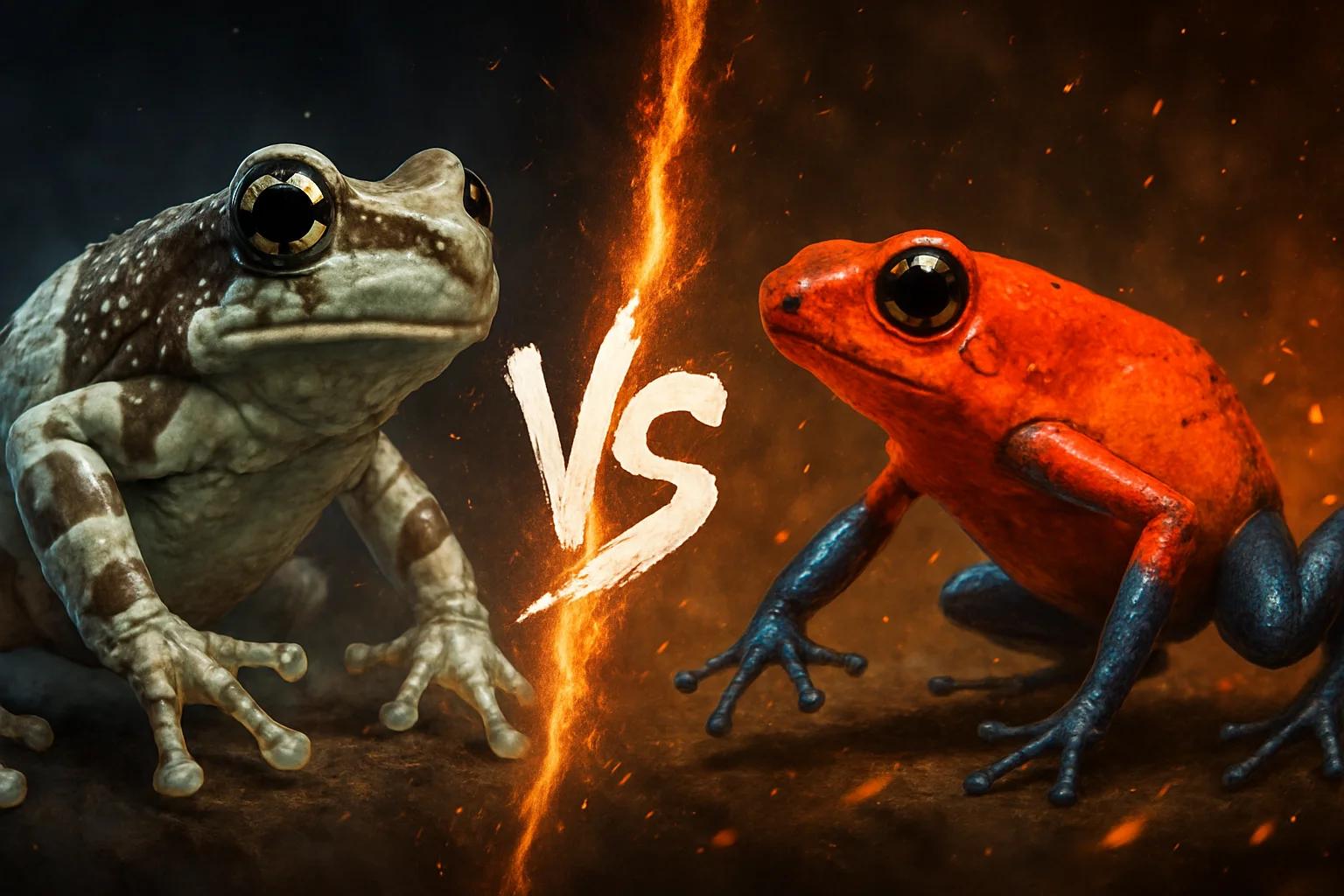
Amazon Milk Frog vs Strawberry Poison Dart Frog: Who Actually Wins?
The Amazon milk frog wins this matchup on size and leverage, but not by fighting. It is an adult treefrog roughly 6–10 cm long, while the strawberry poison dart frog tops out around 2 cm. That size gap gives the milk frog more reach, more mass and a gape large enough to engulf a frog its rival's size. The milk frog also has its own sticky, milky skin secretion that deters handlers. The strawberry dart frog's alkaloid toxins are far more potent and have real deterrent value. Still, those toxins are a defense that punishes a predator only after contact, not a weapon that wins a confrontation. In any realistic encounter, the bigger, stronger and more agile milk frog controls the space. The tiny dart frog's best outcome is being left alone, and that is exactly what its warning colors are built to achieve.
Read comparison
Discussion
What do you think?
Share your reasoning with other readers. Be civil and stick to the animals.
Sign in to join the discussion.
Sign inNo comments yet. Start the conversation.