

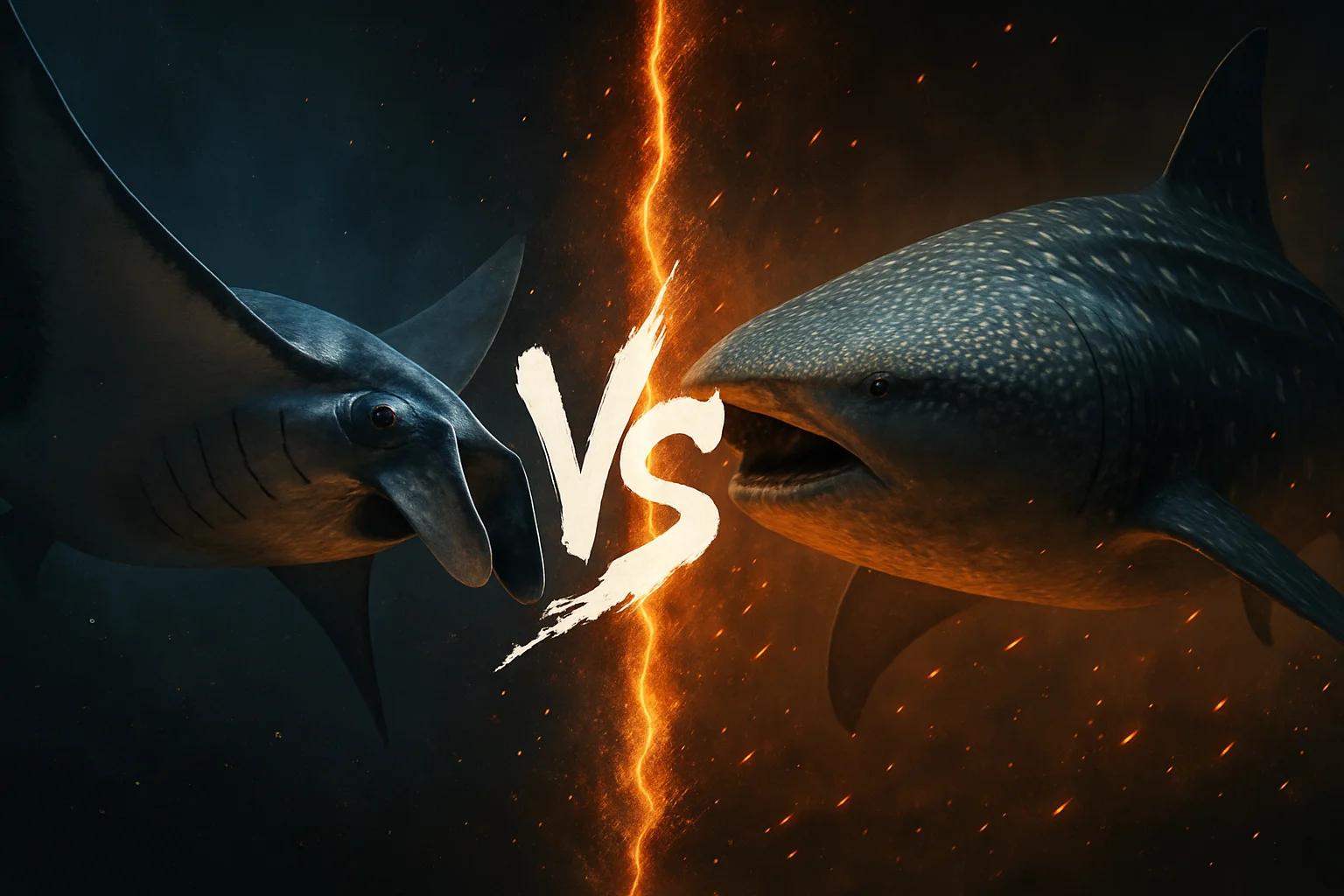
Manta Ray vs Whale Shark: Who Actually Wins?
Giant oceanic manta ray vs whale shark: two gentle filter-feeding giants compared on size, armor, agility and brains, with a clear verdict on who wins a confrontation.
Manta Ray vs Whale Shark
Matchup winner
Whale Shark
Quick verdict
Start with the direct answer, then use the structured comparison below to see what changes the outcome.
The whale shark wins, and it is not especially close on raw physics. Neither animal is built to fight. Both are plankton-straining filter feeders with no meaningful bite and no weaponry; the giant manta does not even carry the venomous tail barb its stingray relatives are known for. That turns any confrontation into a contest of mass, momentum and armor, and the whale shark dominates all three. The largest fish alive commonly reaches about 12 meters and can weigh well over 15 tonnes. It is wrapped in skin reported up to roughly 10 centimeters thick, among the thickest of any animal. A large manta can span about 7 meters wingtip to wingtip but weighs roughly 2 tonnes, and it has nothing that can get through that hide. The manta is smarter, faster on the turn and far more agile, so it decides whether contact happens at all. Once contact does happen, the whale shark simply outweighs and out-armors it.
Read the full explanation
Whale shark wins: roughly 5 to 10 times the mass, with famously thick skin.
Neither has real weapons. Both are filter feeders, and the manta has no stinging barb.
The manta wins on agility, acceleration and brain size, which makes escape easy.
In a real ocean, the likeliest outcome is that the two simply ignore each other.
Reader vote
Who do you think wins?
Pick a side — no account needed. Results update live.
No votes yet — be the first to call it.
Editorial note
Why people disagree
Manta wingspan photos look enormous, but the manta is a flat animal. Its mass is a fraction of a whale shark's body.
Sheer mass
With no weapons on either side, mass is the closest thing to a weapon. A collision or shove favors the heavier body overwhelmingly.
Close-range durability
Whale shark hide shrugs off abrasion and impacts that would mark or injure a manta.
Agile flight control
The manta controls spacing completely and can disengage whenever it wants.
Read the full explanation +
People assume all rays sting. Giant mantas lack a functional venomous barb, so the manta has no 'secret weapon' card to play.
Fans of the manta point to its large brain and agility. Intelligence helps it avoid a fight, but it cannot convert into damage against a 15-tonne armored fish.
Comparison FAQ
Short, direct answers to the next questions readers usually ask after the headline verdict.
Would a manta ray beat a whale shark?+
No. The whale shark has roughly 5 to 10 times the mass and much thicker skin, and the manta has no bite or stinger to hurt it. The manta's real advantage is that it can avoid the encounter altogether.
Which is stronger, a manta ray or a whale shark?+
The whale shark is far stronger in raw terms because of its huge muscle mass and body weight. The manta is stronger relative to its size for acceleration and can propel itself entirely out of the water.
Do giant manta rays have a stinger?+
No functional one. Unlike many stingrays, giant oceanic mantas lack a venomous tail barb, which removes any surprise weapon from this matchup.
Why is the manta ray still dangerous if it loses?+
It is not dangerous to the whale shark, but it is a powerful 2-tonne animal. An accidental wing strike during a breach or a fast turn could injure a diver or damage small gear. Its agility also means the shark can never force a fight.
Do manta rays and whale sharks ever meet in the wild?+
Yes. Both gather at plankton-rich hotspots in tropical and warm-temperate seas. They generally ignore each other and feed side by side.
Head-to-head species stats
These are the same core AnimalDex stat dimensions used on the dedicated animal pages, pulled side by side so the matchup is faster to scan.
Manta Ray
Tier BWhale Shark
Tier CTrait-by-trait comparison
Only the categories that matter to this matchup are included. The goal is not filler stats, but the real design differences that change the result.
About 2 tonnes for large adults
Sheer mass
Whale Shark
Often 15+ tonnes, with the largest individuals heavier still
Sheer mass
Whale Shark
Smooth, mucus-coated skin vulnerable to scarring
Close-range durability
Whale Shark
Skin up to about 10 cm thick, packed with dermal denticles
Close-range durability
Whale Shark
Wing-flapping 'underwater flight', tight turns, full breaches
Agile flight control
Manta Ray
Slow tail-driven cruising, wide turns
Agile flight control
Manta Ray
Quick bursts strong enough to launch clear of the water
Burst acceleration
Manta Ray
Steady cruising at a few km/h
Burst acceleration
Manta Ray
One of the largest brain-to-body ratios among fish; studied for possible self-recognition
Situational intelligence
Manta Ray
Capable navigator, but a simpler behavioral repertoire
Situational intelligence
Manta Ray
None: tiny teeth and no stinging barb
Damage tools
Whale Shark
None meaningful: tiny teeth, but crushing bulk
Damage tools
Whale Shark
How the verdict forms
Verdict timeline
01 · Sheer mass
Whale Shark
02 · Close-range durability
Whale Shark
03 · Agile flight control
Manta Ray
04 · Burst acceleration
Manta Ray
05 · Situational intelligence
Manta Ray
06 · Damage tools
Whale Shark
Change the conditions
Scenario breakdown
This is where shallow battle content usually fails. Terrain, spacing, timing, and engagement style can change the answer.
Scenario lean
Whale Shark
Verdict confidence
82%
Whale shark by momentum
In open blue water, any physical clash comes down to momentum and resistance. A whale shark's slow but enormous body carries several times the manta's mass behind every movement. The manta's flat wing design is superb for lift and gliding but poor for absorbing impact.
AnimalDex field profiles
Explore these animals
Manta Ray
Mobula birostris
Coastal cleaning stations, offshore fronts, reef drop-offs, and plankton-rich ocean zones.
Whale Shark
Rhincodon typus
Warm coastal waters, offshore fronts, reefs, and seasonal plankton aggregation sites.
Systems Intelligence & Hidden Purpose
See the animals behind this comparison as engineered biological systems: what each one is built to do, where it gains leverage, and why the matchup changes by scenario.
Specialized Hardware
Enormous pectoral fins, cephalic lobes, and filter-feeding architecture make manta rays open-water hardware for efficient suspended feeding.
Systems Script
Mantas convert plankton blooms into large graceful biomass while linking reef cleaning stations, migration routes, and productivity pulses. They ride resource patterns instead of trying to manufacture them.
Strategic Insight
Efficiency increases when you learn the flow of abundance and enter it at the right scale.
Specialized Hardware
An enormous mouth, fine filtering structures, and low-cost cruising mechanics allow the whale shark to process huge volumes of plankton-rich water without high-speed pursuit.
Systems Script
Whale sharks connect surface productivity to larger marine food webs by converting diffuse plankton pulses into mobile biomass. Their movement patterns also mark productive ocean zones where energy concentrates seasonally.
Strategic Insight
Scale does not always come from chasing more targets. Sometimes it comes from building a system that can process volume efficiently once the flow arrives.
Final take
The whale shark wins this matchup because, between two weaponless filter feeders, physics is the only judge. Mass, momentum and armor all favor the largest fish in the sea by a wide margin. The manta has no way to inflict meaningful damage on a body protected by skin that thick.
Read the full explanation
The giant manta is still the more impressive athlete and arguably the sharper mind. It flies through the water, breaches clear of the surface, and holds its own around crowded reefs. Its advantage is choice: it decides whether a confrontation ever happens.
In reality, both species often feed in the same productive waters without conflict. As a hypothetical showdown, though, the answer is clear: the whale shark wins.
Collect both animals in AnimalDex
Track the species behind this matchup, compare their real traits, and build the rivalry into your AnimalDex collection.
Related comparisons
Continue with nearby matchups to compare more real-world animal traits without dropping into junky who-wins filler.
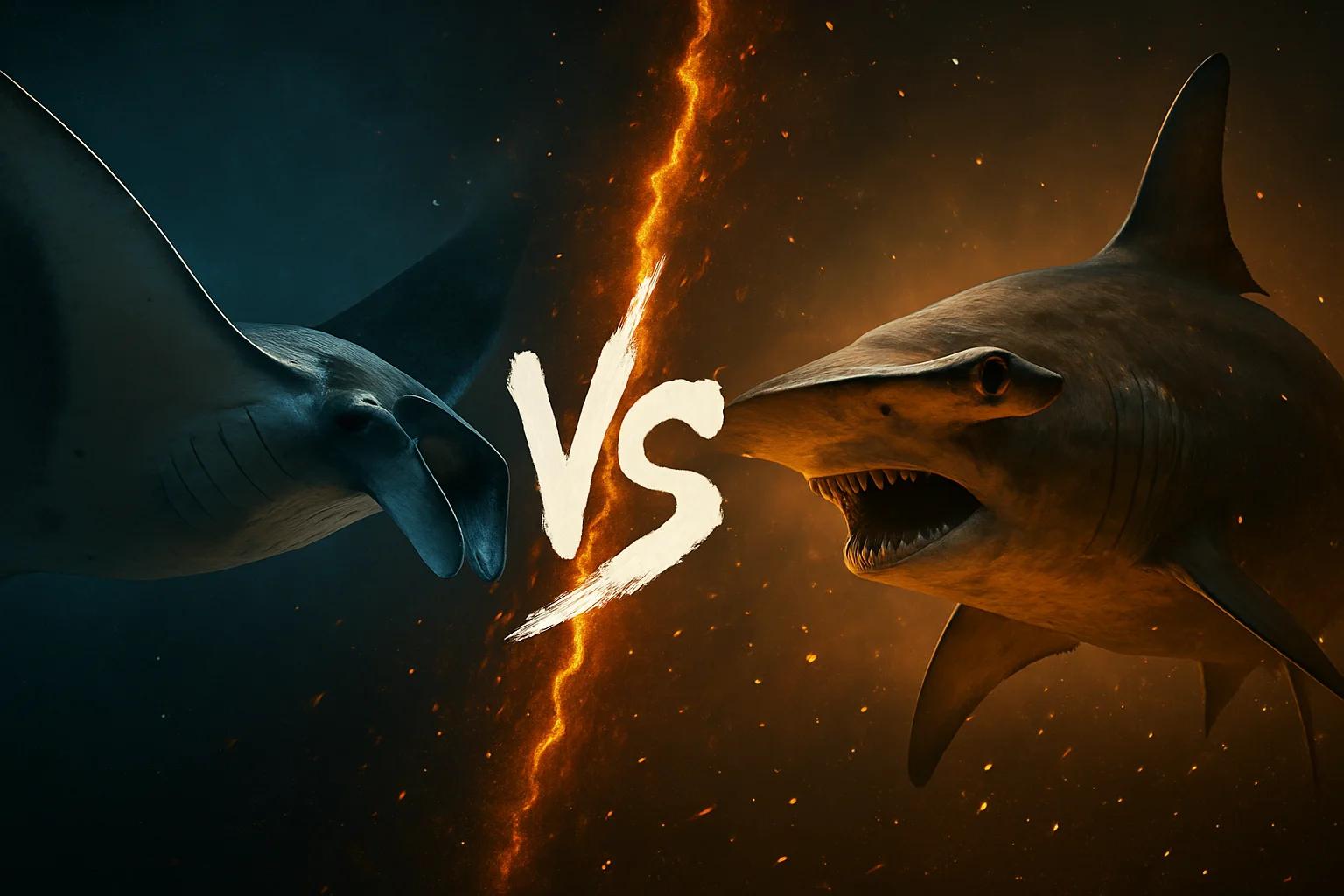
Giant Oceanic Manta Ray vs Scalloped Hammerhead: Who Actually Wins?
The giant oceanic manta ray wins this matchup overall, and it wins the way big ocean animals usually do: by being too large and too well-built to become prey. An adult manta can span up to about 7 meters and weigh well over a ton. A scalloped hammerhead is typically 2–3.5 meters and rarely exceeds a few hundred kilograms. Its mouth is sized for squid, reef fish, and small rays. It has no realistic way to subdue a flat, powerful animal ten times its mass that can simply fly away. The manta has no teeth or stinger worth using in a fight, so it cannot kill the shark. But in a battle frame, the side that cannot be harmed and leaves intact is the winner. The hammerhead's real window is narrow: juvenile, injured, or entangled mantas.
Read comparison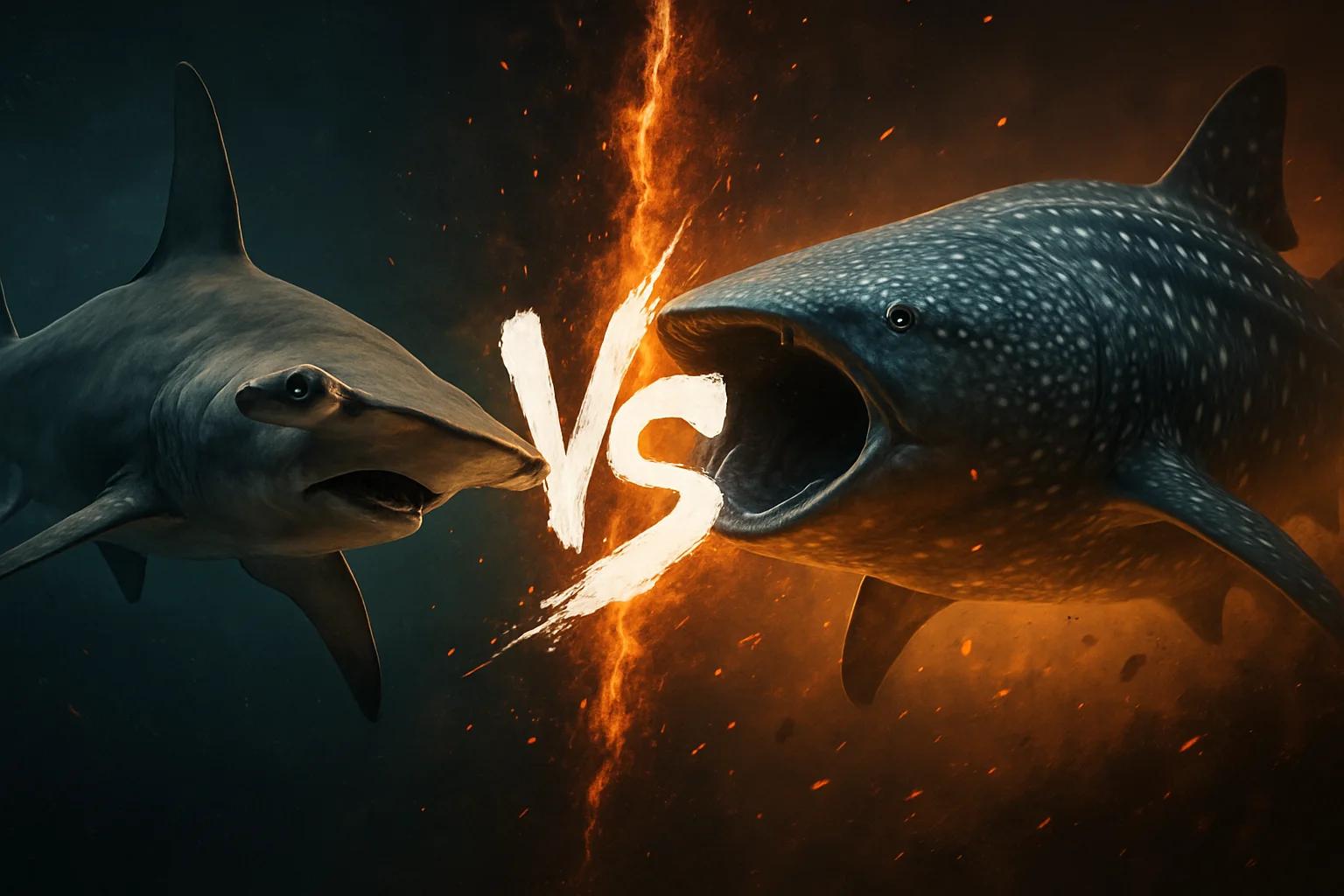
Scalloped Hammerhead vs Whale Shark: Who Actually Wins?
The whale shark wins, and not narrowly. A scalloped hammerhead is a capable predator, usually 2–3 m long, with a sensor-packed head, good acceleration, and a mouth built for squid and reef fish. A whale shark is the largest fish on Earth, commonly 5.5–10 m and sometimes more, with skin roughly 10 cm thick and a body mass more than 50 times greater. The hammerhead has no tool that can reach anything vital. Its bite is sized for prey it can swallow, and against a whale shark it would barely mark the hide. The whale shark is a harmless filter feeder with tiny, useless teeth, so it won't 'win' by killing anything. It wins by being impossible to beat. The hammerhead runs out of options long before the whale shark runs out of body. The only real exception is a newborn or very small juvenile whale shark, which is vulnerable to predatory sharks.
Read comparison
Discussion
What do you think?
Share your reasoning with other readers. Be civil and stick to the animals.
Sign in to join the discussion.
Sign inNo comments yet. Start the conversation.