

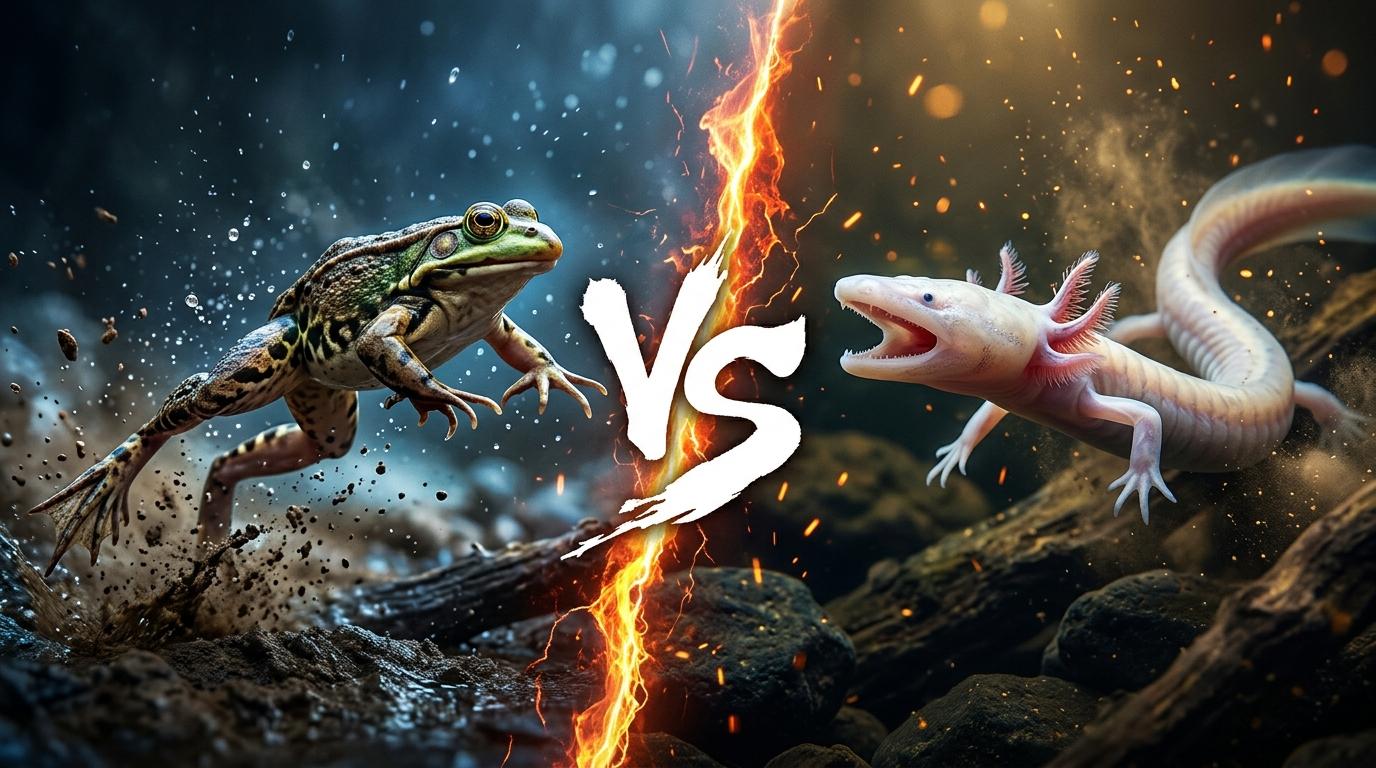
Marsh Frog vs Olm: Who Actually Wins?
Marsh frog vs olm: who would win? A biology-first comparison of Europe's loudest pond predator and its blind cave salamander, covering power, senses, endurance and habitat.
Marsh Frog vs Olm
Matchup winner
Marsh Frog
Quick verdict
Start with the direct answer, then use the structured comparison below to see what changes the outcome.
The marsh frog wins. Pelophylax ridibundus is Europe's largest native water frog. It is a gape-limited ambush predator with a wide mouth and a fast-launching tongue, and it often eats newts, tadpoles and even smaller frogs. The olm (Proteus anguinus) is a slender, blind cave salamander. Its build is tuned for extreme energy saving: it can survive years without food, lives for a century or more, and senses prey through electroreception and chemoreception. Those traits are superb for survival but poor for confrontation. Its body is long, soft-skinned and weak-jawed, and its external gills are fragile and exposed. In any shared, lit, open-water setting, the frog's explosive strike and appetite for elongated amphibian prey decide the outcome quickly. The olm's best card is simply never meeting the frog, because no marsh frog can follow it into flooded karst darkness.
Read the full explanation
Marsh frog wins most realistic encounters thanks to an explosive lunge, a wide gape and a habit of eating other amphibians.
Olm is built for starvation-proof endurance, not combat. Its jaws are small and its frilly gills are a vulnerability.
In total darkness the olm's electrosense narrows the gap, but it still has no real way to hurt the frog.
Overall: Marsh Frog, with about 82% confidence.
Reader vote
Who do you think wins?
Pick a side — no account needed. Results update live.
No votes yet — be the first to call it.
Editorial note
Why people disagree
The olm looks like a mini dragon and lives over 100 years, so people assume it must be tough. In reality, longevity reflects a slow metabolism, not fighting ability.
Explosive power
Encounters between small amphibians are decided in the first strike, and only the frog can deliver one.
Ambush control
The frog's menu already includes newt-shaped prey, so it is mentally and mechanically 'set' to attack the olm.
Close-range durability
The olm's gills are a soft, critical target that the frog can damage without needing precision.
Read the full explanation +
Size numbers are close. The olm is longer (up to ~30 cm), but most of that length is thin tail and body, while the frog's mass sits in launch muscles and head.
The two species almost never share habitat. Olms only surface when floods flush them out of caves, so any 'fight' is a thought experiment about the frog's home turf.
Comparison FAQ
Short, direct answers to the next questions readers usually ask after the headline verdict.
Would a marsh frog beat an olm in a fight?+
Yes. In nearly any shared, lit aquatic setting, the marsh frog would dominate. It can seize and attempt to swallow or injure the olm, while the olm has no effective counterattack.
Which is stronger, the marsh frog or the olm?+
The marsh frog is far stronger for its size, with powerful hind legs and a forceful head-first lunge. The olm's musculature is built for slow, efficient swimming rather than force.
Could a marsh frog actually eat an olm?+
A large marsh frog could plausibly swallow a juvenile or small olm, since it eats newts of similar shape. A full-grown 25 to 30 cm olm would be too long to swallow whole, but it could still be injured.
Why is the olm still dangerous to beat?+
It is extremely hard to catch on its own terms. In darkness, its electroreception and smell detect threats early, and its ability to fast for years means it never has to risk a contested resource. In practice, the olm 'wins' by being somewhere the frog cannot follow.
Do marsh frogs and olms ever meet in the wild?+
Very rarely. They overlap geographically in parts of the Balkans, but olms stay in subterranean karst water. Floods occasionally wash olms into surface springs, which is the only realistic meeting point.
Head-to-head species stats
These are the same core AnimalDex stat dimensions used on the dedicated animal pages, pulled side by side so the matchup is faster to scan.
Marsh Frog
Tier DOlm
Tier CTrait-by-trait comparison
Only the categories that matter to this matchup are included. The goal is not filler stats, but the real design differences that change the result.
Powerful hind-leg launch and lunge strike
Explosive power
Marsh Frog
Slow eel-like swimming, minimal burst
Explosive power
Marsh Frog
Sit-and-wait gulper that takes anything it can swallow
Ambush control
Marsh Frog
Patient forager on tiny crustaceans
Ambush control
Marsh Frog
Firm-bodied with mildly protective skin secretions
Close-range durability
Marsh Frog
Thin, unpigmented skin and exposed external gills
Close-range durability
Marsh Frog
Vision-led hunter, weak in total darkness
Sensory reach in darkness
Olm
Electroreception, acute smell and vibration sensing
Sensory reach in darkness
Olm
Needs regular feeding through the active season
Starvation endurance
Olm
Can go roughly a decade without food
Starvation endurance
Olm
Thrives in sunny ponds, ditches and rivers
Habitat leverage
Marsh Frog
Locked to cold, stable cave water
Habitat leverage
Marsh Frog
How the verdict forms
Verdict timeline
01 · Explosive power
Marsh Frog
02 · Ambush control
Marsh Frog
03 · Close-range durability
Marsh Frog
04 · Sensory reach in darkness
Olm
05 · Starvation endurance
Olm
06 · Habitat leverage
Marsh Frog
Change the conditions
Scenario breakdown
This is where shallow battle content usually fails. Terrain, spacing, timing, and engagement style can change the answer.
Scenario lean
Marsh Frog
Verdict confidence
82%
A clear frog win.
In warm, lit water, the frog has its full visual targeting and a high metabolism. Meanwhile the olm is light-sensitive, stressed by warmth and highly visible because it is pale. The frog's lunge-and-gulp strategy targets exactly this kind of slow, elongated prey.
AnimalDex field profiles
Explore these animals
Marsh Frog
Pelophylax ridibundus
marsh, pond, and slow river edge
Olm
Proteus anguinus
limestone cave water and underground karst river systems
Systems Intelligence & Hidden Purpose
See the animals behind this comparison as engineered biological systems: what each one is built to do, where it gains leverage, and why the matchup changes by scenario.
Specialized Hardware
large green water-frog body, strong jumping hind legs, and loud reedside croaking give the Marsh Frog a body plan tuned for its niche.
Systems Script
Marsh Frogs operate through marsh, pond, and slow river edge. Their design links movement, feeding, shelter, and timing into one workable survival system.
Strategic Insight
Where water controls movement, position and timing often matter more than speed.
Specialized Hardware
blind cave-dwelling body, external gills, and extreme low-energy underground life give the Olm a body plan tuned for its niche.
Systems Script
Olms operate through limestone cave water and underground karst river systems Their design links movement, shelter, and feeding into one workable survival system.
Strategic Insight
When resources are scarce and conditions are stable, slowing the whole system down can be a winning strategy.
Final take
The marsh frog is the overall winner. It is a compact, muscle-loaded ambush eater whose diet already includes newts and salamander-shaped animals. The olm brings no bite, armor or speed to counter that first lunge, and its delicate external gills make any contact costly.
Read the full explanation
The olm is not a lesser animal, just one optimized for a different contest. It is one of the most extreme survival specialists in the vertebrate world, with century-long lifespans, years of fasting and a sensory toolkit for absolute darkness. If the question is 'who lasts longest,' the olm wins easily. If the question is 'who wins the encounter,' it is the frog.
Collect both animals in AnimalDex
Track the species behind this matchup, compare their real traits, and build the rivalry into your AnimalDex collection.
Related comparisons
Continue with nearby matchups to compare more real-world animal traits without dropping into junky who-wins filler.

Dusky Gopher Frog vs Olm: Who Actually Wins?
The dusky gopher frog wins this matchup. The olm is roughly two to three times longer, but most of that length is a slender, weakly muscled body built to conserve energy in cold, food-poor cave water, not to grapple. The gopher frog is the opposite: a compact, stocky sit-and-wait predator with a wide gape and powerful hind limbs. It is willing to swallow anything that fits, including other frogs, and its warty skin releases bitter, sticky secretions that make it unpleasant to bite. The olm keeps a real edge in total darkness and cold water, where its electroreception and chemical senses let it track the frog without sight. In most frames, though, the frog's muscle density, ambush strike, and chemical defense decide the encounter before the olm's patience matters.
Read comparison
Common Tree Frog vs Marsh Frog: Who Actually Wins?
The Marsh Frog wins, and it is not close. Pelophylax ridibundus is Europe's largest native water frog. Big females reach about 15 cm and can weigh well over 100 g. The Common Tree Frog (Hyla arborea) is a 4–5 cm, single-digit-gram climber. That is roughly a 10–20x mass gap. Marsh Frogs are gape-limited opportunists that swallow insects, small fish, tadpoles and smaller frogs whole. A tree frog fits inside that prey window. Any contact on the water's edge, in open ground or around a shared pond ends with the tree frog being treated as food. The tree frog's real answer is not fighting. It escapes upward with adhesive toe pads into reeds and shrubs where the heavy, ground-and-water-bound Marsh Frog cannot follow. That makes the tree frog a survivor, never a winner.
Read comparison
Alpine Newt vs Marsh Frog: Who Actually Wins?
The Marsh Frog wins this matchup clearly. Pelophylax ridibundus is Europe's largest native water frog. Big females can approach 15 cm and well over 100 g. It is a sit-and-lunge generalist predator with a wide gape, a fast sticky tongue and a documented habit of swallowing smaller amphibians whole. The Alpine Newt (Ichthyosaura alpestris) is roughly 8–12 cm from snout to tail tip, and much of that length is tail, so it carries a fraction of the frog's body mass. Its real defense is chemistry: skin secretions that make it unpleasant to eat, plus a bright orange belly that warns predators. That defense can make a frog spit a newt out or hesitate. It does nothing to stop the initial strike. In most realistic encounters the frog sets the terms.
Read comparison
Marsh Frog vs Smooth Newt: Who Actually Wins?
The Marsh Frog wins, and it is not especially close. As one of Europe's largest native frogs, Pelophylax ridibundus can reach about 15 cm and weigh several times more than a Smooth Newt, which usually measures 7–11 cm including its tail. That size gap matters most because of gape. A marsh frog is a sit-and-lunge predator with a wide mouth and a fast tongue-and-jaw strike, and it is documented eating small amphibians, including newts and tadpoles. The Smooth Newt has no bite worth fearing at this scale, and its main defenses are its slippery, mildly distasteful skin secretions, quick tail-driven swimming, and dense weed cover. Those tools can make a frog spit it out or lose track of it, but they cannot turn the newt into the aggressor. In any direct encounter, the frog controls the outcome, and the newt's realistic best result is escape.
Read comparison
Discussion
What do you think?
Share your reasoning with other readers. Be civil and stick to the animals.
Sign in to join the discussion.
Sign inNo comments yet. Start the conversation.