


Mudskipper vs Smalltooth Sawfish: Who Actually Wins?
Mudskipper vs smalltooth sawfish: a biology-first breakdown of size, weaponry, habitat edges and survival tricks, and why the sawfish wins a real confrontation.
Mudskipper vs Smalltooth Sawfish
Matchup winner
Smalltooth Sawfish
Quick verdict
Start with the direct answer, then use the structured comparison below to see what changes the outcome.
The smalltooth sawfish wins, and it isn't close in a straight confrontation. A full-grown Pristis pectinata can pass 5 meters and carries a rostrum lined with tooth-like denticles. It uses that saw to slash through schools of fish and pin prey on the bottom, and a palm-sized mudskipper falls squarely into its menu bracket. The sawfish also hunts in exactly the warm, shallow mangrove and estuary margins where mudskippers live. The mudskipper's real edge is not combat. It is escape: it breathes air, crawls on its fins and can simply leave the water onto mudflats where no sawfish can follow. So the honest answer is that the sawfish dominates any encounter in water, and the mudskipper survives by refusing to fight there at all.
Read the full explanation
Overall winner: Smalltooth Sawfish. It has a massive size advantage, a slashing rostrum and electroreceptive prey detection.
A mudskipper is plausible prey for a sawfish in shallow estuaries.
The mudskipper's best move is leaving the water. Above the tideline, the sawfish cannot reach it.
Out of water the fight never happens, which is a draw by avoidance, not a mudskipper victory.
Reader vote
Who do you think wins?
Pick a side — no account needed. Results update live.
No votes yet — be the first to call it.
Editorial note
Why people disagree
Some readers count 'can't be caught' as winning. The mudskipper's mudflat escape is genuinely elite, but avoiding a fight isn't winning one.
Raw size and mass
A size gap this large means a single contact decides the outcome. The mudskipper has no way to absorb it.
Weaponry
The saw is built to stun and disable small schooling fish, which is exactly the mudskipper's body plan.
Sensory targeting
In murky estuary water, the sawfish can sense a hidden fish's muscle activity without seeing it at all.
Read the full explanation +
The two species overlap in mangrove shallows, so the matchup is less absurd than it looks. That makes habitat edges the whole debate.
People often confuse sawfish with sawsharks or assume the saw is a stabbing spear. In reality it is a sweeping sensory weapon, and that makes it even better against small, darting fish.
Comparison FAQ
Short, direct answers to the next questions readers usually ask after the headline verdict.
Would a smalltooth sawfish beat a mudskipper?+
Yes. In any underwater encounter, the sawfish's size, saw and electroreception make the mudskipper easy prey.
Which is stronger, a mudskipper or a sawfish?+
The sawfish, by orders of magnitude. It can weigh hundreds of kilograms, while a mudskipper weighs only a few grams.
Do sawfish actually eat mudskippers?+
Smalltooth sawfish eat small fish and crustaceans in shallow mangrove habitats, and mudskipper-sized fish fit that diet. The catch is geography. Periophthalmus mudskippers live in Africa and the Indo-Pacific, while smalltooth sawfish today survive mainly around Florida and the Bahamas, so these two species rarely if ever meet. Sawfish relatives that share Indo-Pacific mangroves with mudskippers fill the same predator role, which is why the matchup is still a fair test.
How could the mudskipper survive?+
By leaving the water. Mudskippers breathe air and move across mud, which puts them completely out of a sawfish's reach.
Why does the losing mudskipper stay dangerous at all?+
It isn't dangerous to the sawfish. It is dangerous as a survivor: alert eyes, fast hops and land access make it very hard to catch near the shore.
Is the smalltooth sawfish endangered?+
Yes. It is critically endangered, largely because of fishing nets and the loss of mangrove nursery habitat.
Head-to-head species stats
These are the same core AnimalDex stat dimensions used on the dedicated animal pages, pulled side by side so the matchup is faster to scan.
Mudskipper
Tier CSmalltooth Sawfish
Tier BTrait-by-trait comparison
Only the categories that matter to this matchup are included. The goal is not filler stats, but the real design differences that change the result.
Roughly 10–25 cm, a few grams
Raw size and mass
Smalltooth Sawfish
Up to 5+ m, hundreds of kilograms
Raw size and mass
Smalltooth Sawfish
Small jaws for crabs and insects
Weaponry
Smalltooth Sawfish
Toothed rostrum for slashing and pinning
Weaponry
Smalltooth Sawfish
Raised, mobile eyes for scanning above water
Sensory targeting
Smalltooth Sawfish
Electroreceptors packed into the rostrum
Sensory targeting
Smalltooth Sawfish
Air-breathing, skips and crawls across mud
Escape options
Mudskipper
Fully aquatic, limited to water depth
Escape options
Mudskipper
Quick bursts and skipping hops
Shallow-water agility
Mudskipper
Powerful but broad-bodied in the shallows
Shallow-water agility
Mudskipper
Territorial over burrows
Habitat dominance
Smalltooth Sawfish
Apex-level ray of the estuary
Habitat dominance
Smalltooth Sawfish
How the verdict forms
Verdict timeline
01 · Raw size and mass
Smalltooth Sawfish
02 · Weaponry
Smalltooth Sawfish
03 · Sensory targeting
Smalltooth Sawfish
04 · Escape options
Mudskipper
05 · Shallow-water agility
Mudskipper
06 · Habitat dominance
Smalltooth Sawfish
Change the conditions
Scenario breakdown
This is where shallow battle content usually fails. Terrain, spacing, timing, and engagement style can change the answer.
Scenario lean
Smalltooth Sawfish
Verdict confidence
82%
Fast and decisive sawfish win.
With no mudflat to reach, the mudskipper is a small, weak swimmer in the sawfish's home medium. One lateral sweep of the rostrum stuns it, and the sawfish then pins it against the bottom and swallows. Electroreception defeats any attempt to hide in sediment.
AnimalDex field profiles
Explore these animals
Mudskipper
Periophthalmus argentilineatus
mudflat, mangrove, and tidal estuary
Smalltooth Sawfish
Pristis pectinata
estuary, seagrass flat, mangrove edge, and warm coastal water
Systems Intelligence & Hidden Purpose
See the animals behind this comparison as engineered biological systems: what each one is built to do, where it gains leverage, and why the matchup changes by scenario.
Specialized Hardware
walking fin-like limbs, bulging above-water eyes, and land-and-water living give the Mudskipper a body plan tuned for its niche.
Systems Script
Mudskippers operate through mudflat, mangrove, and tidal estuary Their design links movement, shelter, feeding, and survival into one workable system.
Strategic Insight
Edge spaces reward systems that can handle both sides of the border.
Specialized Hardware
saw-like toothy snout, shallow coastal movement, and bottom-hunting glide give the Smalltooth Sawfish a body plan tuned for its niche.
Systems Script
Smalltooth Sawfishs operate through estuary, seagrass flat, mangrove edge, and warm coastal water Their design links movement, shelter, feeding, and survival into one workable system.
Strategic Insight
Unique tools can become vulnerable when the whole operating space shrinks.
Final take
The smalltooth sawfish is the clear winner. It is a huge, electro-sensing ray armed with a purpose-built saw, and a mudskipper is roughly the kind of animal that saw evolved to handle.
Read the full explanation
The mudskipper deserves respect for a different kind of excellence. It solved the predator problem by leaving the water. Wherever the mudflat is within reach, the sawfish simply runs out of world.
Count only what happens when they actually meet, and the scorecard reads sawfish in three of four contexts. The one exception is the escape, which only proves the point.
Collect both animals in AnimalDex
Track the species behind this matchup, compare their real traits, and build the rivalry into your AnimalDex collection.
Related comparisons
Continue with nearby matchups to compare more real-world animal traits without dropping into junky who-wins filler.
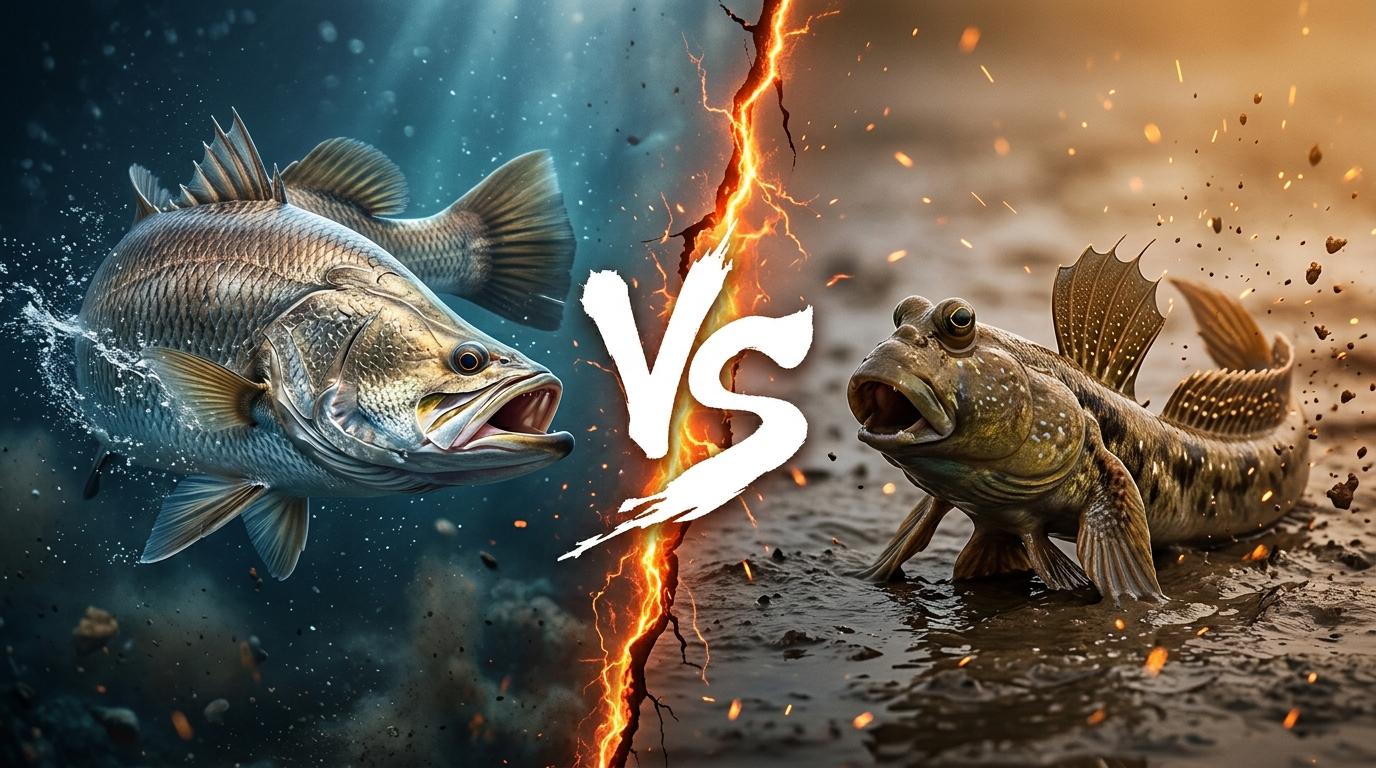
Barramundi vs Mudskipper: Who Actually Wins?
The barramundi wins overall, and in open water it is barely a contest. Lates calcarifer is a powerful estuarine ambush predator that can grow past a meter long. It feeds by suction: it flares its huge mouth and inhales prey whole in a fraction of a second. Small fish like mudskippers sit squarely on its menu. The mudskipper usually measures 10–20 cm and has no bite or armor that can hurt a barramundi. Its real weapon is leaving the water. It breathes through moist skin and gill chambers, skips across mud with its pectoral fins, and retreats into burrows a barramundi cannot follow. So the mudskipper doesn't win fights; it refuses them. Wherever the water is deep enough to swim, the barramundi is the clear winner.
Read comparison
Archerfish vs Mudskipper: Who Actually Wins?
The banded archerfish wins overall. At up to roughly 20–30 cm and deep-bodied, it outweighs most mudskippers several times over. It is a fast, maneuverable open-water swimmer with a visual system tuned to correct for refraction, and in water it can simply overpower, bite, and outlast a smaller goby. The mudskipper's genius is amphibious escape: it breathes air through its skin and gill chambers, skips across exposed mud, and retreats into burrows the archerfish can't follow. So the fight goes to the archerfish wherever water is deep enough to swim, while the mudskipper's real win condition is leaving the fight entirely.
Read comparison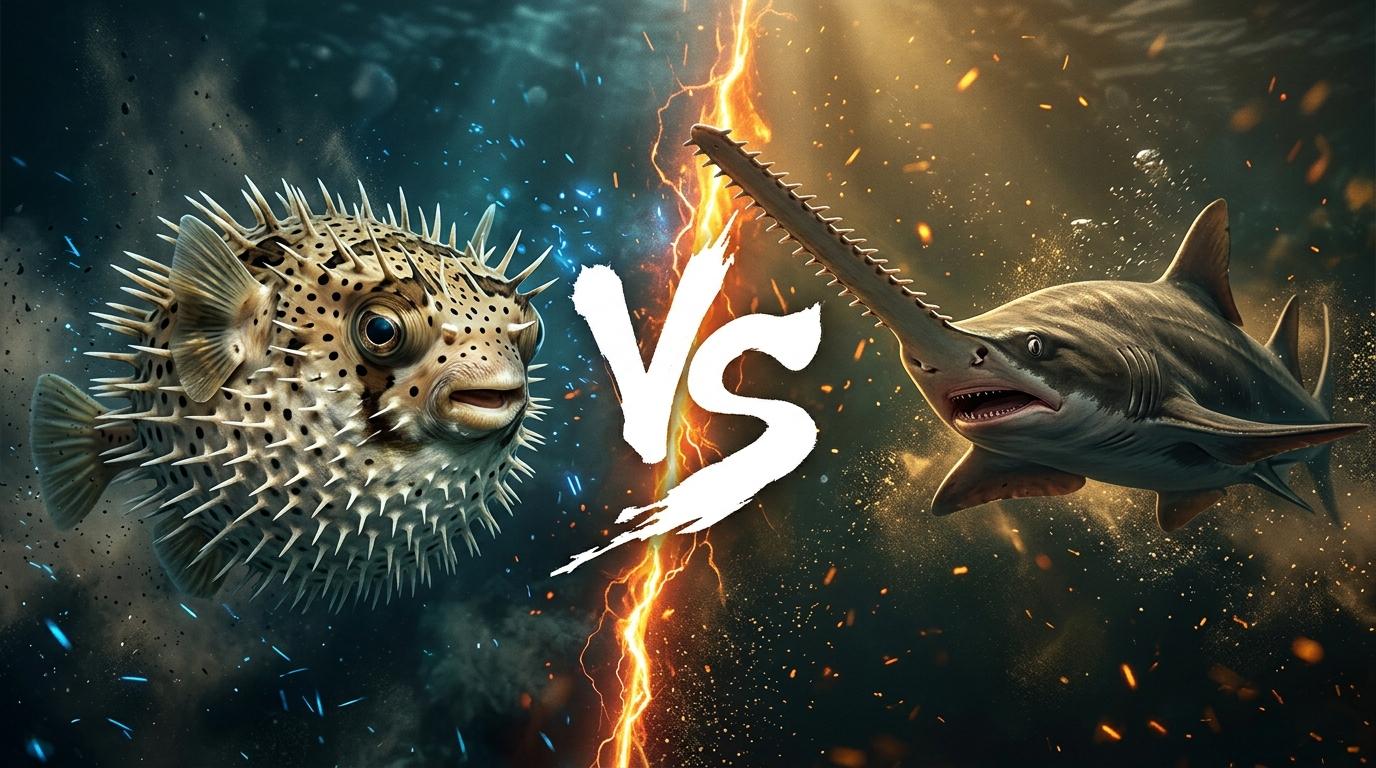
Spot-fin Porcupinefish vs Smalltooth Sawfish: Who Actually Wins?
The smalltooth sawfish wins, and it is not especially close. An adult Pristis pectinata can stretch past 5 meters, and its rostrum, a flattened saw lined with tooth-like denticles and packed with electroreceptors, is built to detect and slash small fish in the water column and pin them to the seabed. The spot-fin porcupinefish tops out around 70–90 cm. Its whole survival plan is to inflate into a spiny ball and carry tetrodotoxin that punishes anything that swallows it. That plan works against predators that bite and gulp. The sawfish does not have to do either. It can strike, stun and reposition prey with its saw, and if the puffer stays inflated and dangerous, the sawfish can simply leave it alone. The porcupinefish can make itself unappealing, but it cannot impose an outcome on an animal fifteen to twenty-five times its length.
Read comparison
Discussion
What do you think?
Share your reasoning with other readers. Be civil and stick to the animals.
Sign in to join the discussion.
Sign inNo comments yet. Start the conversation.