


Narwhal vs Walrus: Who Actually Wins?
Narwhal vs walrus: who would win? A biology-first breakdown of size, tusks, armor, and Arctic behavior shows why the walrus takes this matchup.
Narwhal vs Walrus
Matchup winner
Walrus
Quick verdict
Start with the direct answer, then use the structured comparison below to see what changes the outcome.
The walrus wins. Both are Arctic tusk-bearers of similar length, but they are built for different jobs. An adult male walrus can top 1,200–1,500 kg, roughly double a large male narwhal at 800–1,600 kg with much of that in a slender body. The walrus carries skin up to 4 cm thick on the neck and shoulders, a dense fat layer, and two downward-driving ivory tusks it uses every breeding season in shoving, stabbing duels with rival bulls. The narwhal's famous spiral 'horn' is an elongated canine tooth. It is packed with nerve endings and works mainly as a sensory and display organ. It is a brittle-tipped signal of quality, not a lance designed to pierce armored opponents. The narwhal is faster, a far deeper diver, and smarter in open water, so it can almost always avoid the fight. If contact happens, though, the walrus's mass, armor, and real combat experience decide it.
Read the full explanation
Walrus wins most realistic encounters thanks to greater mass, thick armored hide, and tusks used routinely in combat.
The narwhal tusk is a sensory organ and status signal. It is not built for stabbing a 1-ton armored pinniped.
Narwhal's best outcome is escape. It out-dives and out-maneuvers the walrus in deep water.
Real-world contact is rare. They share Arctic waters but hunt at different depths and almost never clash.
Reader vote
Who do you think wins?
Pick a side — no account needed. Results update live.
No votes yet — be the first to call it.
Editorial note
Why people disagree
The 'unicorn horn' looks like a spear, so people assume the narwhal is the armed one. Biology says the walrus's paired tusks are the true weapons.
Raw mass
Comparable top weights, but walrus mass is concentrated in a thick, shove-ready forequarters that turns collisions in its favor.
Weapon design
Walrus tusks are rooted for hauling out and hooking rivals. The narwhal tusk risks breakage and is nerve-rich, so using it as a weapon hurts its owner too.
Close-range durability
Walrus neck and shoulder skin evolved to absorb tusk strikes from other walruses, which makes it natural armor against a narwhal jab.
Read the full explanation +
Narwhals are faster and dive past 1,500 m, so fans argue the walrus can't catch them. That's true, but escaping is not winning a fight.
Walruses look slow and lumpy on ice, which hides how violent and durable bulls are in the water during breeding disputes.
Comparison FAQ
Short, direct answers to the next questions readers usually ask after the headline verdict.
Would a narwhal beat a walrus in a fight?+
Usually not. In a committed fight the walrus wins because of its thick armored hide, dense build, and two combat tusks. The narwhal's best move is to swim away.
Which is stronger, a narwhal or a walrus?+
The walrus. Bulls have massive neck and shoulder muscles, used to haul their bulk onto ice with their tusks and to shove rivals, so they deliver more close-range force.
Can a narwhal's tusk pierce a walrus?+
It is unlikely to do serious damage. The tusk is a nerve-filled tooth that can snap, and walrus hide up to 4 cm thick plus blubber is built to absorb tusk strikes.
Why is the narwhal still dangerous?+
A narwhal can weigh well over a ton and moves fast. A tusk jab can still wound soft areas. Its speed and diving let it dictate engagement, so a walrus could never chase one down in deep water.
Do narwhals and walruses actually fight?+
There are no well-documented fights. They overlap in Arctic waters but feed differently: walruses work shallow seafloors for clams, while narwhals hunt fish and squid at depth. Orcas and polar bears are their real threats.
Head-to-head species stats
These are the same core AnimalDex stat dimensions used on the dedicated animal pages, pulled side by side so the matchup is faster to scan.
Narwhal
Tier BWalrus
Tier BTrait-by-trait comparison
Only the categories that matter to this matchup are included. The goal is not filler stats, but the real design differences that change the result.
Up to ~1,600 kg, streamlined
Raw mass
Walrus
Bulls up to ~1,500+ kg, extremely dense
Raw mass
Walrus
Single sensory spiral tusk
Weapon design
Walrus
Twin downward-stabbing tusks
Weapon design
Walrus
Smooth skin, blubber
Close-range durability
Walrus
Up to 4 cm hide plus blubber shield
Close-range durability
Walrus
Ritual tusk 'fencing'
Combat experience
Walrus
Bloody dominance battles
Combat experience
Walrus
Fast, elite deep diver
Open-water mobility
Narwhal
Slow, shallow benthic forager
Open-water mobility
Narwhal
Echolocation plus tusk sensing
Sensory intelligence
Narwhal
Whisker touch, limited sonar
Sensory intelligence
Narwhal
How the verdict forms
Verdict timeline
01 · Raw mass
Walrus
02 · Weapon design
Walrus
03 · Close-range durability
Walrus
04 · Combat experience
Walrus
05 · Open-water mobility
Narwhal
06 · Sensory intelligence
Narwhal
Change the conditions
Scenario breakdown
This is where shallow battle content usually fails. Terrain, spacing, timing, and engagement style can change the answer.
Scenario lean
Walrus
Verdict confidence
82%
Walrus dominates tight spaces.
Among broken ice and shallow edges, the narwhal loses its speed and depth advantages. The walrus can close, hook downward with its tusks, and use its body weight to pin. The narwhal's single forward tusk is awkward at close range and vulnerable to snapping.
AnimalDex field profiles
Explore these animals
Narwhal
Monodon monoceros
High Arctic marine waters, deep fjords, and ice-associated coastal seas.
Walrus
Odobenus rosmarus
Arctic seas, ice edges, and shallow marine feeding grounds.
Systems Intelligence & Hidden Purpose
See the animals behind this comparison as engineered biological systems: what each one is built to do, where it gains leverage, and why the matchup changes by scenario.
Specialized Hardware
Long spiral tusk on many males, mottled gray-and-white body, and rounded head without a large dorsal fin give the Narwhal a body plan tuned for its niche.
Systems Script
Narwhals operate in high Arctic marine waters, deep fjords, and ice-associated coastal seas. Their design helps them match food access, shelter, and timing inside that environment.
Strategic Insight
A rare design can still be perfectly tuned to a very narrow world.
Specialized Hardware
Long ivory tusks, heavy wrinkled brown body, and dense whiskers around the muzzle give the Walrus a body plan tuned for its niche.
Systems Script
Walruss operate in arctic seas, ice edges, and shallow marine feeding grounds. Their design helps them match food access, shelter, and timing inside that environment.
Strategic Insight
Scale works best when it is paired with a reliable platform to rest, gather, and launch from.
Final take
The walrus wins the narwhal vs walrus matchup. It is the heavier-built, better-armored, combat-tested animal, and its tusks are actual weapons. The narwhal's tusk is a remarkable sensory and signaling tool, but it was not designed to win fights against armored opponents.
Read the full explanation
The narwhal is no pushover. It has the advantages that matter for survival: speed, depth, echolocation, and the intelligence to avoid trouble. In nature that usually means no fight happens at all. On a forced-contact verdict, though, it's the walrus.
Collect both animals in AnimalDex
Track the species behind this matchup, compare their real traits, and build the rivalry into your AnimalDex collection.
Related comparisons
Continue with nearby matchups to compare more real-world animal traits without dropping into junky who-wins filler.

Beluga Whale vs Walrus: Who Actually Wins?
The walrus wins. A big bull walrus weighs 1,200–1,500 kg, roughly the same as or heavier than an adult male beluga at 1,100–1,600 kg. The weight is close, but the hardware is not. The walrus carries ivory tusks up to a meter long, and its neck and shoulders are wrapped in hide 2–4 cm thick that evolved for stabbing contests with other bulls. The beluga has no weapon better than a mouth of small, peg-like teeth built for grabbing fish and squid, and its defense depends on avoiding trouble. Belugas really do fear walruses. Walruses have been recorded attacking and killing belugas trapped in ice openings, and belugas in Hudson Bay and the Canadian Arctic tend to steer clear of them. The beluga is faster, smarter, and more agile in open water, so it usually escapes. If the fight actually happens, though, the walrus's tusks, armor, and aggression decide it.
Read comparison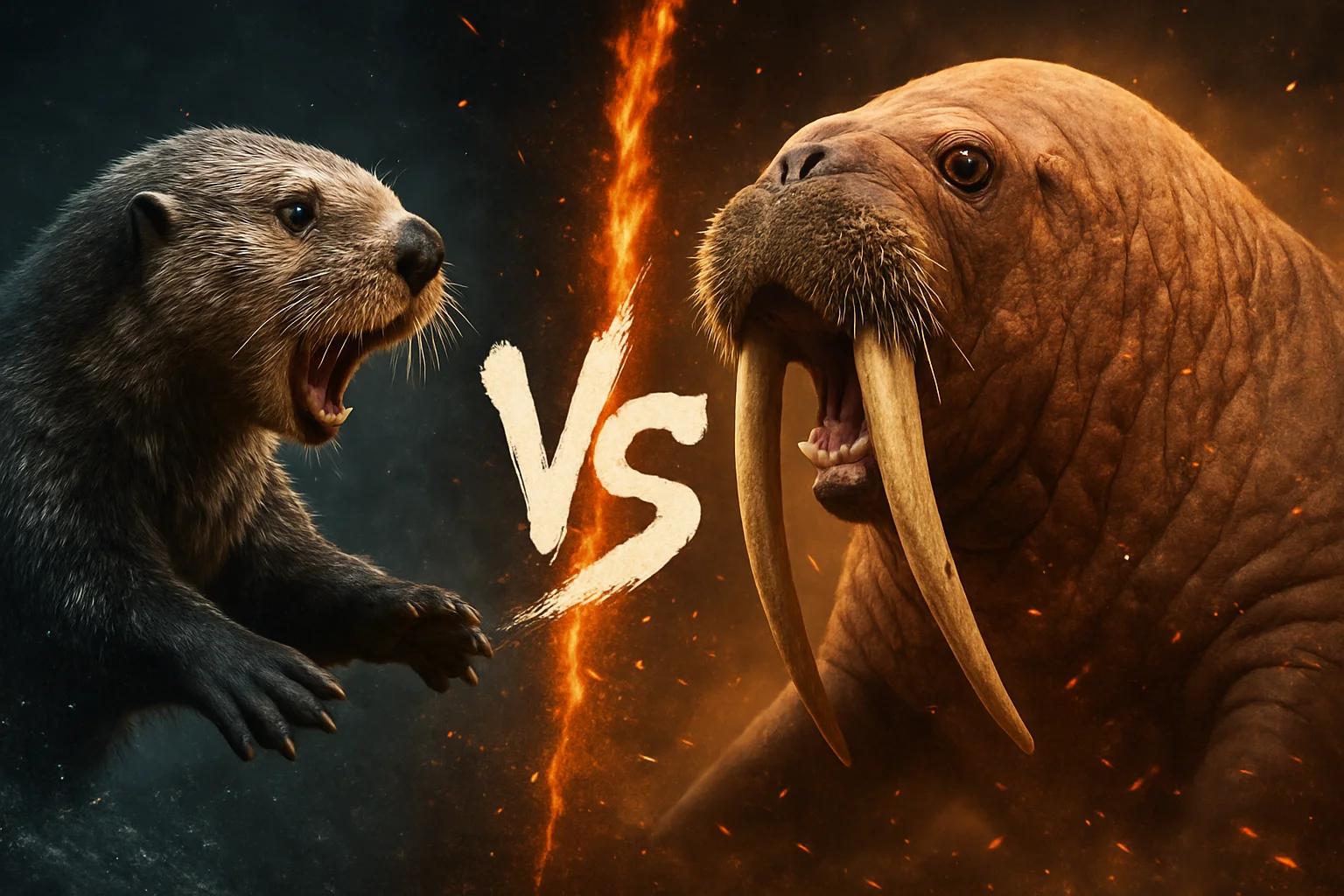
Sea Otter vs Walrus: Who Actually Wins?
The walrus wins, and it isn't close. An adult male walrus can weigh 800–1,700 kg (1,800–3,700 lb) against a sea otter's 14–45 kg (30–100 lb), a mass gap of roughly 30 to 1 or more. The walrus brings tusks up to a meter long, skin several centimeters thick over a deep blubber layer, and a neck and shoulder build forged in brutal male-on-male tusk fights. The sea otter has real strengths: it is quick, clever, dexterous, and has a bite strong enough to crack urchins and clams. But nothing in its toolkit can get through a walrus's armor. Its best play is speed and retreat, not victory.
Read comparison
Discussion
What do you think?
Share your reasoning with other readers. Be civil and stick to the animals.
Sign in to join the discussion.
Sign inNo comments yet. Start the conversation.