

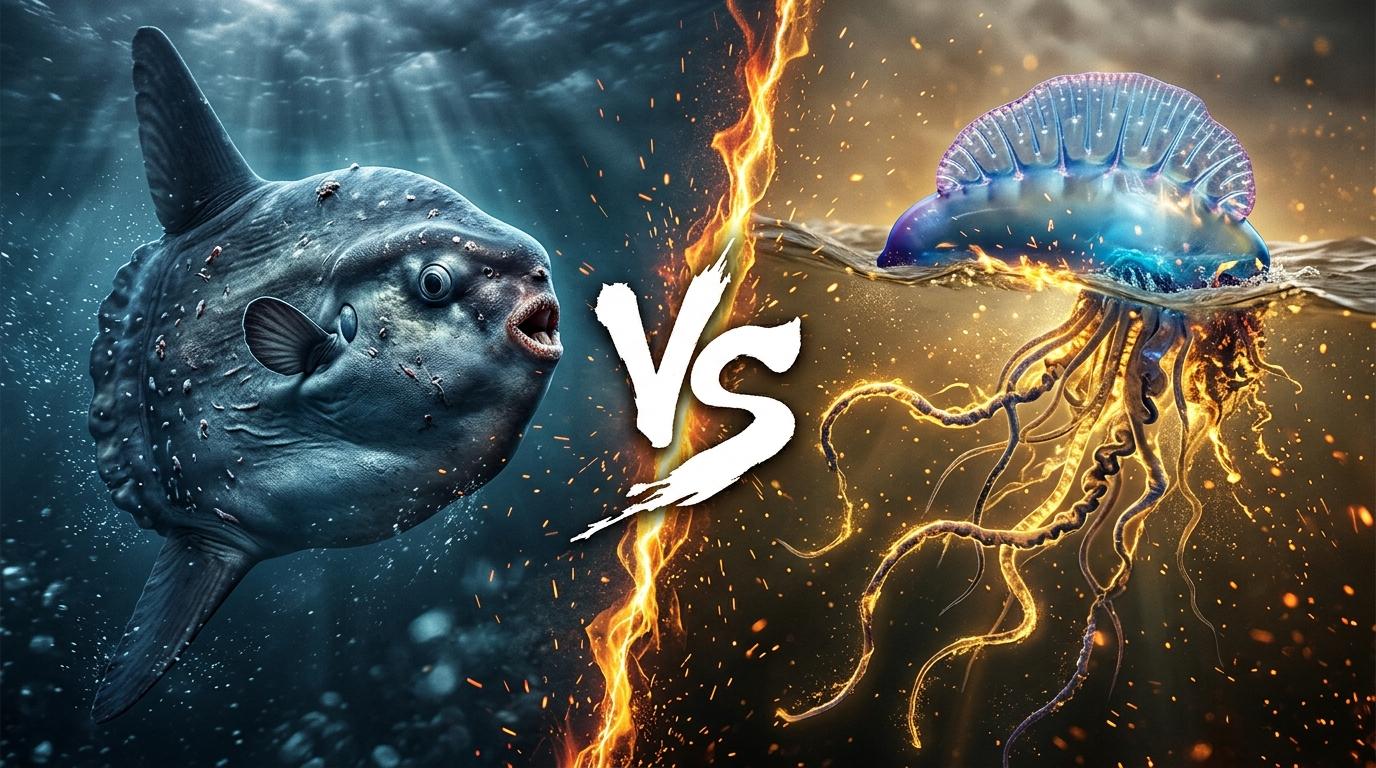
Ocean Sunfish vs Portuguese Man o' War: Who Actually Wins?
Ocean sunfish vs Portuguese man o' war: who wins? A biology-first look at size, armor, venom, and why one of these drifters treats the other as food.
Ocean Sunfish vs Portuguese Man o' War
Matchup winner
Ocean Sunfish
Quick verdict
Start with the direct answer, then use the structured comparison below to see what changes the outcome.
The Ocean Sunfish wins clearly. This isn't a fight in the usual sense. It's a predator meeting a prey type. Mola mola is a specialist grazer of gelatinous zooplankton, including jellyfish and siphonophores, the group the man o' war belongs to. It brings more than a tonne of body mass, thick leathery skin coated in mucus, and a small beak-like mouth built for tearing soft, stinging prey. The Portuguese man o' war has one real weapon: long tentacles packed with nematocysts, venom capsules designed to paralyze small fish. That weapon is calibrated for prey a fraction of the sunfish's size. It can sting, irritate, and maybe make a bite unpleasant, but it cannot meaningfully hurt an animal this large and this well armored. The colony also cannot swim, steer, or flee. It drifts wherever the wind pushes its float.
Read the full explanation
Ocean Sunfish wins. Gelatinous, stinging animals are its normal diet.
The man o' war's venom is built to stop small fish, not a fish weighing a tonne or more.
The man o' war can't swim or escape. Wind and current decide where it goes.
The man o' war stays dangerous to humans and small fish, just not to the sunfish.
Reader vote
Who do you think wins?
Pick a side — no account needed. Results update live.
No votes yet — be the first to call it.
Editorial note
Why people disagree
People see 'venomous' and assume the stinger automatically wins. Venom only matters relative to the target's size and skin, and the sunfish beats it on both.
Sheer mass
Mass dilutes venom. A dose that stops a sardine barely registers in a body this large.
Close-range durability
Nematocysts fire through thin tissue. A thick, slimy hide blunts most of the delivery.
Chemical weaponry
This is the man o' war's only real edge, and it's why the colony can still deter or injure smaller attackers.
Read the full explanation +
The sunfish looks clumsy and slow, so people underrate it. Its entire design is tuned for eating soft, drifting prey.
The man o' war's reputation comes from painful human stings. That says a lot about thin human skin and very little about how it fares against an armored ocean predator.
Comparison FAQ
Short, direct answers to the next questions readers usually ask after the headline verdict.
Would an ocean sunfish beat a Portuguese man o' war?+
Yes. The sunfish is far larger, thick-skinned, and adapted to eat gelatinous, stinging animals. The man o' war has no way to stop it.
Which is stronger, the ocean sunfish or the man o' war?+
The ocean sunfish, by a huge margin in mass, muscle, and mobility. The man o' war has no muscular strength to speak of. Its power is entirely chemical.
Do ocean sunfish eat Portuguese man o' war?+
Sunfish feed heavily on jellyfish, salps, and siphonophores, the group that includes the man o' war. Loggerhead sea turtles are the best-documented dedicated man o' war eaters, but the sunfish's diet and hardware put the man o' war squarely within its prey profile.
Why is the Portuguese man o' war still dangerous if it loses?+
Its nematocysts deliver painful, sometimes medically serious stings to humans and kill small fish efficiently. Detached tentacles and colonies washed onto beaches can still sting. Losing to a specialist predator doesn't make it harmless to everything else.
Can the man o' war's venom kill a sunfish?+
Not realistically. The venom is effective on small prey, but the sunfish's size and thick, mucus-coated skin make it at most an irritant.
Head-to-head species stats
These are the same core AnimalDex stat dimensions used on the dedicated animal pages, pulled side by side so the matchup is faster to scan.
Ocean Sunfish
Tier CPortuguese Man o' War
Tier CTrait-by-trait comparison
Only the categories that matter to this matchup are included. The goal is not filler stats, but the real design differences that change the result.
Often over a tonne, among the heaviest bony fish
Sheer mass
Ocean Sunfish
Float around 30 cm; tentacles average about 10 m but have almost no mass
Sheer mass
Ocean Sunfish
Thick, rough, mucus-coated hide
Close-range durability
Ocean Sunfish
Soft gelatinous tissue
Close-range durability
Ocean Sunfish
None
Chemical weaponry
Portuguese Man o' War
Dense nematocyst batteries along trailing tentacles
Chemical weaponry
Portuguese Man o' War
Slow but capable; dives deep and steers with its tall fins
Mobility and choice
Ocean Sunfish
No propulsion; sails on the wind
Mobility and choice
Ocean Sunfish
Fused beak-like teeth for tearing gelatinous prey
Feeding hardware fit
Ocean Sunfish
Tentacles that hook small fish and pass them to feeding polyps
Feeding hardware fit
Ocean Sunfish
Fish-level vision and lateral-line senses
Awareness
Ocean Sunfish
No brain; colony runs on simple reflexes
Awareness
Ocean Sunfish
How the verdict forms
Verdict timeline
01 · Sheer mass
Ocean Sunfish
02 · Close-range durability
Ocean Sunfish
03 · Chemical weaponry
Portuguese Man o' War
04 · Mobility and choice
Ocean Sunfish
05 · Feeding hardware fit
Ocean Sunfish
06 · Awareness
Ocean Sunfish
Change the conditions
Scenario breakdown
This is where shallow battle content usually fails. Terrain, spacing, timing, and engagement style can change the answer.
Scenario lean
Ocean Sunfish
Verdict confidence
82%
The sunfish feeds and takes only minor stings.
When the sunfish rises toward a drifting colony, it chooses the angle and bites into soft tissue. Some nematocysts fire against its hide, but its size and skin turn a lethal weapon into a nuisance. The man o' war cannot pull away.
AnimalDex field profiles
Explore these animals
Ocean Sunfish
Mola mola
open ocean and warm-temperate pelagic water
Portuguese Man o' War
Physalia physalis
open ocean surface waters and warm pelagic currents
Systems Intelligence & Hidden Purpose
See the animals behind this comparison as engineered biological systems: what each one is built to do, where it gains leverage, and why the matchup changes by scenario.
Specialized Hardware
enormous flattened body, strange fin-powered swimming, and surface basking behavior give the Ocean Sunfish a body plan tuned for its niche.
Systems Script
Ocean Sunfishs operate through open ocean and warm-temperate pelagic water Their design links movement, shelter, and feeding into one workable survival system.
Strategic Insight
Unusual form can still thrive if it fits the flow of the environment.
Specialized Hardware
gas-filled floating sail, stinging trailing tentacles, and colonial body made of specialized parts give the Portuguese Man o' War a body plan tuned for its niche.
Systems Script
Portuguese Man o' Wars operate through open ocean surface waters and warm pelagic currents Their design links movement, shelter, and feeding into one workable survival system.
Strategic Insight
A coordinated system can look like one body even when it is really many specialists combined.
Final take
The Ocean Sunfish wins because it occupies the man o' war's predator niche. Its body, skin, and mouth are built for eating soft, stinging drifters.
Read the full explanation
The man o' war is a superb design against small fish and an awful surprise for swimmers. Its venom is real, but it is scaled for small prey. Against an armored, tonne-scale grazer, that scaling is the whole story.
Collect both animals in AnimalDex
Track the species behind this matchup, compare their real traits, and build the rivalry into your AnimalDex collection.
Related comparisons
Continue with nearby matchups to compare more real-world animal traits without dropping into junky who-wins filler.
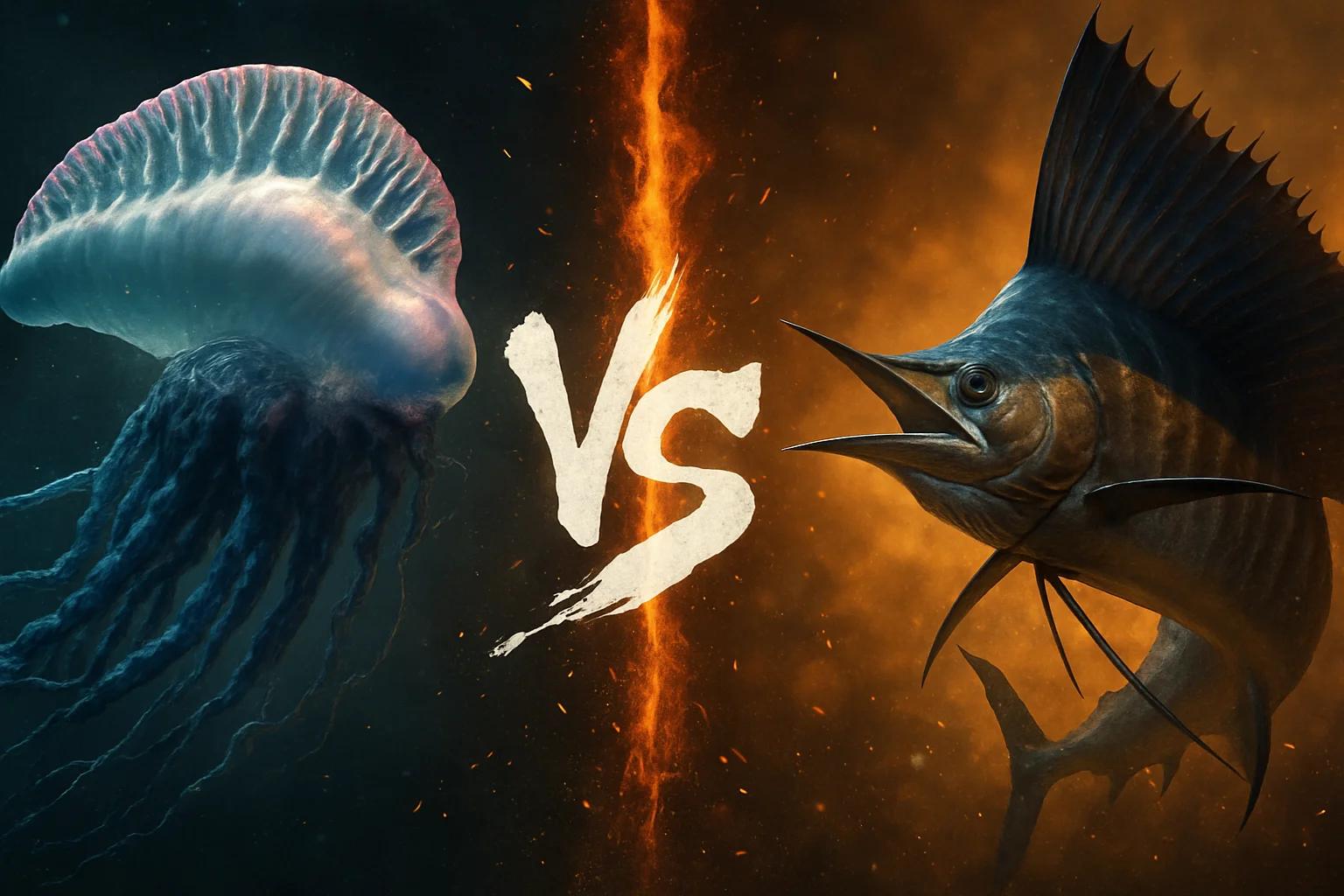
Portuguese Man o' War vs Sailfish: Who Actually Wins?
The sailfish wins, and it isn't close. A Portuguese man o' war is a siphonophore, a floating colony of specialized zooids that cannot steer itself. It drifts on a gas-filled float, pushed by wind, and catches only what blunders into its trailing tentacles. Those tentacles can reach 10 meters or more and carry nematocysts, stinging cells that fire venom on contact and paralyze small fish. A sailfish is a 2–3 meter predator built for burst speed, maneuvering and choosing where it goes. It also has the eyes and judgment to stay away from things that sting. The man o' war can't chase, can't aim and can't force an engagement. The sailfish decides whether contact happens at all. The real danger is accidental: a juvenile sailfish or a careless lunge through a tentacle curtain can end badly. An adult sailfish that keeps its distance takes no damage and can leave whenever it likes.
Read comparison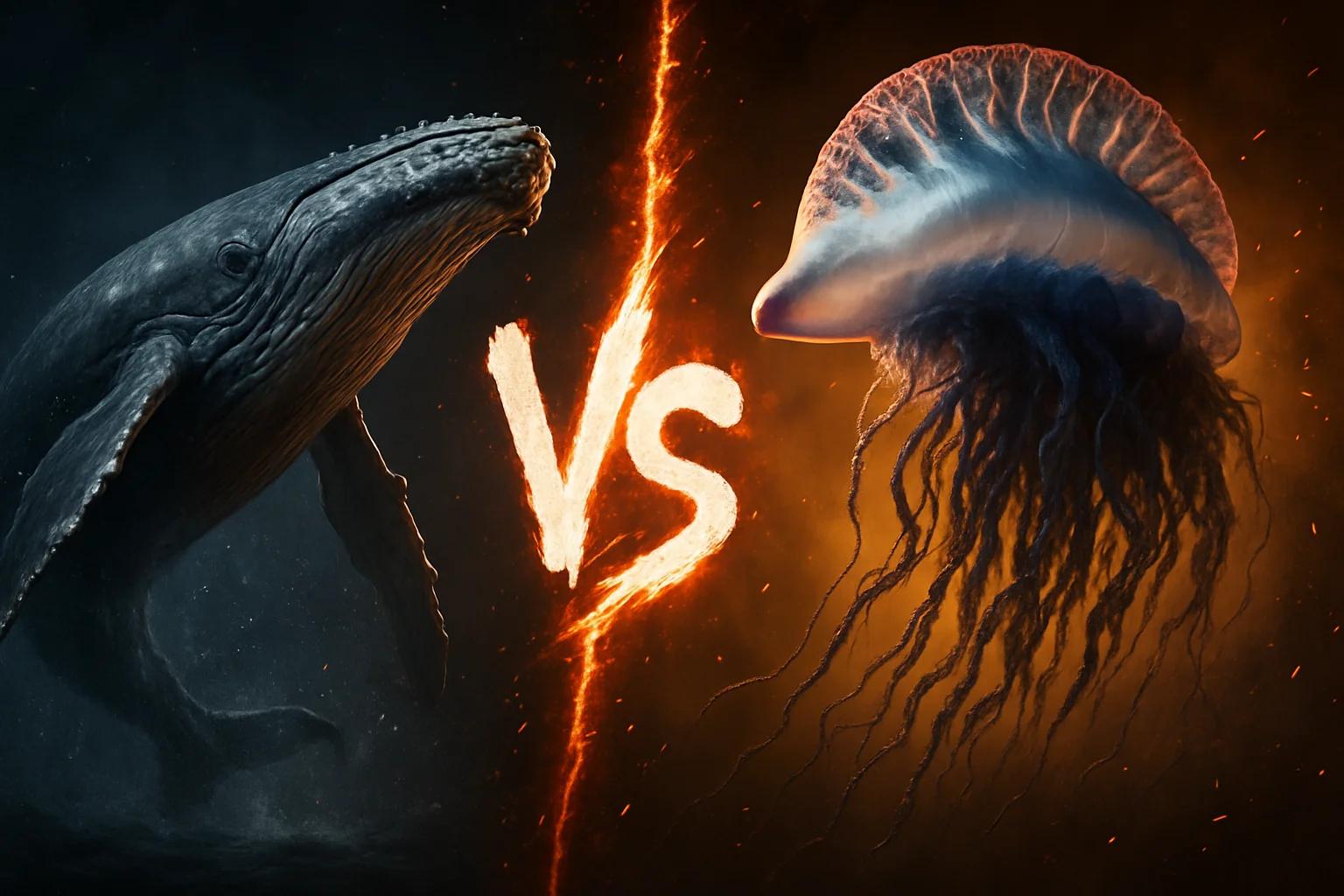
Humpback Whale vs Portuguese Man o' War: Who Actually Wins?
The humpback whale wins clearly. A Portuguese man o' war is not a single animal that can pursue, grapple, or inject a lethal dose into something the size of a school bus. It is a siphonophore, a floating colony of specialized zooids that drifts wherever wind and current push its gas-filled float. Its nematocyst-loaded tentacles can trail 10 meters or more and deliver a sting that cripples small fish and seriously hurts humans. A humpback, though, carries thick skin, a deep blubber layer, roughly 30 to 40 tons of mass, and the agency to simply avoid it. Whales do occasionally take incidental stings around the mouth and eyes, and those are painful irritations. Against a whale's body they are not a fight-ending weapon. The man o' war has no way to choose a target, chase, or escalate. The whale controls every encounter, and the worst realistic outcome for the whale is a stinging nuisance.
Read comparison
Discussion
What do you think?
Share your reasoning with other readers. Be civil and stick to the animals.
Sign in to join the discussion.
Sign inNo comments yet. Start the conversation.